Carbon
By the end of this section, you will be able to:
- Explain why carbon is important for life
- Describe the role of functional groups in biological molecules
Many complex molecules called macromolecules, such as proteins, nucleic acids (RNA and DNA), carbohydrates, and lipids comprise cells. The macromolecules are a subset of organic molecules (any carbon-containing liquid, solid, or gas) that are especially important for life. The fundamental component for all of these macromolecules is carbon. The carbon atom has unique properties that allow it to form covalent bonds to as many as four different atoms, making this versatile element ideal to serve as the basic structural component, or “backbone,” of the macromolecules.
Individual carbon atoms have an incomplete outermost electron shell. With an atomic number of 6 (six electrons and six protons), the first two electrons fill the inner shell, leaving four in the second shell. Therefore, carbon atoms can form up to four covalent bonds with other atoms to satisfy the octet rule. The methane molecule provides an example: it has the chemical formula CH₄. Each of its four hydrogen atoms forms a single covalent bond with the carbon atom by sharing a pair of electrons. This results in a filled outermost shell.
Hydrocarbons
Hydrocarbons are organic molecules consisting entirely of carbon and hydrogen, such as methane (CH₄) described above. We often use hydrocarbons in our daily lives as fuels—like the propane in a gas grill or the butane in a lighter. The many covalent bonds between the atoms in hydrocarbons store a great amount of energy, which releases when these molecules burn (oxidize). Methane, an excellent fuel, is the simplest hydrocarbon molecule, with a central carbon atom bonded to four different hydrogen atoms, as the figure below illustrates. The shape of its electron orbitals determines the shape of the methane molecule’s geometry, where the atoms reside in three dimensions. The carbons and the four hydrogen atoms form a tetrahedron, with four triangular faces. For this reason, we describe methane as having tetrahedral geometry.
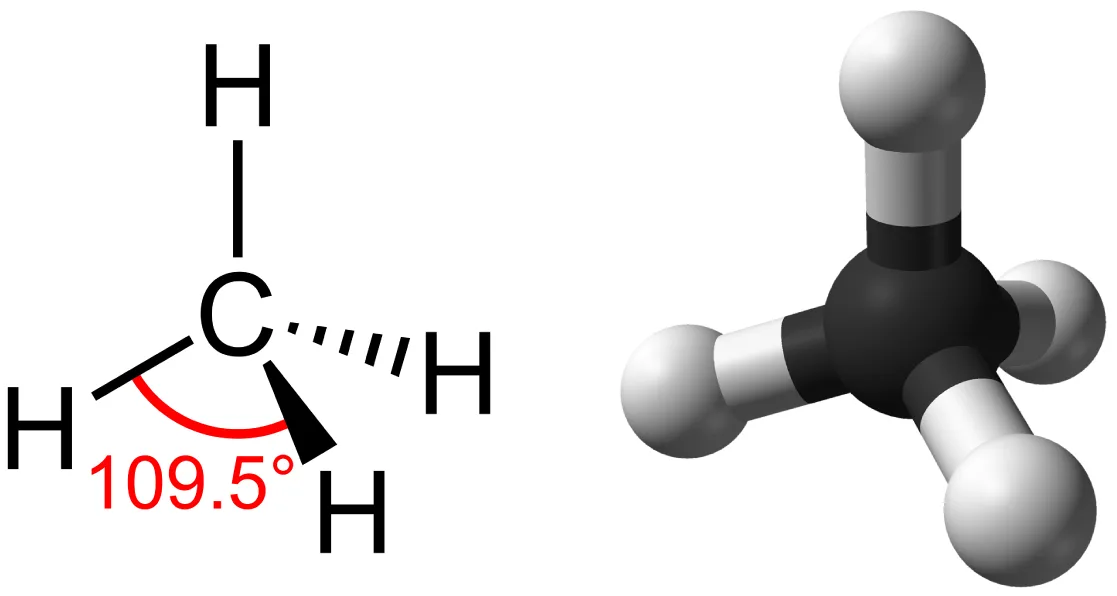
Extended description
Left, a flat schematic of methane: a central carbon bonded to four hydrogens, drawn with one bond as a solid wedge, one as a dashed wedge, and two as plain lines, with the H–C–H angle marked 109.5° in red. Right, a three-dimensional ball-and-stick model of the same molecule: a black carbon sphere bonded to four white hydrogen spheres pointing to the corners of a tetrahedron.
As the backbone of the large molecules of living things, hydrocarbons may exist as linear carbon chains, carbon rings, or combinations of both. Furthermore, individual carbon-to-carbon bonds may be single, double, or triple covalent bonds, and each type of bond affects the molecule’s geometry in a specific way. This three-dimensional shape or conformation of the large molecules of life (macromolecules) is critical to how they function.
Hydrocarbon Chains
Successive bonds between carbon atoms form hydrocarbon chains. These may be branched or unbranched. Furthermore, a molecule’s different geometries of single, double, and triple covalent bonds alter the overall molecule’s geometry as the figure below illustrates. The hydrocarbons ethane, ethene, and ethyne serve as examples of how different carbon-to-carbon bonds affect the molecule’s geometry. The names of all three molecules start with the prefix “eth-,” which is the prefix for two carbon hydrocarbons. The suffixes “-ane,” “-ene,” and “-yne” refer to the presence of single, double, or triple carbon-carbon bonds, respectively. Thus, propane, propene, and propyne follow the same pattern with three carbon molecules, butane, butene, and butyne for four carbon molecules, and so on. Double and triple bonds change the molecule’s geometry: single bonds allow rotation along the bond’s axis; whereas, double bonds lead to a planar configuration and triple bonds to a linear one. These geometries have a significant impact on the shape a particular molecule can assume.
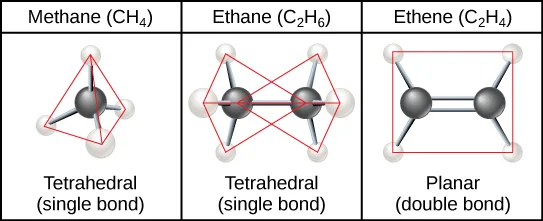
Extended description
Left to right, three ball-and-stick molecules with their outline traced in red and labeled below. Methane (CH₄): one carbon bonded to four hydrogens arranged as a tetrahedron, labeled tetrahedral, single bond. Ethane (C₂H₆): two carbons joined by a single bond, each also bonded to three hydrogens, with the two tetrahedral arrangements overlapping where the carbons meet, labeled tetrahedral, single bond. Ethene (C₂H₄): two carbons joined by a double bond, each bonded to two hydrogens, with all six atoms lying in one flat plane traced by a red rectangle, labeled planar, double bond.
Hydrocarbon Rings
So far, the hydrocarbons we have discussed have been aliphatic hydrocarbons, which consist of linear chains of carbon atoms, and sometimes they can form rings with all single bonds, as shown in the examples of cyclopentane and cyclohexane below. Another type of hydrocarbon, aromatic hydrocarbons, consists of closed rings of carbon atoms with alternating single and double bonds. We find ring structures in aliphatic hydrocarbons, containing only single bonds between carbons, like the cyclohexane’s structure (aliphatic) compared to a ring structure of benzene (aromatic) with alternating single and double bonds in the ring below. Examples of biological molecules that incorporate the benzene ring include some amino acids and cholesterol and its derivatives, including the hormones estrogen and testosterone. We also find the benzene ring in the herbicide 2,4-D. Benzene is a natural component of crude oil and has been classified as a carcinogen. Some hydrocarbons have both aliphatic and aromatic portions. (Source note: the source names beta-carotene as an example of such a hydrocarbon. Beta-carotene’s two end rings are cyclohexene rings, not aromatic rings — its IUPAC name describes each as 2,6,6-trimethylcyclohex-1-ene — so it is aliphatic throughout, and the example is omitted here.)
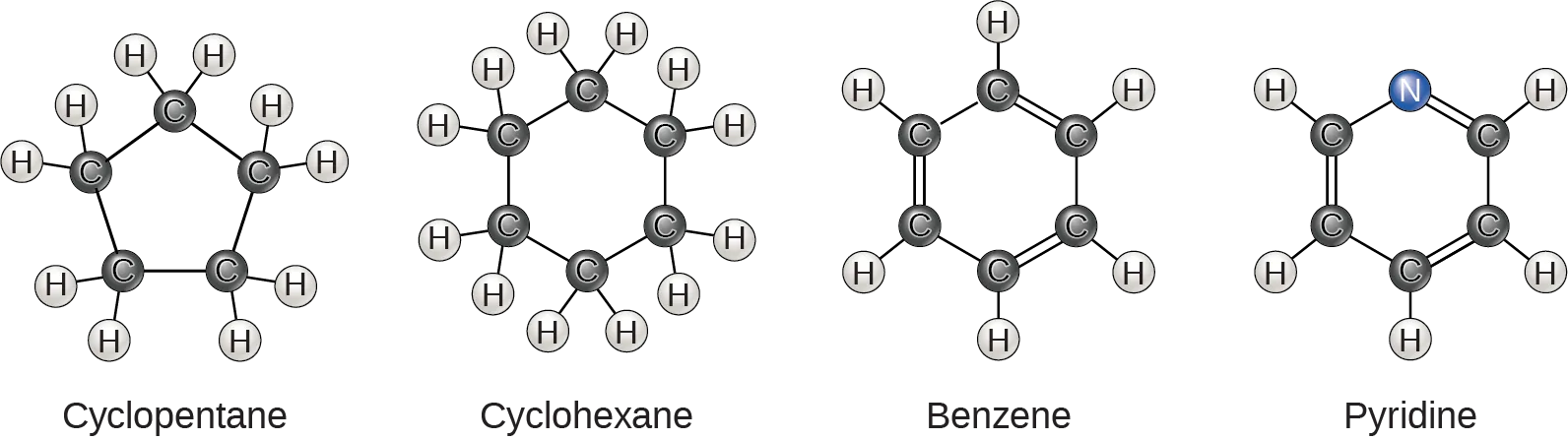
Extended description
Four ball-and-stick ring molecules in a row, carbon shown as a dark gray sphere and hydrogen as light gray. Cyclopentane: a five-membered ring of carbons joined by single bonds, two hydrogens on each carbon. Cyclohexane: a six-membered ring of carbons joined by single bonds, two hydrogens on each carbon. Benzene: a six-membered carbon ring with three double bonds alternating with three single bonds, one hydrogen on each carbon. Pyridine: the same six-membered ring as benzene, but one corner carbon is replaced by a blue nitrogen atom with no hydrogen attached, so the ring holds five carbons and one nitrogen with alternating double and single bonds.
Isomers
The three-dimensional placement of atoms and chemical bonds within organic molecules is central to understanding their chemistry. We call molecules that share the same chemical formula but differ in the placement (structure) of their atoms and/or chemical bonds isomers. Structural isomers (like butane and isobutane in panel (a) of the figure below) differ in the placement of their covalent bonds: both molecules have four carbons and ten hydrogens (C₄H₁₀), but the different atom arrangement within the molecules leads to differences in their chemical properties. For example, butane is suited for use as a fuel for cigarette lighters and torches; whereas, isobutane is suited for use as a refrigerant and a propellant in spray cans.
Geometric isomers, alternatively have similar placements of their covalent bonds but differ in how these bonds are made to the surrounding atoms, especially in carbon-to-carbon double bonds. In the simple molecule butene (C₄H₈), the two methyl groups (CH₃) can be on either side of the double covalent bond central to the molecule, as panel (b) of the figure below illustrates. When the carbons are bound on the same side of the double bond, this is the cis configuration. If they are on opposite sides of the double bond, it is a trans configuration. In the trans configuration, the carbons form a more or less linear structure; whereas, the carbons in the cis configuration make a bend (change in direction) of the carbon backbone.
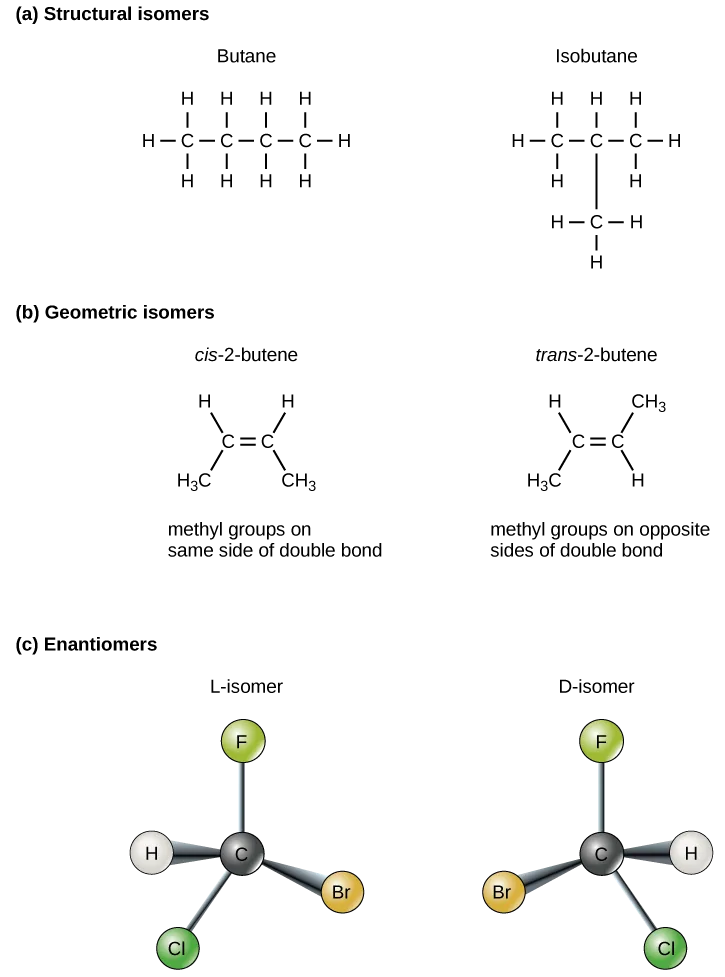
Extended description
(a) Structural isomers: butane is drawn as a straight chain of four carbons with their attached hydrogens (H₃C–CH₂–CH₂–CH₃); isobutane is drawn with three carbons in a row and a fourth carbon branching off the middle carbon. Both have the formula C₄H₁₀ but different carbon-skeleton shapes. (b) Geometric isomers: cis-2-butene shows a central C=C double bond with the two CH₃ groups on the same side and a hydrogen on each carbon on the opposite side; trans-2-butene shows the same double bond with the two CH₃ groups on opposite sides and the two hydrogens on opposite sides. (c) Enantiomers: two ball-and-stick models side by side. The L-isomer has a gray central carbon with a green fluorine sphere above, a white hydrogen sphere to the left, an orange bromine sphere to the right, and a green chlorine sphere below. The D-isomer is its mirror image: fluorine above, hydrogen to the right, bromine to the left, chlorine below. The two cannot be superimposed.
Which of the following statements is false?
Count how many different groups are attached to the central carbon in the enantiomer panel above, and compare that count with each statement.In triglycerides (fats and oils), long carbon chains known as fatty acids may contain double bonds, which can be in either the cis or trans configuration, as the figure below illustrates. Fats with at least one double bond between carbon atoms are unsaturated fats. When some of these bonds are in the cis configuration, the resulting bend in the chain’s carbon backbone means that triglyceride molecules cannot pack tightly, so they remain liquid (oil) at room temperature. Alternatively, triglycerides with trans double bonds (popularly called trans fats), have relatively linear fatty acids that are able to pack tightly together at room temperature and form solid fats. In the human diet, trans fats are linked to an increased risk of cardiovascular disease, so many food manufacturers have reduced or eliminated their use in recent years. In contrast to unsaturated fats, we call triglycerides without double bonds between carbon atoms saturated fats, meaning that they contain all the hydrogen atoms available. Saturated fats are a solid at room temperature and usually of animal origin.
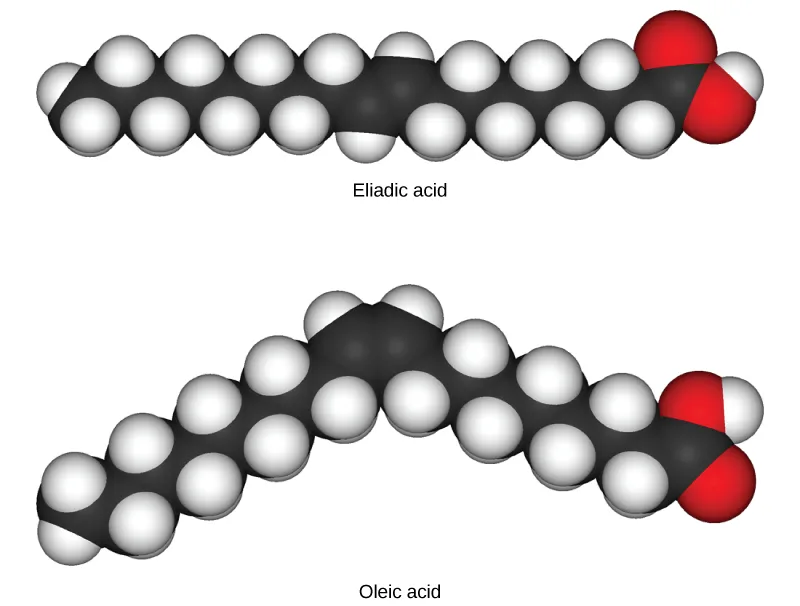
Extended description
Top, eliadic acid: an extended, straight zigzag chain of carbons ending at the right in a red oxygen-bearing carboxyl group. Bottom, oleic acid: a carbon chain of the same length, bent sharply upward partway along its span before continuing to its own carboxyl group at the right — showing how a cis double bond kinks the chain that a trans double bond leaves straight.
Enantiomers
Enantiomers are molecules that share the same chemical structure and chemical bonds but differ in the three-dimensional placement of atoms so that they are non-superimposable mirror images. The figure below shows an amino acid alanine example, where the two structures are nonsuperimposable. In nature, the L-forms of amino acids are predominant in proteins. Some D forms of amino acids are seen in the cell walls of bacteria and polypeptides in other organisms. Similarly, the D-form of glucose is the main product of photosynthesis and we rarely see the molecule’s L-form in nature.
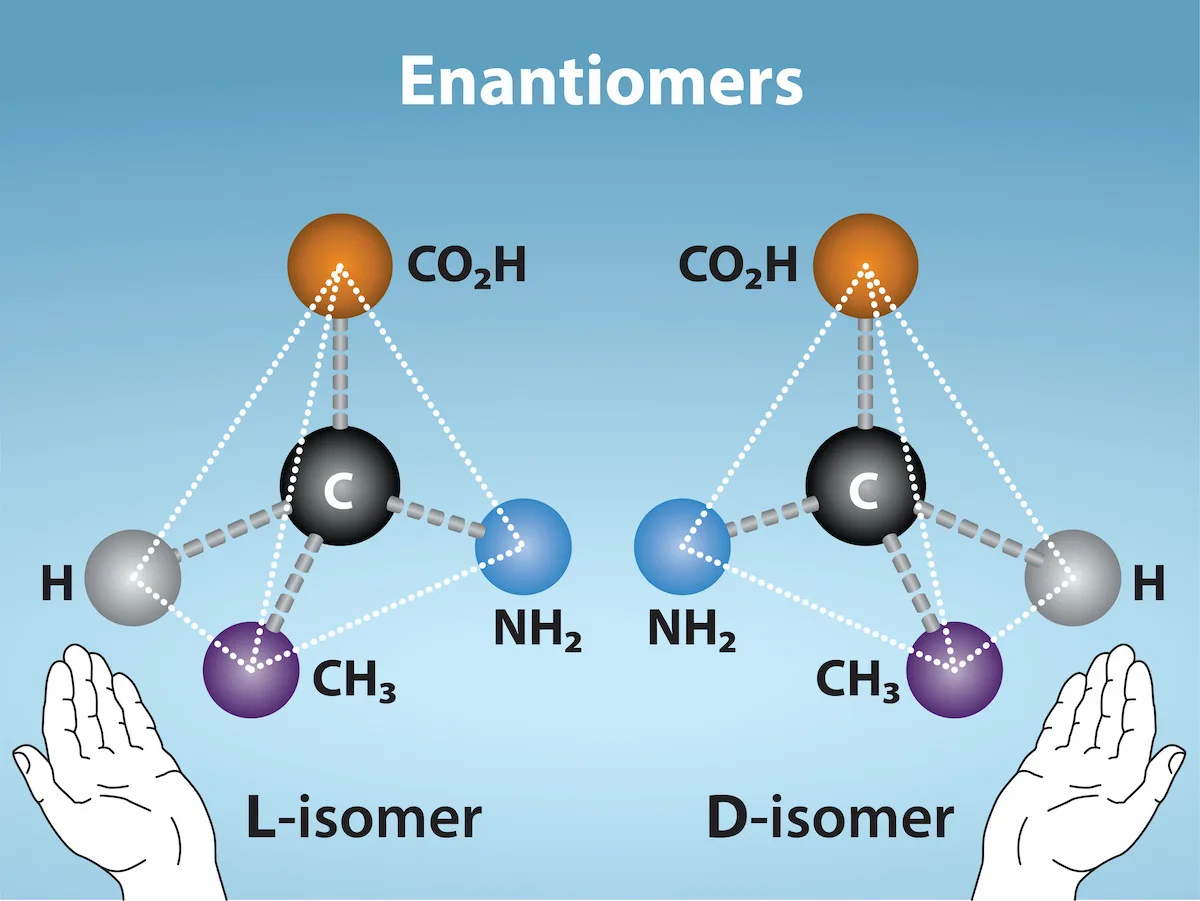
Extended description
A blue-background diagram titled ‘Enantiomers.’ Left, the L-isomer: a black central carbon bonded to an orange CO₂H group above, a gray H to the left, a purple CH₃ below, and a blue NH₂ to the right. Right, the D-isomer: the same four groups around a black central carbon, but with the NH₂ and H positions swapped — NH₂ now on the left and H on the right — so the two structures are mirror images. Beneath both, a pair of open hands, palms up, illustrates that the two isomers cannot be superimposed on each other, like a left and a right hand.
Functional Groups
Functional groups are groups of atoms that occur within molecules and confer specific chemical properties to those molecules. We find them along the “carbon backbone” of macromolecules. Chains and/or rings of carbon atoms with the occasional substitution of an element such as nitrogen or oxygen form this carbon backbone. Molecules with other elements in their carbon backbone are substituted hydrocarbons.
The functional groups in a macromolecule are usually attached to the carbon backbone at one or several different places along its chain and/or ring structure. Each of the four types of macromolecules—proteins, lipids, carbohydrates, and nucleic acids—has its own characteristic set of functional groups that contributes greatly to its differing chemical properties and its function in living organisms.
A functional group can participate in specific chemical reactions. The table below shows some of the important functional groups in biological molecules. They include: hydroxyl, methyl, carbonyl, carboxyl, amino, phosphate, and sulfhydryl. These groups play an important role in forming molecules like DNA, proteins, carbohydrates, and lipids. We usually classify functional groups as hydrophobic or hydrophilic depending on their charge or polarity characteristics. An example of a hydrophobic group is the nonpolar methyl molecule. Among the hydrophilic functional groups is the carboxyl group in amino acids, some amino acid side chains, and the fatty acids that form triglycerides and phospholipids. This carboxyl group ionizes to release hydrogen ions (H⁺) from the COOH group, resulting in the negatively charged COO⁻ group. This contributes to the hydrophilic nature of whatever molecule on which it is found. Other functional groups, such as the carbonyl group, have a partially negatively charged oxygen atom that may form hydrogen bonds with water molecules, again making the molecule more hydrophilic.
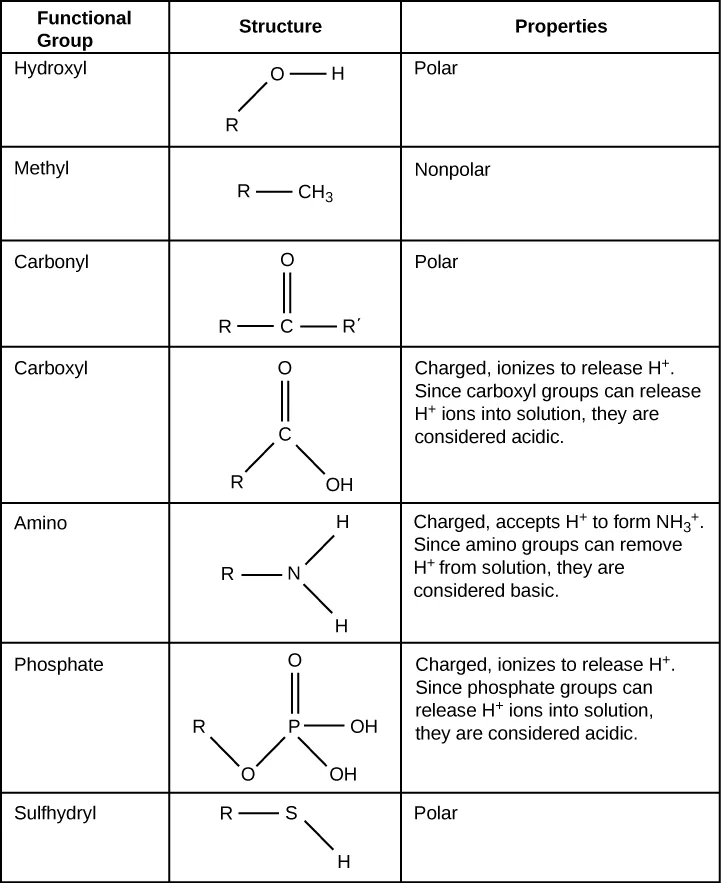
Extended description
A three-column table (Functional Group, Structure, Properties), one row per group. Hydroxyl: R—O—H; polar. Methyl: R—CH₃; nonpolar. Carbonyl: R—C(=O)—R′; polar. Carboxyl: R—C(=O)—OH; ionizes to release H⁺, considered acidic. Amino: R—NH₂; accepts H⁺ to form NH₃⁺, considered basic. Phosphate: R—O—P(=O)(OH)₂ bonded through an oxygen to the carbon chain; ionizes to release H⁺, considered acidic. Sulfhydryl: R—S—H; polar.
Hydrogen bonds between functional groups (within the same molecule or between different molecules) are important to the function of many macromolecules and help them to fold properly into and maintain the appropriate shape for functioning. Hydrogen bonds are also involved in various recognition processes, such as DNA complementary base pairing and the binding of an enzyme to its substrate, as the figure below illustrates.
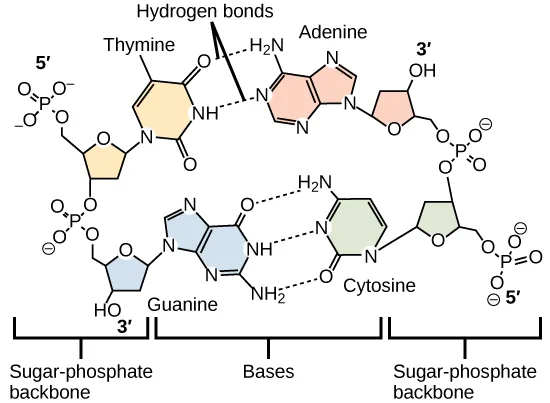
Extended description
Two sugar-phosphate backbones run vertically, one down the left edge and one down the right edge, with the bases reaching inward toward each other. The left backbone is labeled 5′ at the top and 3′ at the bottom; the right backbone is labeled 3′ at the top and 5′ at the bottom, so the two strands run in opposite directions. In the upper row, thymine on the left strand forms two hydrogen bonds (dashed lines) with adenine on the right strand. In the lower row, guanine on the left strand forms three hydrogen bonds with cytosine on the right strand. Each base is attached to a deoxyribose sugar, and the sugars are linked by phosphate groups. Brackets beneath the diagram label the left and right sugar-phosphate backbones and the bases between them.
Summary
The unique properties of carbon make it a central part of biological molecules. Carbon binds to oxygen, hydrogen, and nitrogen covalently to form the many molecules important for cellular function. Carbon has four electrons in its outermost shell and can form four bonds. Carbon and hydrogen can form hydrocarbon chains or rings. Functional groups are groups of atoms that confer specific properties to hydrocarbon (or substituted hydrocarbon) chains or rings that define their overall chemical characteristics and function.
Key terms
- aliphatic hydrocarbon — hydrocarbon consisting of a linear chain of carbon atoms, or of a ring of carbon atoms joined by single bonds (Source note: the source glossary says “a linear chain of carbon atoms” only; this section’s own text classes the single-bonded rings cyclopentane and cyclohexane as aliphatic, and the definition follows the text.)
- aromatic hydrocarbon — hydrocarbon consisting of closed rings of carbon atoms
- enantiomers — molecules that share overall structure and bonding patterns, but differ in how the atoms are three dimensionally placed such that they are mirror images of each other
- functional group — group of atoms that provides or imparts a specific function to a carbon skeleton
- geometric isomer — isomer with similar bonding patterns differing in the placement of atoms alongside a double covalent bond
- hydrocarbon — molecule that consists only of carbon and hydrogen
- isomers — molecules that differ from one another even though they share the same chemical formula
- organic molecule — any molecule containing carbon (except carbon dioxide)
- structural isomers — molecules that share a chemical formula but differ in the placement of their chemical bonds
- substituted hydrocarbon — hydrocarbon chain or ring containing an atom of another element in place of one of the backbone carbons
Practice
Explain why carbon is important for life
Each carbon atom can bond with as many as ________ other atom(s) or molecule(s).
Carbon has four electrons in its outermost shell available for bonding.A molecule made up of only carbon and hydrogen atoms is called a ________.
Methane, ethane, and benzene are all examples of this kind of molecule.What property of carbon makes it essential for organic life?
Show model answer
Did your answer mention:
Compare and contrast saturated and unsaturated triglycerides.
Show model answer
Did your answer mention:
Describe the role of functional groups in biological molecules
Which of the following is not a functional group that can bond with carbon?
The other three options are named in the functional-groups table above; this one is a metal, not a functional group.A group of atoms that occurs within a molecule and confers a specific chemical property on it is called a ________.
Hydroxyl, methyl, and carboxyl are all examples of this kind of group.A carbon chain or ring in which an atom of another element, such as nitrogen or oxygen, takes the place of one of the backbone carbons is called a ________.
Pyridine, with a nitrogen in its ring, is an example.Functional groups are groups of atoms that confer specific properties to hydrocarbon (or substituted hydrocarbon) chains or rings that define their overall ________.
This is the last clause of the section summary’s closing sentence — what a functional group ultimately shapes about the molecule it’s attached to.This section is adapted from Biology 2e, Section 2.3: Carbon by Mary Ann Clark, Jung Choi, Matthew Douglas, and OpenStax, © OpenStax, licensed under CC BY-NC-SA 4.0. Access the original for free at openstax.org. Changes: figures re-encoded as WebP, all eight set to kind="diagram" (the manifest’s file-extension guess called six of them photos, but every figure here is a drawn or rendered molecular structure, not a photograph); a longer extended description added to each figure, since a structural formula’s meaning is not in its caption; the alt text for the ethane/ethene, isomers, and functional-groups-table figures shortened from source alts of over 600 characters, with the full detail moved into the extended description, and the methane figure’s alt rewritten to describe both of its panels; chemical formulas and ions rendered as Unicode sub/superscripts in prose (CH₄, C₄H₁₀, H⁺, COO⁻); the end-of-section Review Questions and Critical Thinking Questions adapted into the closing interactive Practice block (multiple choice and self-check respectively); three key-term recall items added from the glossary (hydrocarbon under the first objective; functional group and substituted hydrocarbon under the second) to round out the groups; the Visual Connection question kept in the body immediately after its figure and rendered as multiple choice; rubric checkpoints added to each self-check, decomposing its model answer (the source solution) into check-off clauses with no new claims; and one summary-derived textin cloze added under the second objective from the section summary’s closing sentence on what functional groups define about a molecule’s chains or rings. Two claims are corrected with visible Source notes: the beta-carotene example of a hydrocarbon with an aromatic portion is omitted, since its rings are cyclohexene rings, and the aliphatic-hydrocarbon key term admits the single-bonded rings the section itself calls aliphatic (errata 383–384).