Synthesis of Biological Macromolecules
By the end of this section, you will be able to:
- Understand macromolecule synthesis
- Explain dehydration (or condensation) and hydrolysis reactions
As you’ve learned, biological macromolecules are large molecules, necessary for life, that are built from smaller organic molecules. There are four major biological macromolecule classes (carbohydrates, lipids, proteins, and nucleic acids). Each is an important cell component and performs a wide array of functions. Combined, these molecules make up the majority of a cell’s dry mass (recall that water makes up the majority of its complete mass). Biological macromolecules are organic, meaning they contain carbon and are bound to hydrogen, and may contain oxygen, nitrogen, and additional minor elements.
Dehydration Synthesis
Most macromolecules are made from single subunits, or building blocks, called monomers. The monomers combine with each other using covalent bonds to form larger molecules known as polymers. In doing so, monomers release water molecules as byproducts. This type of reaction is dehydration synthesis, which means “to put together while losing water.”
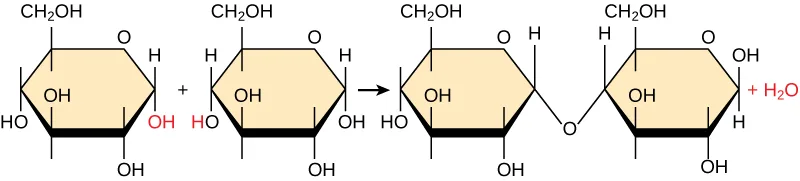
Extended description
Before the arrow: two glucose rings side by side, joined by a plus sign, each showing a CH₂OH group, several OH groups, and an H at its right-hand ring carbon; the OH on the left molecule’s linking carbon and the H on the right molecule’s linking carbon are both highlighted in red. After the arrow: the same two glucose rings, now joined to each other by a single bridging oxygen atom where the highlighted OH and H used to be, forming the disaccharide maltose; to the right of the joined rings, a separate red plus-H₂O label shows the water molecule released by the reaction.
In a dehydration synthesis reaction (the figure above), the hydrogen of one monomer combines with the hydroxyl group of another monomer, releasing a water molecule. At the same time, the monomers share electrons and form covalent bonds. As additional monomers join, this chain of repeating monomers forms a polymer. Different monomer types can combine in many configurations, giving rise to a diverse group of macromolecules. Even one kind of monomer can combine in a variety of ways to form several different polymers. For example, glucose monomers are the constituents of starch, glycogen, and cellulose.
Hydrolysis
Polymers break down into monomers during hydrolysis. A chemical reaction occurs when inserting a water molecule across the bond. Breaking a covalent bond with this water molecule in the compound achieves this (the figure below). During these reactions, the polymer breaks into two components: one part gains a hydrogen atom (H⁺) and the other gains a hydroxyl molecule (OH⁻) from a split water molecule.
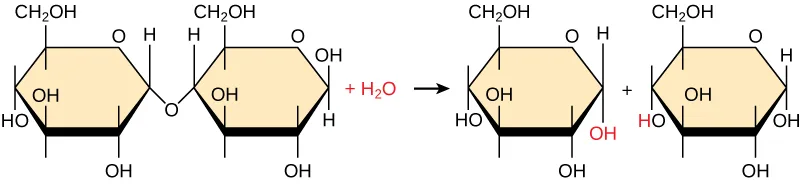
Extended description
Before the arrow: the maltose molecule, two glucose rings joined by a bridging oxygen, sits beside a red plus-H₂O label naming the water molecule added as a reactant. After the arrow: the bridge is broken and the rings separate into two glucose molecules; the left glucose now carries an added OH group (highlighted in red) at its former linking carbon, and the right glucose carries an added H (highlighted in red) at its former linking carbon.
Dehydration and hydrolysis reactions are catalyzed, or “sped up,” by specific enzymes; dehydration reactions involve the formation of new bonds, requiring energy, while hydrolysis reactions break bonds and release energy. These reactions are similar for most macromolecules, but each monomer and polymer reaction is specific for its class. For example, catalytic enzymes in the digestive system hydrolyze or break down the food we ingest into smaller molecules. This allows cells in our body to easily absorb nutrients in the intestine. A specific enzyme breaks down each macromolecule. For instance, amylase, sucrase, lactase, or maltase break down carbohydrates. Enzymes called proteases, such as pepsin and peptidase, and hydrochloric acid break down proteins. Lipases break down lipids. These broken down macromolecules provide energy for cellular activities.
Summary
Proteins, carbohydrates, nucleic acids, and lipids are the four major classes of biological macromolecules—large molecules necessary for life that are built from smaller organic molecules. Macromolecules are comprised of single units scientists call monomers that are joined by covalent bonds to form larger polymers. The polymer is more than the sum of its parts: it acquires new characteristics, and leads to an osmotic pressure that is much lower than that formed by its ingredients. This is an important advantage in maintaining cellular osmotic conditions. A monomer joins with another monomer with water molecule release, leading to a covalent bond forming. Scientists call these dehydration or condensation reactions. When polymers break down into smaller units (monomers), they use a water molecule for each bond broken by these reactions. Such reactions are hydrolysis reactions. Dehydration and hydrolysis reactions are similar for all macromolecules, but each monomer and polymer reaction is specific to its class. Dehydration reactions typically require an investment of energy for new bond formation, while hydrolysis reactions typically release energy by breaking bonds.
Key terms
- biological macromolecule — large molecule necessary for life that is built from smaller organic molecules
- dehydration synthesis — (also, condensation) reaction that links monomer molecules, releasing a water molecule for each bond formed
- hydrolysis — reaction that causes breakdown of larger molecules into smaller molecules by utilizing water
- monomer — smallest unit of larger molecules that are polymers
- polymer — chain of monomer residues that covalent bonds link; polymerization is the process of polymer formation from monomers by condensation
Practice
Understand macromolecule synthesis
Why are biological macromolecules considered organic?
Show model answer
Did your answer mention:
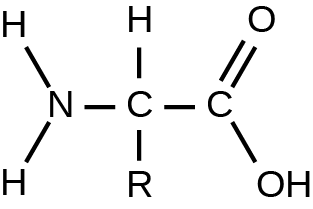
Amino acids have the generic structure shown above, where R represents different carbon-based side chains. Describe how the structure of amino acids allows them to be linked into long peptide chains to form proteins.
Show model answer
Did your answer mention:
A chain of monomer residues linked together by covalent bonds is called a ________.
Repeating this kind of unit over and over is what builds a macromolecule out of smaller building blocks.Explain dehydration (or condensation) and hydrolysis reactions
Dehydration synthesis leads to formation of ________.
The reaction both builds a new bond between monomers and releases a byproduct — name both.During the breakdown of polymers, which of the following reactions takes place?
Breaking a polymer apart uses a water molecule to split each bond — what is that class of reaction called?The following chemical reactants produce the ester ethyl ethanoate (C₄H₈O₂): C₂H₆O + CH₃COOH. What type of reaction occurs to make ethyl ethanoate?
Two smaller molecules are joining into one larger one — what is that kind of bond-forming reaction called, whether or not the product is a biological polymer?What role do electrons play in dehydration synthesis and hydrolysis?
Show model answer
Did your answer mention:
A reaction that breaks down larger molecules into smaller ones by using water is called ________.
It is the reverse of dehydration synthesis, and it is how digestive enzymes take food apart.This section is adapted from Biology 2e, Section 3.1: Synthesis of Biological Macromolecules by Mary Ann Clark, Jung Choi, Matthew Douglas, and OpenStax, © OpenStax, licensed under CC BY-NC-SA 4.0. Access the original for free at openstax.org. Changes: both reaction-diagram figures re-encoded as WebP and re-kinded from the manifest’s photo guess to diagram (they are structural-formula drawings, not photographs), each given a rewritten alt naming the molecules and the group gained or lost and a longdesc walking the before/after structures in reading order; the hydrolysis figure’s caption cross-reference to the dehydration figure (“the synthesis reaction in [Figure 3.2]”) is rendered as “the synthesis reaction above” since this page does not number figures; the one Link to Learning note rendered as a callout with descriptive link text in place of the source’s “this site”; the third assessment figure (the generic amino-acid structure) added as its own mediafigure immediately before the Critical Thinking question that depends on it; the Review Questions and Critical Thinking Questions adapted into the closing interactive Practice block (multiple choice and self-check, respectively); and two key-term recall items (polymer, hydrolysis) added from the glossary to round out both objective groups; rubric checkpoints added to each self-check, decomposing its model answer (the source solution) into check-off clauses with no new claims.