Energy and Metabolism
By the end of this section, you will be able to:
- Explain metabolic pathways and describe the two major types
- Discuss how chemical reactions play a role in energy transfer
Scientists use the term bioenergetics to discuss the concept of energy flow through living systems, such as cells. Cellular processes such as building and breaking down complex molecules occur through stepwise chemical reactions. Some of these chemical reactions are spontaneous and release energy; whereas, others require energy to proceed. Just as living things must continually consume food to replenish what they have used, cells must continually obtain more energy to replenish that which the many energy-requiring chemical reactions that constantly take place use. All of the chemical reactions that transpire inside cells, including those that use and release energy, are the cell’s metabolism.
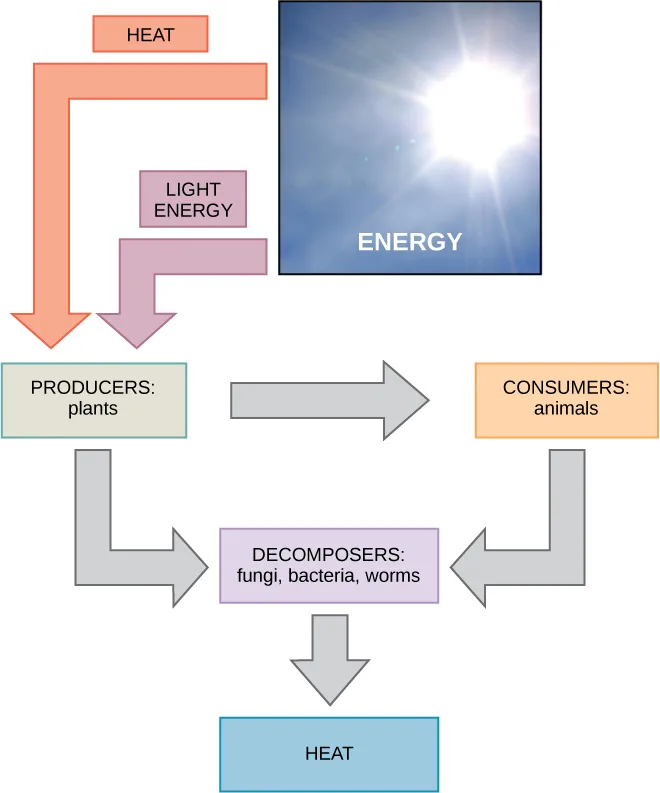
Extended description
A flow chart. An orange arrow labeled ‘Heat’ and a pink arrow labeled ‘Light Energy’ both curve downward, pointing into a box labeled ‘Producers: plants.’ Beside those two labeled arrows, a photograph of the sun is captioned ‘Energy.’ A gray arrow points right from ‘Producers: plants’ to a box labeled ‘Consumers: animals.’ Gray arrows from both ‘Producers: plants’ and ‘Consumers: animals’ point down and inward to a box labeled ‘Decomposers: fungi, bacteria, worms,’ and a final gray arrow points down from that box to a box labeled ‘Heat’ at the bottom.
Carbohydrate Metabolism
Sugar (a simple carbohydrate) metabolism (chemical reactions) is a classic example of the many cellular processes that use and produce energy. Living things consume sugar as a major energy source, because sugar molecules have considerable energy stored within their bonds. The following equation describes the breakdown of glucose, a simple sugar:
C₆H₁₂O₆ + 6O₂ → 6CO₂ + 6H₂O + energy
Consumed carbohydrates have their origins in photosynthesizing organisms like plants. During photosynthesis, plants use the energy of sunlight to convert carbon dioxide gas (CO₂) into sugar molecules, like glucose (C₆H₁₂O₆). Because this process involves synthesizing a larger, energy-storing molecule, it requires an energy input to proceed. The following equation (notice that it is the reverse of the previous equation) describes the synthesis of glucose:
6CO₂ + 6H₂O + energy → C₆H₁₂O₆ + 6O₂
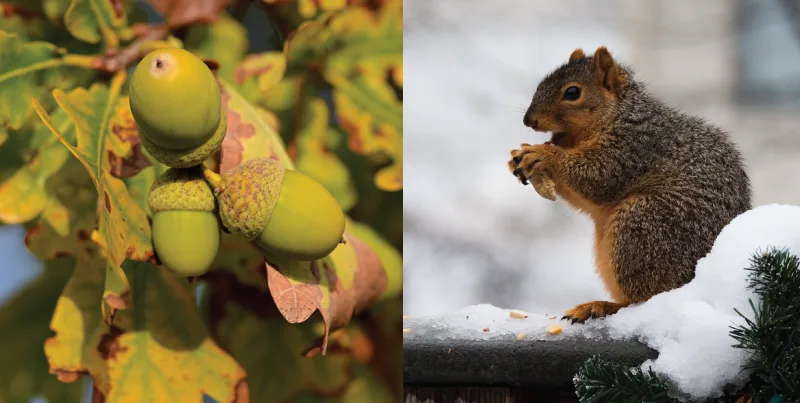
During photosynthesis chemical reactions, energy is in the form of a very high-energy molecule scientists call ATP, or adenosine triphosphate. This is the primary energy currency of all cells. Just as the dollar is the currency we use to buy goods, cells use ATP molecules as energy currency to perform immediate work. The sugar (glucose) is stored as starch or glycogen. Energy-storing polymers like these break down into glucose to supply ATP molecules.
Solar energy is required to synthesize a glucose molecule during the photosynthesis reactions. In photosynthesis, light energy from the sun initially transforms into chemical energy that temporarily stores itself in the energy carrier molecules ATP and NADPH (nicotinamide adenine dinucleotide phosphate). Photosynthesis later uses the stored energy in ATP and NADPH to build one glucose molecule from six molecules of CO₂. This process is analogous to eating breakfast in the morning to acquire energy for your body that you can use later in the day. Under ideal conditions, energy from 18 molecules of ATP is required to synthesize one glucose molecule during photosynthesis reactions. Glucose molecules can also combine with and convert into other sugar types. When an organism consumes sugars, glucose molecules eventually make their way into each organism’s living cell. Inside the cell, each sugar molecule breaks down through a complex series of chemical reactions. The goal of these reactions is to harvest the energy stored inside the sugar molecules. The harvested energy makes high-energy ATP molecules, which perform work, powering many chemical reactions in the cell. The amount of energy needed to make one glucose molecule from six carbon dioxide molecules is 18 ATP molecules and 12 NADPH molecules (each one of which is energetically equivalent to three ATP molecules), or a total of 54 molecule equivalents required for synthesizing one glucose molecule. This process is a fundamental and efficient way for cells to generate the molecular energy that they require.
Metabolic Pathways
The processes of making and breaking down sugar molecules illustrate two types of metabolic pathways. A metabolic pathway is a series of interconnected biochemical reactions that convert a substrate molecule or molecules, step-by-step, through a series of metabolic intermediates, eventually yielding a final product or products. In the case of sugar metabolism, the first metabolic pathway synthesized sugar from smaller molecules, and the other pathway broke sugar down into smaller molecules. Scientists call these two opposite processes—the first requiring energy and the second producing energy—anabolic (building) and catabolic (breaking down) pathways, respectively. Consequently, building (anabolism) and degradation (catabolism) comprise metabolism.
Evolution Connection. Evolution of Metabolic Pathways.
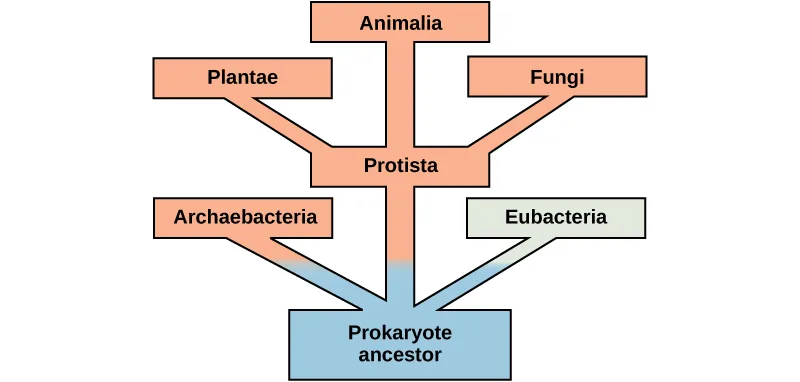
Extended description
A branching tree diagram read bottom to top. A blue box labeled ‘Prokaryote ancestor’ sits at the base. Three separate trunks rise from it and never rejoin: the left trunk, blue at its base and orange above, leads up and left to an orange box labeled ‘Archaebacteria’; the middle trunk, blue at its base and orange above, rises straight to an orange box labeled ‘Protista’; the right trunk, blue at its base and pale gray-green above, leads up and right to a pale gray-green box labeled ‘Eubacteria.’ From ‘Protista’ three orange branches fan upward to three orange boxes: ‘Plantae’ on the left, ‘Animalia’ at the top centre, and ‘Fungi’ on the right.
There is more to the complexity of metabolism than understanding the metabolic pathways alone. Metabolic complexity varies from organism to organism. Photosynthesis is the primary pathway in which photosynthetic organisms like plants (planktonic algae perform the majority of global photosynthesis) harvest the sun’s energy and convert it into carbohydrates. The by-product of photosynthesis is oxygen, which some cells require to carry out cellular respiration. During cellular respiration, oxygen aids in the catabolic breakdown of carbon compounds, like carbohydrates. Among the products are CO₂ and ATP. In addition, some eukaryotes perform catabolic processes without oxygen (fermentation); that is, they perform or use anaerobic metabolism.
Organisms probably evolved anaerobic metabolism to survive (living organisms came into existence about 3.8 billion years ago, when the atmosphere lacked oxygen). Despite the differences between organisms and the complexity of metabolism, researchers have found that all branches of life share some of the same metabolic pathways, suggesting that all organisms evolved from the same ancient common ancestor. Evidence indicates that over time, the pathways diverged, adding specialized enzymes to allow organisms to better adapt to their environment, thus increasing their chance to survive. However, the underlying principle remains that all organisms must harvest energy from their environment and convert it to ATP to carry out cellular functions.
Anabolic and Catabolic Pathways
Anabolic pathways require an input of energy to synthesize complex molecules from simpler ones. Synthesizing sugar from CO₂ is one example. Other examples are synthesizing large proteins from amino acid building blocks, and synthesizing new DNA strands from nucleic acid building blocks. These biosynthetic processes are critical to the cell’s life, take place constantly, and demand energy that ATP and other high-energy molecules like NADH (nicotinamide adenine dinucleotide) and NADPH provide.
ATP is an important molecule for cells to have in sufficient supply at all times. The breakdown of sugars illustrates how a single glucose molecule can store enough energy to make a great deal of ATP, 36 to 38 molecules. This is a catabolic pathway. Catabolic pathways involve degrading (or breaking down) complex molecules into simpler ones. Molecular energy stored in the bonds of complex molecules is released in catabolic pathways and harvested in such a way that it can produce ATP. Other energy-storing molecules, such as fats, also break down through similar catabolic reactions to release energy and make ATP.
It is important to know that metabolic pathway chemical reactions do not take place spontaneously. A protein called an enzyme facilitates or catalyzes each reaction step. Enzymes are important for catalyzing all types of biological reactions—those that require energy as well as those that release energy.
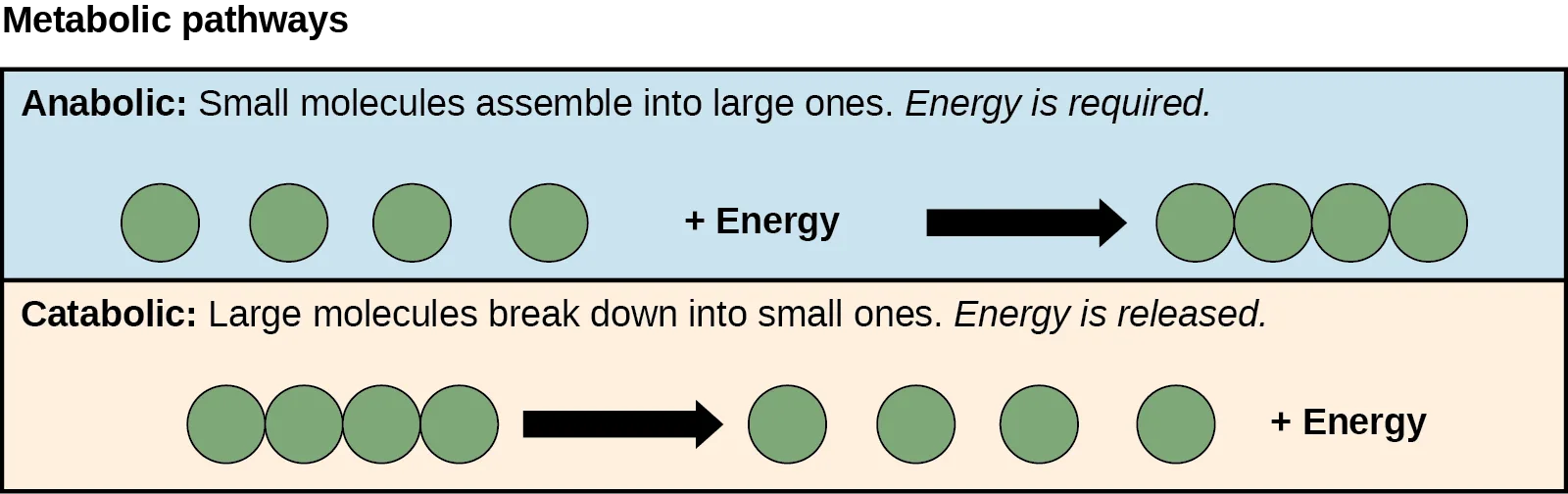
Extended description
Two horizontal panels stacked under the heading ‘Metabolic pathways.’ The top panel, tinted pale blue and labeled ‘Anabolic,’ shows four separate green circles, the bold label ‘+ Energy,’ a plain arrow, and then four green circles joined into one row. The bottom panel, tinted pale orange and labeled ‘Catabolic,’ shows the reverse: four joined green circles, an arrow, and then four separate green circles beside the label ‘+ Energy.’
Summary
Cells perform the functions of life through various chemical reactions. A cell’s metabolism refers to the chemical reactions that take place within it. There are metabolic reactions that involve breaking down complex chemicals into simpler ones, such as breaking down large macromolecules. Scientists refer to this process as catabolism, and we associate such reactions an energy release. On the other end of the spectrum, anabolism refers to metabolic processes that build complex molecules out of simpler ones, such as macromolecule synthesis. Anabolic processes require energy. Glucose synthesis and glucose breakdown are examples of anabolic and catabolic pathways, respectively.
Key terms
- anabolic — (also, anabolism) pathways that require an energy input to synthesize complex molecules from simpler ones
- bioenergetics — study of energy flowing through living systems
- catabolic — (also, catabolism) pathways in which complex molecules break down into simpler ones
- metabolism — all the chemical reactions that take place inside cells, including anabolism and catabolism
Practice
Explain metabolic pathways and describe the two major types
DNA replication involves unwinding two strands of parent DNA, copying each strand to synthesize complementary strands, and releasing the parent and daughter DNA. Which of the following accurately describes this process?
Ask whether the process builds a new, more complex molecule from simpler building blocks, or breaks a complex molecule apart.Pathways that require an input of energy to synthesize complex molecules from simpler ones are called ________ pathways.
Building sugar from carbon dioxide, or building a protein from amino acids, are examples.Pathways in which complex molecules break down into simpler ones are called ________ pathways.
Breaking glucose down to release its stored energy is an example.Does physical exercise involve anabolic and/or catabolic processes? Give evidence for your answer.
Show model answer
Did your answer mention:
Discuss how chemical reactions play a role in energy transfer
Energy is stored long-term in the bonds of ________ and used short-term to perform work from a(n) ________ molecule.
Think about which molecule the cell stockpiles and which one it spends immediately to do work.All of the chemical reactions that take place inside a cell, including anabolism and catabolism, are collectively that cell’s ________.
Bioenergetics is the study of energy flowing through this collection of reactions.The study of energy flowing through living systems is called ________.
The term names a field of study, not any single reaction.Name two different cellular functions that require energy that parallel human energy-requiring functions.
Show model answer
Did your answer mention:
This section is adapted from Biology 2e, Section 6.1: Energy and Metabolism by Mary Ann Clark, Jung Choi, Matthew Douglas, and OpenStax, © OpenStax, licensed under CC BY-NC-SA 4.0. Access the original for free at openstax.org. Changes: figures re-encoded as WebP, with two of the four re-kinded from the manifest’s file-extension guess of “photo” to “diagram” after inspection (the sun-energy-flow chart and the evolutionary-tree diagram are both labeled illustrations, not photographs; only the oak-tree/squirrel figure is a true photo pair); a longdesc extended description added for the three figures that are labeled diagrams whose full visual layout (arrows, colors, box arrangement) is not carried by their captions (the energy-flow chart, the evolutionary tree, and the anabolic/catabolic pathway diagram); the two chemical equations for glucose breakdown and synthesis set as Unicode text rather than KaTeX, since the source prints them as reactions, not mathematics; a source typo (“temporally stores itself,” which the printed PDF gives as “temporarily stores itself”) corrected to “temporarily” — reported as a source defect; the Evolution Connection feature box rendered as a callout with its bold name and the note’s own subheading kept as an italic clause; the end-of-section Review Questions and Critical Thinking Questions adapted into the closing interactive Practice block (multiple choice and self-check, respectively); and four key-term recall items (anabolic, catabolic, metabolism, bioenergetics) added from the glossary so every objective group carries at least one auto-graded item; and rubric checkpoints added to each self-check, decomposing its model answer (the source solution) into check-off clauses with no new claims.