ATP: Adenosine Triphosphate
By the end of this section, you will be able to:
- Explain ATP’s role as the cellular energy currency
- Describe how energy releases through ATP hydrolysis
Even exergonic, energy-releasing reactions require a small amount of activation energy in order to proceed. However, consider endergonic reactions, which require much more energy input, because their products have more free energy than their reactants. Within the cell, from where does energy to power such reactions come? The answer lies with an energy-supplying molecule scientists call adenosine triphosphate, or ATP. This is a small, relatively simple molecule (below), but within some of its bonds, it contains the potential for a quick burst of energy that can be harnessed to perform cellular work. Think of this molecule as the cells’ primary energy currency in much the same way that money is the currency that people exchange for things they need. ATP powers the majority of energy-requiring cellular reactions.
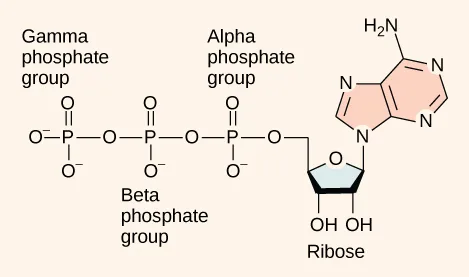
Extended description
A structural diagram, left to right: a gamma phosphate group, a beta phosphate group, and an alpha phosphate group, each drawn as a phosphorus atom double-bonded to one oxygen and single-bonded to two negatively charged oxygens (O⁻), with each phosphate linked to the next by a bridging oxygen. The alpha phosphate bonds to a five-membered ribose ring, shown with two OH groups at its base, and the ribose in turn bonds to adenine, a nitrogen-containing double-ring structure with an NH₂ group, at the upper right.
As its name suggests, adenosine triphosphate is comprised of adenosine bound to three phosphate groups (above). Adenosine is a nucleoside consisting of the nitrogenous base adenine and a five-carbon sugar, ribose. The three phosphate groups, in order of closest to furthest from the ribose sugar, are alpha, beta, and gamma. Together, these chemical groups constitute an energy powerhouse. However, not all bonds within this molecule exist in a particularly high-energy state. Both bonds that link the phosphates are equally high-energy bonds (phosphoanhydride bonds) that, when broken, during chemical reactions can release sufficient energy to power a variety of cellular reactions and processes. These high-energy bonds are the bonds between the second and third (or beta and gamma) phosphate groups and between the first and second phosphate groups. These bonds are “high-energy” because the products of hydrolysis—adenosine diphosphate (ADP) and one inorganic phosphate group (Pi)—have considerably lower free energy than the reactants: ATP and a water molecule. In other words, ATP hydrolyzes into ADP in the following reaction:
ATP + H₂O → ADP + Pi + free energy
Like most chemical reactions, ATP to ADP hydrolysis is reversible. The reverse reaction regenerates ATP from ADP + Pi. Cells rely on ATP regeneration just as people rely on regenerating spent money through some sort of income. Since ATP hydrolysis releases energy, ATP regeneration must require an input of free energy. This equation expresses ATP formation:
ADP + Pi + free energy → ATP + H₂O
Two prominent questions remain with regard to using ATP as an energy source. Exactly how much free energy releases with ATP hydrolysis, and how does that free energy do cellular work? The calculated ΔG for the hydrolysis of one ATP mole into ADP and Pi is −7.3 kcal/mole (−30.5 kJ/mol). Since this calculation is true under standard conditions, one would expect a different value exists under cellular conditions. In fact, the ΔG for one ATP mole’s hydrolysis in a living cell is almost double the value at standard conditions: −14 kcal/mol (−57 kJ/mol).
ATP is a highly unstable molecule. Unless quickly used to perform work, ATP spontaneously dissociates into ADP + Pi, and the free energy released during this process is lost as heat. The second question we posed above discusses how ATP hydrolysis energy release performs work inside the cell. This depends on a strategy scientists call energy coupling. Cells couple the ATP hydrolysis’ exergonic reaction allowing them to proceed. One example of energy coupling using ATP involves a transmembrane ion pump that is extremely important for cellular function. This sodium-potassium pump (Na⁺/K⁺ pump) drives sodium out of the cell and potassium into the cell (below). A large percentage of a cell’s ATP powers this pump, because cellular processes bring a considerable amount of sodium into the cell and potassium out of it. The pump works constantly to stabilize cellular concentrations of sodium and potassium. In order for the pump to turn one cycle (exporting three Na⁺ ions and importing two K⁺ ions), one ATP molecule must hydrolyze. When ATP hydrolyzes, its gamma phosphate does not simply float away, but it actually transfers onto the pump protein. Scientists call this process of a phosphate group binding to a molecule phosphorylation. As with most ATP hydrolysis cases, a phosphate from ATP transfers onto another molecule. In a phosphorylated state, the Na⁺/K⁺ pump has more free energy and is triggered to undergo a conformational change. This change allows it to release Na⁺ to the cell’s outside. It then binds extracellular K⁺, which, through another conformational change, causes the phosphate to detach from the pump. This phosphate release triggers the K⁺ to release to the cell’s inside. Essentially, the energy released from the ATP hydrolysis couples with the energy required to power the pump and transport Na⁺ and K⁺ ions. Once again, the ATP hydrolysis releases energy used for phosphorylation of another molecule, creating an unstable intermediate that powers the conformational change. In this way, ATP performs cellular work using this basic form of energy coupling through phosphorylation.
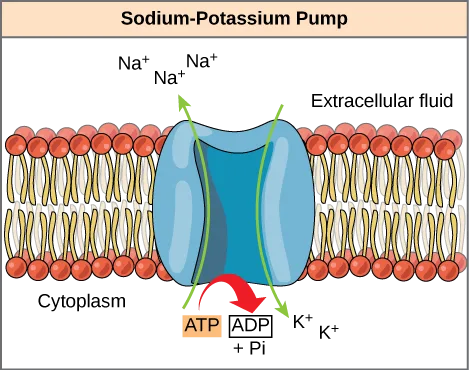
Extended description
A phospholipid bilayer, drawn as two rows of phospholipid heads and tails, with a blue pump protein embedded across it. Extracellular fluid is labeled above the membrane, cytoplasm below. A green arrow on the left carries three Na⁺ ions from the cytoplasm, up through the pump, to the extracellular fluid; a second green arrow on the right carries two K⁺ ions from the extracellular fluid, down through the pump, to the cytoplasm. Below the pump, a red curved arrow labeled ATP converting to ADP + Pi represents the hydrolysis reaction that powers the pump’s conformational change.
One ATP molecule’s hydrolysis releases 7.3 kcal/mol of energy (ΔG = −7.3 kcal/mol of energy). If it takes 2.1 kcal/mol of energy to move one Na⁺ across the membrane (ΔG = +2.1 kcal/mol of energy), how many sodium ions could one ATP molecule’s hydrolysis move?
Show model answer
Did your answer mention:
Often during cellular metabolic reactions, such as nutrient synthesis and breakdown, certain molecules must alter slightly in their conformation to become substrates for the next step in the reaction series. One example is during the very first steps of cellular respiration, when a sugar glucose molecule breaks down in the process of glycolysis. In the first step, ATP is required to phosphorylate glucose, creating a high-energy but unstable intermediate. This phosphorylation reaction powers a conformational change that allows the phosphorylated glucose molecule to convert to the phosphorylated sugar fructose. Fructose is a necessary intermediate for glycolysis to move forward. Here, ATP hydrolysis’ exergonic reaction couples with the endergonic reaction of converting glucose into a phosphorylated intermediate in the pathway. Once again, the energy released by breaking a phosphate bond within ATP was used for phosphorylating another molecule, creating an unstable intermediate and powering an important conformational change.
Summary
ATP is the primary energy-supplying molecule for living cells. ATP is comprised of a nucleotide, a five-carbon sugar, and three phosphate groups. The bonds that connect the phosphates (phosphoanhydride bonds) have high-energy content. The energy released from ATP hydrolysis into ADP + Pi performs cellular work. Cells use ATP to perform work by coupling ATP hydrolysis’ exergonic reaction with endergonic reactions. ATP donates its phosphate group to another molecule via phosphorylation. The phosphorylated molecule is at a higher-energy state and is less stable than its unphosphorylated form, and this added energy from phosphate allows the molecule to undergo its endergonic reaction.
Key terms
- ATP — adenosine triphosphate, the cell’s energy currency
- energy coupling — process during which energy released by one reaction is used to drive another reaction
- phosphoanhydride bond — bond that connects phosphates in an ATP molecule
Practice
Explain ATP’s role as the cellular energy currency
The molecule that serves as the cell’s main energy currency — a nucleoside bonded to three phosphate groups — is commonly known by its three-letter abbreviation ________.
Its full chemical name describes a nucleoside bonded to three phosphate groups; almost everyone uses the short form instead.Which of the following molecules is likely to have the most potential energy?
ATP is built for a quick, small burst of energy release, not for storing a large reserve of chemical energy — ask which molecule holds the most total energy in its bonds.ATP is the ________ for living cells.
The section summary opens with this description of ATP’s overall role.ATP donates its phosphate group to another molecule via ________.
This is the process the section names for a phosphate group binding to a molecule.Describe how energy releases through ATP hydrolysis
The energy released by the hydrolysis of ATP is ________.
Ask what the cell actually does with the free energy released by hydrolysis, rather than where in the molecule it was stored or how much of it there was.The high-energy bonds that connect the phosphate groups within an ATP molecule are called ________ bonds.
Two of these bonds link the three phosphate groups to each other; breaking one releases the free energy ATP hydrolysis is known for.The strategy by which the energy released from one reaction — such as ATP hydrolysis — is used to drive a second, energy-requiring reaction is called ________.
The sodium-potassium pump uses this strategy: the exergonic breakdown of ATP powers the pump’s energy-requiring conformational change.Do you think that the EA for ATP hydrolysis is relatively low or high? Explain your reasoning.
Show model answer
Did your answer mention:
This section is adapted from Biology 2e, Section 6.4: ATP: Adenosine Triphosphate by Mary Ann Clark, Jung Choi, Matthew Douglas, and OpenStax, © OpenStax, licensed under CC BY-NC-SA 4.0. Access the original for free at openstax.org. Changes: both figures re-encoded as WebP; the ATP structure figure re-kinded from the manifest’s file-extension guess of “photo” to “diagram” (it is a labeled chemical-structure illustration, not a photograph), and both figures gained a longdesc walking through their labeled parts (phosphate groups, ribose, and adenine for the ATP structure; the membrane, ion arrows, and ATP-to-ADP reaction for the sodium-potassium pump), since neither figure’s full reading is carried by its caption; the pump figure’s alt corrected from the source’s misprinted “A T P” spacing to “ATP”; the two chemical equations (ATP hydrolysis and ATP formation) set as short Unicode text paragraphs with an arrow rather than as KaTeX math, since they are reactions, not mathematics; the source’s ∆ (increment) glyph set with the Greek Δ used elsewhere in this book’s notation; ion charges and the sodium-potassium pump’s name set with Unicode superscripts (Na⁺, K⁺); the Visual Connection question kept in the body immediately after its figure and rendered as a self-check, since the source keys it with a prose solution rather than a lettered option; the two end-of-section Review Questions and the one Critical Thinking Question adapted into the closing interactive Practice block (two multiple choice and one self-check); and three key-term recall items (ATP, phosphoanhydride bond, energy coupling) added from the glossary so each objective group carries at least one auto-graded item; a source typo (“phosphorylyzing”) corrected to “phosphorylating”; rubric checkpoints added to each self-check, decomposing its model answer (the source solution) into check-off clauses with no new claims; and two summary-derived items added under the first objective from the section summary’s own sentences on ATP’s role and on phosphorylation.