Glycolysis
By the end of this section, you will be able to:
- Describe the overall result in terms of molecules produced during the chemical breakdown of glucose by glycolysis
- Compare the output of glycolysis in terms of ATP molecules and NADH molecules produced
As you have read, nearly all of the energy used by living cells comes to them in the bonds of the sugar glucose. Glycolysis is the first step in the breakdown of glucose to extract energy for cellular metabolism. In fact, nearly all living organisms carry out glycolysis as part of their metabolism. The process does not use oxygen directly and therefore is termed anaerobic. Glycolysis takes place in the cytoplasm of both prokaryotic and eukaryotic cells. Glucose enters heterotrophic cells in two ways. One method is through secondary active transport in which the transport takes place against the glucose concentration gradient. The other mechanism uses a group of integral proteins called GLUT proteins, also known as glucose transporter proteins. These transporters assist in the facilitated diffusion of glucose.
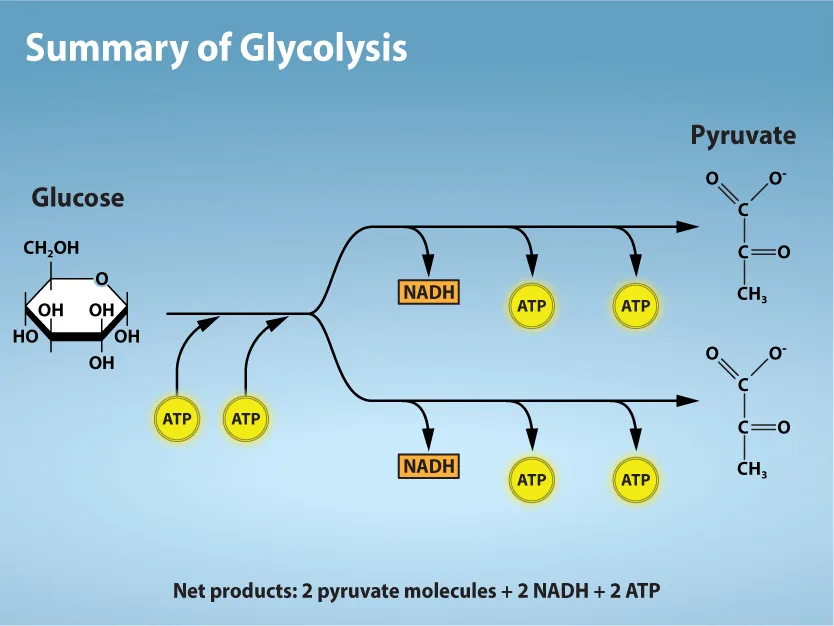
Glycolysis begins with the six-carbon ring-shaped structure of a single glucose molecule and ends with two molecules of a three-carbon keto acid called pyruvate. Glycolysis consists of two distinct phases. The first part of the glycolysis pathway traps the glucose molecule in the cell and uses energy to modify it so that the six-carbon sugar molecule can be split evenly into the two three-carbon molecules. The second part of glycolysis extracts energy from the molecules and stores it in the form of ATP and NADH—remember: this is the reduced form of NAD.
Extended description
A schematic titled Summary of Glycolysis. On the left, a glucose ring structure is labeled Glucose. Two curved arrows, each labeled ATP, feed into a horizontal arrow leading to a fork. Past the fork, the pathway splits into two identical parallel branches, one above the other. Each branch has an arrow labeled NADH branching off downward into an orange box, followed by two more arrows each labeled ATP branching off into yellow circles, before the branch arrives at a pyruvate structure on the right labeled Pyruvate. A caption band across the bottom reads: Net products: 2 pyruvate molecules + 2 NADH + 2 ATP.
First Half of Glycolysis (Energy-Requiring Steps)
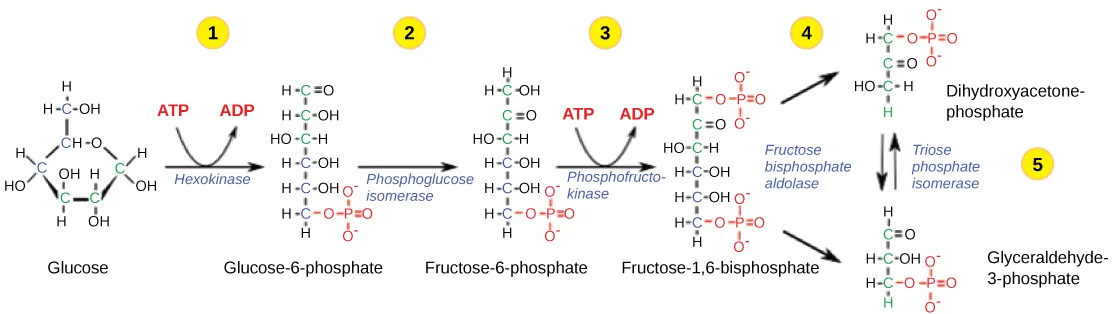
Step 1. The first step in glycolysis (below) is catalyzed by hexokinase, an enzyme with broad specificity that catalyzes the phosphorylation of six-carbon sugars. Hexokinase phosphorylates glucose using ATP as the source of the phosphate, producing glucose-6-phosphate, a more reactive form of glucose. This reaction prevents the phosphorylated glucose molecule from continuing to interact with the GLUT proteins, and it can no longer leave the cell because the negatively charged phosphate will not allow it to cross the hydrophobic interior of the plasma membrane.
Step 2. In the second step of glycolysis, an isomerase converts glucose-6-phosphate into one of its isomers, fructose-6-phosphate (this isomer has a phosphate attached at the location of the sixth carbon of the ring). An isomerase is an enzyme that catalyzes the conversion of a molecule into one of its isomers. (This change from phosphoglucose to phosphofructose allows the eventual split of the sugar into two three-carbon molecules.)
Step 3. The third step is the phosphorylation of fructose-6-phosphate, catalyzed by the enzyme phosphofructokinase. A second ATP molecule donates a high-energy phosphate to fructose-6-phosphate, producing fructose-1,6-bisphosphate. In this pathway, phosphofructokinase is a rate-limiting enzyme. It is active when the concentration of ADP is high; it is less active when ADP levels are low and the concentration of ATP is high. Thus, if there is “sufficient” ATP in the system, the pathway slows down. This is a type of end product inhibition, since ATP is the end product of glucose catabolism.
Step 4. The newly added high-energy phosphates further destabilize fructose-1,6-bisphosphate. The fourth step in glycolysis employs an enzyme, aldolase, to cleave fructose-1,6-bisphosphate into two three-carbon isomers: dihydroxyacetone phosphate and glyceraldehyde-3-phosphate.
Step 5. In the fifth step, an isomerase transforms the dihydroxyacetone-phosphate into its isomer, glyceraldehyde-3-phosphate. Thus, the pathway will continue with two molecules of a glyceraldehyde-3-phosphate. At this point in the pathway, there is a net investment of energy from two ATP molecules in the breakdown of one glucose molecule.
Extended description
A left-to-right chain of five labeled reaction steps, each numbered 1 through 5 in a yellow circle. Step 1: glucose (a six-membered ring) reacts with ATP, releasing ADP, catalyzed by hexokinase, to form glucose-6-phosphate. Step 2: glucose-6-phosphate is rearranged by phosphoglucose isomerase into fructose-6-phosphate, drawn as an open-chain structure. Step 3: fructose-6-phosphate reacts with a second ATP, releasing ADP, catalyzed by phosphofructokinase, to form fructose-1,6-bisphosphate, now carrying two phosphate groups. Step 4: fructose bisphosphate aldolase splits fructose-1,6-bisphosphate into two separate three-carbon branches. Step 5, shown with a double-headed arrow linking the two branches: triose phosphate isomerase interconverts the upper branch, dihydroxyacetone phosphate, with the lower branch, glyceraldehyde-3-phosphate.
Second Half of Glycolysis (Energy-Releasing Steps)
So far, glycolysis has cost the cell two ATP molecules and produced two small, three-carbon sugar molecules. Both of these molecules will proceed through the second half of the pathway, and sufficient energy will be extracted to pay back the two ATP molecules used as an initial investment and produce a profit for the cell of two additional ATP molecules and two even higher-energy NADH molecules.
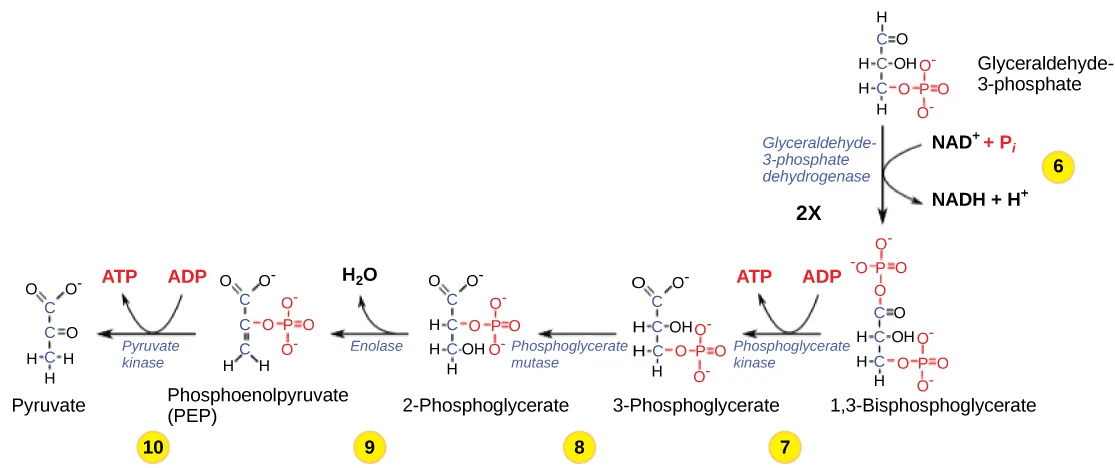
Step 6. The sixth step in glycolysis (below) oxidizes the sugar (glyceraldehyde-3-phosphate), extracting high-energy electrons, which are picked up by the electron carrier NAD⁺, producing NADH. The sugar is then phosphorylated by the addition of a second phosphate group, producing 1,3-bisphosphoglycerate. Note that the second phosphate group does not require another ATP molecule.
Extended description
A chain of five labeled reaction steps, numbered 6 through 10 in yellow circles, running top to bottom and then right to left. Step 6, at top right: glyceraldehyde-3-phosphate reacts with NAD⁺ and inorganic phosphate, releasing NADH and H⁺, catalyzed by glyceraldehyde-3-phosphate dehydrogenase (doubled, since two three-carbon molecules pass through), to form 1,3-bisphosphoglycerate, now carrying two phosphate groups. Step 7: 1,3-bisphosphoglycerate reacts with ADP, releasing ATP, catalyzed by phosphoglycerate kinase, to form 3-phosphoglycerate. Step 8: phosphoglycerate mutase rearranges 3-phosphoglycerate into 2-phosphoglycerate, moving the remaining phosphate to the adjacent carbon. Step 9: enolase removes a water molecule from 2-phosphoglycerate, forming phosphoenolpyruvate (PEP). Step 10, at far left: PEP reacts with ADP, releasing ATP, catalyzed by pyruvate kinase, to form pyruvate.
Here again is a potential limiting factor for this pathway. The continuation of the reaction depends upon the availability of the oxidized form of the electron carrier, NAD⁺. Thus, NADH must be continuously oxidized back into NAD⁺ in order to keep this step going. If NAD⁺ is not available, the second half of glycolysis slows down or stops. If oxygen is available in the system, the NADH will be oxidized readily, though indirectly, and the high-energy electrons from the hydrogen released in this process will be used to produce ATP. In an environment without oxygen, an alternate pathway (fermentation) can provide the oxidation of NADH to NAD⁺.
Step 7. In the seventh step, catalyzed by phosphoglycerate kinase (an enzyme named for the reverse reaction), 1,3-bisphosphoglycerate donates a high-energy phosphate to ADP, forming one molecule of ATP. (This is an example of substrate-level phosphorylation.) A carbonyl group on the 1,3-bisphosphoglycerate is oxidized to a carboxyl group, and 3-phosphoglycerate is formed.
Step 8. In the eighth step, the remaining phosphate group in 3-phosphoglycerate moves from the third carbon to the second carbon, producing 2-phosphoglycerate (an isomer of 3-phosphoglycerate). The enzyme catalyzing this step is a mutase (isomerase).
Step 9. Enolase catalyzes the ninth step. This enzyme causes 2-phosphoglycerate to lose water from its structure; this is a dehydration reaction, resulting in the formation of a double bond that increases the potential energy in the remaining phosphate bond and produces phosphoenolpyruvate (PEP).
Step 10. The last step in glycolysis is catalyzed by the enzyme pyruvate kinase (the enzyme in this case is named for the reverse reaction of pyruvate’s conversion into PEP) and results in the production of a second ATP molecule by substrate-level phosphorylation and the compound pyruvic acid (or its salt form, pyruvate). Many enzymes in enzymatic pathways are named for the reverse reactions, since the enzyme can catalyze both forward and reverse reactions (these may have been described initially by the reverse reaction that takes place in vitro, under nonphysiological conditions).
Outcomes of Glycolysis
Glycolysis begins with glucose and produces two pyruvate molecules, four new ATP molecules, and two molecules of NADH. (Note: two ATP molecules are used in the first half of the pathway to prepare the six-carbon ring for cleavage, so the cell has a net gain of two ATP molecules and two NADH molecules for its use). If the cell cannot catabolize the pyruvate molecules further, it will harvest only two ATP molecules from one molecule of glucose. Mature mammalian red blood cells do not have mitochondria and thus are not capable of aerobic respiration—the process in which organisms convert energy in the presence of oxygen—and glycolysis is their sole source of ATP. If glycolysis is interrupted, these cells lose their ability to maintain their sodium-potassium pumps, and eventually, they die.
The last step in glycolysis will not occur if pyruvate kinase, the enzyme that catalyzes the formation of pyruvate, is not available in sufficient quantities. In this situation, the entire glycolysis pathway will proceed, but only two ATP molecules will be made in the second half. Thus, pyruvate kinase is a rate-limiting enzyme for glycolysis.
Summary
Glycolysis is the first pathway within the cytoplasm used in the breakdown of glucose to extract energy. It was probably one of the earliest metabolic pathways to evolve and is used by nearly all of the organisms on Earth. Glycolysis consists of two parts: The first part prepares the six-carbon ring of glucose for cleavage into two three-carbon sugars. ATP is invested in the process during this half to energize the separation. The second half of glycolysis extracts ATP and high-energy electrons from hydrogen atoms and attaches them to NAD⁺. Two ATP molecules are invested in the first half and four ATP molecules are formed by substrate phosphorylation during the second half. This produces a net gain of two ATP and two NADH molecules for the cell.
Key terms
- aerobic respiration — process in which organisms convert energy in the presence of oxygen
- anaerobic — process that does not use oxygen
- glycolysis — process of breaking glucose into two three-carbon molecules with the production of ATP and NADH
- isomerase — enzyme that converts a molecule into its isomer
- pyruvate — three-carbon keto acid that can be decarboxylated and oxidized to make acetyl CoA, which enters the citric acid cycle under aerobic conditions; the end product of glycolysis
Practice
Describe the overall result in terms of molecules produced during the chemical breakdown of glucose by glycolysis
The process of breaking glucose into two three-carbon molecules with the production of ATP and NADH is called ________.
This is the section’s own subject: the first pathway in the breakdown of glucose, and it takes place in the cytoplasm without using oxygen directly.The three-carbon keto acid that is the end product of glycolysis, and that can be decarboxylated and oxidized to make acetyl CoA, is called ________.
Two molecules of it are produced from each glucose molecule that enters the pathway.Nearly all organisms on Earth carry out some form of glycolysis. How does this fact support or not support the assertion that glycolysis is one of the oldest metabolic pathways?
Show model answer
Did your answer mention:
The first part of glycolysis prepares the six-carbon ring of glucose for cleavage into ________ three-carbon sugars.
The section’s summary states how many three-carbon sugars the six-carbon ring is split into.Compare the output of glycolysis in terms of ATP molecules and NADH molecules produced
During the second half of glycolysis, what occurs?
The first half of the pathway spends ATP to prime the sugar for cleavage; the second half’s job is the opposite.Because they lose their mitochondria during development, red blood cells cannot perform aerobic respiration; however, they do perform glycolysis in the cytoplasm. Why do all cells need an energy source, and what would happen if glycolysis were blocked in a red blood cell?
Show model answer
Did your answer mention:
Two ATP molecules are invested in the first half of glycolysis and ________ ATP molecules are formed by substrate phosphorylation during the second half.
The section’s summary gives the count of ATP molecules formed by substrate phosphorylation in the second half.Glycolysis produces a net gain of two ATP and two ________ molecules for the cell.
This is the other high-energy electron carrier the pathway reduces, alongside its net ATP gain.This section is adapted from Biology 2e, Section 7.2: Glycolysis by Mary Ann Clark, Jung Choi, Matthew Douglas, and OpenStax, © OpenStax, licensed under CC BY-NC-SA 4.0. Access the original for free at openstax.org. Changes: figures re-encoded as WebP and re-kinded from the manifest’s file-extension guess of “photo” to “diagram” for all three (each is a schematic pathway illustration, not a photograph); the alt text for all three was rewritten from the source (the source alts for the two step-by-step figures ran 663 and 723 characters, spelling out each letter of “ATP”/“NADH” and using “dash” for hyphens) — each now gives a short summary of what the figure teaches, with the full step-by-step walk-through moved into a longdesc, added to each since none of their meanings is fully carried by its caption; the source’s underline emphasis on “bi” in “fructose-1,6-bisphosphate” (a typographic cue about the bis- prefix, not a defining term) is dropped in favor of plain text; inline references to figures changed from the source’s print numbers (“Figure 7.8,” “Figure 7.9”) to descriptive phrases (“below”) since figures are not numbered here; the Link to Learning note is rendered as a callout with a descriptive link (“this interactive animation of glycolysis”) in place of the source’s bare “site”; the end-of-section Review Question and Critical Thinking Questions are adapted into the closing interactive Practice block (one multiple choice and two self-checks); two key-term recall items (glycolysis, pyruvate) are added from the glossary to give the first objective’s group an auto-graded item, with “pyruvic acid” accepted for pyruvate since the section itself treats the acid and its salt form as the same answer; rubric checkpoints added to each self-check, decomposing its model answer (the source solution) into check-off clauses with no new claims; and three summary-derived items added — a cloze textin on the number of three-carbon sugars from the first-half sentence (first objective), a cloze textin on the four ATP molecules formed in the second half, and a select-the-term multiple choice on the NADH molecules named in the pathway’s net-gain sentence (both second objective) — to raise the second objective’s group and the section as a whole to the practice floor.