Oxidation of Pyruvate and the Citric Acid Cycle
By the end of this section, you will be able to:
- Explain how a circular pathway, such as the citric acid cycle, fundamentally differs from a linear biochemical pathway, such as glycolysis
- Describe how pyruvate, the product of glycolysis, is prepared for entry into the citric acid cycle
If oxygen is available, aerobic respiration will go forward. In eukaryotic cells, the pyruvate molecules produced at the end of glycolysis are transported into the mitochondria, which are the sites of cellular respiration. There, pyruvate is transformed into an acetyl group that will be picked up and activated by a carrier compound called coenzyme A (CoA). The resulting compound is called acetyl CoA. CoA is derived from vitamin B5, pantothenic acid. Acetyl CoA can be used in a variety of ways by the cell, but its major function is to deliver the acetyl group derived from pyruvate to the next stage of the pathway in glucose catabolism.
Breakdown of Pyruvate
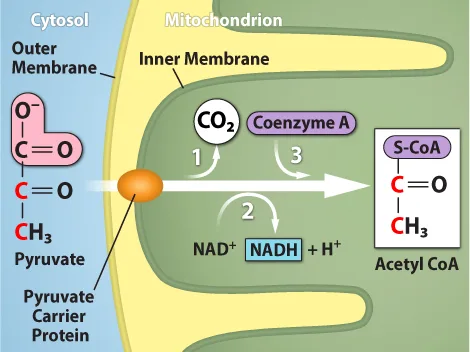
In order for pyruvate, the product of glycolysis, to enter the next pathway, it must undergo several changes. The conversion is a three-step process, shown below.
Step 1. A carboxyl group is removed from pyruvate, releasing a molecule of carbon dioxide into the surrounding medium. This reaction creates a two-carbon hydroxyethyl group bound to the enzyme (pyruvate dehydrogenase). We should note that this is the first of the six carbons from the original glucose molecule to be removed. (This step proceeds twice because there are two pyruvate molecules produced at the end of glycolysis for every molecule of glucose metabolized anaerobically; thus, two of the six carbons will have been removed at the end of both steps.)
Step 2. The hydroxyethyl group is oxidized to an acetyl group, and the electrons are picked up by NAD⁺, forming NADH. The high-energy electrons from NADH will be used later to generate ATP.
Step 3. The enzyme-bound acetyl group is transferred to CoA, producing a molecule of acetyl CoA.
Extended description
The diagram is divided into two shaded regions: a light blue cytosol at left and a green mitochondrion at right, separated by the mitochondrion’s outer and inner membranes. Pyruvate, drawn as a three-carbon structure with a carboxyl group, a central C=O, and a CH₃ group, sits in the cytosol. An orange oval labeled Pyruvate Carrier Protein spans both membranes, and a white arrow carries the molecule through it into the mitochondrion, branching into three numbered steps. Step 1 shows a carboxyl group leaving the molecule as CO₂. Step 2 shows NAD⁺ combining with the intermediate to form NADH plus H⁺. Step 3 shows coenzyme A joining the remaining two-carbon fragment. The resulting acetyl CoA, drawn as S-CoA, C=O, CH₃, sits in a box at right.
Note that during the second stage of glucose metabolism, whenever a carbon atom is removed, it is bound to two oxygen atoms, producing carbon dioxide, one of the major end products of cellular respiration.
Acetyl CoA to CO₂
In the presence of oxygen, acetyl CoA delivers its acetyl (2C) group to a four-carbon molecule, oxaloacetate, to form citrate, a six-carbon molecule with three carboxyl groups; this pathway will harvest the remainder of the extractable energy from what began as a glucose molecule and release the remaining four CO₂ molecules. This single pathway is called by different names: the citric acid cycle (for the first intermediate formed—citric acid, or citrate—when acetate joins to the oxaloacetate), the TCA cycle (because citric acid or citrate and isocitrate are tricarboxylic acids), and the Krebs cycle, after Hans Krebs, who first identified the steps in the pathway in the 1930s in pigeon flight muscles.
Citric Acid Cycle
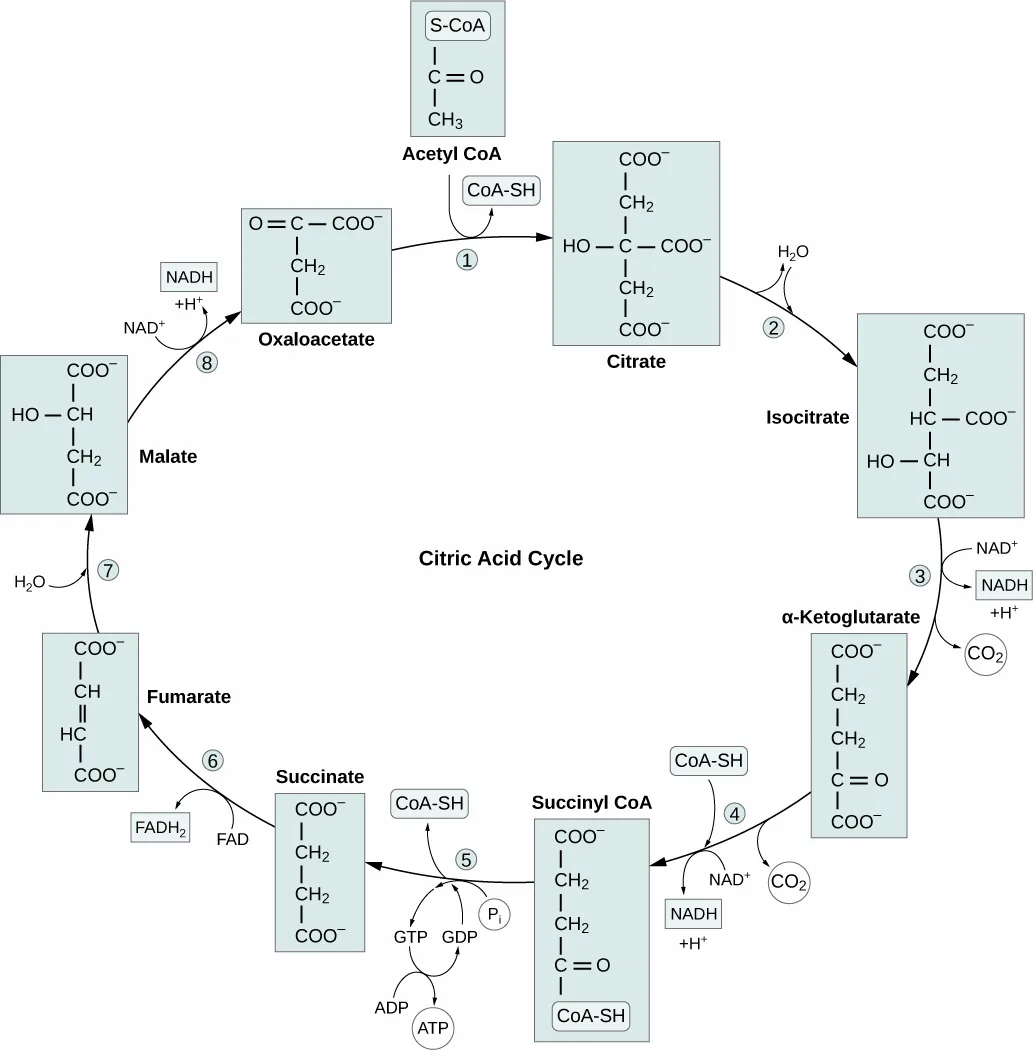
Like the conversion of pyruvate to acetyl CoA, the citric acid cycle takes place in the matrix of mitochondria. Almost all of the enzymes of the citric acid cycle are soluble, with the single exception of the enzyme succinate dehydrogenase, which is embedded in the inner membrane of the mitochondrion. Unlike glycolysis, the citric acid cycle is a closed loop: the last part of the pathway regenerates the compound used in the first step. The eight steps of the cycle are a series of redox, dehydration, hydration, and decarboxylation reactions that produce two carbon dioxide molecules, one GTP/ATP, and the reduced carriers NADH and FADH₂, shown below. This is considered an aerobic pathway because the NADH and FADH₂ produced must transfer their electrons to the next pathway in the system, which will use oxygen. If this transfer does not occur, the oxidation steps of the citric acid cycle also do not occur. Note that the citric acid cycle produces very little ATP directly and does not directly consume oxygen.
Extended description
The eight boxed intermediates are arranged in a ring, read clockwise starting at the top. Acetyl CoA (S-CoA, C=O, CH₃) enters at the top and combines with oxaloacetate; arrow 1 forms citrate, releasing CoA-SH. Arrow 2 converts citrate to isocitrate, losing and regaining a water molecule. Arrow 3 converts isocitrate to α-ketoglutarate, releasing CO₂ and reducing NAD⁺ to NADH plus H⁺. Arrow 4 converts α-ketoglutarate to succinyl CoA, adding CoA-SH and again releasing CO₂ while reducing NAD⁺ to NADH plus H⁺. Arrow 5 converts succinyl CoA to succinate, releasing CoA-SH and converting GDP plus Pi to GTP, shown as interconvertible with ADP and ATP. Arrow 6 converts succinate to fumarate, reducing FAD to FADH₂. Arrow 7 adds water to fumarate to form malate. Arrow 8 oxidizes malate back to oxaloacetate, reducing another NAD⁺ to NADH plus H⁺ and closing the loop at the top of the ring.
Steps in the Citric Acid Cycle
Step 1. Prior to the first step, a transitional phase occurs during which pyruvic acid is converted to acetyl CoA. Then, the first step of the cycle begins: This condensation step combines the two-carbon acetyl group with a four-carbon oxaloacetate molecule to form a six-carbon molecule of citrate. CoA is bound to a sulfhydryl group (-SH) and diffuses away to eventually combine with another acetyl group. This step is irreversible because it is highly exergonic. The rate of this reaction is controlled by negative feedback and the amount of ATP available. If ATP levels increase, the rate of this reaction decreases. If ATP is in short supply, the rate increases.
Step 2. In step two, citrate loses one water molecule and gains another as citrate is converted into its isomer, isocitrate.
Step 3. In step three, isocitrate is oxidized, producing a five-carbon molecule, α-ketoglutarate, along with a molecule of CO₂ and two electrons, which reduce NAD⁺ to NADH. This step is also regulated by negative feedback from ATP and NADH and a positive effect of ADP.
Step 4. Steps three and four are both oxidation and decarboxylation steps, which as we have seen, release electrons that reduce NAD⁺ to NADH and release carboxyl groups that form CO₂ molecules. Alpha-ketoglutarate is the product of step three, and a succinyl group is the product of step four. CoA binds with the succinyl group to form succinyl CoA. The enzyme that catalyzes step four is regulated by feedback inhibition of ATP, succinyl CoA, and NADH.
Step 5. In step five, a carboxyl group is substituted for coenzyme A, and a high-energy bond is formed. This energy is used in substrate-level phosphorylation (during the conversion of the succinyl group to succinate) to form either guanosine triphosphate (GTP) or ATP. There are two forms of the enzyme, called isoenzymes, for this step, depending upon the type of animal tissue in which they are found. One form is found in tissues that use large amounts of ATP, such as heart and skeletal muscle. This form produces ATP. The second form of the enzyme is found in tissues that have a high number of anabolic pathways, such as liver. This form produces GTP. GTP is energetically equivalent to ATP; however, its use is more restricted. In particular, protein synthesis primarily uses GTP.
Step 6. Step six is a dehydrogenation process that converts succinate into fumarate. Two hydrogen atoms are transferred to FAD, reducing it to FADH₂. (Note: the energy contained in the electrons of these hydrogens is insufficient to reduce NAD⁺ but adequate to reduce FAD.) Unlike NADH, this carrier remains attached to the enzyme and transfers the electrons to the electron transport chain directly. This process is made possible by the localization of the enzyme catalyzing this step inside the inner membrane of the mitochondrion.
Step 7. Water is added by hydration to fumarate during step seven, and malate is produced. The last step in the citric acid cycle regenerates oxaloacetate by oxidizing malate. Another molecule of NADH is then produced in the process.
Link to Learning
Products of the Citric Acid Cycle
Two carbon atoms come into the citric acid cycle from each acetyl group, representing four out of the six carbons of one glucose molecule. Two carbon dioxide molecules are released on each turn of the cycle; however, these do not necessarily contain the most recently added carbon atoms. The two acetyl carbon atoms will eventually be released on later turns of the cycle; thus, all six carbon atoms from the original glucose molecule are eventually incorporated into carbon dioxide. Each turn of the cycle forms three NADH molecules and one FADH₂ molecule. These carriers will connect with the last portion of aerobic respiration, the electron transport chain, to produce ATP molecules. One GTP or ATP is also made in each cycle. Several of the intermediate compounds in the citric acid cycle can be used in synthesizing nonessential amino acids; therefore, the cycle is amphibolic (both catabolic and anabolic).
Summary
In the presence of oxygen, pyruvate is transformed into an acetyl group attached to a carrier molecule of coenzyme A. The resulting acetyl CoA can enter several pathways, but most often, the acetyl group is delivered to the citric acid cycle for further catabolism. During the conversion of pyruvate into the acetyl group, a molecule of carbon dioxide and two high-energy electrons are removed. The carbon dioxide accounts for two (conversion of two pyruvate molecules) of the six carbons of the original glucose molecule. The electrons are picked up by NAD⁺, and the NADH carries the electrons to a later pathway for ATP production. At this point, the glucose molecule that originally entered cellular respiration has been completely oxidized. Chemical potential energy stored within the glucose molecule has been transferred to electron carriers or has been used to synthesize a few ATPs.
The citric acid cycle is a series of redox and decarboxylation reactions that removes high-energy electrons and carbon dioxide. The electrons, temporarily stored in molecules of NADH and FADH₂, are used to generate ATP in a subsequent pathway. One molecule of either GTP or ATP is produced by substrate-level phosphorylation on each turn of the cycle. There is no comparison of the cyclic pathway with a linear one.
Key terms
- acetyl CoA — combination of an acetyl group derived from pyruvic acid and coenzyme A, which is made from pantothenic acid (a B-group vitamin)
- citric acid cycle — (also Krebs cycle) series of enzyme-catalyzed chemical reactions of central importance in all living cells for extraction of energy from carbohydrates
- Krebs cycle — (also citric acid cycle) alternate name for the citric acid cycle, named after Hans Krebs, who first identified the steps in the pathway in the 1930s in pigeon flight muscles; see citric acid cycle
- TCA cycle — (also citric acid cycle) alternate name for the citric acid cycle, named after the group name for citric acid, tricarboxylic acid (TCA); see citric acid cycle
Practice
Explain how a circular pathway, such as the citric acid cycle, fundamentally differs from a linear biochemical pathway, such as glycolysis
GTP or ATP is produced during the conversion of ________.
Look for the step where the enzyme releases coenzyme A directly into a high-energy phosphate bond — that is substrate-level phosphorylation.How many NADH molecules are produced on each turn of the citric acid cycle?
Count only the redox steps of the cycle that reduce NAD⁺ rather than FAD.What is the primary difference between a circular pathway and a linear pathway?
Show model answer
Did your answer mention:
The citric acid cycle is a series of ________ and decarboxylation reactions that removes high-energy electrons and carbon dioxide.
The cycle’s steps are described as this category of reaction, together with dehydration, hydration, and decarboxylation reactions.The alternate name for the citric acid cycle, named after the scientist who first identified its steps in the 1930s in pigeon flight muscles, is the ________ cycle.
The section’s glossary names this cycle after the scientist who traced its steps in pigeon flight muscles.Describe how pyruvate, the product of glycolysis, is prepared for entry into the citric acid cycle
What is removed from pyruvate during its conversion into an acetyl group?
This is the same kind of carbon-releasing reaction, a decarboxylation, that recurs throughout the citric acid cycle itself.What do the electrons added to NAD⁺ do?
NADH is a carrier, not a final destination — its high-energy electrons still have somewhere to go.The combination of an acetyl group derived from pyruvic acid and coenzyme A is called ________.
This is the carrier compound that delivers the acetyl group derived from pyruvate into the citric acid cycle.This section is adapted from Biology 2e, Section 7.3: Oxidation of Pyruvate and the Citric Acid Cycle by Mary Ann Clark, Jung Choi, Matthew Douglas, and OpenStax, © OpenStax, licensed under CC BY-NC-SA 4.0. Access the original for free at openstax.org. Changes: both figures re-encoded as WebP and re-kinded from the manifest’s file-extension guess of “photo” to “diagram” (each is a schematic molecular illustration, not a photograph); the source’s spelled-out alt text (“upper case C lower case o upper case A”) was rewritten into a short description of what each diagram shows, with the full numbered step-by-step walk-through moved into a longdesc added to each, since neither figure’s full reading is carried by its caption; the two inline cross-references to the figures are rendered as “shown below” in place of the source’s print figure numbers, since figures are not numbered here; the Link to Learning note is rendered as a callout with a descriptive link (“an animation of the citric acid cycle”) in place of the source’s bare “here”; the end-of-section Review Questions and the Critical Thinking Question are adapted into the closing interactive Practice block (four multiple choice and one self-check), with the two Review Questions on the citric acid cycle’s own steps grouped under the circular-pathway objective and the two Review Questions on pyruvate’s oxidation grouped under the pyruvate-preparation objective; rubric checkpoints added to the section’s self-check, decomposing its model answer (the source solution) into check-off clauses with no new claims; a summary-derived select-the-term multiple choice added under the circular-pathway objective, naming the reaction category (“redox”) the summary’s own sentence pairs with decarboxylation; and two glossary recall textin items added (Krebs cycle under the circular-pathway objective, acetyl CoA under the pyruvate-preparation objective) to raise both objective groups and the section as a whole to the practice floor.