Metabolism without Oxygen
By the end of this section, you will be able to:
- Discuss the fundamental difference between anaerobic cellular respiration and fermentation
- Describe the type of fermentation that readily occurs in animal cells and the conditions that initiate that fermentation
In aerobic respiration, the final electron acceptor is an oxygen molecule, O₂. If aerobic respiration occurs, then ATP will be produced using the energy of high-energy electrons carried by NADH or FADH₂ to the electron transport chain. If aerobic respiration does not occur, NADH must be reoxidized to NAD⁺ for reuse as an electron carrier for the glycolytic pathway to continue. How is this done? Some living systems use an organic molecule as the final electron acceptor. Processes that use an organic molecule to regenerate NAD⁺ from NADH are collectively referred to as fermentation. In contrast, in some living systems, the electron transport chain (ETC) uses an inorganic molecule as a final electron acceptor, which is called anaerobic cellular respiration. Both processes allow organisms to convert energy for their use in the absence of oxygen. Both methods are anaerobic, in which organisms convert energy for their use in the absence of oxygen.
Anaerobic Cellular Respiration
Certain prokaryotes, including some species in the domains Bacteria and Archaea, use anaerobic respiration. For example, a group of archaeans called methanogens reduces carbon dioxide to methane to oxidize NADH. These microorganisms are found in soil and in the digestive tracts of ruminants, such as cows and sheep. Similarly, sulfate-reducing bacteria, most of which are anaerobic (below), reduce sulfate to hydrogen sulfide to regenerate NAD⁺ from NADH.

Lactic Acid Fermentation
The fermentation method used by animals and certain bacteria, such as those in yogurt, is lactic acid fermentation (below). This type of fermentation is used routinely in mammalian red blood cells, which do not have mitochondria, and in skeletal muscle that has an insufficient oxygen supply to allow aerobic respiration to continue (that is, in muscles used to the point of fatigue). In muscles, lactic acid accumulation must be removed by the blood circulation, and when the lactic acid loses a hydrogen, the resulting lactate is brought to the liver for further metabolism. The chemical reactions of lactic acid fermentation are the following:
Pyruvic acid + NADH ↔ lactic acid + NAD⁺
The enzyme used in this reaction is lactate dehydrogenase (LDH). The reaction can proceed in either direction, but the reaction from left to right is inhibited by acidic conditions. Such lactic acid accumulation was once believed to cause muscle stiffness, fatigue, and soreness, although more recent research disputes this hypothesis. Once the lactic acid has been removed from the muscle and circulated to the liver, it can be reconverted into pyruvic acid and further catabolized for energy.
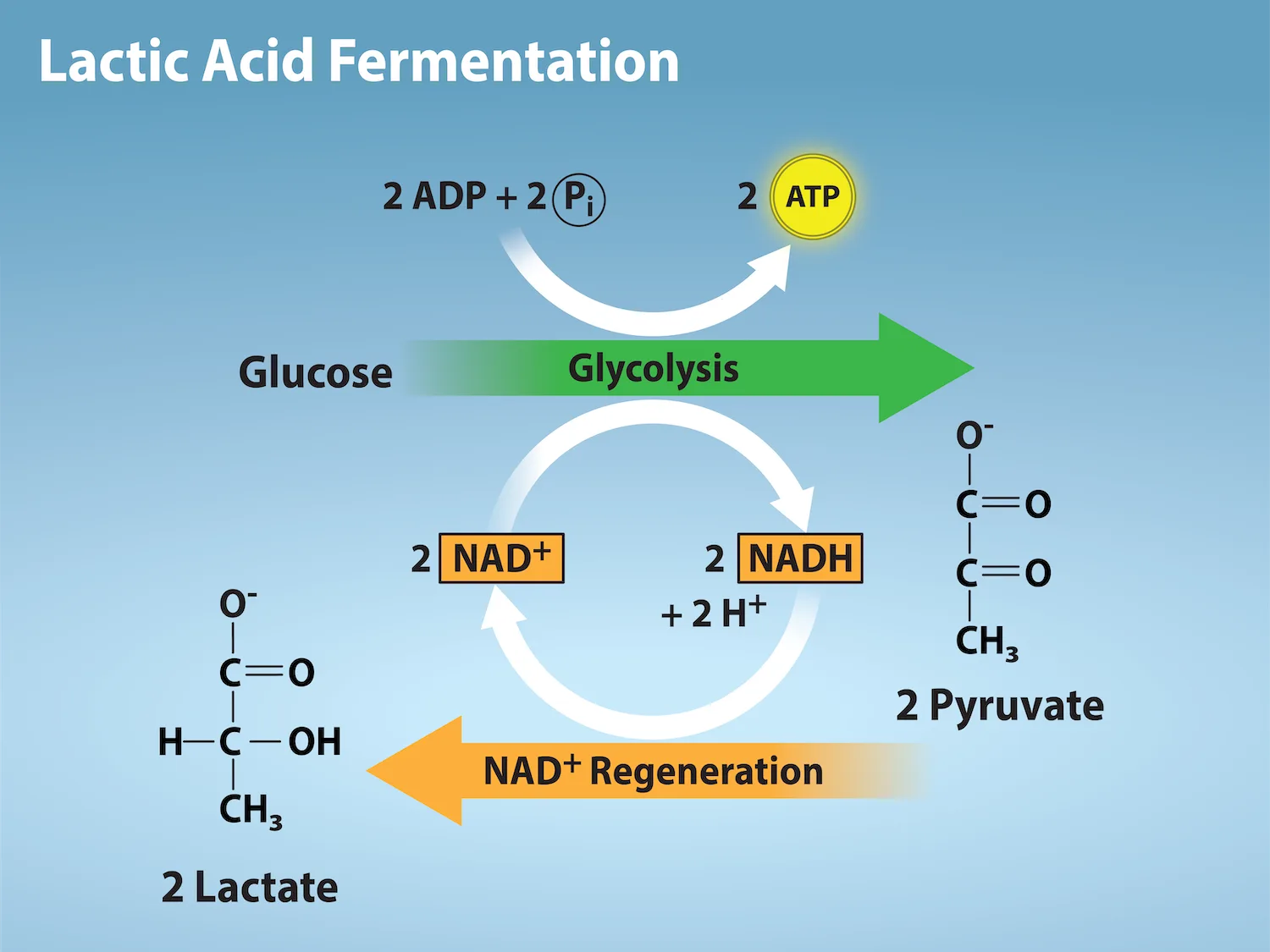
Extended description
A flow diagram titled ‘Lactic Acid Fermentation.’ At the top, a curved arrow shows 2 ADP + 2 Pi converting to 2 ATP in a yellow circle. Below, a green arrow labeled ‘Glycolysis’ runs left to right from ‘Glucose’ to a pyruvate structural formula (O⁻, two C=O groups, then CH₃) labeled ‘2 Pyruvate.’ A pair of curved white arrows forms a cycle beneath the glycolysis arrow, carrying ‘2 NAD⁺’ up and ‘2 NADH + 2 H⁺’ down between the glucose/pyruvate level and the lactate level. An orange arrow labeled ‘NAD⁺ Regeneration’ points left from the pyruvate structure to a lactate structural formula (O⁻, C=O, H–C–OH, CH₃) labeled ‘2 Lactate,’ showing the reduction of pyruvate to lactate paired with the reoxidation of NADH to NAD⁺.
Tremetol, a metabolic poison found in the white snakeroot plant, prevents the metabolism of lactate. When cows eat this plant, tremetol is concentrated in the milk they produce. Humans who consume the milk can become seriously ill. Symptoms of this disease, which include vomiting, abdominal pain, and tremors, become worse after exercise. Why do you think this is the case?
Show model answer
Did your answer mention:
Alcohol Fermentation
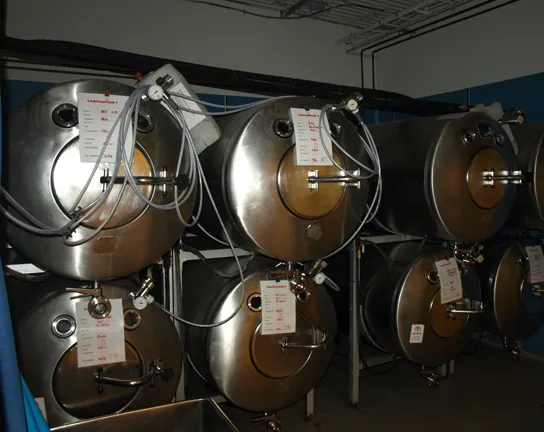
Another familiar fermentation process is alcohol fermentation (below), which produces ethanol. The first chemical reaction of alcohol fermentation is the following (CO₂ does not participate in the second reaction):
pyruvic acid + H⁺ → CO₂ + acetaldehyde + NADH + H⁺ → ethanol + NAD⁺
The first reaction is catalyzed by pyruvate decarboxylase, a cytoplasmic enzyme, with a coenzyme of thiamine pyrophosphate (TPP, derived from vitamin B₁ and also called thiamine). A carboxyl group is removed from pyruvic acid, releasing carbon dioxide as a gas. The loss of carbon dioxide reduces the size of the molecule by one carbon, producing acetaldehyde. The second reaction is catalyzed by alcohol dehydrogenase to oxidize NADH to NAD⁺ and reduce acetaldehyde to ethanol. The fermentation of pyruvic acid by yeast produces the ethanol found in alcoholic beverages. Ethanol tolerance of yeast is variable, ranging from about 5 percent to 21 percent, depending on the yeast strain and environmental conditions.
Other Types of Fermentation
Other fermentation methods take place in bacteria. We should note that many prokaryotes are facultatively anaerobic. This means that they can switch between aerobic respiration and fermentation, depending on the availability of free oxygen. Certain prokaryotes, such as Clostridia, are obligate anaerobes. Obligate anaerobes live and grow in the absence of molecular oxygen. Oxygen is a poison to these microorganisms and kills them on exposure. We should also note that most forms of fermentation produce gas (an exception is lactic acid fermentation which, in most cases, does not result in gas production). The production of particular types of gas is used as an indicator of the fermentation of specific carbohydrates, which plays a role in the laboratory identification of the bacteria. Various methods of fermentation are used by assorted organisms to ensure an adequate supply of NAD⁺ for the sixth step in glycolysis. Without these pathways, this step would not occur, and ATP could not be harvested from the breakdown of glucose.
Summary
If NADH cannot be oxidized through aerobic respiration, another electron acceptor is used. Most organisms will use some form of fermentation to accomplish the regeneration of NAD⁺, ensuring the continuation of glycolysis. The regeneration of NAD⁺ in fermentation is not accompanied by ATP production; therefore, the potential of NADH to produce ATP using an electron transport chain is not utilized.
Key terms
- anaerobic cellular respiration — process in which organisms convert energy for their use in the absence of oxygen
- fermentation — process of regenerating NAD⁺ with either an inorganic or organic compound serving as the final electron acceptor; occurs in the absence of oxygen
Practice
Discuss the fundamental difference between anaerobic cellular respiration and fermentation
What is the primary difference between fermentation and anaerobic respiration?
Show model answer
Did your answer mention:
Using an inorganic molecule as the final electron acceptor of the electron transport chain, in the absence of oxygen, is called ________.
Contrast this with fermentation, which uses an organic molecule as the final electron acceptor instead.The process that uses an organic molecule to regenerate NAD⁺ from NADH, allowing energy conversion in the absence of oxygen, is called ________.
It’s the term the section defines using an organic, rather than inorganic, final electron acceptor.The regeneration of NAD⁺ in fermentation is not accompanied by ________ production.
This is the fundamental thing anaerobic respiration’s electron transport chain still makes that fermentation does not.Describe the type of fermentation that readily occurs in animal cells and the conditions that initiate that fermentation
Which of the following fermentation methods can occur in animal skeletal muscles?
Skeletal muscle cells, unlike yeast, do not carry out the alternative pathway that produces ethanol and carbon dioxide.Under what conditions does lactic acid fermentation occur in skeletal muscle, and why is it needed there?
Show model answer
Did your answer mention:
Lactic acid fermentation is used routinely in mammalian red blood cells because they lack ________.
Red blood cells lose this organelle during development, so they cannot carry out aerobic respiration.Lactic acid fermentation is used in skeletal muscle that has an insufficient oxygen supply to allow aerobic respiration to continue — that is, in muscles used to the point of ________.
This is the condition of a working muscle whose oxygen supply can no longer keep up with its demand for aerobic respiration.This section is adapted from Biology 2e, Section 7.5: Metabolism without Oxygen by Mary Ann Clark, Jung Choi, Matthew Douglas, and OpenStax, © OpenStax, licensed under CC BY-NC-SA 4.0. Access the original for free at openstax.org. Changes: figures re-encoded as WebP (all three kinds — two photos, one diagram — matched the manifest’s guess after inspection); the two chemical-reaction equations set as Unicode text with arrows rather than KaTeX; the two photo alts rewritten from the source’s bare “This photo shows…” wording to describe what each image depicts; a longdesc added to the lactic acid fermentation diagram, the only figure whose full reading is not carried by its caption; the Link to Learning’s link text made descriptive (“this interactive fermentation site”) rather than the source’s bare “site”; the Visual Connection question kept in the body immediately after its figure and rendered as a self-check, since the source keys it with a prose solution rather than a lettered option; the end-of-section Review Question and Critical Thinking Question adapted into the closing interactive Practice block (multiple choice and self-check respectively); two key-term recall items (anaerobic cellular respiration, fermentation) added from the glossary; one additional self-check written locally, paraphrasing the section’s own paragraph on when skeletal muscle uses lactic acid fermentation, since the module’s three keyed exercises did not otherwise cover the second objective’s “conditions that initiate” clause; rubric checkpoints added to all four self-checks, the body Visual Connection included, decomposing each model answer (the source solution) into check-off clauses with no new claims; a summary-derived cloze textin item added under the first objective, on the ATP production the summary says fermentation’s NAD⁺ regeneration is not accompanied by; and, since the module’s exercises, glossary, and summary are otherwise exhausted for the second objective, two items written locally and strictly from the section’s own sentences on lactic acid fermentation — a multiple choice on why red blood cells use it (disclosed in the ledger) and a cloze textin on the muscle condition (“fatigue”) that initiates it (disclosed in the ledger) — to raise the second objective’s group and the section as a whole to the practice floor.