Connections of Carbohydrate, Protein, and Lipid Metabolic Pathways
By the end of this section, you will be able to:
- Discuss the ways in which carbohydrate metabolic pathways, glycolysis, and the citric acid cycle interrelate with protein and lipid metabolic pathways
- Explain why metabolic pathways are not considered closed systems
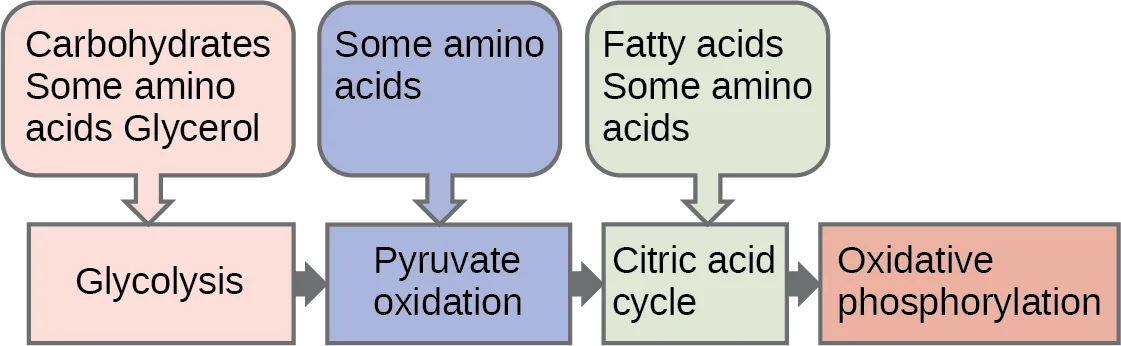
You have learned about the catabolism of glucose, which provides energy to living cells. But living things consume organic compounds other than glucose for food. How does a turkey sandwich end up as ATP in your cells? This happens because all of the catabolic pathways for carbohydrates, proteins, and lipids eventually connect into glycolysis and the citric acid cycle pathways (see the flow chart below). Metabolic pathways should be thought of as porous and interconnecting—that is, substances enter from other pathways, and intermediates leave for other pathways. These pathways are not closed systems! Many of the substrates, intermediates, and products in a particular pathway are reactants in other pathways.
Connections of Other Sugars to Glucose Metabolism
Glycogen, a polymer of glucose, is an energy storage molecule in animals. When there is adequate ATP present, excess glucose is stored as glycogen in both liver and muscle cells. The glycogen will be hydrolyzed into glucose 1-phosphate monomers (G-1-P) if blood sugar levels drop. The presence of glycogen as a source of glucose allows ATP to be produced for a longer period of time during exercise. Glycogen is broken down into glucose-1-phosphate (G-1-P) and converted into glucose-6-phosphate (G-6-P) in both muscle and liver cells, and this product enters the glycolytic pathway.
Sucrose is a disaccharide with a molecule of glucose and a molecule of fructose bonded together with a glycosidic linkage. Fructose is one of the three “dietary” monosaccharides, along with glucose and galactose (part of the milk sugar disaccharide lactose), which are absorbed directly into the bloodstream during digestion. The catabolism of fructose, galactose, and glucose produces the same number of ATP molecules.
Connections of Proteins to Glucose Metabolism
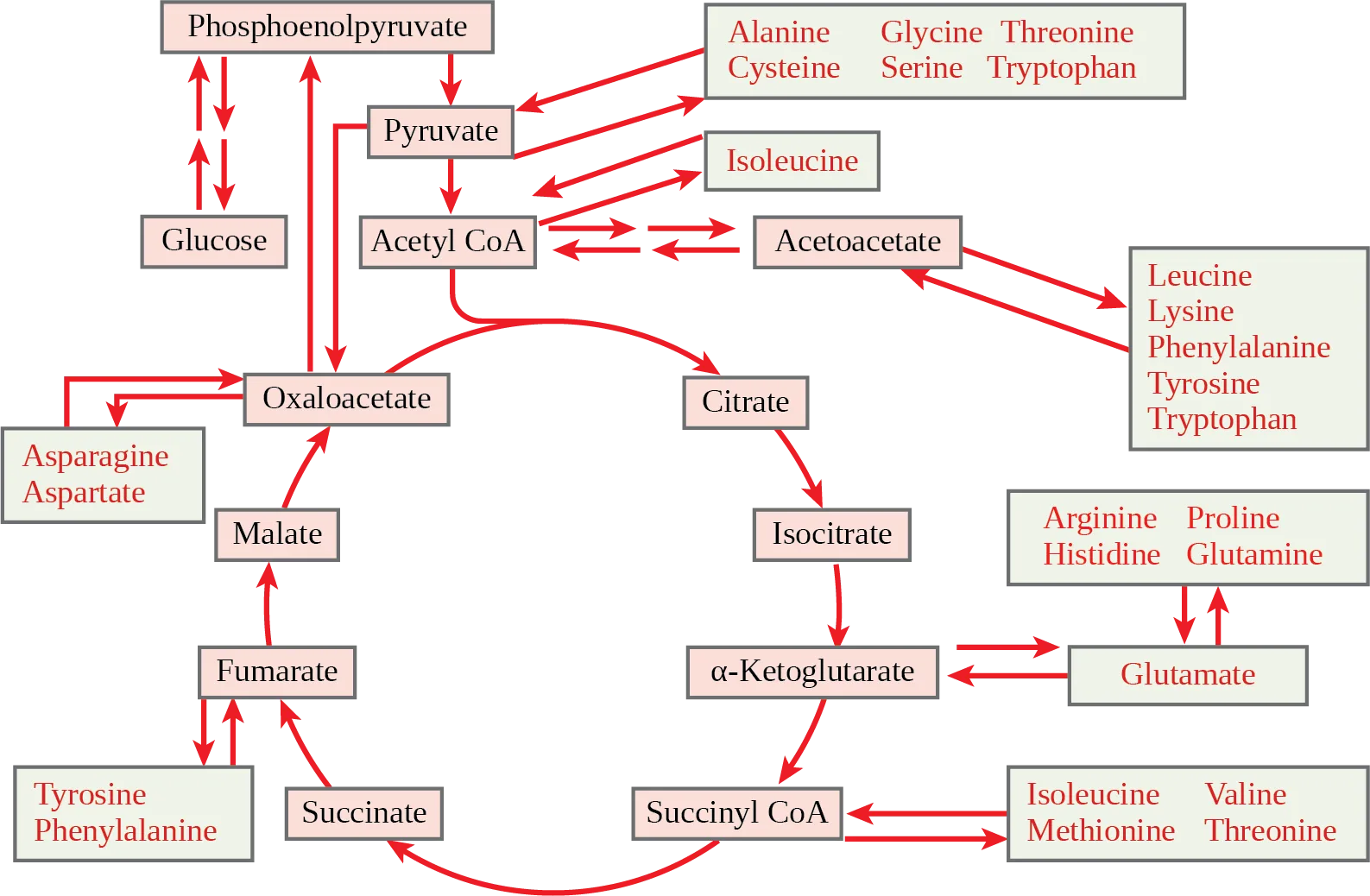
Proteins are hydrolyzed by a variety of enzymes in cells. Most of the time, the amino acids are recycled into the synthesis of new proteins. If there are excess amino acids, however, or if the body is in a state of starvation, some amino acids will be shunted into the pathways of glucose catabolism (see the illustration below). It is very important to note that each amino acid must have its amino group removed prior to entry into these pathways. The amino group is converted into ammonia. In mammals, the liver synthesizes urea from two ammonia molecules and a carbon dioxide molecule. Thus, urea is the principal waste product in mammals, produced from the nitrogen originating in amino acids, and it leaves the body in urine. It should be noted that amino acids can be synthesized from the intermediates and reactants in the cellular respiration cycle.
Extended description
The cycle’s pink boxes run glucose and phosphoenolpyruvate, linked by double-headed arrows, and phosphoenolpyruvate and oxaloacetate, also linked by a double-headed arrow; phosphoenolpyruvate flows one-way into pyruvate, which flows one-way into acetyl CoA and is also connected to oxaloacetate; acetyl CoA enters the ring at citrate, and the ring runs one-way through isocitrate, alpha-ketoglutarate, succinyl CoA, succinate, fumarate, and malate back to oxaloacetate. Six pale-green amino-acid boxes surround the ring, each linked to it by red arrows: alanine, glycine, threonine, cysteine, serine, and tryptophan feed (one-way) into pyruvate; isoleucine, boxed alone, connects (double-headed) to both pyruvate and acetyl CoA (the pyruvate link is as drawn; the module’s own alt text lists isoleucine only among the amino acids that enter as acetyl CoA and succinyl CoA, and isoleucine is not degraded to pyruvate); leucine, lysine, phenylalanine, tyrosine, and tryptophan connect (double-headed) to acetoacetate, which itself connects (double-headed) to acetyl CoA; arginine, proline, histidine, and glutamine connect (double-headed) to glutamate, which connects (double-headed) to alpha-ketoglutarate; isoleucine, valine, methionine, and threonine connect (double-headed) to succinyl CoA; tyrosine and phenylalanine connect (double-headed) to fumarate; and asparagine and aspartate feed (one-way) into oxaloacetate.
Connections of Lipid and Glucose Metabolisms
The lipids connected to the glucose pathway include cholesterol and triglycerides. Cholesterol is a lipid that contributes to cell membrane flexibility and is a precursor of steroid hormones. The synthesis of cholesterol starts with acetyl groups and proceeds in only one direction. The process cannot be reversed.
Triglycerides—made from the bonding of glycerol and three fatty acids—are a form of long-term energy storage in animals. Animals can make most of the fatty acids they need. Triglycerides can be both made and broken down through parts of the glucose catabolism pathways. Glycerol can be phosphorylated to glycerol-3-phosphate, which continues through glycolysis. Fatty acids are catabolized in a process called beta-oxidation, which takes place in the matrix of the mitochondria and converts their fatty acid chains into two-carbon units of acetyl groups. The acetyl groups are picked up by CoA to form acetyl CoA that proceeds into the citric acid cycle.
Extended description
Three colored input boxes sit above a row of four connected process boxes, in reading order left to right. The first input box, labeled carbohydrates, some amino acids, and glycerol, has an arrow down into the first process box, glycolysis. The second input box, labeled some amino acids, has an arrow down into the second process box, pyruvate oxidation. The third input box, labeled fatty acids and some amino acids, has an arrow down into the third process box, citric acid cycle. Arrows connect glycolysis to pyruvate oxidation, pyruvate oxidation to the citric acid cycle, and the citric acid cycle to the fourth process box, oxidative phosphorylation, which has no input box of its own above it.
Evolution Connection. Pathways of Photosynthesis and Cellular Metabolism. The processes of photosynthesis and cellular metabolism consist of several very complex pathways. It is generally thought that the first cells arose in an aqueous environment—a “soup” of nutrients—possibly on the surface of some porous clays, perhaps in warm marine environments. If these cells reproduced successfully and their numbers climbed steadily, it follows that the cells would begin to deplete the nutrients from the medium in which they lived as they shifted the nutrients into the components of their own bodies. This hypothetical situation would have resulted in natural selection favoring those organisms that could exist by using the nutrients that remained in their environment and by manipulating these nutrients into materials upon which they could survive. Selection would favor those organisms that could extract maximal value from the nutrients to which they had access.
An early form of photosynthesis developed that harnessed the sun’s energy using water as a source of hydrogen atoms, but this pathway did not produce free oxygen (anoxygenic photosynthesis). (Another type of anoxygenic photosynthesis did not produce free oxygen because it did not use water as the source of hydrogen ions; instead, it used materials such as hydrogen sulfide and consequently produced sulfur). It is thought that glycolysis developed at this time and could take advantage of the simple sugars being produced but that these reactions were unable to fully extract the energy stored in the carbohydrates. The development of glycolysis probably predated the evolution of photosynthesis, as it was well suited to extract energy from materials spontaneously accumulating in the “primeval soup.” A later form of photosynthesis used water as a source of electrons and hydrogen and generated free oxygen. Over time, the atmosphere became oxygenated, but not before the oxygen released oxidized metals in the ocean and created a “rust” layer in the sediment, permitting the dating of the rise of the first oxygenic photosynthesizers. Living things adapted to exploit this new atmosphere that allowed aerobic respiration as we know it to evolve. When the full process of oxygenic photosynthesis developed and the atmosphere became oxygenated, cells were finally able to use the oxygen expelled by photosynthesis to extract considerably more energy from the sugar molecules using the citric acid cycle and oxidative phosphorylation.
Summary
The breakdown and synthesis of carbohydrates, proteins, and lipids connect with the pathways of glucose catabolism. The simple sugars are galactose, fructose, glycogen, and pentose. These are catabolized during glycolysis. The amino acids from proteins connect with glucose catabolism through pyruvate, acetyl CoA, and components of the citric acid cycle. Cholesterol synthesis starts with acetyl groups, and the components of triglycerides come from glycerol-3-phosphate from glycolysis and acetyl groups produced in the mitochondria from pyruvate.
Practice
Discuss the ways in which carbohydrate metabolic pathways, glycolysis, and the citric acid cycle interrelate with protein and lipid metabolic pathways
A major connection for sugars in glycolysis is ________.
Glycogen is broken down into glucose-1-phosphate and then converted into this compound before it enters the glycolytic pathway.Beta-oxidation is ________.
It happens in the mitochondrial matrix and produces two-carbon acetyl groups that CoA picks up.Before an amino acid can enter the pathways of glucose catabolism, it must first ________.
The section names one modification every amino acid needs before entry, and what its removed nitrogen becomes.Cholesterol synthesis starts with ________ groups.
The summary names the group cholesterol synthesis starts with, before the process runs in only one direction.The sugars and storage carbohydrates catabolized during glycolysis include galactose, fructose, glycogen, and ________.
The section’s summary lists this fourth simple sugar last.Explain why metabolic pathways are not considered closed systems
According to this section, why are metabolic pathways not considered closed systems?
The opening paragraph states directly what substances entering and leaving a pathway have in common with other pathways.Would you describe metabolic pathways as inherently wasteful or inherently economical? Why?
Show model answer
Did your answer mention:
Metabolic pathways should be thought of as porous and interconnecting—that is, substances enter from other pathways, and intermediates ________ for other pathways.
The opening paragraph pairs what happens to substances entering a pathway with what happens to its own intermediates.This section is adapted from Biology 2e, Section 7.6: Connections of Carbohydrate, Protein, and Lipid Metabolic Pathways by Mary Ann Clark, Jung Choi, Matthew Douglas, and OpenStax, © OpenStax, licensed under CC BY-NC-SA 4.0. Access the original for free at openstax.org. Changes: both figures re-encoded as WebP (both are diagrams, confirming the manifest’s guess); each figure’s alt shortened to what it shows and teaches, with the arrow-by-arrow walk-through moved into a longdesc (the source alts were longer than the 600-character cap allows); the citric-acid-cycle figure’s alt and longdesc also correct a source-alt omission — the amino-acid box linked to pyruvate includes tryptophan in the image, a sixth member the source’s own alt text left out; inline references to the two figures changed from the source’s print numbers (“Figure 7.19,” “Figure 7.18”) to descriptive phrases (“the flow chart below,” “the illustration below”); the one Evolution Connection feature box rendered as a callout with its bold name and italicized title; the end-of-section Review Questions and the Critical Thinking Question adapted into the closing interactive Practice block (multiple choice and self-check respectively). This module carries no glossary, so ## Key terms is omitted rather than emitted empty. With only three source exercises across two objectives, one multiple-choice item under each objective group is author-written rather than sourced from an exercise or definition, so that every group reaches its two-item minimum and keeps an auto-graded item: the protein-entry question (first objective) is drawn strictly from the amino-group sentence in the section’s own protein-connections paragraph, and the closed-systems question (second objective) is drawn strictly from the section’s own opening paragraph, with its correct option quoting that paragraph and its distractors describing the opposite or an unsupported claim; rubric checkpoints added to the section’s self-check, decomposing its model answer (the source solution) into check-off clauses with no new claims; two summary-derived cloze textin items added under the first objective (the acetyl groups cholesterol synthesis starts with, and pentose as the fourth simple sugar the summary names); and one additional cloze textin written locally under the second objective, on the “leave” half of the opening paragraph’s “enter… leave” pairing describing why pathways are porous (disclosed in the ledger), to raise the second objective’s group and the section as a whole to the practice floor.; and the summary-derived sugar-list prompt rephrased from the source’s “simple sugars” to “sugars and storage carbohydrates,” since glycogen is a polysaccharide (source defect, erratum 137). The amino-acid figure is reproduced as drawn, and its long description notes that the drawn isoleucine-to-pyruvate link is a defect of the source figure that the module’s own alt text does not repeat (erratum 390).