Photosynthesis
Extended description
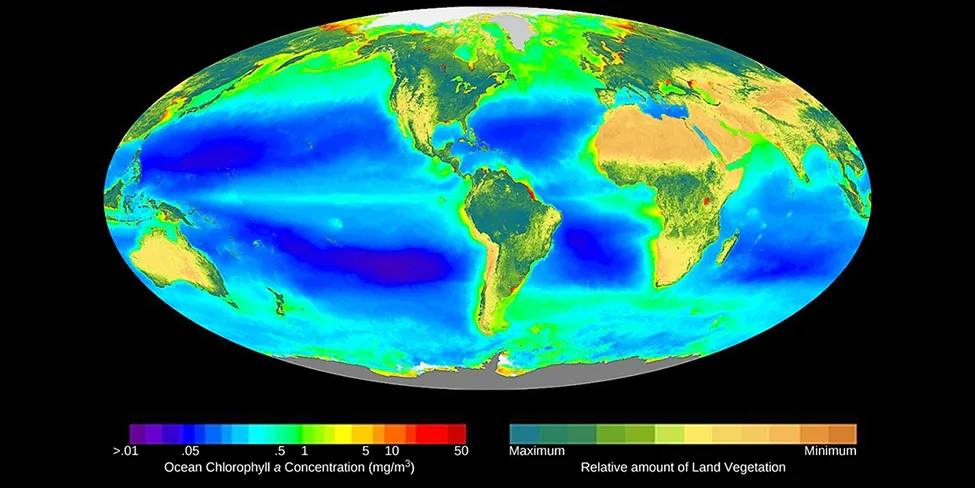
The ocean legend, labeled Ocean Chlorophyll a Concentration in mg/m3, runs from dark purple at .01 through blue, cyan, green, yellow, and orange to red at 50. The land legend, labeled Relative amount of Land Vegetation, runs from blue-green at Maximum through green and yellow to tan at Minimum.
The metabolic processes in all organisms—from bacteria to humans—require energy. To get this energy, many organisms access stored energy by eating, that is, by ingesting other organisms. But where does the stored energy in food originate? All of this energy can be traced back to photosynthesis.
Sections
- Overview of Photosynthesis — why photosynthesis matters to other living organisms, the main structures involved, and its substrates and products.
- The Light-Dependent Reactions of Photosynthesis — how plants absorb energy from sunlight, short and long wavelengths of light, and where within a plant photosynthesis takes place.
- Using Light Energy to Make Organic Molecules — the Calvin cycle, carbon fixation, and photosynthesis’s place in the energy cycle of all living things.
This chapter is adapted from Biology 2e, Chapter 8: Photosynthesis by Mary Ann Clark, Jung Choi, Matthew Douglas, and OpenStax, © OpenStax, licensed under CC BY-NC-SA 4.0. Access the original for free at openstax.org. Each section page records its own changes from the source. Changes: the chapter-opening satellite map is the source’s, re-encoded for the web with its credit kept in the caption, its alt text rewritten to describe the map’s layout and color coding rather than restate the caption, and its two color-scale legends transcribed into a longdesc; kept as a photo rather than a diagram because its black background is part of the original satellite composite, not a plate the dark theme would need to add.