Overview of Photosynthesis
By the end of this section, you will be able to:
- Explain the significance of photosynthesis to other living organisms
- Describe the main structures involved in photosynthesis
- Identify the substrates and products of photosynthesis
Photosynthesis is essential to almost all life on earth; both plants and animals depend on it. It is the only biological process that can capture energy that originates from sunlight and convert it into chemical compounds (carbohydrates) that every organism uses to power its metabolism. It is also a source of oxygen necessary for many living organisms. In brief, the energy of sunlight is “captured” to energize electrons, whose energy is then stored in the covalent bonds of sugar molecules. How long lasting and stable are those covalent bonds? The energy extracted today by the burning of coal and petroleum products represents sunlight energy captured and stored by photosynthesis 350 to 300 million years ago during the Carboniferous Period (Source note: the source says “350 to 200 million years ago”; the Carboniferous ran from about 359 to 299 million years ago (International Commission on Stratigraphy chart), so the span is trimmed to the period the sentence names.).
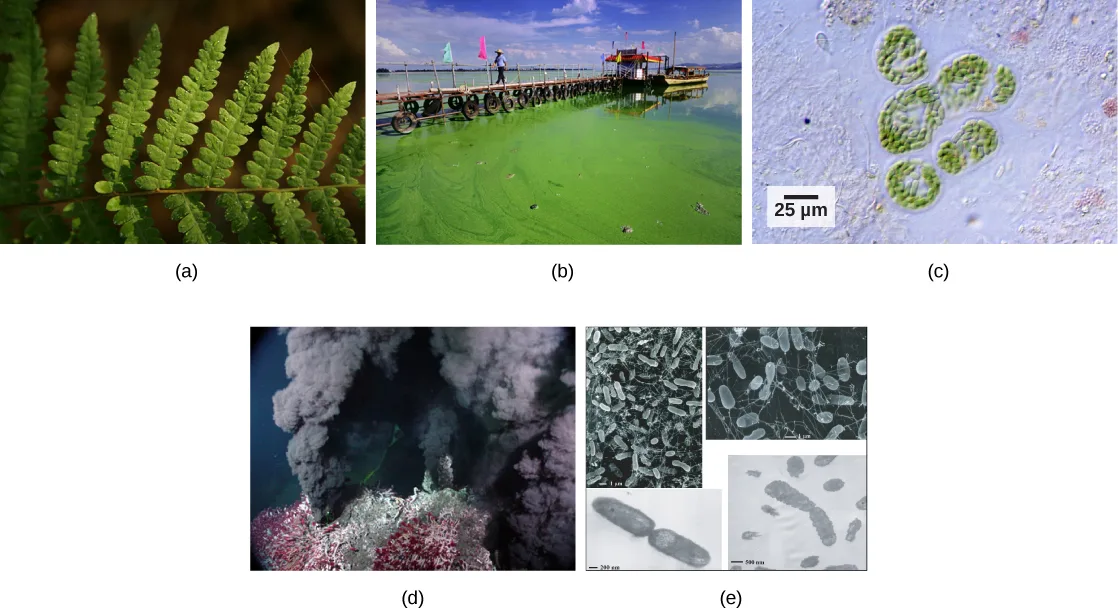
Plants, algae, and a group of bacteria called cyanobacteria are the only organisms capable of performing photosynthesis (below). Because they use light to manufacture their own food, they are called photoautotrophs (literally, “self-feeders using light”). Other organisms, such as animals, fungi, and most other bacteria, are termed heterotrophs (“other feeders”), because they must rely on the sugars produced by photosynthetic organisms for their energy needs. A third very interesting group of bacteria synthesize sugars, not by using sunlight’s energy, but by extracting energy from inorganic chemical compounds. For this reason, they are referred to as chemoautotrophs.
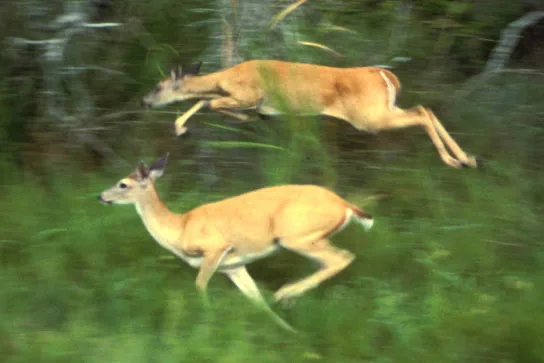
The importance of photosynthesis is not just that it can capture sunlight’s energy. After all, a lizard sunning itself on a cold day can use the sun’s energy to warm up in a process called behavioral thermoregulation. In contrast, photosynthesis is vital because it evolved as a way to store the energy from solar radiation (the “photo-” part) to energy in the carbon-carbon bonds of carbohydrate molecules (the “-synthesis” part). Those carbohydrates are the energy source that heterotrophs use to power the synthesis of ATP via respiration. Therefore, photosynthesis powers 99 percent of Earth’s ecosystems. When a top predator, such as a wolf, preys on a deer (below), the wolf is at the end of an energy path that went from nuclear reactions on the surface of the sun, to visible light, to photosynthesis, to vegetation, to deer, and finally to the wolf.
Main Structures and Summary of Photosynthesis
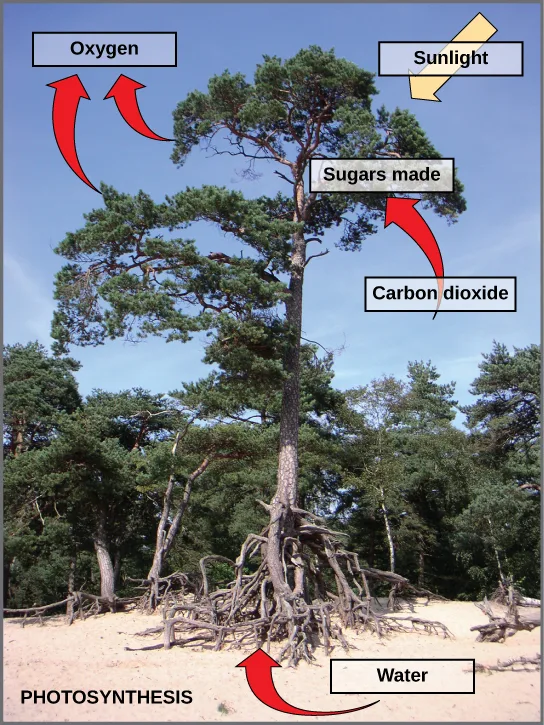
Photosynthesis is a multi-step process that requires specific wavelengths of visible sunlight, carbon dioxide (which is low in energy), and water as substrates (below). After the process is complete, it releases oxygen and produces glyceraldehyde-3-phosphate (G3P), as well as simple carbohydrate molecules (high in energy) that can then be converted into glucose, sucrose, or any of dozens of other sugar molecules. These sugar molecules contain energy and the energized carbon that all living things need to survive.
The following is the chemical equation for photosynthesis:
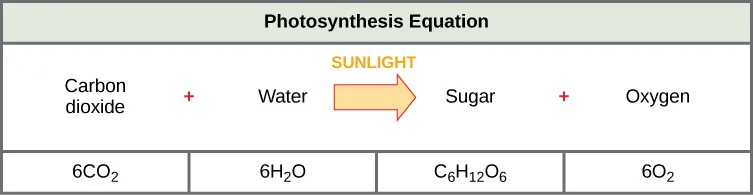
Carbon dioxide + water + sunlight → sugar + oxygen
6CO₂ + 6H₂O + sunlight → C₆H₁₂O₆ + 6O₂
Although the equation looks simple, the many steps that take place during photosynthesis are actually quite complex. Before learning the details of how photoautotrophs turn sunlight into food, it is important to become familiar with the structures involved.
Basic Photosynthetic Structures
In plants, photosynthesis generally takes place in leaves, which consist of several layers of cells. The process of photosynthesis occurs in a middle layer called the mesophyll. The gas exchange of carbon dioxide and oxygen occurs through small, regulated openings called stomata (singular: stoma), which also play roles in the regulation of gas exchange and water balance. The stomata are typically located on the underside of the leaf, which helps to minimize water loss due to high temperatures on the upper surface of the leaf. Each stoma is flanked by guard cells that regulate the opening and closing of the stomata by swelling or shrinking in response to osmotic changes.
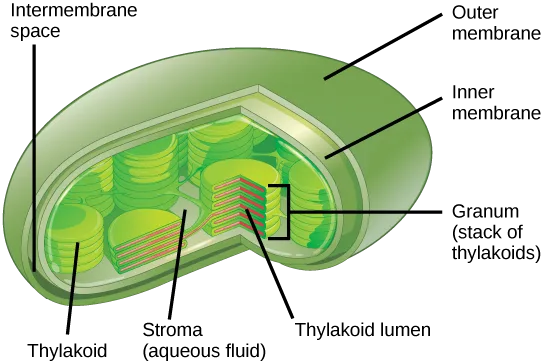
In all autotrophic eukaryotes, photosynthesis takes place inside an organelle called a chloroplast. For plants, chloroplast-containing cells exist mostly in the mesophyll. Chloroplasts have a double membrane envelope (composed of an outer membrane and an inner membrane), and are ancestrally derived from ancient free-living cyanobacteria. Within the chloroplast are stacked, disc-shaped structures called thylakoids. Embedded in the thylakoid membrane is chlorophyll, a pigment (molecule that absorbs light) responsible for the initial interaction between light and plant material, and numerous proteins that make up the electron transport chain. The thylakoid membrane encloses an internal space called the thylakoid lumen. As shown below, a stack of thylakoids is called a granum, and the liquid-filled space surrounding the granum is called stroma or “bed” (not to be confused with stoma or “mouth,” an opening on the leaf epidermis).
On a hot, dry day, the guard cells of plants close their stomata to conserve water. What impact will this have on photosynthesis?
Show model answer
Did your answer mention:
The Two Parts of Photosynthesis
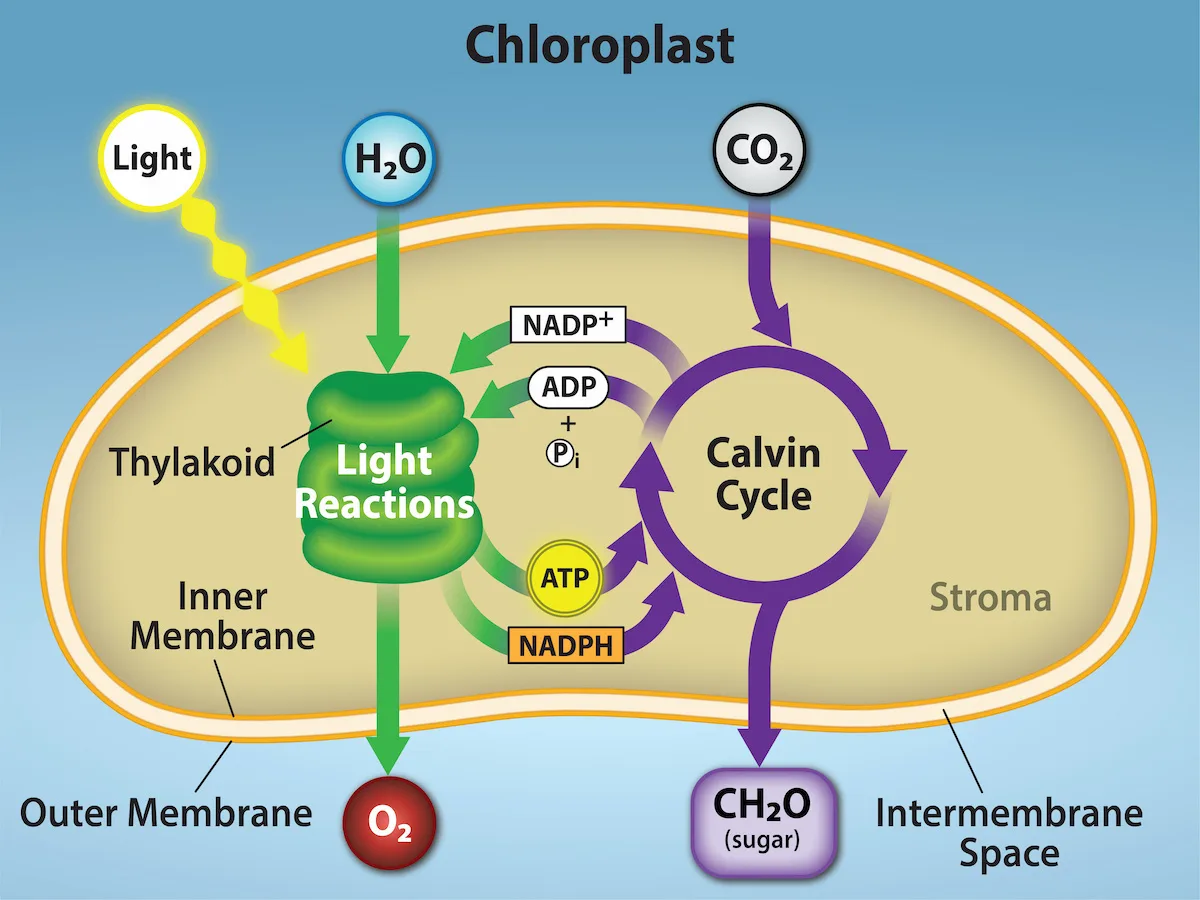
Photosynthesis takes place in two sequential stages: the light-dependent reactions and the light-independent reactions. In the light-dependent reactions, energy from sunlight is absorbed by chlorophyll and that energy is converted into stored chemical energy. In the light-independent reactions, the chemical energy harvested during the light-dependent reactions drives the assembly of sugar molecules from carbon dioxide. Therefore, although the light-independent reactions do not use light as a reactant, they require the products of the light-dependent reactions to function. In addition, however, several enzymes of the light-independent reactions are activated by light. The light-dependent reactions utilize certain molecules to temporarily store the energy: These are referred to as energy carriers. The energy carriers that move energy from light-dependent reactions to light-independent reactions can be thought of as “full” because they are rich in energy. After the energy is released, the “empty” energy carriers return to the light-dependent reaction to obtain more energy. Below illustrates the components inside the chloroplast where the light-dependent and light-independent reactions take place.
Extended description
Inside a chloroplast bounded by an outer membrane and an inner membrane: on the left, light and H₂O enter the thylakoid, where the light reactions (green box) use the light energy to split water, releasing O₂ downward and producing ATP and NADPH. Arrows carry the ATP and NADPH rightward into the Calvin cycle (a purple circular arrow occupying the stroma on the right), which also takes in CO₂ from outside the chloroplast. The Calvin cycle uses the ATP and NADPH to build CH₂O (sugar), released at the bottom, and returns the spent carriers — ADP plus inorganic phosphate (Pi), and NADP⁺ — back to the light reactions to be recharged, completing the cycle.
Everyday Connection. Photosynthesis at the Grocery Store.
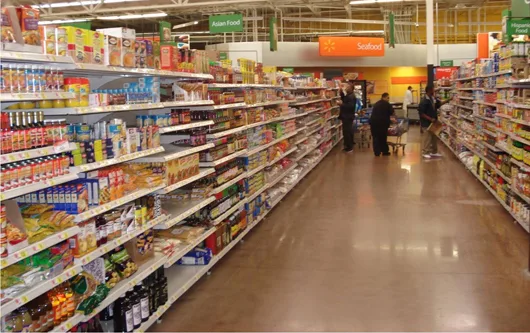
Major grocery stores in the United States are organized into departments, such as dairy, meats, produce, bread, cereals, and so forth. Each aisle (above) contains hundreds, if not thousands, of different products for customers to buy and consume.
Although there is a large variety, each item ultimately can be linked back to photosynthesis. Meats and dairy link, because the animals were fed plant-based foods. The breads, cereals, and pastas come largely from starchy grains, which are the seeds of photosynthesis-dependent plants. What about desserts and drinks? All of these products contain sugar—sucrose is a plant product, a disaccharide, a carbohydrate molecule, which is built directly from photosynthesis. Moreover, many items are less obviously derived from plants: For instance, paper goods are generally plant products, and many plastics (abundant as products and packaging) are derived from “algae” (unicellular plant-like organisms, and cyanobacteria). Virtually every spice and flavoring in the spice aisle was produced by a plant as a leaf, root, bark, flower, fruit, or stem. Ultimately, photosynthesis connects to every meal and every food a person consumes.
Summary
The process of photosynthesis transformed life on Earth. By harnessing energy from the sun, the evolution of photosynthesis allowed living things access to enormous amounts of energy. Because of photosynthesis, living things gained access to sufficient energy that allowed them to build new structures and achieve the biodiversity evident today.
Only certain organisms (photoautotrophs), can perform photosynthesis; they require the presence of chlorophyll, a specialized pigment that absorbs certain wavelengths of the visible spectrum and can capture energy from sunlight. Photosynthesis uses carbon dioxide and water to assemble carbohydrate molecules and release oxygen as a byproduct into the atmosphere. Eukaryotic autotrophs, such as plants and algae, have organelles called chloroplasts in which photosynthesis takes place, and starch accumulates. In prokaryotes, such as cyanobacteria, the process is less localized and occurs within folded membranes, extensions of the plasma membrane, and in the cytoplasm.
Key terms
- chemoautotroph — organism that can build organic molecules using energy derived from inorganic chemicals instead of sunlight
- chloroplast — organelle in which photosynthesis takes place
- granum — stack of thylakoids located inside a chloroplast
- heterotroph — organism that consumes organic substances or other organisms for food
- light-dependent reaction — first stage of photosynthesis where certain wavelengths of the visible light are absorbed to form two energy-carrying molecules (ATP and NADPH)
- light-independent reaction — second stage of photosynthesis, through which carbon dioxide is used to build carbohydrate molecules using energy from ATP and NADPH
- mesophyll — middle layer of chlorophyll-rich cells in a leaf
- photoautotroph — organism capable of producing its own organic compounds from sunlight
- pigment — molecule that is capable of absorbing certain wavelengths of light and reflecting others (which accounts for its color)
- stoma — opening that regulates gas exchange and water evaporation between leaves and the environment, typically situated on the underside of leaves
- stroma — fluid-filled space surrounding the grana inside a chloroplast where the light-independent reactions of photosynthesis take place
- thylakoid — disc-shaped, membrane-bound structure inside a chloroplast where the light-dependent reactions of photosynthesis take place; stacks of thylakoids are called grana
- thylakoid lumen — aqueous space bound by a thylakoid membrane where protons accumulate during light-driven electron transport
Practice
Explain the significance of photosynthesis to other living organisms
Why are carnivores, such as lions, dependent on photosynthesis to survive?
Show model answer
Did your answer mention:
Describe how the grey wolf population would be impacted by a volcanic eruption that spewed a dense ash cloud that blocked sunlight in a section of Yellowstone National Park.
Show model answer
Did your answer mention:
An organism that consumes organic substances or other organisms for food, because it cannot make its own, is called a ________.
Animals, fungi, and most other bacteria fall into this category, in contrast to organisms that make their own food using sunlight.Describe the main structures involved in photosynthesis
Which of the following components is not used by both plants and cyanobacteria to carry out photosynthesis?
Cyanobacteria are prokaryotes and have no membrane-bound organelles.In which compartment of the plant cell do the light-independent reactions of photosynthesis take place?
This is the liquid-filled space surrounding the grana, not the stacked membranes themselves.Which statement about thylakoids in eukaryotes is not correct?
Eukaryotic thylakoids are stacked into grana; a maze of folded membranes describes how prokaryotes like cyanobacteria arrange their photosynthetic membranes instead.Identify the substrates and products of photosynthesis
What two main products result from photosynthesis?
One product is released as a gas; the other stores the captured energy in carbon-carbon bonds.Predict the end result if a chloroplast’s light-independent enzymes developed a mutation that prevented them from activating in response to light.
Ask which molecules the light-independent reactions normally consume, and what happens to them if that consumption stops.How are the NADPH and G3P molecules made during photosynthesis similar?
One is a product of the light-dependent reactions and the other of the light-independent reactions, but both hold onto energy the same way.What is the overall outcome of the light reactions in photosynthesis?
Show model answer
Did your answer mention:
Why are energy carriers thought of as either ‘full’ or ’empty’?
Show model answer
Did your answer mention:
How does the closing of the stomata limit photosynthesis?
Show model answer
Did your answer mention:
This section is adapted from Biology 2e, Section 8.1: Overview of Photosynthesis by Mary Ann Clark, Jung Choi, Matthew Douglas, and OpenStax, © OpenStax, licensed under CC BY-NC-SA 4.0. Access the original for free at openstax.org. Changes: figures re-encoded as WebP, with three of the seven re-kinded from the manifest’s file-extension guess of “photo” to “diagram” after inspection (the labeled tree diagram, the photosynthesis-equation graphic, and the light-reactions/Calvin-cycle chloroplast illustration all carry their teaching in overlaid labels and arrows rather than as documentary photography), and the labeled tree diagram’s alt rewritten from the image to give each arrow’s direction (sunlight, water, and carbon dioxide into the tree; oxygen and sugars out); a longer extended description added for the light-reactions/Calvin-cycle chloroplast diagram, whose full arrow-and-label reading is not carried by its caption; the composite photoautotroph/chemoautotroph figure’s alt normalized to consistent lowercase panel letters (the source alternated “Photo D” and “Micrograph E” with the rest lowercase); the grocery-store aisle photo’s alt expanded from the source’s bare “A photo shows people shopping in a grocery store” to name the aisle and shelves it shows; the photosynthesis-equation figure additionally transcribed as two Unicode-text chemical equations (the word form and the balanced numeric form) immediately after it, since a display chemical equation is not KaTeX math here; inline references to figures changed from the source’s print numbers to “below”/“above” since figures are not numbered here; feature boxes (one Link to Learning note and one Everyday Connection) rendered as callouts with their bold names; the Visual Connection question kept in the body immediately after its figure and rendered as a self-check, since the source keys it with a prose solution rather than a lettered option; the end-of-section Review Questions and Critical Thinking Questions adapted into the closing interactive Practice block (multiple choice and self-check respectively), with the “lions” critical-thinking answer turned into a complete sentence; and one key-term recall item (heterotroph) added from the glossary to give its objective group an auto-graded item; and rubric checkpoints added to each self-check, decomposing its model answer (the source solution) into check-off clauses with no new claims. One claim is corrected with a visible Source note: the Carboniferous span reads 350 to 300 million years ago rather than 350 to 200 (erratum 391).