Using Light Energy to Make Organic Molecules
By the end of this section, you will be able to:
- Describe the Calvin cycle
- Define carbon fixation
- Explain how photosynthesis works in the energy cycle of all living organisms
After the energy from the sun is converted into chemical energy and temporarily stored in ATP and NADPH molecules, the cell has the fuel needed to build carbohydrate molecules for long-term energy storage. The products of the light-dependent reactions, ATP and NADPH, have lifespans in the range of millionths of seconds, whereas the products of the light-independent reactions (carbohydrates and other forms of reduced carbon) can survive almost indefinitely. The carbohydrate molecules made will have a backbone of carbon atoms. But where does the carbon come from? It comes from carbon dioxide—the gas that is a waste product of respiration in microbes, fungi, plants, and animals.
The Calvin Cycle
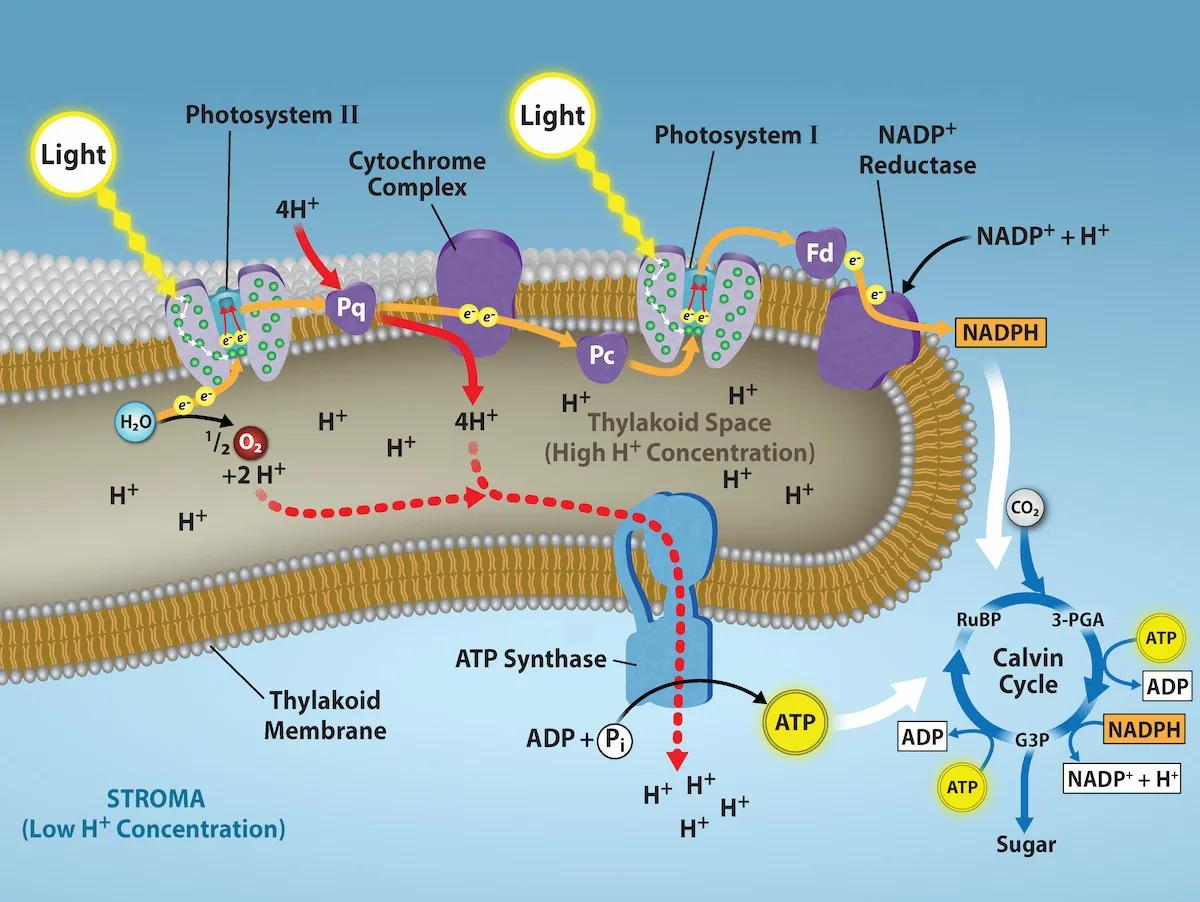
In plants, carbon dioxide (CO₂) enters the leaves through stomata, where it diffuses over short distances through intercellular spaces until it reaches the mesophyll cells. Once in the mesophyll cells, CO₂ diffuses into the stroma of the chloroplast—the site of light-independent reactions of photosynthesis. These reactions actually have several names associated with them. Another term, the Calvin cycle, is named for the man who discovered it, and because these reactions function as a cycle. Others call it the Calvin-Benson cycle to include the name of another scientist involved in its discovery. The most outdated name is “dark reaction,” because light is not directly required (below). However, the term dark reaction can be misleading because it implies incorrectly that the reaction only occurs at night or is independent of light, which is why most scientists and instructors no longer use it.
Extended description
Light strikes Photosystem II (left) and Photosystem I (right of center), embedded in the thylakoid membrane. At Photosystem II, water splits into oxygen, hydrogen ions, and electrons; the electrons pass through the carrier Pq to the Cytochrome Complex, which pumps four hydrogen ions into the thylakoid space, then on through the carrier Pc to Photosystem I. There, light re-energizes the electrons, which pass through Fd to NADP+ Reductase, combining with NADP+ and a hydrogen ion to form NADPH. Hydrogen ions accumulate in the thylakoid space, labeled High H+ Concentration, while the stroma below is labeled Low H+ Concentration; the ions flow back through ATP Synthase into the stroma, converting ADP and inorganic phosphate into ATP. At right, the ATP and NADPH feed into the Calvin Cycle, shown as a circle with RuBP, 3-PGA, ADP, NADPH, NADP+, G3P, and ATP labeled around it, with CO₂ entering and Sugar leaving.
The light-independent reactions of the Calvin cycle can be organized into three basic stages: fixation, reduction, and regeneration.
Stage 1: Fixation
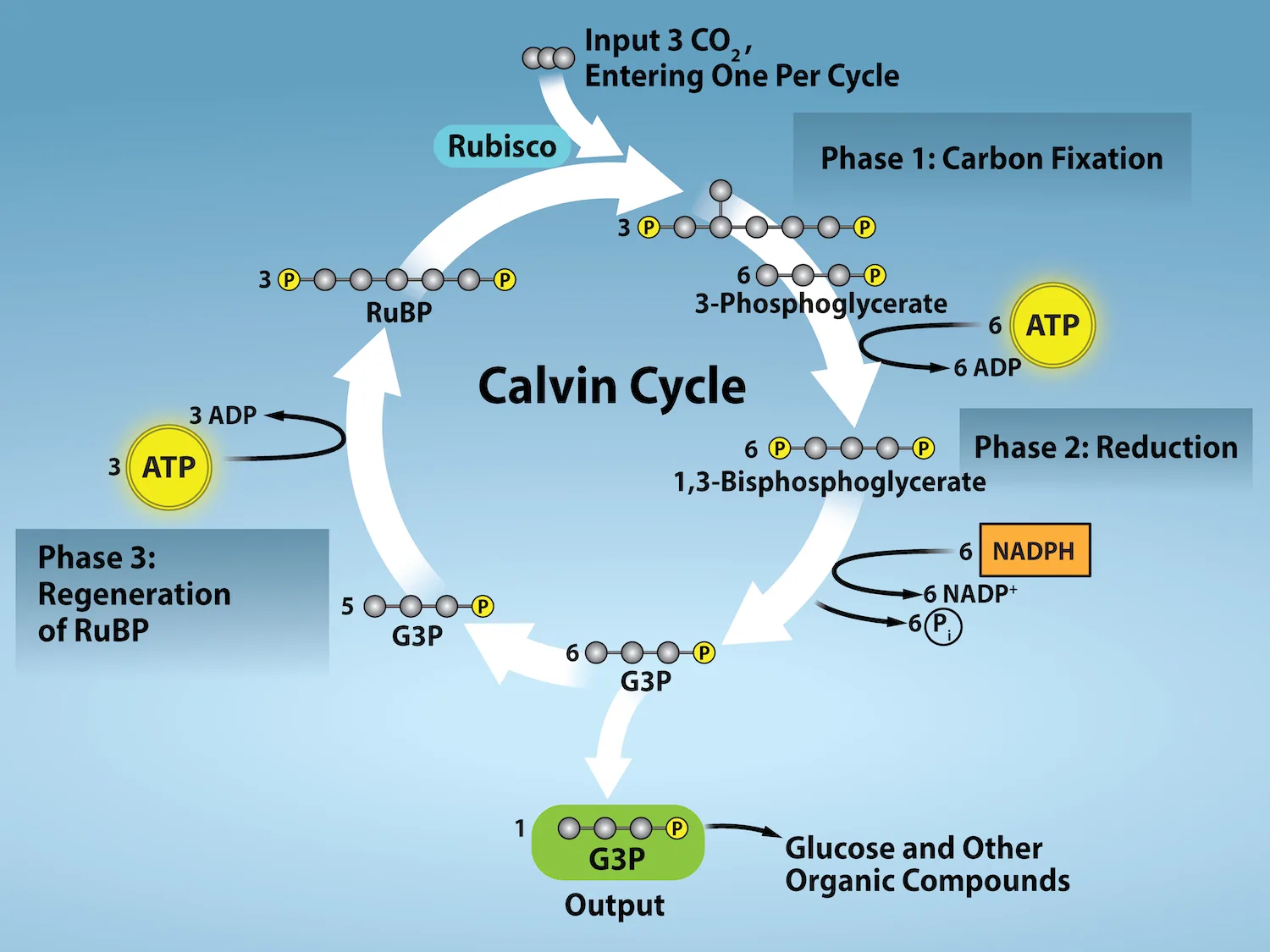
In the stroma, in addition to CO₂, two other components are present to initiate the light-independent reactions: an enzyme called ribulose-1,5-bisphosphate carboxylase/oxygenase (RuBisCO), and three molecules of ribulose bisphosphate (RuBP), as shown below. RuBP has five atoms of carbon, flanked by two phosphates.
Extended description
Three CO₂ molecules enter at the top, one per turn of the cycle. Phase 1, Carbon Fixation: the enzyme RuBisCO combines each CO₂ with a RuBP molecule, producing six molecules of 3-phosphoglycerate. Phase 2, Reduction: six ATP convert the six 3-phosphoglycerate molecules into six 1,3-bisphosphoglycerate molecules, releasing six ADP; six NADPH then reduce these into six G3P molecules, releasing six NADP+ and six inorganic phosphate groups. Phase 3, Regeneration of RuBP: one of the six G3P molecules exits the cycle as output, going on to form glucose and other organic compounds, while the remaining five G3P molecules are rearranged, using three ATP, to regenerate three RuBP molecules and restart the cycle.
Which of the following statements is true?
Overall photosynthesis combines both the light-dependent reactions and the Calvin cycle — track what enters and leaves the whole process, not just one stage of it.RuBisCO catalyzes a reaction between CO₂ and RuBP. For each CO₂ molecule that reacts with one RuBP, two molecules of another compound 3-phospho glyceric acid (3-PGA) form. PGA has three carbons and one phosphate. Each turn of the cycle involves only one RuBP and one carbon dioxide and forms two molecules of 3-PGA. The number of carbon atoms remains the same, as the atoms move to form new bonds during the reactions (3 C atoms from 3CO₂ + 15 C atoms from 3RuBP = 18 C atoms in 6 molecules of 3-PGA). This process is called carbon fixation, because CO₂ is “fixed” from an inorganic form into organic molecules.
Stage 2: Reduction
ATP and NADPH are used to convert the six molecules of 3-PGA into six molecules of a chemical called glyceraldehyde 3-phosphate (G3P). That is a reduction reaction because it involves the gain of electrons by 3-PGA. (Recall that a reduction is the gain of an electron by an atom or molecule.) Six molecules of both ATP and NADPH are used. For ATP, energy is released with the loss of the terminal phosphate atom, converting it into ADP; for NADPH, both energy and a hydrogen atom are lost, converting it into NADP⁺. Both of these molecules return to the nearby light-dependent reactions to be reused and re-energized.
Stage 3: Regeneration
Interestingly, at this point, only one of the G3P molecules leaves the Calvin cycle and is sent to the cytoplasm to contribute to the formation of other compounds needed by the plant. Because the G3P exported from the chloroplast has three carbon atoms, it takes three “turns” of the Calvin cycle to fix enough net carbon to export one G3P. But each turn makes two G3Ps, thus three turns make six G3Ps. One is exported while the remaining five G3P molecules remain in the cycle and are used to regenerate RuBP, which enables the system to prepare for more CO₂ to be fixed. Three more molecules of ATP are used in these regeneration reactions.
Evolution Connection. Photosynthesis. During the evolution of photosynthesis, a major shift occurred from the bacterial type of photosynthesis that involves only one photosystem and is typically anoxygenic (does not generate oxygen) into modern oxygenic (does generate oxygen) photosynthesis, employing two photosystems. This modern oxygenic photosynthesis is used by many organisms—from giant tropical leaves in the rainforest to tiny cyanobacterial cells—and the process and components of this photosynthesis remain largely the same. Photosystems absorb light and use electron transport chains to convert energy into the chemical energy of ATP and NADPH. (Source note: the source says NADH here; the rest of this chapter, including this section’s opening paragraph, names NADPH as the reduced carrier the light reactions make.) The subsequent light-independent reactions then assemble carbohydrate molecules with this energy.
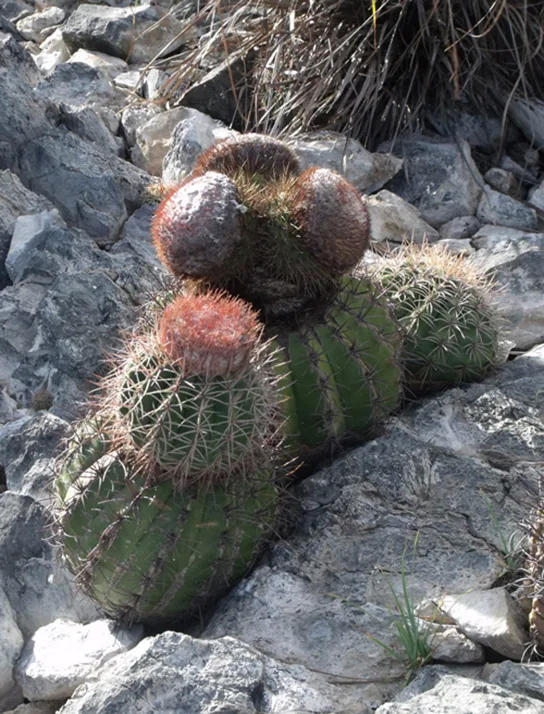
In the harsh dry heat of the desert, plants must conserve and use every drop of water to survive. Because stomata must open to allow for the uptake of CO₂, water escapes from the leaf during active photosynthesis. Desert plants have evolved processes to conserve water and deal with harsh conditions. Mechanisms to capture and store CO₂ allows plants to adapt to living with less water. Some plants such as cacti (below) can prepare materials for photosynthesis during the night by a temporary carbon fixation/storage process, because opening the stomata at this time conserves water due to cooler temperatures. During the day cacti use the captured CO₂ for photosynthesis, and keep their stomata closed.
The Energy Flow
Whether the organism is a bacterium, plant, or animal, all living things access energy by breaking down carbohydrate and other carbon-rich organic molecules. But if plants make carbohydrate molecules, why would they need to break them down, especially when it has been shown that the gas organisms release as a “waste product” (CO₂) acts as a substrate for the formation of more food in photosynthesis? Remember, living things need energy to perform life functions. In addition, an organism can either make its own food or eat another organism—either way, the food still needs to be broken down. Finally, in the process of breaking down food, called cellular respiration, heterotrophs release needed energy and produce “waste” in the form of CO₂ gas.
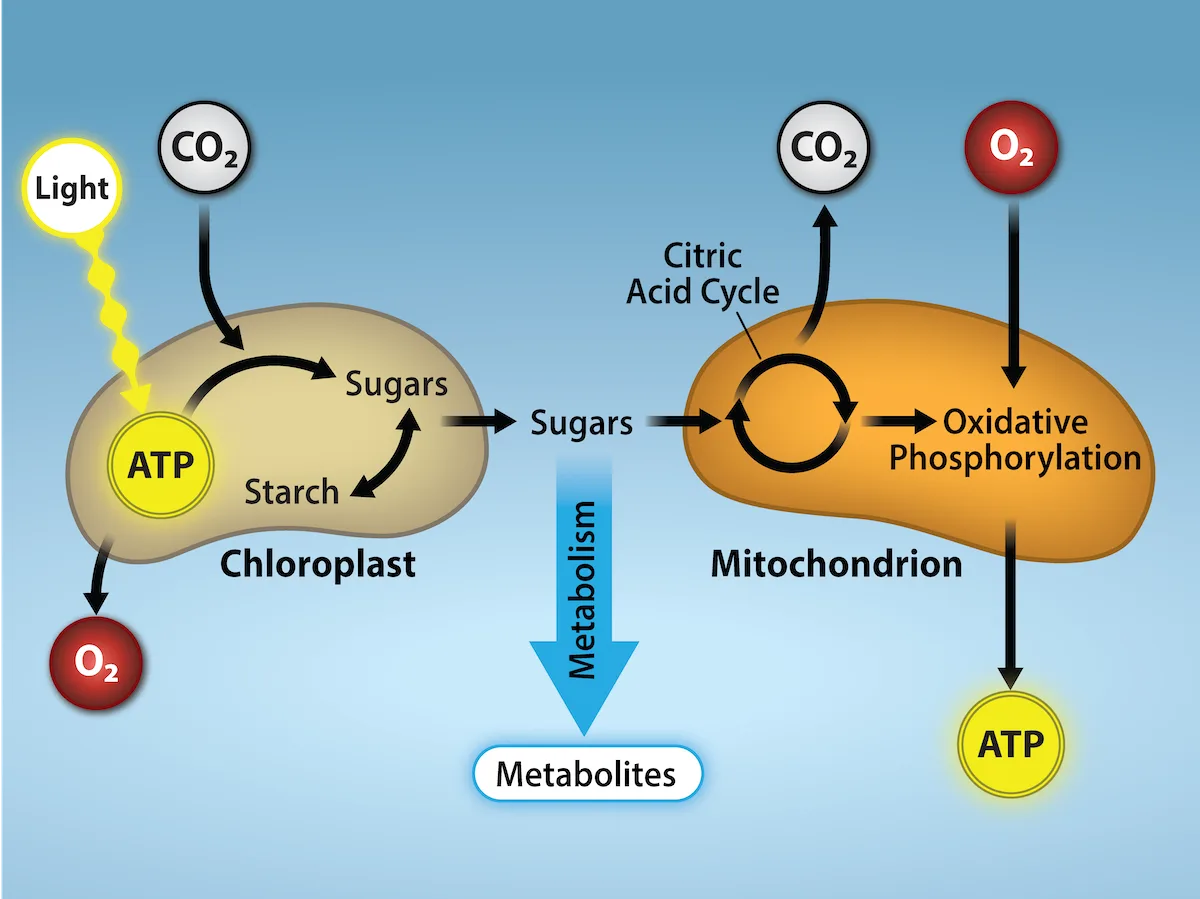
However, in nature, there is no such thing as “waste.” Every single atom of matter and energy is conserved, recycled over and over infinitely. Substances change form or move from one type of molecule to another, but their constituent atoms never disappear (below).
In reality, CO₂ is no more a form of waste than oxygen is wasteful to photosynthesis. Both are byproducts of reactions that move on to other reactions. Photosynthesis absorbs light energy to build carbohydrates in chloroplasts, and aerobic cellular respiration releases energy by using oxygen to metabolize carbohydrates in the cytoplasm and mitochondria. Both processes use electron transport chains to capture the energy necessary to drive other reactions. These two powerhouse processes, photosynthesis and cellular respiration, function in biological, cyclical harmony to allow organisms to access life-sustaining energy that originates millions of miles away in a burning star humans call the sun.
Extended description
A chloroplast on the left and a mitochondrion on the right, joined by a downward arrow labeled Metabolism leading to a box labeled Metabolites. Into the chloroplast: an arrow labeled Light and an arrow labeled CO₂. Inside the chloroplast, ATP drives a cycle that produces Sugars and Starch. Out of the chloroplast: an arrow labeled O₂ and an arrow carrying Sugars across to the mitochondrion. Inside the mitochondrion, the Sugars enter a Citric Acid Cycle that feeds Oxidative Phosphorylation. Into the mitochondrion: an arrow labeled O₂. Out of the mitochondrion: an arrow labeled CO₂ and an arrow labeled ATP.
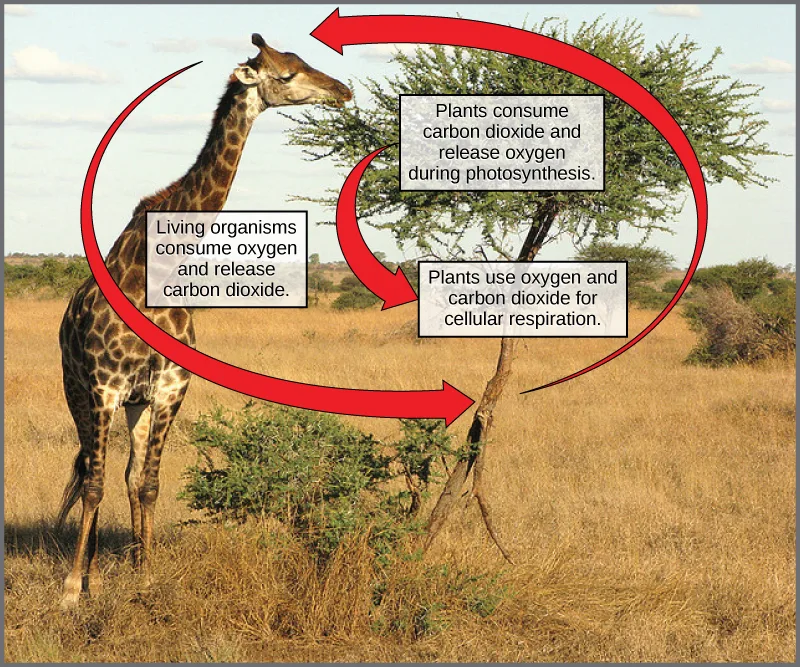
Extended description
Three text boxes are arranged around the looping red arrow: near the giraffe, ‘Living organisms consume oxygen and release carbon dioxide’; near the tree’s canopy, ‘Plants consume carbon dioxide and release oxygen during photosynthesis’; and near the tree’s base, ‘Plants use oxygen and carbon dioxide for cellular respiration.’ The arrow loops from the giraffe up and over to the tree and back again, illustrating the cycle between them.
Summary
Using the energy carriers formed in the first steps of photosynthesis, the light-independent reactions, or the Calvin cycle, take in CO₂ from the atmosphere. An enzyme, RuBisCO, catalyzes a reaction with CO₂ and another organic compound, RuBP. After three cycles, a three-carbon molecule of G3P leaves the cycle to become part of a carbohydrate molecule. The remaining G3P molecules stay in the cycle to be regenerated into RuBP, which is then ready to react with more CO₂. Photosynthesis forms an energy cycle with the process of cellular respiration. Because plants contain both chloroplasts and mitochondria, they rely upon both photosynthesis and respiration for their ability to function in both the light and dark, and to be able to interconvert essential metabolites.
Key terms
- Calvin cycle — light-independent reactions of photosynthesis that convert carbon dioxide from the atmosphere into carbohydrates using the energy and reducing power of ATP and NADPH
- carbon fixation — process of converting inorganic CO₂ gas into organic compounds
- reduction — gain of electron(s) by an atom or molecule
Practice
Describe the Calvin cycle
Which molecule must enter the Calvin cycle continually for the light-independent reactions to take place?
RuBisCO and RuBP are recycled within the cycle; only this molecule must keep arriving from outside it.Which order of molecular conversions is correct for the Calvin cycle?
Start with the two molecules that combine in the fixation stage, and track which name is the catalyzing enzyme rather than a molecule being converted.Where in eukaryotic cells does the Calvin cycle take place?
This is the fluid space surrounding the thylakoids, not a compartment inside them.Why is the third stage of the Calvin cycle called the regeneration stage?
Show model answer
Did your answer mention:
The light-independent reactions of photosynthesis that convert carbon dioxide from the atmosphere into carbohydrates using the energy and reducing power of ATP and NADPH are known as the ________.
Its outdated name is the “dark reaction,” and it is named for the scientist who traced the path of carbon through it.The gain of one or more electrons by an atom or molecule is called ________.
The opposite process — the loss of an electron — is oxidation.Define carbon fixation
Which statement correctly describes carbon fixation?
Match this to the general definition of the term itself, not to a specific enzyme’s role or a later stage of the cycle.If four molecules of carbon dioxide enter the Calvin cycle (four “turns” of the cycle), how many G3P molecules are produced and how many are exported?
Each turn of the cycle fixes one CO₂ and makes two G3P; only a complete three-turn set exports one net G3P.Which part of the light-independent reactions would be affected if a cell could not produce the enzyme RuBisCO?
Show model answer
Did your answer mention:
Why does it take three turns of the Calvin cycle to produce G3P, the initial product of photosynthesis?
Show model answer
Did your answer mention:
The process of converting inorganic CO₂ gas into organic compounds is called ________.
RuBisCO catalyzes the first step of this process, combining the gas with RuBP.Explain how photosynthesis works in the energy cycle of all living organisms
Imagine a sealed terrarium containing a plant and a beetle. How does each organism provide resources for the other? Could each organism survive if it was the only living thing in the terrarium? Why or why not?
Show model answer
An energy cycle between the plant and the beetle would work as follows: the plant consumes carbon dioxide and releases oxygen as a byproduct of photosynthesis; the beetle consumes oxygen and releases carbon dioxide to create chemical energy during aerobic respiration; the plant takes up that carbon dioxide from the air; and the cycle repeats. The plant would also provide a carbon-based food source for the beetle.
The beetle is a heterotroph and would not survive without the plant, because it would deplete all the oxygen within the terrarium. The plant is an autotroph and could survive without the beetle, but it would be unlikely to grow: through photosynthesis the plant can make and store its own energy in carbon-based molecules and produce oxygen, and that oxygen can then be used to power aerobic respiration in the plant, which releases carbon dioxide. However, since the plant would essentially be reusing its own resources by cycling between carbon- and oxygen-consuming pathways, its growth would be limited.
Did your answer mention:
Compare the flow of energy with the flow of nutrients in a closed, sunny ecosystem consisting of a giraffe and a tree.
Show model answer
In the defined ecosystem, energy would radiate from the Sun and be absorbed by the chlorophyll in the leaves of the tree. Photosynthesis would occur in the leaves, transforming the light energy into stored chemical energy in the covalent bonds of carbon molecules. The giraffe would eat the leaves of the tree and digest the carbon molecules to release energy.
In the same ecosystem, nutrients would cycle between the tree and the giraffe. The giraffe would consume oxygen and release carbon dioxide as its cells perform aerobic respiration to create chemical energy. The tree would consume the released carbon dioxide during photosynthesis to create its own stored chemical energy, and release oxygen as a by-product.
Did your answer mention:
Which gas does aerobic respiration consume that photosynthesis produces as a byproduct?
Photosynthesis releases this gas when it splits water in the light reactions; respiration then uses it to extract energy from sugars.This section is adapted from Biology 2e, Section 8.3: Using Light Energy to Make Organic Molecules by Mary Ann Clark, Jung Choi, Matthew Douglas, and OpenStax, © OpenStax, licensed under CC BY-NC-SA 4.0. Access the original for free at openstax.org. Changes: figures re-encoded as WebP, with the first figure (the light-reactions membrane diagram) re-kinded from the manifest’s file-extension guess of “photo” to “diagram” after inspection, since it is a drawn illustration, not a photograph; a clean alt and a longdesc written for that figure and for the Calvin-cycle stage diagram, replacing the source alt’s garbled letter-by-letter spelling of the labels (“upper case R lower case u…”) with a description of what the image shows and a longdesc walking its three phases and quantities; a longdesc also added for the photosynthesis/respiration organelle diagram and for the giraffe/tree photo’s three overlaid text boxes, none of which is fully carried by its caption; feature boxes (one Link to Learning, one Evolution Connection) rendered as callouts with their bold names; the note.visual-connection kept in the body immediately after its figure and rendered as a multiplechoice, since the source keys it with a lettered option, and not duplicated in the identical Visual Connection Questions exercise; the five Review Questions and five Critical Thinking Questions adapted into the closing interactive Practice block (multiple choice and self-check respectively), with the Critical Thinking terrarium answer’s telegraphic list reformatted into complete sentences; the chemical-equation multiple-choice options rendered as Unicode text with arrows rather than KaTeX, since they are reaction sequences, not mathematics; the “Explain how photosynthesis works in the energy cycle” objective group’s auto-graded item is a locally authored multiple choice drawn strictly from the page’s own Energy Flow prose, since the two source Critical Thinking items for that objective are both free-response; and three key-term recall items (Calvin cycle, carbon fixation, reduction) added from the glossary to round out every objective group with an auto-graded item; in the review question on carbon fixation, the source’s option “the use of RuBisCO to form 3-PGA” — which the section’s own prose also calls carbon fixation, so the printed item had two correct answers — is changed to “the use of RuBisCO to form G3P”, which the section rules out (RuBisCO forms 3-PGA; G3P is made in the reduction stage); and rubric checkpoints added to each self-check, decomposing its model answer (the source solution) into check-off clauses with no new claims. One claim is corrected with a visible Source note: the Evolution Connection’s light-reaction product reads NADPH, as everywhere else in the chapter, not NADH (erratum 394).