Cell Reproduction
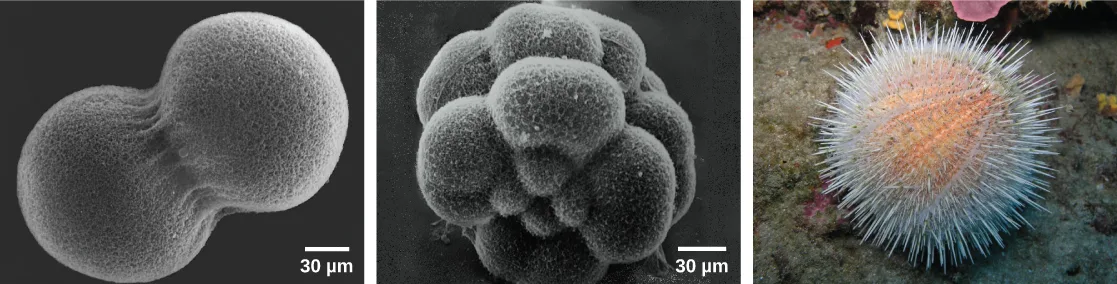
A human, like every sexually reproducing organism, begins life as a fertilized egg (embryo) or zygote. In our species, billions of cell divisions subsequently must occur in a controlled manner in order to produce a complex, multicellular human comprising trillions of cells. Thus, the original single-celled zygote is literally the ancestor of all cells in the body. However, once a human is fully grown, cell reproduction is still necessary to repair and regenerate tissues, and sometimes to increase our size! In fact, all multicellular organisms use cell division for growth and the maintenance and repair of cells and tissues. Cell division is closely regulated, and the occasional failure of this regulation can have life-threatening consequences. Single-celled organisms may also use cell division as their method of reproduction.
Sections
- Cell Division — the structure of prokaryotic and eukaryotic genomes, how chromosomes, genes, and traits differ, and how chromosomes compact.
- The Cell Cycle — the three stages of interphase, how chromosomes behave during mitosis, how cytokinesis divides the cytoplasm, and the quiescent G0 phase.
- Control of the Cell Cycle — how internal and external mechanisms control the cell cycle, its three internal checkpoints, and the molecules that regulate it.
- Cancer and the Cell Cycle — how uncontrolled cell growth causes cancer, how mutated proto-oncogenes become oncogenes, and how tumor suppressors function and fail.
- Prokaryotic Cell Division — the process of binary fission in prokaryotes and how FtsZ and tubulin are homologous proteins.
This chapter is adapted from Biology 2e, Chapter 10: Cell Reproduction by Mary Ann Clark, Jung Choi, Matthew Douglas, and OpenStax, © OpenStax, licensed under CC BY-NC-SA 4.0. Access the original for free at openstax.org. Each section page records its own changes from the source. Changes: the chapter-opening micrograph triptych is the source’s, re-encoded for the web with its credit kept in the caption; its alt text is the source’s own description, lightly retouched, since it already names what each panel shows without repeating the caption’s identification.