Meiosis and Sexual Reproduction
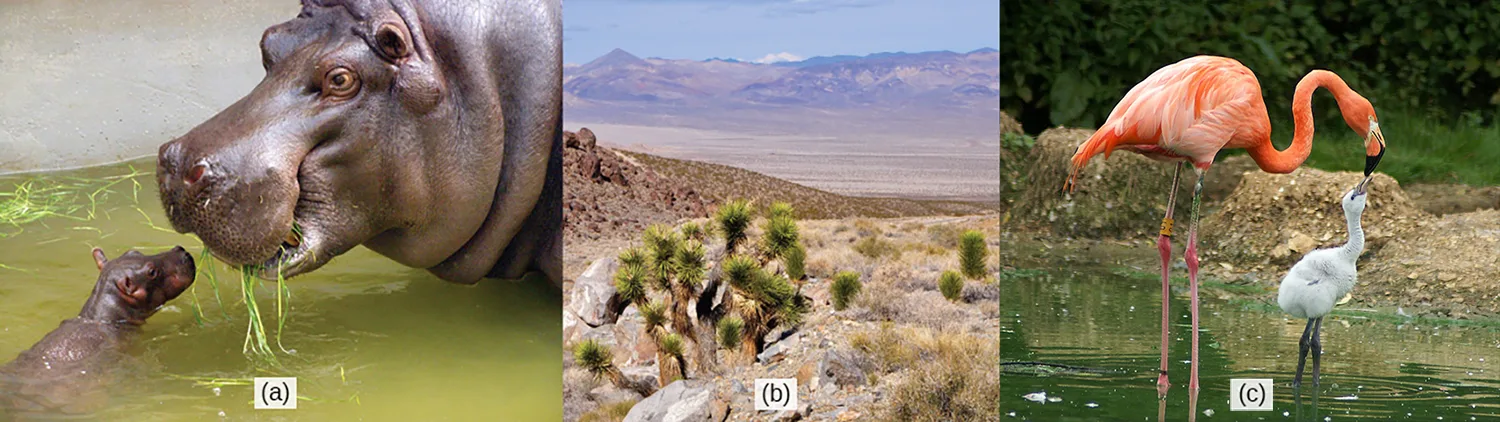
The ability to reproduce is a basic characteristic of all organisms: Hippopotamuses give birth to hippopotamus calves; Joshua trees produce seeds from which Joshua tree seedlings emerge; and adult flamingos lay eggs that hatch into flamingo chicks. However, unlike the organisms shown above, offspring may or may not resemble their parents. For example, in the case of most insects such as butterflies (with a complete metamorphosis), the larval forms rarely resemble the adult forms.
Although many unicellular organisms and a few multicellular organisms can produce genetically identical clones of themselves through asexual reproduction, many single-celled organisms and most multicellular organisms reproduce regularly using another method—sexual reproduction. This highly evolved method involves the production by parents of two haploid cells and the fusion of two haploid cells to form a single, genetically recombined diploid cell—a genetically unique organism. In almost all sexually reproducing species, these two haploid cells differ in size, with the smaller cell called “male” and the larger one called “female." These haploid cells are produced by a type of cell division called meiosis. Sexual reproduction, involving both meiosis and fertilization, introduces variation into offspring that may account for the evolutionary success of sexual reproduction. The vast majority of eukaryotic organisms, both multicellular and unicellular, can or must employ some form of meiosis and fertilization to reproduce.
In most plants and animals the zygote formed by fertilization, through thousands of rounds of mitotic cell division, will develop into an adult organism.
Sections
- The Process of Meiosis — how chromosome behavior differs between meiosis I and meiosis II and between meiosis and mitosis, the cellular events of meiosis, and the mechanisms that produce genetic variation among haploid gametes.
- Sexual Reproduction — why meiosis and sexual reproduction are highly evolved traits, how variation among offspring is a potential evolutionary advantage of sexual reproduction, and the three life-cycle types among sexually reproducing multicellular organisms.
This chapter is adapted from Biology 2e, Chapter 11: Meiosis and Sexual Reproduction by Mary Ann Clark, Jung Choi, Matthew Douglas, and OpenStax, © OpenStax, licensed under CC BY-NC-SA 4.0. Access the original for free at openstax.org. Each section page records its own changes from the source. Changes: the chapter-opening triptych is the source’s own chapter 7 splash image, reused by the source for this chapter’s opener and re-encoded for the web with its credit kept in the caption; its alt text is the source’s own description, kept as written since it already names what each panel shows without repeating the caption’s identification.