Sexual Reproduction
By the end of this section, you will be able to:
- Explain that meiosis and sexual reproduction are highly evolved traits
- Identify variation among offspring as a potential evolutionary advantage of sexual reproduction
- Describe the three different life-cycle types among sexually reproducing multicellular organisms.
Sexual reproduction was likely an early evolutionary innovation after the appearance of eukaryotic cells. It appears to have been very successful because most eukaryotes are able to reproduce sexually and, in many animals, it is the only mode of reproduction. And yet, scientists also recognize some real disadvantages to sexual reproduction. On the surface, creating offspring that are genetic clones of the parent appears to be a better system. If the parent organism is successfully occupying a habitat, offspring with the same traits should be similarly successful. There is also the obvious benefit to an organism that can produce offspring whenever circumstances are favorable by asexual budding, fragmentation, or by producing eggs asexually. These methods of reproduction do not require a partner with which to reproduce. Indeed, some organisms that lead a solitary lifestyle have retained the ability to reproduce asexually. In addition, in asexual populations, every individual is capable of reproduction. In sexual populations, the males are not producing the offspring themselves, so hypothetically an asexual population could grow twice as fast.
However, multicellular organisms that exclusively depend on asexual reproduction are exceedingly rare. Why are meiosis and sexual reproductive strategies so common? These are important (and as yet unanswered) questions in biology, even though they have been the focus of much research beginning in the latter half of the 20th century. There are several possible explanations, one of which is that the variation that sexual reproduction creates among offspring is very important to the survival and reproduction of the population. Thus, on average, a sexually reproducing population will leave more descendants than an otherwise similar asexually reproducing population. The only source of variation in asexual organisms is mutation. Mutations that take place during the formation of germ cell lines are also a source of variation in sexually reproducing organisms. However, in contrast to mutation during asexual reproduction, the mutations during sexual reproduction can be continually reshuffled from one generation to the next when different parents combine their unique genomes and the genes are mixed into different combinations by crossovers during prophase I and random assortment at metaphase I.
Evolution Connection. The Red Queen Hypothesis. Genetic variation is the outcome of sexual reproduction, but why are ongoing variations necessary, even under seemingly stable environmental conditions? Enter the Red Queen hypothesis, first proposed by Leigh Van Valen in 1973 (Leigh Van Valen, “A New Evolutionary Law,” Evolutionary Theory 1 (1973): 1–30). The concept was named in reference to the Red Queen’s race in Lewis Carroll’s book, Through the Looking-Glass.
All species coevolve (evolve together) with other organisms. For example, predators evolve with their prey, and parasites evolve with their hosts. Each tiny advantage gained by favorable variation gives a species a reproductive edge over close competitors, predators, parasites, or even prey. However, survival of any given genotype or phenotype in a population is dependent on the reproductive fitness of other genotypes or phenotypes within a given species. The only method that will allow a coevolving species to maintain its own share of the resources is to also continually improve its fitness (the capacity of the members to produce more reproductively viable offspring relative to others within a species). As one species gains an advantage, this increases selection on the other species; they must also develop an advantage or they will be outcompeted. No single species progresses too far ahead because genetic variation among the progeny of sexual reproduction provides all species with a mechanism to improve rapidly. Species that cannot keep up become extinct. The Red Queen’s catchphrase was, “It takes all the running you can do to stay in the same place.” This is an apt description of coevolution between competing species.
Life Cycles of Sexually Reproducing Organisms
Fertilization and meiosis alternate in sexual life cycles. What happens between these two events depends on the organism’s “reproductive strategy.” The process of meiosis reduces the chromosome number by half. Fertilization, the joining of two haploid gametes, restores the diploid condition. Some organisms have a multicellular diploid stage that is most obvious and only produce haploid reproductive cells. Animals, including humans, have this type of life cycle. Other organisms, such as fungi, have a multicellular haploid stage that is most obvious. Plants and some algae have alternation of generations, in which they have multicellular diploid and haploid life stages that are apparent to different degrees depending on the group.
Nearly all animals employ a diploid-dominant life-cycle strategy in which the only haploid cells produced by the organism are the gametes. Early in the development of the embryo, specialized diploid cells, called germ cells, are produced within the gonads (such as the testes and ovaries). Germ cells are capable of mitosis to perpetuate the germ cell line and meiosis to produce haploid gametes. Once the haploid gametes are formed, they lose the ability to divide again. There is no multicellular haploid life stage. Fertilization occurs with the fusion of two gametes, usually from different individuals, restoring the diploid state (below).
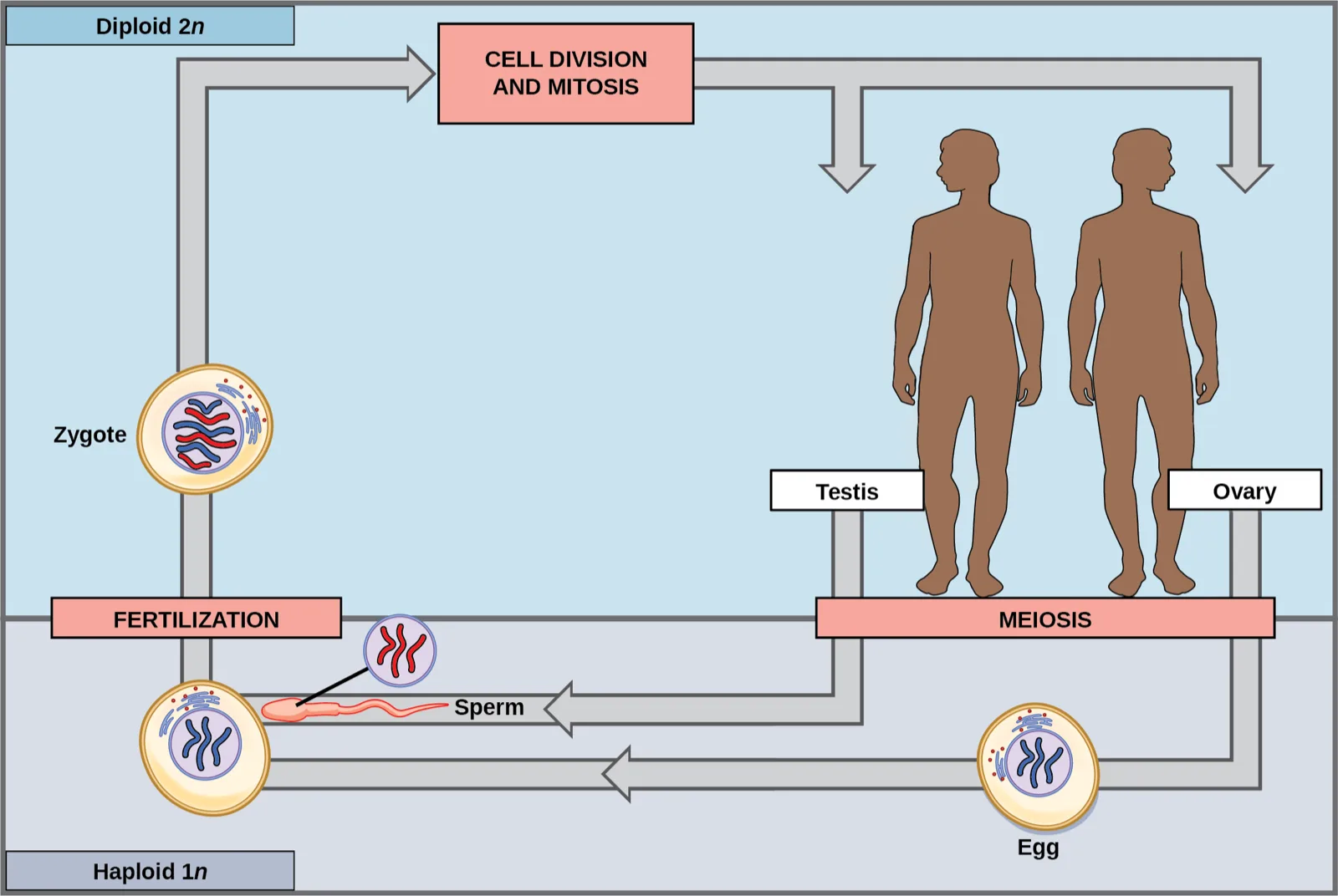
Extended description
A flow chart split into an upper light-blue band labeled ‘Diploid 2n’ and a lower gray band labeled ‘Haploid 1n.’ In the diploid band, a Zygote cell (bottom left, drawn with paired blue and red chromosomes) has an arrow leading up and right into a red ‘CELL DIVISION AND MITOSIS’ box; from there an arrow forks right and down into two brown human silhouettes, one above a box labeled ‘Testis’ and one above a box labeled ‘Ovary.’ A red ‘MEIOSIS’ bar spans the width of the diagram just below the two silhouettes, at the boundary between the diploid and haploid bands. In the haploid band, an arrow from the Testis leads down to a small circular cell containing a single red chromosome, which becomes a tadpole-shaped ‘Sperm’ cell; an arrow from the Ovary leads down to a circular ‘Egg’ cell containing a single blue chromosome. Arrows from both the Sperm and the Egg converge on a red ‘FERTILIZATION’ bar at the left, which leads back up into the Zygote cell, closing the loop into the diploid band.
Most fungi and algae employ a life-cycle type in which the “body” of the organism—the ecologically important part of the life cycle—is haploid. The haploid cells that make up the tissues of the dominant multicellular stage are formed by mitosis. During sexual reproduction, specialized haploid cells from two individuals—designated the (+) and (−) mating types—join to form a diploid zygote. The zygote immediately undergoes meiosis to form four haploid cells called spores. Although these spores are haploid like the “parents,” they contain a new genetic combination from two parents. The spores can remain dormant for various time periods. Eventually, when conditions are favorable, the spores form multicellular haploid structures through many rounds of mitosis (below).
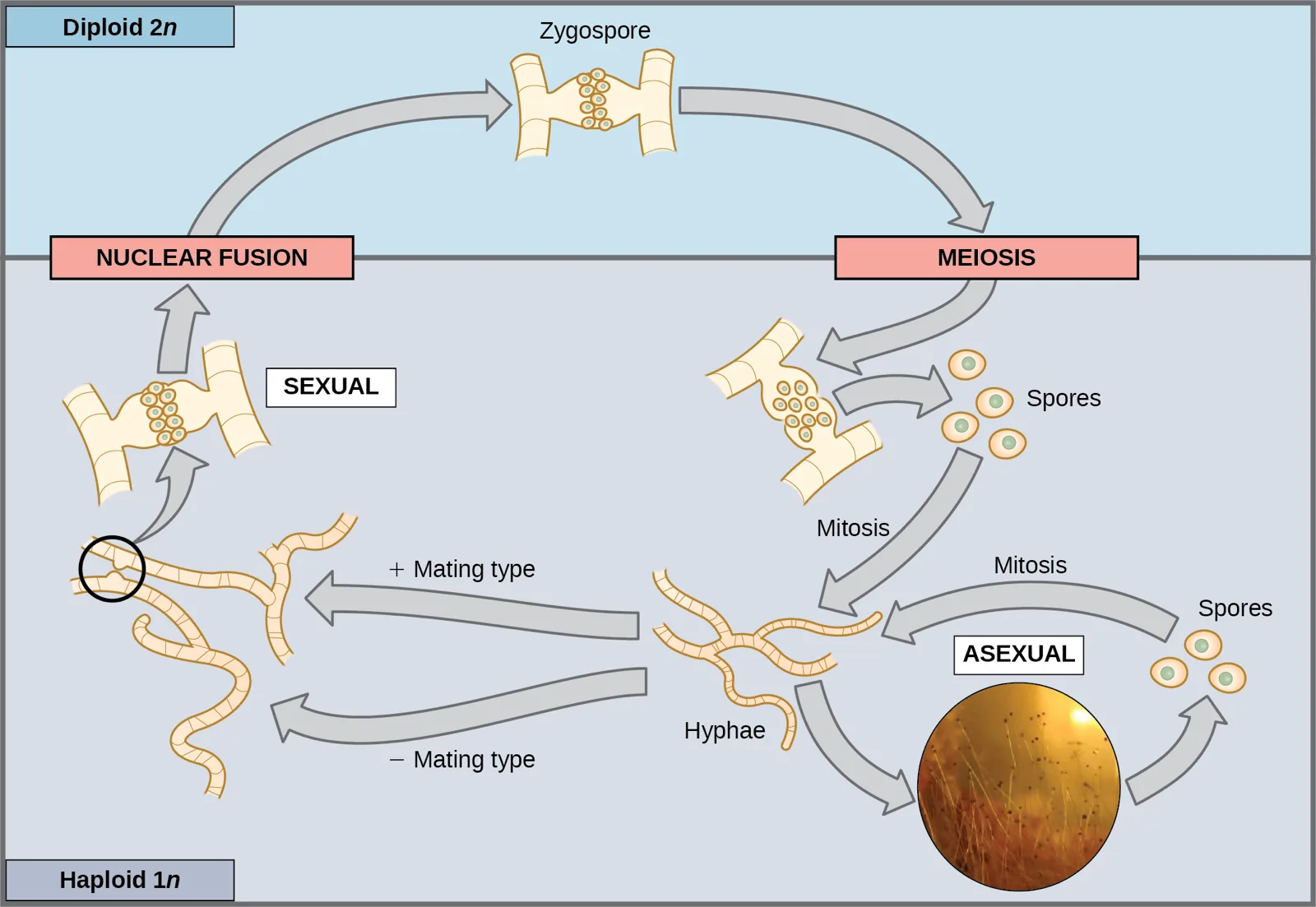
Extended description
A flow chart split into an upper light-blue band labeled ‘Diploid 2n’ and a lower gray band labeled ‘Haploid 1n,’ with a small circular photograph of the mold’s dark, speckled growth in its lower-right corner. In the diploid band, a tan structure labeled ‘Zygospore’ (two hyphal tips joined around a cluster of small circles) sits at top center, with an arrow leading into it from a red ‘NUCLEAR FUSION’ box at the left and an arrow leading from it to a red ‘MEIOSIS’ box at the right. In the haploid band, an arrow from the meiosis box leads down to a second zygospore-like structure, from which one ‘Mitosis’ arrow leads left to branching hyphae and another ‘Mitosis’ arrow leads right to round ‘Spores.’ At the left, a box labeled ‘SEXUAL’ sits above two branching hyphae strands labeled ‘+ Mating type’ and ‘− Mating type,’ each with an arrow pointing left toward a circled junction that feeds back up into ‘NUCLEAR FUSION.’ At the lower right, a box labeled ‘ASEXUAL’ sits where a separate pair of ‘Mitosis’ arrows cycle back and forth between hyphae and a cluster of spores, with the circular photograph of the growing mold connected into that same cycle.
If a mutation occurs so that a fungus is no longer able to produce a minus mating type, will it still be able to reproduce?
Show model answer
Did your answer mention:
The third life-cycle type, employed by some algae and all plants, is a blend of the haploid-dominant and diploid-dominant extremes. Species with alternation of generations have both haploid and diploid multicellular organisms as part of their life cycle. The haploid multicellular plants are called gametophytes, because they produce gametes from specialized cells. Meiosis is not directly involved in the production of gametes in this case, because the organism that produces the gametes is already haploid. Fertilization between the gametes forms a diploid zygote. The zygote will undergo many rounds of mitosis and give rise to a diploid multicellular plant called a sporophyte. Specialized cells of the sporophyte will undergo meiosis and produce haploid spores. The spores will subsequently develop into the gametophytes (below).
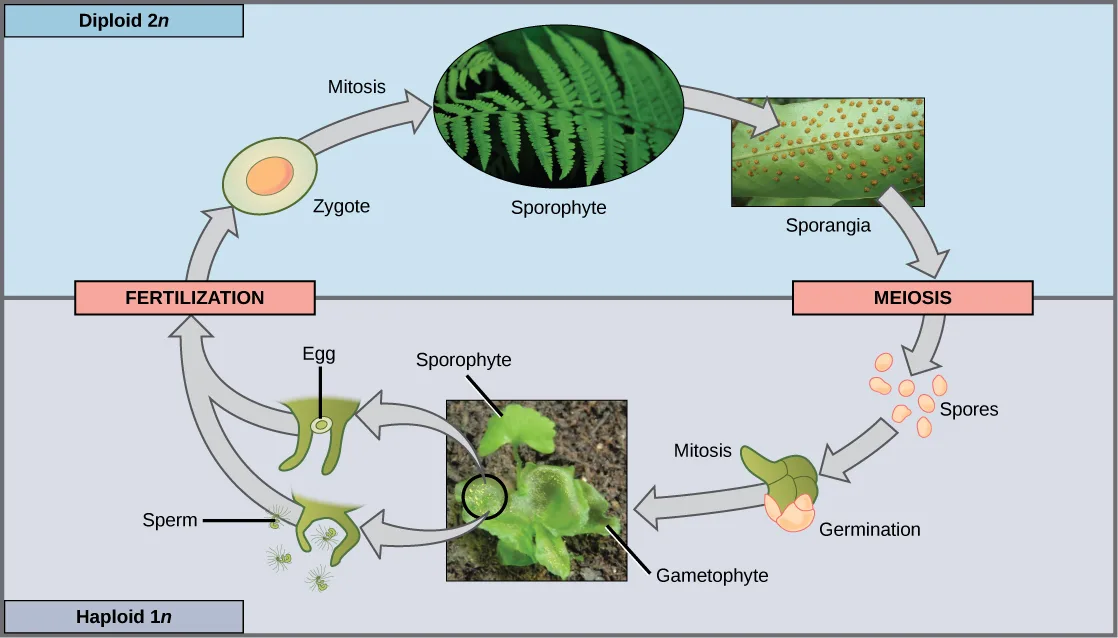
Extended description
A flow chart split into an upper light-blue band labeled ‘Diploid 2n’ and a lower gray band labeled ‘Haploid 1n,’ its several photographs connected by labeled gray arrows. In the diploid band, a small orange-centered oval labeled ‘Zygote’ at upper left has an arrow labeled ‘Mitosis’ leading right to a photograph of a green fern frond labeled ‘Sporophyte,’ which has an arrow leading right to a close-up photograph of a leaf’s underside covered in small brown dots, labeled ‘Sporangia.’ A red ‘MEIOSIS’ bar spans the diagram at the boundary between the two bands, below the sporangia photograph. In the haploid band, an arrow leads down and left from the meiosis bar to a cluster of small oval ‘Spores,’ which have a ‘Mitosis’-labeled ‘Germination’ arrow leading left to a photograph of a small green gametophyte plant growing in soil, itself labeled ‘Gametophyte’; pointers on the photograph identify a tiny structure labeled ‘Egg,’ a structure labeled ‘Sperm’ beside small drawn tadpole-shaped sperm cells, and a separate pointer labeled ‘Sporophyte’ identifying a young sporophyte beginning to grow from the gametophyte. A red ‘FERTILIZATION’ bar spans the left edge between the two bands, with arrows from the Egg and Sperm leading up into it and an arrow from Fertilization leading up to the Zygote, closing the loop.
Although all plants utilize some version of the alternation of generations, the relative size of the sporophyte and the gametophyte and the relationship between them vary greatly. In plants such as moss, the gametophyte organism is the free-living plant and the sporophyte is physically dependent on the gametophyte. In other plants, such as ferns, both the gametophyte and sporophyte plants are free-living; however, the sporophyte is much larger. In seed plants, such as magnolia trees and daisies, the gametophyte is composed of only a few cells and, in the case of the female gametophyte, is completely retained within the sporophyte.
Sexual reproduction takes many forms in multicellular organisms. The fact that nearly every multicellular organism on Earth employs sexual reproduction is strong evidence for the benefits of producing offspring with unique gene combinations, though there are other possible benefits as well.
Summary
Nearly all eukaryotes undergo sexual reproduction. The variation introduced into the reproductive cells by meiosis provides an important advantage that has made sexual reproduction evolutionarily successful. Meiosis and fertilization alternate in sexual life cycles. The process of meiosis produces unique reproductive cells called gametes, which have half the number of chromosomes as the parent cell. When two haploid gametes fuse, this restores the diploid condition in the new zygote. Thus, most sexually reproducing organisms alternate between haploid and diploid stages. However, the ways in which reproductive cells are produced and the timing between meiosis and fertilization vary greatly.
Key terms
- alternation of generations — life-cycle type in which the diploid and haploid stages alternate
- gametophyte — a multicellular haploid life-cycle stage that produces gametes
- germ cells — specialized cell line that produces gametes, such as eggs or sperm
- life cycle — the sequence of events in the development of an organism and the production of cells that produce offspring
- sporophyte — a multicellular diploid life-cycle stage that produces haploid spores by meiosis
Practice
Explain that meiosis and sexual reproduction are highly evolved traits
Explain why sexual reproduction is beneficial to a population but can be detrimental to an individual offspring.
Show model answer
Did your answer mention:
List and briefly describe the three processes that lead to variation in offspring with the same parents.
Show model answer
Did your answer mention:
According to the Red Queen hypothesis, why must sexually reproducing species continually generate new genetic variation, even when their environment appears stable?
The hypothesis is named for a race in which running is required just to stay in the same place — think about what everyone else in that race is also doing.Identify variation among offspring as a potential evolutionary advantage of sexual reproduction
What is a likely evolutionary advantage of sexual reproduction over asexual reproduction?
Compare what each strategy does, or does not, reshuffle between generations.Hydras and jellyfish both live in a freshwater lake that is slowly being acidified by the runoff from a chemical plant built upstream. Which population is predicted to be better able to cope with the changing environment?
One of these two animals reproduces sexually far more often than the other, which changes how much variation its population carries.Many farmers are worried about the decreasing genetic diversity of plants associated with generations of artificial selection and inbreeding. Why is limiting random sexual reproduction of food crops concerning?
Think about what a population with little genetic variation has in common, plant to plant, when a new disease arrives.How do organisms with haploid-dominant life cycles ensure continued genetic diversification in offspring without using a meiotic process to make gametes?
Show model answer
Did your answer mention:
Describe the three different life-cycle types among sexually reproducing multicellular organisms.
Which type of life cycle has both a haploid and diploid multicellular stage?
Two of the four options name a single life-cycle strategy; only one names a blend of the two.What is the ploidy of the most conspicuous form of most fungi?
The mold’s visible hyphae and the spores they produce come before nuclear fusion forms the brief diploid zygospore stage.A diploid, multicellular life-cycle stage that gives rise to haploid cells by meiosis is called a ________.
This is the fern or moss plant that produces spores, not the plant that grows from them.Animals and plants both have diploid and haploid cells. How does the animal life cycle differ from the alternation of generations exhibited by plants?
Show model answer
Did your answer mention:
How does the role of meiosis in gamete production differ between organisms with a diploid-dominant life cycle and organisms with an alternation of generations life cycle?
Show model answer
Did your answer mention:
A multicellular haploid life-cycle stage that produces gametes is called a ________.
This is the free-living moss plant, or the small plant that bears the egg and sperm on a fern.This section is adapted from Biology 2e, Section 11.2: Sexual Reproduction by Mary Ann Clark, Jung Choi, Matthew Douglas, and OpenStax, © OpenStax, licensed under CC BY-NC-SA 4.0. Access the original for free at openstax.org. Changes: figures re-encoded as WebP; a longdesc extended description added for all three figures, which are labeled life-cycle flow charts whose full reading is not carried by their captions (the fungal life cycle’s longdesc names the diagram’s “ASEXUAL” pathway as a structural element without stating that it answers the adjacent Visual Connection question); the fern figure’s alt corrected from the source’s “sphorophyte” typo (repeated twice) to “sporophyte,” reported as a source defect; the footnoted Red Queen hypothesis citation (Leigh Van Valen, 1973) kept as a parenthetical after the sentence it supports rather than as a footnote marker; the evolution note rendered as an Evolution Connection callout with its bold name and italicized title; the Visual Connection question kept in the body immediately after its figure and rendered as a self-check, since the source keys it with a prose solution rather than a lettered option; the end-of-section Review Questions and Critical Thinking Questions adapted into the closing interactive Practice block (multiple choice and self-check respectively); one multiple choice written directly from the Red Queen Connection callout’s own text (no new claim) added because no end-of-section exercise or glossary term otherwise tests the “highly evolved traits” objective; one key-term recall item (gametophyte) added from the glossary to the life-cycle-types objective group; and rubric checkpoints added to each self-check, including the body self-check bound to the fungal life-cycle figure, decomposing its model answer (the source solution) into check-off clauses with no new claims.