Basics of DNA Replication
By the end of this section, you will be able to:
- Explain how the structure of DNA reveals the replication process
- Describe the Meselson and Stahl experiments
The elucidation of the structure of the double helix provided a hint as to how DNA divides and makes copies of itself. In their 1953 paper, Watson and Crick penned an incredible understatement: “It has not escaped our notice that the specific pairing we have postulated immediately suggests a possible copying mechanism for the genetic material.” With specific base pairs, the sequence of one DNA strand can be predicted from its complement. The double-helix model suggests that the two strands of the double helix separate during replication, and each strand serves as a template from which the new complementary strand is copied. What was not clear was how the replication took place. There were three models suggested: conservative, semi-conservative, and dispersive.
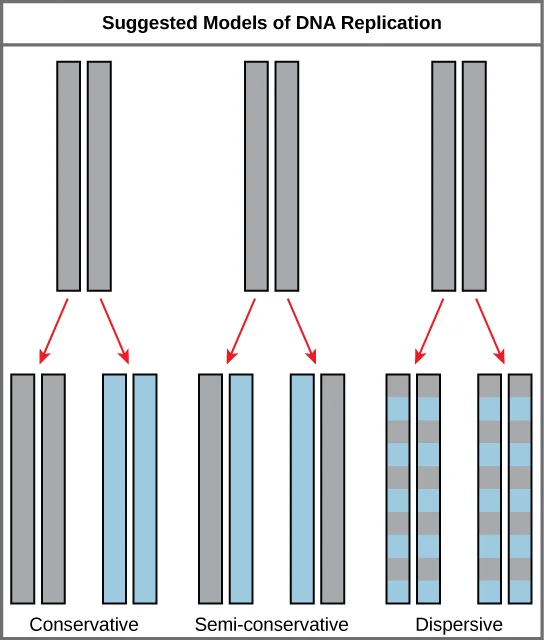
Extended description
Three columns, left to right, labeled Conservative, Semi-conservative, and Dispersive. Each column starts with the same pair of gray strands representing the original double helix, with two red arrows pointing down to that column’s two resulting double-stranded products. In the Conservative column, one product is two gray strands paired together (both original strands, unchanged) and the other product is two blue strands paired together (both newly synthesized). In the Semi-conservative column, both products are a gray strand paired with a blue strand (one original strand and one new strand in each). In the Dispersive column, both products are strands made of alternating short gray and blue segments, so original and new DNA are interspersed within a single strand in each product.
In conservative replication, the parental DNA remains together, and the newly formed daughter strands are together. The semi-conservative method suggests that each of the two parental DNA strands acts as a template for new DNA to be synthesized; after replication, each double-stranded DNA includes one parental or “old” strand and one “new” strand. In the dispersive model, both copies of DNA have double-stranded segments of parental DNA and newly synthesized DNA interspersed.
Meselson and Stahl were interested in understanding how DNA replicates. They grew E. coli for several generations in a medium containing a “heavy” isotope of nitrogen (¹⁵N), which gets incorporated into nitrogenous bases, and eventually into the DNA.
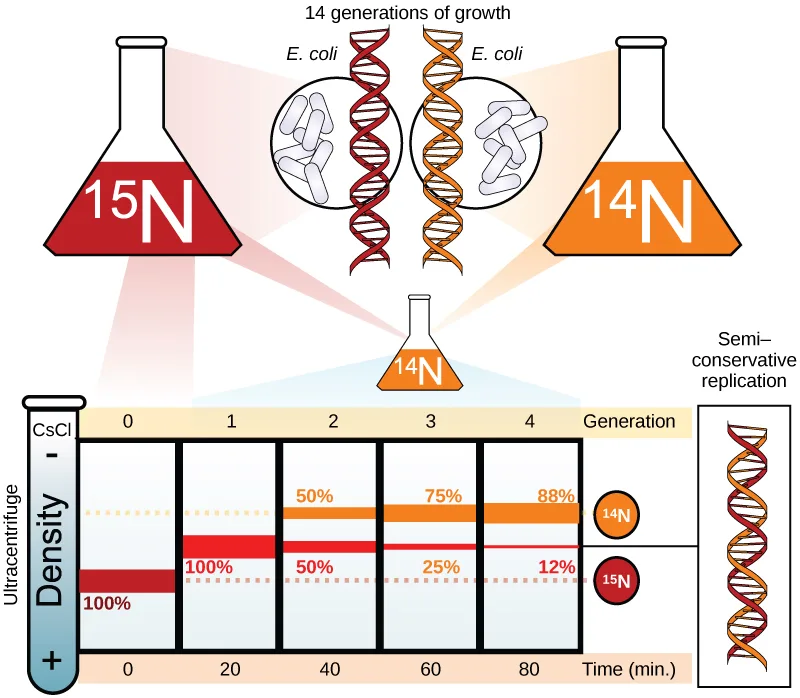
Extended description
At the top, a bracket labeled ‘14 generations of growth’ spans two circles, each containing E. coli bacteria and a strand of DNA: the left circle’s strand is red, running down to a red flask labeled ¹⁵N; the right circle’s strand is orange, running down to an orange flask labeled ¹⁴N. Below the two circles, a smaller orange flask labeled ¹⁴N feeds into a density-gradient diagram: a vertical tube with ‘CsCl’ at the top and density increasing downward, columns for Generation 0 through 4 (corresponding to 0, 20, 40, 60, and 80 minutes), a lower band position labeled ¹⁵N, and an upper band position labeled ¹⁴N. The lower (¹⁵N) band holds 100% of the DNA at Generation 0, still 100% at Generation 1 (now at the intermediate density between the ¹⁵N and ¹⁴N levels), then 50%, 25%, and 12% at Generations 2, 3, and 4. The upper (¹⁴N) band appears at Generation 2 with 50% of the DNA, rising to 75% at Generation 3 and 88% at Generation 4. To the right of the gradient, a bracket labeled ‘Semi-conservative replication’ points to a small drawing of a double helix with one red strand and one orange strand twisted together.
The E. coli culture was then placed into medium containing ¹⁴N and allowed to grow for several generations. After each of the first few generations, the cells were harvested and the DNA was isolated, then centrifuged at high speeds in an ultracentrifuge. During the centrifugation, the DNA was loaded into a gradient (typically a solution of salt such as cesium chloride or sucrose) and spun at high speeds of 50,000 to 60,000 rpm. Under these circumstances, the DNA will form a band according to its buoyant density: the density within the gradient at which it floats. DNA grown in ¹⁵N will form a band at a higher density position (i.e., farther down the centrifuge tube) than that grown in ¹⁴N. Meselson and Stahl noted that after one generation of growth in ¹⁴N after they had been shifted from ¹⁵N, the single band observed was intermediate in position in between DNA of cells grown exclusively in ¹⁵N and ¹⁴N. This suggested either a semi-conservative or dispersive mode of replication. The DNA harvested from cells grown for two generations in ¹⁴N formed two bands: one DNA band was at the intermediate position between ¹⁵N and ¹⁴N, and the other corresponded to the band of ¹⁴N DNA. These results could only be explained if DNA replicates in a semi-conservative manner. And for this reason, therefore, the other two models were ruled out.
During DNA replication, each of the two strands that make up the double helix serves as a template from which new strands are copied. The new strands will be complementary to the parental or “old” strands. When two daughter DNA copies are formed, they have the same sequence and are divided equally into the two daughter cells.
Summary
During cell division, each daughter cell receives a copy of each molecule of DNA by a process known as DNA replication. The single chromosome of a prokaryote or each chromosome of a eukaryote consists of a single continuous double helix. The model for DNA replication suggests that the two strands of the double helix separate during replication, and each strand serves as a template from which the new complementary strand is copied. In the conservative model of replication, the parental DNA is conserved, and the daughter DNA is newly synthesized. The semi-conservative model suggests that each of the two parental DNA strands acts as template for new DNA to be synthesized; after replication, each double-stranded DNA retains the parental or “old” strand and one “new” strand. The dispersive model suggested that the two copies of the DNA would have segments of parental DNA and newly synthesized DNA. The Meselson and Stahl experiment supported the semi-conservative model of replication, in which an entire replicated chromosome consists of one parental strand and one newly synthesized strand of DNA.
Practice
Explain how the structure of DNA reveals the replication process
If the sequence of the 5′-3′ strand is AATGCTAC, then the complementary sequence has which of the following sequences?
Pair each base with its complement (A↔T, G↔C) at each position, then read the new strand’s 3′ end from the position across from the original strand’s 5′ end.During DNA replication, the two strands of the double helix separate, and each strand serves as a ________ from which the new complementary strand is copied.
Think of it as the mold that the new, complementary strand is built against.During cell division, each daughter cell receives a copy of each molecule of DNA by a process known as ________.
This is the name of the whole process this section describes.In which model of DNA replication does the parental DNA remain intact and paired together, while the daughter DNA is built as an entirely new, separately paired double helix?
Nothing from the old DNA mixes into the new copy — the original stays whole, and a brand-new copy is built alongside it.Describe the Meselson and Stahl experiments
Meselson and Stahl’s experiments proved that DNA replicates by which mode?
Their ultracentrifuge results showed one intermediate-density band after one generation, not two separate bands.How did Meselson and Stahl support Watson and Crick’s double-helix model?
Watson and Crick’s model proposed this specific structural role for each strand during copying; the experiment’s semi-conservative result confirmed it.How did the scientific community learn that DNA replication takes place in a semi-conservative fashion?
Show model answer
Did your answer mention:
Imagine the Meselson and Stahl experiments had supported conservative replication instead of semi-conservative replication. What results would you predict to observe after two rounds of replication? Be specific regarding percent distributions of DNA incorporating ¹⁵N and ¹⁴N in the gradient.
Show model answer
Did your answer mention:
This section is adapted from Biology 2e, Section 14.3: Basics of DNA Replication by Mary Ann Clark, Jung Choi, Matthew Douglas, and OpenStax, © OpenStax, licensed under CC BY-NC-SA 4.0. Access the original for free at openstax.org. Changes: this module has no <glossary>, so it carries no Key terms heading; both figures re-encoded as WebP and re-kinded from the manifest’s file-extension guess of “photo” to “diagram” after inspection (both are colored line illustrations, not photographs); both source alts, which were letter-spaced text-to-speech spellings (“D N A”, “superscript 15 baseline upper case N”), rewritten from the images, with a full walkthrough of each diagram’s panels, bands, and percentages moved into a longdesc; isotope labels set with Unicode superscript digits (¹⁵N, ¹⁴N) in place of the source’s <sup> markup; primes in the complementary-sequence Review Question set as the Unicode prime (′) in place of the source’s ASCII apostrophes; the interactive note rendered as a Link to Learning callout with descriptive anchor text in place of the source’s bare “this video”; the end-of-section Review Questions and Critical Thinking Questions adapted into the closing interactive Practice block; rubric checkpoints added to each self-check, decomposing its model answer (the source solution) into check-off clauses with no new claims; and, because this module has no glossary to draw recall items from, three summary-derived items (a cloze textin on the summary’s “template” clause, a cloze textin on the summary’s opening “DNA replication” clause, and a select-the-term multiple choice built from the summary’s conservative-replication clause, offered with three options because the module names exactly three replication models) added to raise “Explain how the structure of DNA reveals the replication process” to the book’s three-item floor.