DNA Replication in Eukaryotes
By the end of this section, you will be able to:
- Discuss the similarities and differences between DNA replication in eukaryotes and prokaryotes
- State the role of telomerase in DNA replication
Eukaryotic genomes are much more complex and larger in size than prokaryotic genomes. Eukaryotes also have a number of different linear chromosomes. The human genome has 3 billion base pairs per haploid set of chromosomes, and 6 billion base pairs are replicated during the S phase of the cell cycle. There are multiple origins of replication on each eukaryotic chromosome; humans can have up to 100,000 origins of replication across the genome. The rate of replication is approximately 100 nucleotides per second, much slower than prokaryotic replication. In yeast, which is a eukaryote, special sequences known as autonomously replicating sequences (ARS) are found on the chromosomes. These are equivalent to the origin of replication in E. coli.
The number of DNA polymerases in eukaryotes is much more than in prokaryotes: 14 are known, of which five are known to have major roles during replication and have been well studied. They are known as pol α, pol β, pol γ, pol δ, and pol ε.
The essential steps of replication are the same as in prokaryotes. Before replication can start, the DNA has to be made available as a template. Eukaryotic DNA is bound to basic proteins known as histones to form structures called nucleosomes. Histones must be removed and then replaced during the replication process, which helps to account for the lower replication rate in eukaryotes. The chromatin (the complex between DNA and proteins) may undergo some chemical modifications, so that the DNA may be able to slide off the proteins or be accessible to the enzymes of the DNA replication machinery. At the origin of replication, a pre-replication complex is made with other initiator proteins. Helicase and other proteins are then recruited to start the replication process (the table below).
Difference between Prokaryotic and Eukaryotic Replication
| Property | Prokaryotes | Eukaryotes |
|---|---|---|
| Origin of replication | Single | Multiple |
| Rate of replication | 1000 nucleotides/s | 50 to 100 nucleotides/s |
| DNA polymerase types | 5 | 14 |
| Telomerase | Not present | Present |
| RNA primer removal | DNA pol I | RNase H |
| Strand elongation | DNA pol III | Pol α, pol δ, pol ε |
| Sliding clamp | Sliding clamp | PCNA |
A helicase using the energy from ATP hydrolysis opens up the DNA helix. Replication forks are formed at each replication origin as the DNA unwinds. The opening of the double helix causes over-winding, or supercoiling, in the DNA ahead of the replication fork. These are resolved with the action of topoisomerases. Primers are formed by the enzyme primase, and using the primer, DNA pol can start synthesis. Three major DNA polymerases are then involved: α, δ and ε. DNA pol α adds a short (20 to 30 nucleotides) DNA fragment to the RNA primer on both strands, and then hands off to a second polymerase. While the leading strand is continuously synthesized by the enzyme pol ε, the lagging strand is synthesized by pol δ. A sliding clamp protein known as PCNA (proliferating cell nuclear antigen) holds the DNA pol in place so that it does not slide off the DNA. As pol δ runs into the primer RNA on the lagging strand, it displaces it from the DNA template. The displaced primer RNA is then removed by RNase H and flap endonuclease (Source note: the source says “RNase H (AKA flap endonuclease)”; the two are distinct enzymes — RNase H removes most of the RNA primer and flap endonuclease 1 the last displaced nucleotides — as the reference cited in the errata log shows.) and replaced with DNA nucleotides. The Okazaki fragments in the lagging strand are joined after the replacement of the RNA primers with DNA. The gaps that remain are sealed by DNA ligase, which forms the phosphodiester bond.
Telomere replication
Unlike prokaryotic chromosomes, eukaryotic chromosomes are linear. As you’ve learned, the enzyme DNA pol can add nucleotides only in the 5′ to 3′ direction. In the leading strand, synthesis continues until the end of the chromosome is reached. On the lagging strand, DNA is synthesized in short stretches, each of which is initiated by a separate primer. When the replication fork reaches the end of the linear chromosome, there is no way to replace the primer on the 5′ end of the lagging strand. The DNA at the ends of the chromosome thus remains unpaired, and over time these ends, called telomeres, may get progressively shorter as cells continue to divide.
Telomeres comprise repetitive sequences that code for no particular gene. In humans, a six-base-pair sequence, TTAGGG, is repeated 100 to 1000 times in the telomere regions. In a way, these telomeres protect the genes from getting deleted as cells continue to divide. The telomeres are added to the ends of chromosomes by a separate enzyme, telomerase (below), whose discovery helped in the understanding of how these repetitive chromosome ends are maintained. The telomerase enzyme contains a catalytic part and a built-in RNA template. It attaches to the end of the chromosome, and DNA nucleotides complementary to the RNA template are added on the 3′ end of the DNA strand. Once the 3′ end of the lagging strand template is sufficiently elongated, DNA polymerase can add the nucleotides complementary to the ends of the chromosomes. Thus, the ends of the chromosomes are replicated.
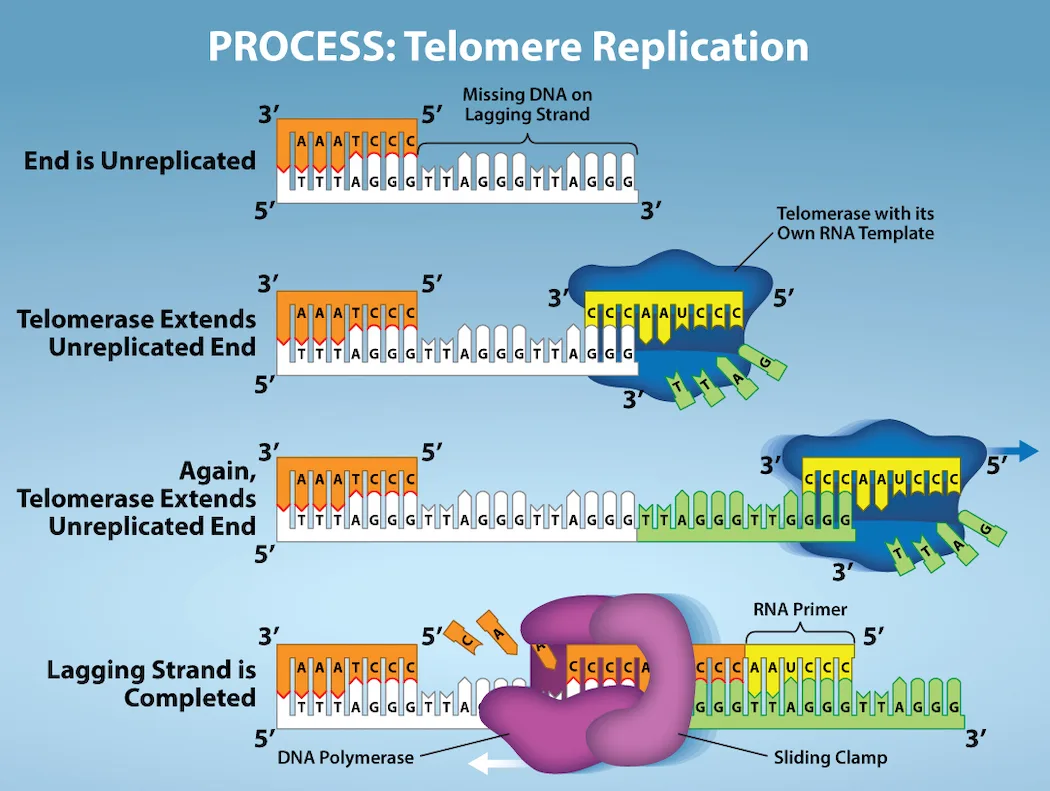
Extended description
Four labeled panels read top to bottom, each showing DNA as two rows of lettered boxes: a short orange top row (the incomplete lagging strand, 3′ at its left and 5′ at its right) paired over a longer white bottom row (its parent template, 5′ at the left and 3′ at the right). ‘End is Unreplicated’: the top row stops partway, and a bracket over the exposed stretch of the bottom row is labeled ‘Missing DNA on Lagging Strand.’ ‘Telomerase Extends Unreplicated End’: a blue blob labeled ‘Telomerase with its Own RNA Template’ docks at the bottom row’s 3′ end; a yellow row of letters on the blob is its RNA template, and short green boxes show new telomere DNA being added to the bottom row’s 3′ end. ‘Again, Telomerase Extends Unreplicated End’: the bottom row’s green extension is longer, the telomerase blob has shifted further right to add another repeat, and a blue arrow points right to show continued extension. ‘Lagging Strand is Completed’: a purple blob labeled ‘DNA Polymerase’ with a ring labeled ‘Sliding Clamp’ moves left along the extended bottom row, adding new boxes to the top row behind a yellow segment labeled ‘RNA Primer’, so the top row now reaches across the once-missing stretch; the bottom row keeps its original white boxes, with the green telomerase-added repeats at its right end.
Telomerase is typically active in germ cells and adult stem cells. It is not active in adult somatic cells. For their discovery of telomerase and its action, Elizabeth Blackburn, Carol W. Greider, and Jack W. Szostak (below) received the Nobel Prize for Medicine and Physiology in 2009. Later research using HeLa cells (obtained from Henrietta Lacks) confirmed that telomerase is present in human cells. And in 2001, researchers including Diane L. Wright found that telomerase is necessary for cells in human embryos to rapidly proliferate.

Telomerase and Aging
Cells that undergo cell division continue to have their telomeres shortened because most somatic cells do not make telomerase. This essentially means that telomere shortening is associated with aging. With the advent of modern medicine, preventative health care, and healthier lifestyles, the human life span has increased, and there is an increasing demand for people to look younger and have a better quality of life as they grow older.
In 2010, scientists found that telomerase can reverse some age-related conditions in mice (Jaskelioff et al., “Telomerase reactivation reverses tissue degeneration in aged telomerase-deficient mice,” Nature 469 (2011): 102-7). This may have potential in regenerative medicine. Telomerase-deficient mice were used in these studies; these mice have tissue atrophy, stem cell depletion, organ system failure, and impaired tissue injury responses. Telomerase reactivation in these mice caused extension of telomeres, reduced DNA damage, reversed neurodegeneration, and improved the function of the testes, spleen, and intestines. Thus, telomere reactivation may have potential for treating age-related diseases in humans.
Cancer is characterized by uncontrolled cell division of abnormal cells. The cells accumulate mutations, proliferate uncontrollably, and can migrate to different parts of the body through a process called metastasis. Scientists have observed that cancerous cells have considerably shortened telomeres and that telomerase is active in these cells. Interestingly, only after the telomeres were shortened in the cancer cells did the telomerase become active. If the action of telomerase in these cells can be inhibited by drugs during cancer therapy, then the cancerous cells could potentially be stopped from further division.
Summary
Replication in eukaryotes starts at multiple origins of replication. The mechanism is quite similar to that in prokaryotes. A primer is required to initiate synthesis, which is then extended by DNA polymerase as it adds nucleotides one by one to the growing chain. The leading strand is synthesized continuously, whereas the lagging strand is synthesized in short stretches called Okazaki fragments. The RNA primers are replaced with DNA nucleotides; the DNA Okazaki fragments are linked into one continuous strand by DNA ligase. The ends of the chromosomes pose a problem as the primer RNA at the 5′ ends of the DNA cannot be replaced with DNA, and the chromosome is progressively shortened. Telomerase, an enzyme with an inbuilt RNA template, extends the ends by copying the RNA template and extending one strand of the chromosome. DNA polymerase can then fill in the complementary DNA strand using the regular replication enzymes. In this way, the ends of the chromosomes are protected.
Key terms
- endonuclease — enzymes that cleave the phosphodiester bond within a polynucleotide chain
- telomerase — enzyme that contains a catalytic part and an inbuilt RNA template; it functions to maintain telomeres at chromosome ends
- telomere — DNA at the end of linear chromosomes
Practice
Discuss the similarities and differences between DNA replication in eukaryotes and prokaryotes
Assign each replication property to the cell type it describes.
Prokaryotes
Eukaryotes
Which of the following is not a true statement comparing prokaryotic and eukaryotic DNA replication?
Prokaryotic cells have no nucleus, so their DNA replication cannot take place inside one.Enzymes that cleave the phosphodiester bond within a polynucleotide chain are called a(n) ________.
Reread the sentence about removing the displaced primer RNA on the lagging strand — the enzyme named there alongside RNase H.State the role of telomerase in DNA replication
The ends of the linear chromosomes are maintained by
This is the enzyme this section names for extending chromosome ends with its own built-in RNA template, not one of the three enzymes that unwind, prime, or synthesize a strand generally.How do the linear chromosomes in eukaryotes ensure that its ends are replicated completely?
Show model answer
Did your answer mention:
An enzyme with a catalytic part and a built-in RNA template, which functions to maintain the ends of chromosomes, is called ________.
It is the enzyme this section discusses attaching to the end of the chromosome and elongating the 3′ end of the lagging strand template.The DNA at the end of a linear chromosome, made of a repetitive sequence that codes for no particular gene, is called a ________.
Its human repeat unit is the six-base-pair sequence TTAGGG.According to the section summary, which enzyme extends the ends of the chromosomes by copying its own inbuilt RNA template?
The section summary names only one enzyme here as carrying its own inbuilt RNA template.This section is adapted from Biology 2e, Section 14.5: DNA Replication in Eukaryotes by Mary Ann Clark, Jung Choi, Matthew Douglas, and OpenStax, © OpenStax, licensed under CC BY-NC-SA 4.0. Access the original for free at openstax.org. Changes: figures re-encoded as WebP, with the telomere-replication diagram re-kinded from the manifest’s file-extension guess of “photo” to “diagram” after inspection (it is a four-panel colored illustration, not a photograph), and given a longdesc walking its four labeled panels since the process it depicts is not carried by its one-line caption; the Blackburn photo’s source alt (“Photo of Elizabeth Blackburn.”) rewritten from the image, since it named the subject without describing what is actually shown; every prime mark set as the Unicode ′ in place of a straight apostrophe or the source’s right single quotation mark, throughout the prose, summary, and exercise text; the footnote citing the 2010 telomerase-reactivation mouse study rendered as a parenthetical after the sentence it supports, with its title and journal citation kept in full; inline references to the table and the two figures changed from the source’s numbered pointers (“Table 14.2,” “Figure 14.15,” “Figure 14.16”) to descriptive phrases (“the table below,” “below”) since tables and figures are not numbered here; the comparison table of prokaryotic and eukaryotic replication kept as a Markdown table in the body and also rendered as a sort-into-bins exercise under the first objective, with five of its seven rows (origin count, polymerase count, telomerase presence, RNA-primer removal, and strand elongation) each split into one distinguishing item per cell type; the end-of-section Review Questions and Critical Thinking Question adapted into the closing interactive Practice block (multiple choice and self-check respectively); three key-term recall items (endonuclease, telomerase, telomere) added from the glossary; one summary-derived multiple choice added under the second objective (reading the summary’s own sentence naming telomerase as the enzyme with an inbuilt RNA template, with three same-category distractors — helicase, primase, DNA ligase — all drawn from this section’s own text) to raise that objective’s group to the practice floor; and rubric checkpoints added to the self-check, decomposing its model answer (the source solution) into check-off clauses with no new claims. One claim is corrected with a visible Source note: RNase H and flap endonuclease are distinct primer-removal enzymes, not two names for one, and the endonuclease recall item’s hint was reworded to match (erratum 401).