Genes and Proteins
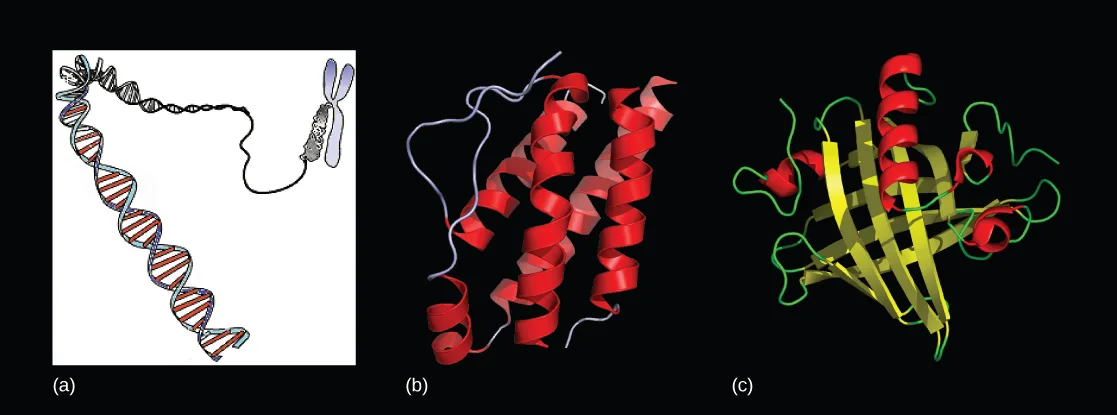
Since the rediscovery of Mendel’s work in 1900, the definition of the gene has progressed from an abstract unit of heredity to a tangible molecular entity capable of replication, expression, and mutation. Genes are composed of DNA and are linearly arranged on chromosomes. Genes specify the sequences of amino acids, which are the building blocks of proteins. In turn, proteins are responsible for orchestrating nearly every function of the cell. Both genes and the proteins they encode are absolutely essential to life as we know it.
Sections
- The Genetic Code — the “central dogma” of DNA-protein synthesis and how the genetic code’s nucleotide sequence prescribes the amino acid and the protein sequence.
- Prokaryotic Transcription — the steps of prokaryotic transcription, the role of promoters, and how and when transcription is terminated.
- Eukaryotic Transcription — the steps of eukaryotic transcription, the roles of the three RNA polymerases, and the significance of transcription factors.
- RNA Processing in Eukaryotes — the steps of RNA processing, the significance of exons, introns, and splicing for mRNAs, and how tRNAs and rRNAs are processed.
- Ribosomes and Protein Synthesis — the steps of protein synthesis and the role of ribosomes in it.
This chapter is adapted from Biology 2e, Chapter 15: Genes and Proteins by Mary Ann Clark, Jung Choi, Matthew Douglas, and OpenStax, © OpenStax, licensed under CC BY-NC-SA 4.0. Access the original for free at openstax.org. Each section page records its own changes from the source. Changes: the chapter-opening illustration is the source’s, re-encoded for the web with its credit kept in the caption, and the credit’s missing closing quotation mark after “chromosome” is supplied to match the punctuation of the two credits beside it — reported as a source defect; its alt text is the source’s own description, kept as written since it already names what each panel shows.