Prokaryotic Transcription
By the end of this section, you will be able to:
- List the different steps in prokaryotic transcription
- Discuss the role of promoters in prokaryotic transcription
- Describe how and when transcription is terminated
The prokaryotes, which include Bacteria and Archaea, are mostly single-celled organisms that, by definition, lack membrane-bound nuclei and other organelles. A bacterial chromosome is a closed circle that, unlike eukaryotic chromosomes, is not organized around histone proteins. The central region of the cell in which prokaryotic DNA resides is called the nucleoid region. In addition, prokaryotes often have abundant plasmids, which are shorter, circular DNA molecules that may only contain one or a few genes. Plasmids can be transferred independently of the bacterial chromosome during cell division and often carry traits such as those involved with antibiotic resistance.
Transcription in prokaryotes (and in eukaryotes) requires the DNA double helix to partially unwind in the region of mRNA synthesis. The region of unwinding is called a transcription bubble. Transcription always proceeds from the same DNA strand for each gene, which is called the template strand. The mRNA product is complementary to the template strand and is almost identical to the other DNA strand, called the nontemplate strand, or the coding strand. The only nucleotide difference is that in mRNA, all of the T nucleotides are replaced with U nucleotides (see the figure below). In an RNA double helix, A can bind U via two hydrogen bonds, just as in A–T pairing in a DNA double helix.
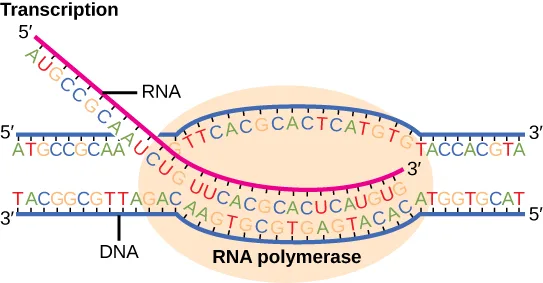
Extended description
Two parallel DNA strands run left to right. The top strand, labeled 5′ at the left and 3′ at the right, reads ATGCCGCAAT…TACCACGTA and is the nontemplate strand. The bottom strand, labeled 3′ at the left and 5′ at the right, reads TACGGCGTTAGAC…ATGGTGCAT and is the template strand. A large tan oval labeled RNA polymerase surrounds the middle portion of both strands, where the double helix has unwound into a bubble; every base letter in the figure is colored by its identity — A green, T and U red, C blue, G orange — on both strands alike. A magenta strand labeled RNA branches off the top strand’s 5′ end, labeled 5′, runs diagonally down through the polymerase where it base-pairs with the unwound template strand, and exits labeled 3′. A bracket below the strands labels DNA on the lower strand and RNA on the diagonal strand.
The nucleotide pair in the DNA double helix that corresponds to the site from which the first 5′ mRNA nucleotide is transcribed is called the +1 site, or the initiation site. Nucleotides preceding the initiation site are denoted with a “−” and are designated upstream nucleotides. Conversely, nucleotides following the initiation site are denoted with “+” numbering and are called downstream nucleotides.
Initiation of Transcription in Prokaryotes
Prokaryotes do not have membrane-enclosed nuclei. Therefore, the processes of transcription, translation, and mRNA degradation can all occur simultaneously. The intracellular level of a bacterial protein can quickly be amplified by multiple transcription and translation events that occur concurrently on the same DNA template. Prokaryotic genomes are very compact, and prokaryotic transcripts often cover more than one gene or cistron (a coding sequence for a single protein). Polycistronic mRNAs are then translated to produce more than one kind of protein.
Our discussion here will exemplify transcription by describing this process in Escherichia coli, a well-studied eubacterial species. Although some differences exist between transcription in E. coli and transcription in archaea, an understanding of E. coli transcription can be applied to virtually all bacterial species.
Prokaryotic RNA Polymerase
Prokaryotes use the same RNA polymerase to transcribe all of their genes. In E. coli, the polymerase is composed of five polypeptide subunits, two of which are identical. Four of these subunits, denoted α, α, β, and β′, comprise the polymerase core enzyme. These subunits assemble every time a gene is transcribed, and they disassemble once transcription is complete. Each subunit has a unique role; the two α-subunits are necessary to assemble the polymerase on the DNA; the β-subunit binds to the ribonucleoside triphosphate that will become part of the nascent mRNA molecule; and the β′ subunit binds the DNA template strand. The fifth subunit, σ, is involved only in transcription initiation. It confers transcriptional specificity such that the polymerase begins to synthesize mRNA from an appropriate initiation site. Without σ, the core enzyme would transcribe from random sites and would produce mRNA molecules that specified protein gibberish. The polymerase comprised of all five subunits is called the holoenzyme.
Prokaryotic Promoters
A promoter is a DNA sequence onto which the transcription machinery, including RNA polymerase, binds and initiates transcription. In most cases, promoters exist upstream of the genes they regulate. The specific sequence of a promoter is very important because it determines whether the corresponding gene is transcribed all the time, some of the time, or infrequently. Although promoters vary among prokaryotic genomes, a few elements are evolutionarily conserved in many species. At the −10 and −35 regions upstream of the initiation site, there are two promoter consensus sequences, or regions that are similar across all promoters and across various bacterial species (see the figure below). The −10 sequence, called the −10 region, has the consensus sequence TATAAT. The −35 sequence has the consensus sequence TTGACA. These consensus sequences are recognized and bound by σ. Once this interaction is made, the subunits of the core enzyme bind to the site. The A–T-rich −10 region facilitates unwinding of the DNA template, and several phosphodiester bonds are made. The transcription initiation phase ends with the production of abortive transcripts, which are polymers of approximately 10 nucleotides that are made and released.
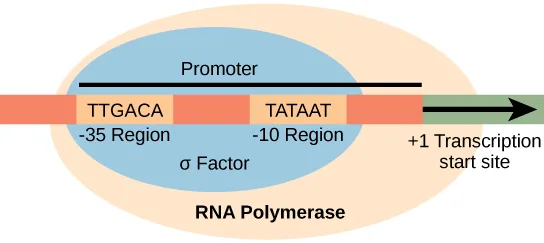
Extended description
Left to right along a horizontal DNA bar: a bracket labeled Promoter spans two shaded boxes — the first reads TTGACA and is labeled −35 Region, the second reads TATAAT and is labeled −10 Region — followed by a black arrow labeled +1 Transcription start site marking where transcription begins. A large tan oval labeled RNA Polymerase, with a smaller blue oval labeled σ Factor nested inside it, surrounds the DNA bar over the promoter region, showing the polymerase and its σ factor bound at both consensus sequences.
Elongation and Termination in Prokaryotes
The transcription elongation phase begins with the release of the σ subunit from the polymerase. The dissociation of σ allows the core enzyme to proceed along the DNA template, synthesizing mRNA in the 5′ to 3′ direction at a rate of approximately 40 nucleotides per second. As elongation proceeds, the DNA is continuously unwound ahead of the core enzyme and rewound behind it. The base pairing between DNA and RNA is not stable enough to maintain the stability of the mRNA synthesis components. Instead, the RNA polymerase acts as a stable linker between the DNA template and the nascent RNA strands to ensure that elongation is not interrupted prematurely.
Prokaryotic Termination Signals
Once a gene is transcribed, the prokaryotic polymerase needs to be instructed to dissociate from the DNA template and liberate the newly made mRNA. Depending on the gene being transcribed, there are two kinds of termination signals. One is protein-based and the other is RNA-based. Rho-dependent termination is controlled by the rho (ρ) protein, which tracks along behind the polymerase on the growing mRNA chain. Near the end of the gene, the polymerase encounters a run of G nucleotides on the DNA template and it stalls. As a result, the rho protein collides with the polymerase. The interaction with rho releases the mRNA from the transcription bubble.
Rho-independent termination is controlled by specific sequences in the DNA template strand. As the polymerase nears the end of the gene being transcribed, it encounters a region rich in C–G nucleotides. The mRNA folds back on itself, and the complementary C–G nucleotides bind together. The result is a stable hairpin that causes the polymerase to stall as soon as it begins to transcribe a region rich in A–T nucleotides. The complementary U–A region of the mRNA transcript forms only a weak interaction with the template DNA. This, coupled with the stalled polymerase, induces enough instability for the core enzyme to break away and liberate the new mRNA transcript.
Upon termination, the process of transcription is complete. By the time termination occurs, the prokaryotic transcript would already have been used to begin synthesis of numerous copies of the encoded protein because these processes can occur concurrently. The unification of transcription, translation, and even mRNA degradation is possible because all of these processes occur in the same 5′ to 3′ direction, and because there is no membranous compartmentalization in the prokaryotic cell (see the figure below). In contrast, the presence of a nucleus in eukaryotic cells precludes simultaneous transcription and translation.
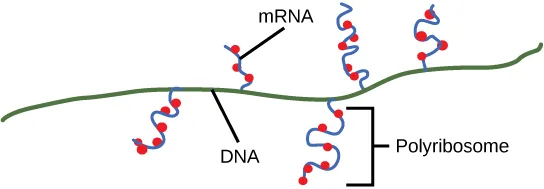
Extended description
A single green DNA strand runs horizontally. At several points along it, a blue mRNA strand extends outward, each with red ribosome shapes attached at increasing distances from the DNA, representing ribosomes that began translating earlier and have produced longer polypeptide chains. One mRNA strand, with five ribosomes attached along its length, is bracket-labeled Polyribosome.
Summary
In prokaryotes, mRNA synthesis is initiated at a promoter sequence on the DNA template comprising two consensus sequences that recruit RNA polymerase. The prokaryotic polymerase consists of a core enzyme of four protein subunits and a σ protein that assists only with initiation. Elongation synthesizes mRNA in the 5′ to 3′ direction at a rate of 40 nucleotides per second. Termination liberates the mRNA and occurs either by rho protein interaction or by the formation of an mRNA hairpin.
Key terms
- consensus — DNA sequence that is used by many species to perform the same or similar functions
- core enzyme — prokaryotic RNA polymerase consisting of α, α, β, and β′ but missing σ; this complex performs elongation
- downstream — nucleotides following the initiation site in the direction of mRNA transcription; in general, sequences that are toward the 3′ end relative to a site on the mRNA
- hairpin — structure of RNA when it folds back on itself and forms intramolecular hydrogen bonds between complementary nucleotides
- holoenzyme — prokaryotic RNA polymerase consisting of α, α, β, β′, and σ; this complex is responsible for transcription initiation
- initiation site — nucleotide from which mRNA synthesis proceeds in the 5′ to 3′ direction; denoted with a “+1”
- nontemplate strand — strand of DNA that is not used to transcribe mRNA; this strand is identical to the mRNA except that T nucleotides in the DNA are replaced by U nucleotides in the mRNA
- plasmid — extrachromosomal, covalently closed, circular DNA molecule that may only contain one or a few genes; common in prokaryotes
- promoter — DNA sequence to which RNA polymerase and associated factors bind and initiate transcription
- rho-dependent termination — in prokaryotes, termination of transcription by an interaction between RNA polymerase and the rho protein at a run of G nucleotides on the DNA template
- rho-independent — termination sequence-dependent termination of prokaryotic mRNA synthesis; caused by hairpin formation in the mRNA that stalls the polymerase
- TATA box — conserved promoter sequence in eukaryotes and prokaryotes that helps to establish the initiation site for transcription
- template strand — strand of DNA that specifies the complementary mRNA molecule
- transcription bubble — region of locally unwound DNA that allows for transcription of mRNA
- upstream — nucleotides preceding the initiation site; in general, sequences toward the 5′ end relative to a site on the mRNA
Practice
List the different steps in prokaryotic transcription
If mRNA is complementary to the DNA template strand and the DNA template strand is complementary to the DNA nontemplate strand, then why are base sequences of mRNA and the DNA nontemplate strand not identical? Could they ever be?
Show model answer
Did your answer mention:
A fragment of bacterial DNA reads: 3′–TACCTATAATCTCAATTGATAGAAGCACTCTAC–5′. Assuming that this fragment is the template strand, what is the sequence of mRNA that would be transcribed? (Hint: Be sure to identify the initiation site.)
Show model answer
Did your answer mention:
The region of locally unwound DNA that allows mRNA to be transcribed is called the ________.
It forms where the double helix partially unwinds so RNA polymerase can read the exposed strand.The strand of DNA that specifies the complementary mRNA molecule is called the ________.
Transcription always proceeds from this same DNA strand for a given gene.Discuss the role of promoters in prokaryotic transcription
Which subunit of the E. coli polymerase confers specificity to transcription?
This subunit dissociates once transcription begins and determines which sites the polymerase recognizes.The −10 and −35 regions of prokaryotic promoters are called consensus sequences because ________.
A consensus sequence describes a broad resemblance across species, not an exact identity.Three different bacteria species have the following consensus sequences upstream of a conserved gene.
| Species A | Species B | Species C | |
|---|---|---|---|
| −10 | TAATAAT | TTTAAT | TATATT |
| −35 | TTGACA | TTGGCC | TTGAAA |
The table above shows the −10 and −35 consensus sequences upstream of a conserved gene in three bacterial species. Order the bacteria from most to least efficient initiation of gene transcription.
Compare each species’ sequences with the −10 consensus TATAAT and the −35 consensus TTGACA — closer matches to both mean more efficient initiation.Describe how and when transcription is terminated
In your own words, describe the difference between rho-dependent and rho-independent termination of transcription in prokaryotes.
Show model answer
Did your answer mention:
Termination of transcription in prokaryotes by an interaction between RNA polymerase and the rho protein at a run of G nucleotides on the DNA template is called ________.
This mechanism is protein-based, not sequence-based.The structure RNA forms when it folds back on itself and creates intramolecular hydrogen bonds between complementary nucleotides is called a ________.
This RNA structure causes the polymerase to stall during rho-independent termination.This section is adapted from Biology 2e, Section 15.2: Prokaryotic Transcription by Mary Ann Clark, Jung Choi, Matthew Douglas, and OpenStax, © OpenStax, licensed under CC BY-NC-SA 4.0. Access the original for free at openstax.org. Changes: figures re-encoded as WebP; all three figures re-kinded from the manifest’s file-extension guess of “photo” to “diagram” after inspection (each is a colored schematic illustration, not a photograph); each figure’s source alt (a letter-spaced, screen-reader-style description, e.g. “R N A”, “5 prime to 3 prime”) rewritten from the image, with a longdesc added for the transcription-bubble and promoter schematics (Figures 15.7 and 15.8) and the polyribosome diagram (Figure 15.9) since their full walkthroughs are not carried by the one- or two-sentence captions; both interactive notes rendered as Link to Learning callouts with descriptive anchor text; the −10 and −35 region labels and every other upstream/downstream minus sign set as the Unicode minus sign (−) rather than a hyphen, and every prime mark set as the Unicode prime (′), per this book’s molecular-biology notation; the end-of-section Review Questions and Critical Thinking Questions adapted into the closing interactive Practice block, keeping the Review Question comparison table (Table 15.2) as a Markdown table in Practice, immediately above the multiple choice question it supports, since it holds per-species DNA sequences rather than category data and so is not sortbins material; two key-term recall items added to “List the different steps in prokaryotic transcription” (transcription bubble, template strand) and two to “Describe how and when transcription is terminated” (rho-dependent termination, hairpin), all four drawn from the glossary; rubric checkpoints added to each self-check, decomposing its model answer (the source solution) into check-off clauses with no new claims.