Regulation of Gene Expression
By the end of this section, you will be able to:
- Discuss why every cell does not express all of its genes all of the time
- Describe how prokaryotic gene regulation occurs at the transcriptional level
- Discuss how eukaryotic gene regulation occurs at the epigenetic, transcriptional, post-transcriptional, translational, and post-translational levels
For a cell to function properly, necessary proteins must be synthesized at the proper time and place. All cells control or regulate the synthesis of proteins from information encoded in their DNA. The process of turning on a gene to produce RNA and protein is called gene expression. Whether in a simple unicellular organism or a complex multi-cellular organism, each cell controls when and how its genes are expressed. For this to occur, there must be internal chemical mechanisms that control when a gene is expressed to make RNA and protein, how much of the protein is made, and when it is time to stop making that protein because it is no longer needed.
The regulation of gene expression conserves energy and space. It would require a significant amount of energy for an organism to express every gene at all times, so it is more energy efficient to turn on the genes only when they are required. In addition, only expressing a subset of genes in each cell saves space because DNA must be unwound from its tightly coiled structure to transcribe and translate the DNA. Cells would have to be enormous if every protein were expressed in every cell all the time.
The control of gene expression is extremely complex. Malfunctions in this process are detrimental to the cell and can lead to the development of many diseases, including cancer.
Prokaryotic versus Eukaryotic Gene Expression
To understand how gene expression is regulated, we must first understand how a gene codes for a functional protein in a cell. The process occurs in both prokaryotic and eukaryotic cells, just in slightly different manners.
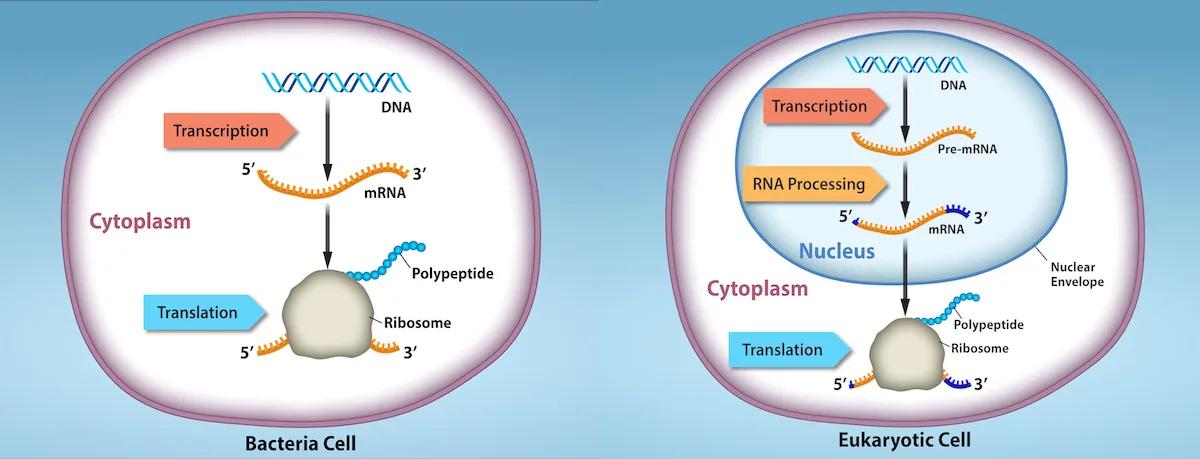
Prokaryotic organisms are single-celled organisms that lack a cell nucleus, and their DNA therefore floats freely in the cell cytoplasm. To synthesize a protein, the processes of transcription and translation occur almost simultaneously. When the resulting protein is no longer needed, transcription stops. As a result, the primary method to control what type of protein and how much of each protein is expressed in a prokaryotic cell is the regulation of DNA transcription. All of the subsequent steps occur automatically. When more protein is required, more transcription occurs. Therefore, in prokaryotic cells, the control of gene expression is mostly at the transcriptional level.
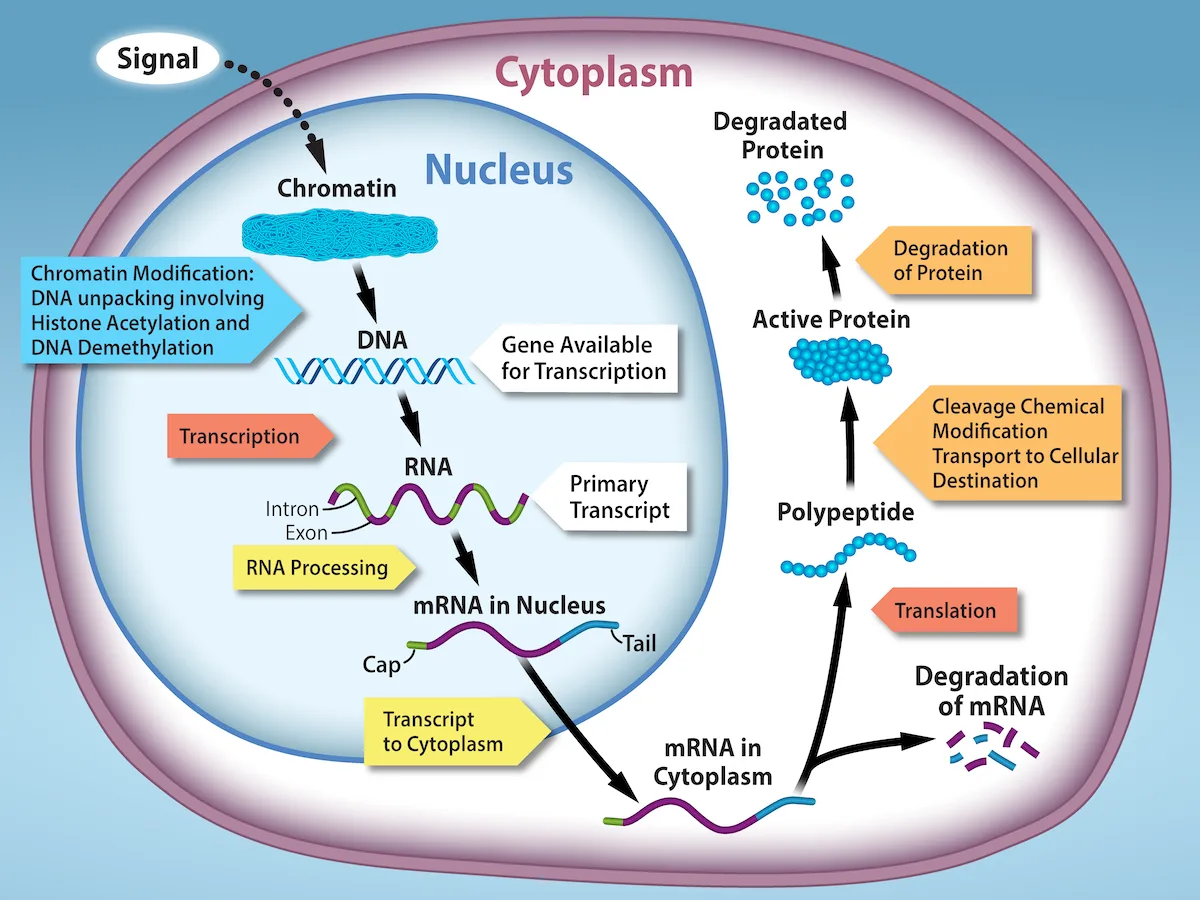
Eukaryotic cells, in contrast, have intracellular organelles that add to their complexity. In eukaryotic cells, the DNA is contained inside the cell’s nucleus and there it is transcribed into RNA. The newly synthesized RNA is then transported out of the nucleus into the cytoplasm, where ribosomes translate the RNA into protein. The processes of transcription and translation are physically separated by the nuclear membrane; transcription occurs only within the nucleus, and translation occurs only outside the nucleus in the cytoplasm. The regulation of gene expression can occur at all stages of the process (see the figure below). Regulation may occur when the DNA is uncoiled and loosened from nucleosomes to bind transcription factors (epigenetic level), when the RNA is transcribed (transcriptional level), when the RNA is processed and exported to the cytoplasm after it is transcribed (post-transcriptional level), when the RNA is translated into protein (translational level), or after the protein has been made (post-translational level).
Extended description
In the nucleus, a dotted arrow from an oval labeled ‘Signal’ points to a coiled strand labeled ‘Chromatin.’ An arrow labeled ‘Chromatin Modification: DNA unpacking involving Histone Acetylation and DNA Demethylation’ points down to a double helix labeled ‘DNA,’ beside a white arrow labeled ‘Gene Available for Transcription.’ An orange arrow labeled ‘Transcription’ points down to a wavy strand labeled ‘RNA,’ marked with an ‘Intron’ segment and an ‘Exon’ segment, beside a white arrow labeled ‘Primary Transcript.’ A yellow arrow labeled ‘RNA Processing’ points down to a capped and tailed strand labeled ‘mRNA in Nucleus’ (‘Cap’ and ‘Tail’). A yellow arrow labeled ‘Transcript to Cytoplasm’ carries the strand, now labeled ‘mRNA in Cytoplasm,’ out of the nucleus into the surrounding cytoplasm. From there, one arrow points to a dashed, broken-up strand labeled ‘Degradation of mRNA,’ and another, through a red ‘Translation’ arrow, points up to a beaded chain labeled ‘Polypeptide.’ An orange arrow labeled ‘Cleavage Chemical Modification Transport to Cellular Destination’ points up to a folded shape labeled ‘Active Protein,’ and a final orange arrow labeled ‘Degradation of Protein’ points to a cluster of loose dots labeled ‘Degraded Protein.’
Extended description
Left, a bacterial cell with no internal compartments: an arrow labeled ‘Transcription’ leads from a DNA double helix down to an mRNA strand marked 5′ and 3′ at its ends, and an arrow labeled ‘Translation’ leads from the mRNA to a ribosome from which a beaded polypeptide chain extends; the whole cell is labeled ‘Cytoplasm.’ Right, a eukaryotic cell with an outlined nucleus inside the cytoplasm: inside the nucleus, an arrow labeled ‘Transcription’ leads from DNA down to a strand labeled ‘Pre-mRNA,’ and an arrow labeled ‘RNA Processing’ leads from the pre-mRNA to a shorter, capped strand labeled ‘mRNA,’ marked 5′ and 3′; the mRNA then crosses the labeled ‘Nuclear Envelope’ into the cytoplasm, where an arrow labeled ‘Translation’ leads to a ribosome producing a polypeptide chain, exactly as in the bacterial cell.
The differences in the regulation of gene expression between prokaryotes and eukaryotes are summarized in the table below. The regulation of gene expression is discussed in detail in subsequent modules.
Differences in the Regulation of Gene Expression of Prokaryotic and Eukaryotic Organisms
| Prokaryotic organisms | Eukaryotic organisms |
|---|---|
| Lack a membrane-bound nucleus | Contain nucleus |
| DNA is found in the cytoplasm | DNA is confined to the nuclear compartment |
| RNA transcription and protein formation occur almost simultaneously | RNA transcription occurs prior to protein formation, and it takes place in the nucleus. Translation of RNA to protein occurs in the cytoplasm. |
| Gene expression is regulated primarily at the transcriptional level | Gene expression is regulated at many levels (epigenetic, transcriptional, nuclear shuttling, post-transcriptional, translational, and post-translational) |
Evolution Connection. Evolution of Gene Regulation. Prokaryotic cells can only regulate gene expression by controlling the amount of transcription. As eukaryotic cells evolved, the complexity of the control of gene expression increased. For example, with the evolution of eukaryotic cells came compartmentalization of important cellular components and cellular processes. A nuclear region that contains the DNA was formed. Transcription and translation were physically separated into two different cellular compartments. It therefore became possible to control gene expression by regulating transcription in the nucleus, and also by controlling the RNA levels and protein translation present outside the nucleus.
Most gene regulation is done to conserve cell resources. However, other regulatory processes may be defensive. Cellular processes such as gene silencing developed to protect the cell from viral or parasitic infections. If the cell could quickly shut off gene expression for a short period of time, it would be able to survive an infection when other organisms could not. Therefore, the organism evolved a new process that helped it survive, and it was able to pass this new development to offspring.
Summary
While all somatic cells within an organism contain the same DNA, not all cells within that organism express the same proteins. Prokaryotic organisms express most of their genes most of the time. However, some genes are expressed only when they are needed. Eukaryotic organisms, on the other hand, express only a subset of their genes in any given cell. To express a protein, the DNA is first transcribed into RNA, which is then translated into proteins, which are then targeted to specific cellular locations. In prokaryotic cells, transcription and translation occur almost simultaneously. In eukaryotic cells, transcription occurs in the nucleus and is separate from the translation that occurs in the cytoplasm. Gene expression in prokaryotes is mostly regulated at the transcriptional level (some epigenetic and post-translational regulation is also present), whereas in eukaryotic cells, gene expression is regulated at the epigenetic, transcriptional, post-transcriptional, translational, and post-translational levels.
Key terms
- epigenetic — heritable changes that do not involve changes in the DNA sequence
- gene expression — processes that control the turning on or turning off of a gene
- post-transcriptional — control of gene expression after the RNA molecule has been created but before it is translated into protein
- post-translational — control of gene expression after a protein has been created
Practice
Discuss why every cell does not express all of its genes all of the time
How does the regulation of gene expression support continued evolution of more complex organisms?
Two of the four options are each individually defensible — check whether the fourth option just names both of them together.The processes that control the turning on or turning off of a gene are collectively called ________.
This is the term the section’s opening paragraph introduces for turning a gene on to produce RNA and protein.Although every somatic cell in an organism contains the same DNA, not every cell expresses the same ________.
This is what genes are ultimately transcribed and translated to produce, and it is what differs between cell types despite an identical genome.Describe how prokaryotic gene regulation occurs at the transcriptional level
Assign each property to the type of cell it describes.
Prokaryotic organisms
Eukaryotic organisms
Name two differences between prokaryotic and eukaryotic cells and how these differences benefit multicellular organisms.
Show model answer
Eukaryotic cells have a nucleus, whereas prokaryotic cells do not. In eukaryotic cells, DNA is confined within the nuclear region. Because of this, transcription and translation are physically separated. This creates a more complex mechanism for the control of gene expression that benefits multicellular organisms because it compartmentalizes gene regulation.
Gene expression occurs at many stages in eukaryotic cells, whereas in prokaryotic cells, control of gene expression only occurs at the transcriptional level. This allows for greater control of gene expression in eukaryotes and more complex systems to be developed. Because of this, different cell types can arise in an individual organism.
Did your answer mention:
In prokaryotic cells, transcription and translation occur almost ________.
Prokaryotic cells have no nuclear membrane to separate the two processes in time.Discuss how eukaryotic gene regulation occurs at the epigenetic, transcriptional, post-transcriptional, translational, and post-translational levels
Control of gene expression in eukaryotic cells occurs at which level(s)?
Eukaryotic regulation is not limited to any one stage between DNA and a finished, functional protein.Post-translational control refers to:
“Post-” means after, and the second half of the word names which step it comes after.Describe how controlling gene expression will alter the overall protein levels in the cell.
Show model answer
Did your answer mention:
Heritable changes that do not involve changes in the DNA sequence describe the ________ level of gene regulation.
This is the level of regulation that controls how tightly DNA is packaged, before transcription factors can even bind it.Control of gene expression after the RNA molecule has been created but before it is translated into protein is called the ________ level.
This level of control falls between the making of the RNA and its translation into protein.This section is adapted from Biology 2e, Section 16.1: Regulation of Gene Expression by Mary Ann Clark, Jung Choi, Matthew Douglas, and OpenStax, © OpenStax, licensed under CC BY-NC-SA 4.0. Access the original for free at openstax.org. Changes: figures re-encoded as WebP, with the second re-kinded from the manifest’s file-extension guess of “photo” to “diagram” after inspection (it is a drawn schematic, not a photograph); an extended description added to both figures, since neither labeled flow diagram’s arrows and box text are fully carried by its caption; the source alt’s letter-by-letter spellings (“D N A,” “m R N A”) rewritten as plain text; the stripped print cross-references to the figure and the table changed to descriptive “the figure below” and “the table below” since figures and tables are not numbered here; the comparison table kept in the body as a Markdown table and reused as a sort-into-bins exercise; the Evolution Connection feature box rendered as a callout with its bold name and italic subheading kept; the end-of-section Review Questions and Critical Thinking Questions adapted into the closing interactive Practice block (multiple choice and self-check respectively); rubric checkpoints added to each self-check, decomposing its model answer (the source solution) into check-off clauses with no new claims; two key-term recall items (gene expression, epigenetic) and one glossary recall item (post-transcriptional) added from the glossary; and two summary-derived recall items added, one under the first objective (the shared-DNA-versus-shared-proteins sentence) and one under the second (the prokaryotic transcription-and-translation-simultaneity sentence).