Prokaryotic Gene Regulation
By the end of this section, you will be able to:
- Describe the steps involved in prokaryotic gene regulation
- Explain the roles of activators, inducers, and repressors in gene regulation
The DNA of prokaryotes is organized into a circular chromosome, supercoiled within the nucleoid region of the cell cytoplasm. Proteins that are needed for a specific function, or that are involved in the same biochemical pathway, are encoded together in blocks called operons. For example, all of the genes needed to use lactose as an energy source are coded next to each other in the lactose (or lac) operon, and transcribed into a single mRNA.
In prokaryotic cells, there are three types of regulatory molecules that can affect the expression of operons: repressors, activators, and inducers. Repressors and activators are proteins produced in the cell. Both repressors and activators regulate gene expression by binding to specific DNA sites adjacent to the genes they control. In general, activators bind to the promoter site, while repressors bind to operator regions. Repressors prevent transcription of a gene in response to an external stimulus, whereas activators increase the transcription of a gene in response to an external stimulus. Inducers are small molecules that may be produced by the cell or that are in the cell’s environment. Inducers either activate or repress transcription depending on the needs of the cell and the availability of substrate.
The trp Operon: A Repressible Operon
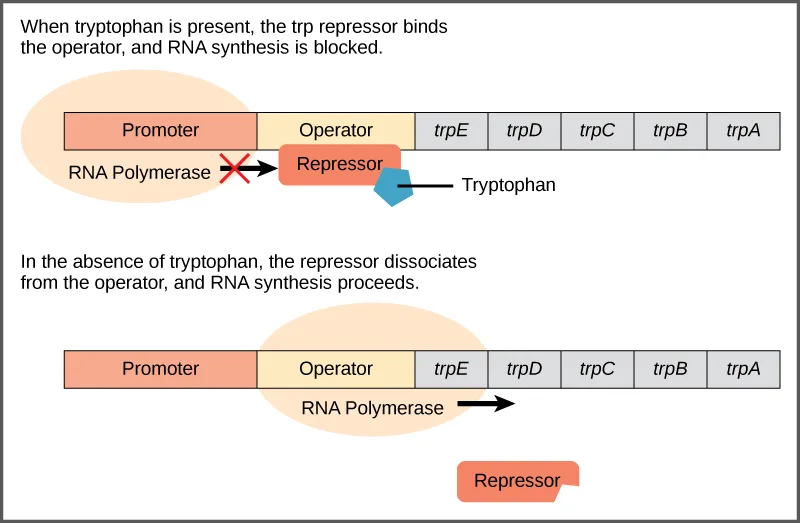
Bacteria such as Escherichia coli need amino acids to survive, and are able to synthesize many of them. Tryptophan is one such amino acid that E. coli can either ingest from the environment or synthesize using enzymes that are encoded by five genes. These five genes are next to each other in what is called the tryptophan (trp) operon (see the figure below). The genes are transcribed into a single mRNA, which is then translated to produce all five enzymes. If tryptophan is present in the environment, then E. coli does not need to synthesize it and the trp operon is switched off. However, when tryptophan availability is low, the switch controlling the operon is turned on, the mRNA is transcribed, the enzyme proteins are translated, and tryptophan is synthesized.
Extended description
Top panel, labeled ‘When tryptophan is present, the trp repressor binds the operator, and RNA synthesis is blocked’: the gene bar reads Promoter, Operator, trpE, trpD, trpC, trpB, trpA left to right; a peach oval labeled RNA Polymerase overlaps the Promoter and Operator; a red X sits between RNA Polymerase and an orange Repressor box on the Operator; a blue pentagon labeled Tryptophan points into the Repressor box with an arrow. Bottom panel, labeled ‘In the absence of tryptophan, the repressor dissociates from the operator, and RNA synthesis proceeds’: the same gene bar; the RNA Polymerase oval now has a black arrow running through the Operator into trpE; a separate, unbound orange Repressor box sits below and to the right of the bar.
The trp operon includes three important regions: the coding region, the trp operator and the trp promoter. The coding region includes the genes for the five tryptophan biosynthesis enzymes. Just before the coding region is the transcriptional start site. The promoter sequence, to which RNA polymerase binds to initiate transcription, is before or “upstream” of the transcriptional start site. Between the promoter and the transcriptional start site is the operator region.
The trp operator contains the DNA code to which the trp repressor protein can bind. However, the repressor alone cannot bind to the operator. When tryptophan is present in the cell, two tryptophan molecules bind to the trp repressor, which changes the shape of the repressor protein to a form that can bind to the trp operator. Binding of the tryptophan–repressor complex at the operator physically prevents the RNA polymerase from binding to the promoter and transcribing the downstream genes.
When tryptophan is not present in the cell, the repressor by itself does not bind to the operator, the polymerase can transcribe the enzyme genes, and tryptophan is synthesized. Because the repressor protein actively binds to the operator to keep the genes turned off, the trp operon is said to be negatively regulated and the proteins that bind to the operator to silence trp expression are negative regulators.
Catabolite Activator Protein (CAP): A Transcriptional Activator
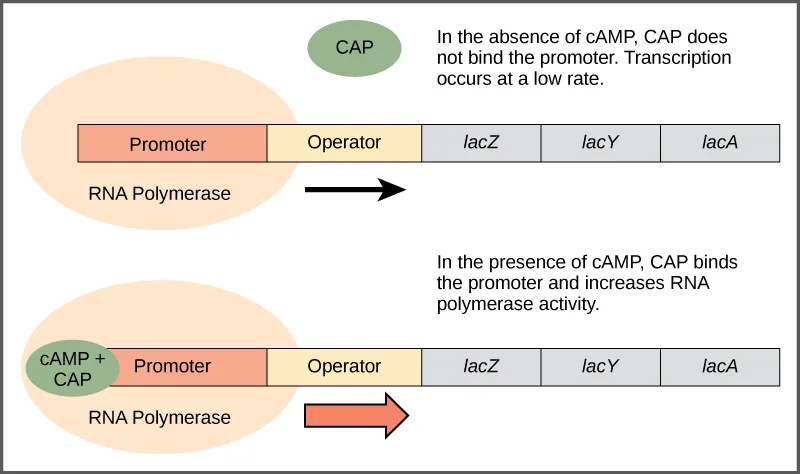
Just as the trp operon is negatively regulated by tryptophan molecules, there are proteins that bind to the promoter sequences that act as positive regulators to turn genes on and activate them. For example, when glucose is scarce, E. coli bacteria can turn to other sugar sources for fuel. To do this, new genes to process these alternate sugars must be transcribed. When glucose levels drop, cyclic AMP (cAMP) begins to accumulate in the cell. The cAMP molecule is a signaling molecule that is involved in glucose and energy metabolism in E. coli. Accumulating cAMP binds to the positive regulator catabolite activator protein (CAP), a protein that binds to the promoters of operons which control the processing of alternative sugars. When cAMP binds to CAP, the complex then binds to the promoter region of the genes that are needed to use the alternate sugar sources (see the figure below). In these operons, a CAP-binding site is located upstream of the RNA-polymerase-binding site in the promoter. CAP binding stabilizes the binding of RNA polymerase to the promoter region and increases transcription of the associated protein-coding genes.
Extended description
Top panel, labeled ‘In the absence of cAMP, CAP does not bind the promoter. Transcription occurs at a low rate’: a green oval labeled CAP sits apart from the gene bar, which reads Promoter, Operator, lacZ, lacY, lacA; a peach oval labeled RNA Polymerase overlaps the Promoter, with a thin black arrow pointing right toward the genes. Bottom panel, labeled ‘In the presence of cAMP, CAP binds the promoter and increases RNA polymerase activity’: the same gene bar, now with a green oval labeled cAMP + CAP attached to the left edge of the Promoter; the RNA Polymerase oval overlaps the Promoter as before, but the arrow toward the genes is thick and orange.
The lac Operon: An Inducible Operon
The third type of gene regulation in prokaryotic cells occurs through inducible operons, which have proteins that bind to activate or repress transcription depending on the local environment and the needs of the cell. The lac operon is a typical inducible operon. As mentioned previously, E. coli is able to use other sugars as energy sources when glucose concentrations are low. One such sugar source is lactose. The lac operon encodes the genes necessary to acquire and process the lactose from the local environment. The Z gene of the lac operon encodes beta-galactosidase, which breaks lactose down to glucose and galactose.
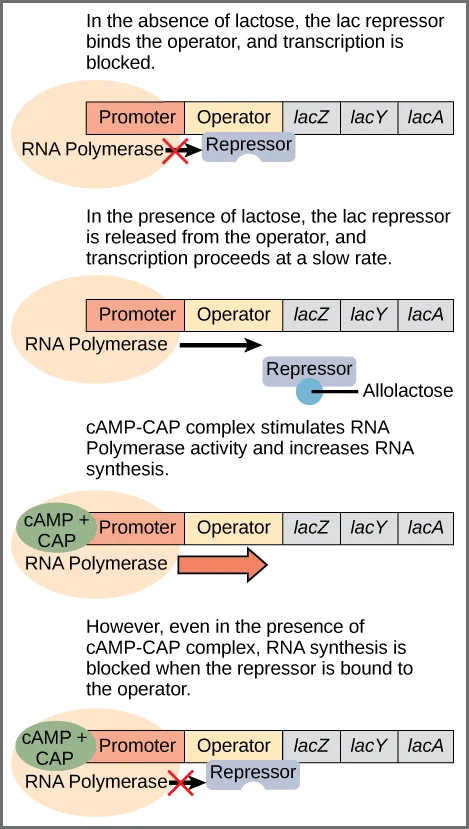
However, for the lac operon to be activated, two conditions must be met. First, the level of glucose must be very low or non-existent. Second, lactose must be present. Only when glucose is absent and lactose is present will the lac operon be transcribed (see the figure below). In the absence of glucose, the binding of the CAP protein makes transcription of the lac operon more effective. When lactose is present, its metabolite, allolactose, binds to the lac repressor and changes its shape so that it cannot bind to the lac operator to prevent transcription. This combination of conditions makes sense for the cell, because it would be energetically wasteful to synthesize the enzymes to process lactose if glucose was plentiful or lactose was not available. It should be mentioned that the lac operon is transcribed at a very low rate even when glucose is present and lactose absent.
Extended description
Panel 1, labeled ‘In the absence of lactose, the lac repressor binds the operator, and transcription is blocked’: the gene bar reads Promoter, Operator, lacZ, lacY, lacA; RNA Polymerase overlaps the Promoter, a red X sits between it and a blue-grey Repressor box on the Operator. Panel 2, labeled ‘In the presence of lactose, the lac repressor is released from the operator, and transcription proceeds at a slow rate’: the same bar; RNA Polymerase has a thin black arrow through to the genes; the Repressor box sits detached to the right, with a small blue circle labeled Allolactose attached to it. Panel 3, labeled ‘cAMP-CAP complex stimulates RNA Polymerase activity and increases RNA synthesis’: a green oval labeled cAMP + CAP is attached to the left edge of the Promoter; RNA Polymerase has a thick orange arrow through to the genes. Panel 4, labeled ‘However, even in the presence of cAMP-CAP complex, RNA synthesis is blocked when the repressor is bound to the operator’: the cAMP + CAP oval is still attached to the Promoter, but a red X and a blue-grey Repressor box on the Operator again block RNA Polymerase.
In E. coli, the trp operon is on by default, while the lac operon is off. Why do you think that this is the case?
Show model answer
Did your answer mention:
If glucose is present, then CAP fails to bind to the promoter sequence to activate transcription. If lactose is absent, then the repressor binds to the operator to prevent transcription. If either of these conditions is met, then transcription remains off. Only when glucose is absent and lactose is present is the lac operon transcribed at a higher rate. If both glucose and lactose are present, the transcription rate is low as the CAP is not bound to promote maximal rates of lac operon transcription (see the table below).
| Signals that Induce or Repress Transcription of the lac Operon | ||||
|---|---|---|---|---|
| Glucose | CAP binds | Lactose | Repressor binds | Transcription |
| + | − | − | + | No |
| + | − | + | − | Some |
| − | + | − | + | No |
| − | + | + | − | Yes |
Summary
The regulation of gene expression in prokaryotic cells occurs at the transcriptional level. There are two majors kinds of proteins that control prokaryotic transcription: repressors and activators. Repressors bind to an operator region to block the action of RNA polymerase. Activators bind to the promoter to enhance the binding of RNA polymerase. Inducer molecules can increase transcription either by inactivating repressors or by activating activator proteins. In the trp operon, the trp repressor is itself activated by binding to tryptophan. Therefore, if tryptophan is not needed, the repressor is bound to the operator and transcription remains off. The lac operon is activated by the CAP (catabolite activator protein), which binds to the promoter to stabilize RNA polymerase binding. CAP is itself activated by cAMP, whose concentration rises as the concentration of glucose falls. However, the lac operon also requires the presence of lactose for transcription to occur. Lactose inactivates the lac repressor, and prevents the repressor protein from binding to the lac operator. With the repressor inactivated, transcription may proceed. Therefore glucose must be absent and lactose must be present for effective transcription of the lac operon.
Key terms
- activator — protein that binds to prokaryotic promoters to increase transcription
- catabolite activator protein (CAP) — protein that complexes with cAMP to bind to the promoter sequences of operons which control sugar processing when glucose is not available
- inducer — a small molecule that either activates or represses transcription
- inducible operon — operon that can be activated or repressed depending on cellular needs and the surrounding environment
- lac operon — operon in prokaryotic cells that encodes genes required for processing and intake of lactose
- negative regulator — protein that prevents transcription
- operator — region of DNA outside of the promoter region that binds activators or repressors that control gene expression in prokaryotic cells
- operon — collection of genes involved in a pathway that are transcribed together as a single mRNA in prokaryotic cells
- positive regulator — protein that increases transcription
- repressor — protein that binds to the operator of prokaryotic genes to prevent transcription
- transcriptional start site — site at which transcription begins
- trp operon — series of genes necessary to synthesize tryptophan in prokaryotic cells
- tryptophan — amino acid that can be synthesized by prokaryotic cells when necessary
Practice
Describe the steps involved in prokaryotic gene regulation
Prokaryotic cells lack a nucleus. Therefore, the genes in prokaryotic cells are:
Check whether translation really can begin before transcription ends, and whether that also means transcription is controlled — both, one, or neither?What is the difference between a repressible and an inducible operon?
Show model answer
Did your answer mention:
A collection of genes involved in the same pathway that are transcribed together as a single mRNA in prokaryotic cells is called a(n) ________.
The lac and trp examples in this section are both named this way.In the trp operon, the DNA region between the promoter and the transcriptional start site, to which the repressor protein can bind, is called the ________.
It sits downstream of the promoter and is where the trp repressor binds when tryptophan is present.The site at which transcription begins, located just after a gene’s promoter and operator, is called the ________.
RNA polymerase reaches this point right after it has bound the promoter.Explain the roles of activators, inducers, and repressors in gene regulation
If glucose is absent, but so is lactose, the lac operon will be ________.
Both conditions the section names for turning the operon fully on are not met here — check what happens when lactose alone is missing.The ara operon is an inducible operon that controls the breakdown of the sugar arabinose. When arabinose is present in a bacterium it binds to the protein AraC, and the complex binds to the initiator site to promote transcription. In this scenario, AraC is a(n) ________.
AraC’s binding to the initiator site promotes transcription rather than blocking it.Describe how transcription in prokaryotic cells can be altered by external stimulation such as excess lactose in the environment.
Show model answer
Did your answer mention:
A protein that binds to a prokaryotic promoter sequence to increase transcription of a gene is called a(n) ________.
It is a positive regulator — the opposite of a repressor.A protein that binds to the operator of a prokaryotic gene to prevent its transcription is called a(n) ________.
Two molecules of tryptophan must bind this protein before it can bind the trp operator.A small molecule, produced by the cell or present in its environment, that can activate or repress transcription depending on the cell’s needs is called a(n) ________.
Allolactose and cAMP both act as one of these in this section’s examples.This section is adapted from Biology 2e, Section 16.2: Prokaryotic Gene Regulation by Mary Ann Clark, Jung Choi, Matthew Douglas, and OpenStax, © OpenStax, licensed under CC BY-NC-SA 4.0. Access the original for free at openstax.org. Changes: figures re-encoded as WebP and set kind="diagram" (the manifest’s file-extension guess called the first two figures “photo,” but all three are labeled operon schematics); the source’s letter-spelled screen-reader alts (“The t r p operon has a promoter…”) rewritten as plain descriptions, with an extended description added to each figure since none of the three schematics’ arrows, boxes, and labels are carried by their captions; internal print cross-references (“Figure 16.4”) changed to “see the figure below” since figures are not numbered here; the note wrapping the Visual Connection question rendered as the figure plus the question kept in the body as a self-check, since the source keys it with a prose answer rather than a lettered option; the two Link to Learning notes rendered as callouts with descriptive link text; the source’s glossary definition of “activator,” which both the CNXML and the printed Key Terms page give as a protein that binds to prokaryotic “operators,” corrected here to “promoters” to match this section’s own explicit statement that “activators bind to the promoter site, while repressors bind to operator regions” (reported to the errata log); the end-of-section Review Questions and Critical Thinking Questions adapted into the closing interactive Practice block (multiple choice and self-check respectively); rubric checkpoints added to each self-check, decomposing its model answer (the source solution) into check-off clauses with no new claims; and six key-term recall items (operon, operator, transcriptional start site, activator, repressor, inducer) added from the glossary; the repressible-operon self-check’s source solution corrected from a protein bound to the “promoter region” to the “operator region”, per the module’s own sentence that repressors bind operator regions (reported as a source defect); and the tryptophan self-check’s source phrase “the expression of the trp receptor is repressed” corrected to “the trp operon”, matching every other passage in the module (reported as a source defect).