Eukaryotic Transcription Gene Regulation
By the end of this section, you will be able to:
- Discuss the role of transcription factors in gene regulation
- Explain how enhancers and repressors regulate gene expression
Like prokaryotic cells, the transcription of genes in eukaryotes requires the action of an RNA polymerase to bind to a DNA sequence upstream of a gene in order to initiate transcription. However, unlike prokaryotic cells, the eukaryotic RNA polymerase requires other proteins, or transcription factors, to facilitate transcription initiation. RNA polymerase by itself cannot initiate transcription in eukaryotic cells. There are two types of transcription factors that regulate eukaryotic transcription: General (or basal) transcription factors bind to the core promoter region to assist with the binding of RNA polymerase. Specific transcription factors bind to various regions outside of the core promoter region and interact with the proteins at the core promoter to enhance or repress the activity of the polymerase.
The Promoter and the Transcription Machinery
Genes are organized to make the control of gene expression easier. The promoter region is immediately upstream of the coding sequence. This region can be short (only a few nucleotides in length) or quite long (hundreds of nucleotides long). The longer the promoter, the more available space for proteins to bind. This also adds more control to the transcription process. The length of the promoter is gene-specific and can differ dramatically between genes. Consequently, the level of control of gene expression can also differ quite dramatically between genes. The purpose of the promoter is to bind transcription factors that control the initiation of transcription.
Within the core promoter region, 25 to 35 bases upstream of the transcriptional start site, resides the TATA box. The TATA box has the consensus sequence of 5′-TATAAA-3′. The TATA box is the binding site for a protein complex called TFIID, which contains a TATA-binding protein. Binding of TFIID recruits other transcription factors, including TFIIB, TFIIE, TFIIF, and TFIIH. Some of these transcription factors help to bind the RNA polymerase to the promoter, and others help to activate the transcription initiation complex.
In addition to the TATA box, other binding sites are found in some promoters. Some biologists prefer to restrict the range of the eukaryotic promoter to the core promoter, or polymerase binding site, and refer to these additional sites as promoter-proximal elements, because they are usually found within a few hundred base pairs upstream of the transcriptional start site. Examples of these elements are the CAAT box, with the consensus sequence 5′-CCAAT-3′ and the GC box, with the consensus sequence 5′-GGGCGG-3′. Specific transcription factors can bind to these promoter-proximal elements to regulate gene transcription. A given gene may have its own combination of these specific transcription-factor binding sites. There are hundreds of transcription factors in a cell, each of which binds specifically to a particular DNA sequence motif. When transcription factors bind to the promoter just upstream of the encoded gene, it is referred to as a cis-acting element, because it is on the same chromosome just next to the gene. Transcription factors respond to environmental stimuli that cause the proteins to find their binding sites and initiate transcription of the gene that is needed.
Enhancers and Transcription
In some eukaryotic genes, there are additional regions that help increase or enhance transcription. These regions, called enhancers, are not necessarily close to the genes they enhance. They can be located upstream of a gene, within the coding region of the gene, downstream of a gene, or may be thousands of nucleotides away.
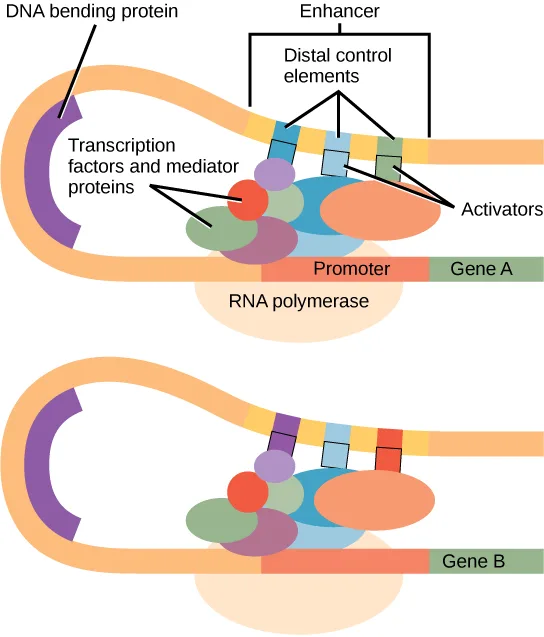
Enhancer regions are binding sequences, or sites, for specific transcription factors. When a protein transcription factor binds to its enhancer sequence, the shape of the protein changes, allowing it to interact with proteins at the promoter site. However, since the enhancer region may be distant from the promoter, the DNA must bend to allow the proteins at the two sites to come into contact. DNA bending proteins help to bend the DNA and bring the enhancer and promoter regions together (see the diagram below). This shape change allows for the interaction of the specific activator proteins bound to the enhancers with the general transcription factors bound to the promoter region and the RNA polymerase.
Extended description
Two nearly identical diagrams, stacked. In each, a single long DNA strand loops back on itself; a purple crescent labeled ‘DNA bending protein’ sits at the near end of the loop. Following the strand from there, it passes through a short segment holding three small colored boxes labeled ‘Distal control elements’ under the heading ‘Enhancer,’ then into a segment labeled ‘Promoter’ and, at the strand’s end, a segment labeled ‘Gene A’ in the top diagram or ‘Gene B’ in the bottom diagram. Where the loop brings the enhancer beside the promoter, five colored ovals labeled ‘Transcription factors and mediator proteins’ cluster in the gap between them: a large orange oval, a large blue oval, a purple oval, a green oval, and a small red circle. Beneath each distal control element sits a small colored square — the activators, each bound to its own element; a label reading ‘Activators’ at the right points to two of these squares with thin lines. A pale oval behind the promoter is labeled ‘RNA polymerase.’ The top and bottom diagrams differ only in the colors of the three distal-control-element/activator pairs and in which gene is labeled at the end, showing that two different genes can share a promoter but carry different distal control elements.
Turning Genes Off: Transcriptional Repressors
Like prokaryotic cells, eukaryotic cells also have mechanisms to prevent transcription. Transcriptional repressors can bind to promoter or enhancer regions and block transcription. Like the transcriptional activators, repressors respond to external stimuli to prevent the binding of activating transcription factors.
Summary
To start transcription, general transcription factors, such as TFIID, TFIIB, and others, must first bind to the TATA box and recruit RNA polymerase to that location. Additional transcription factors may also bind to other regulatory elements at the promoter to increase or prevent transcription. In addition to promoter sequences, enhancer regions help augment transcription. Enhancers can be upstream, downstream, within a gene itself, or on other chromosomes. Specific transcription factors bound to enhancer regions may either increase or prevent transcription.
Key terms
- cis-acting element — transcription factor binding sites within the promoter that regulate the transcription of a gene adjacent to it.
- enhancer — segment of DNA that is upstream, downstream, perhaps thousands of nucleotides away, or on another chromosome that influence the transcription of a specific gene.
- trans-acting element — transcription factor binding site found outside the promoter or on another chromosome that influences the transcription of a particular gene.
- transcription factor binding site — sequence of DNA to which a transcription factor binds.
Practice
Discuss the role of transcription factors in gene regulation
A scientist compares the promoter regions of two genes. Gene A’s core promoter plus proximal promoter elements encompasses 70bp. Gene B’s core promoter plus proximal promoter elements encompasses 250bp. Which of the scientist’s hypotheses is most likely to be correct?
A longer promoter has more room for binding sites — think about what each additional site is for.The binding of ________ is required for transcription to start.
Every other listed factor helps this molecule find and bind the promoter, but transcription itself begins only once it does.Transcription factor binding sites within the promoter that regulate transcription of the adjacent gene are known as a ________.
The Latin prefix means ‘on the same side’ — the site sits on the same chromosome as the gene it controls.A sequence of DNA to which a transcription factor binds is called a ________.
Name the DNA sequence itself, not the protein that recognizes it.A mutation within the promoter region can alter transcription of a gene. Describe how this can happen.
Show model answer
Did your answer mention:
What could happen if a cell had too much of an activating transcription factor present?
Show model answer
Did your answer mention:
Explain how enhancers and repressors regulate gene expression
What will result from the binding of a transcription factor to an enhancer region?
An enhancer is not necessarily near the gene it acts on.A segment of DNA that can sit upstream, downstream, thousands of nucleotides away, or on another chromosome, and that increases transcription of a specific gene, is called a(n) ________.
Its name describes what it does to transcription.A transcription factor binding site located outside the promoter, or on another chromosome, that influences transcription of a particular gene is called a ________.
The Latin prefix means ‘across’ or ‘on the other side’ — it sits apart from the gene it controls, unlike its promoter-adjacent counterpart.A scientist identifies a potential transcription regulation site 300bp downstream of a gene and hypothesizes that it is a repressor. What experiment (with results) could he perform to support this hypothesis?
Show model answer
Did your answer mention:
This section is adapted from Biology 2e, Section 16.4: Eukaryotic Transcription Gene Regulation by Mary Ann Clark, Jung Choi, Matthew Douglas, and OpenStax, © OpenStax, licensed under CC BY-NC-SA 4.0. Access the original for free at openstax.org. Changes: the figure re-encoded as WebP and re-kinded from the manifest’s file-extension guess of “photo” to “diagram” after inspection (it is a colored schematic, not a photograph); its source alt, a letter-spaced text-to-speech spelling (“D N A,” “R N A”), rewritten from the image, with a full element-by-element walkthrough moved into a longdesc; the Link to Learning feature box rendered as a callout with descriptive anchor text in place of the source’s bare video link; the end-of-section Review Questions and Critical Thinking Questions adapted into the closing interactive Practice block (multiple choice and self-check respectively); all four key-term recall items added from the glossary (cis-acting element, enhancer, trans-acting element, transcription factor binding site); and rubric checkpoints added to each self-check, decomposing its model answer (the source solution) into check-off clauses with no new claims.