Eukaryotic Translational and Post-translational Gene Regulation
By the end of this section, you will be able to:
- Understand the process of translation and discuss its key factors
- Describe how the initiation complex controls translation
- Explain the different ways in which the post-translational control of gene expression takes place
After RNA has been transported to the cytoplasm, it is translated into protein. Control of this process is largely dependent on the RNA molecule. As previously discussed, the stability of the RNA will have a large impact on its translation into a protein. As the stability changes, the amount of time that it is available for translation also changes.
The Initiation Complex and Translation Rate
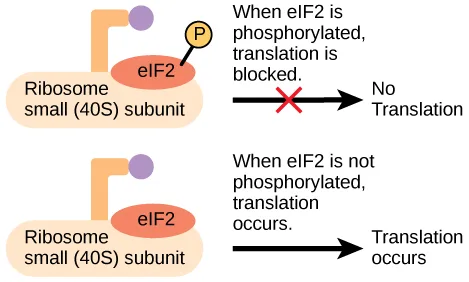
Like transcription, translation is controlled by proteins that bind and initiate the process. In translation, the complex that assembles to start the process is referred to as the translation initiation complex. In eukaryotes, translation is initiated by binding the initiating met-tRNAi to the 40S ribosome. This tRNA is brought to the 40S ribosome by a protein initiation factor, eukaryotic initiation factor-2 (eIF-2). The eIF-2 protein binds to the high-energy molecule guanosine triphosphate (GTP). The tRNA-eIF2-GTP complex then binds to the 40S ribosome. A second complex forms on the mRNA. Several different initiation factors recognize the 5′ cap of the mRNA and proteins bound to the poly-A tail of the same mRNA, forming the mRNA into a loop. The cap-binding protein eIF4F brings the mRNA complex together with the 40S ribosome complex. The ribosome then scans along the mRNA until it finds a start codon AUG. When the anticodon of the initiator tRNA and the start codon are aligned, the GTP is hydrolyzed, the initiation factors are released, and the large 60S ribosomal subunit binds to form the translation complex. The binding of eIF-2 to the RNA is controlled by phosphorylation. If eIF-2 is phosphorylated, it undergoes a conformational change and cannot bind to GTP. Therefore, the initiation complex cannot form properly and translation is impeded (see the diagram below). When eIF-2 remains unphosphorylated, the initiation complex can form normally and translation can proceed.
Extended description
Two stacked panels, each showing a pale orange rounded shape labeled ‘Ribosome small (40S) subunit’ with an orange elbow-shaped strand rising from it to a small purple circle, and a red oval labeled ’eIF2’ sitting on the ribosome. Top panel: a yellow circle labeled ‘P’ is attached to the eIF2 oval; text beside it reads ‘When eIF2 is phosphorylated, translation is blocked,’ followed by a black arrow crossed by a red X and the words ‘No Translation.’ Bottom panel: the eIF2 oval carries no phosphate circle; text beside it reads ‘When eIF2 is not phosphorylated, translation occurs,’ followed by an uncrossed black arrow and the words ‘Translation occurs.’
An increase in phosphorylation levels of eIF-2 has been observed in patients with neurodegenerative diseases such as Alzheimer’s, Parkinson’s, and Huntington’s. What impact do you think this might have on protein synthesis?
Show model answer
Did your answer mention:
Chemical Modifications, Protein Activity, and Longevity
Proteins can be chemically modified with the addition of groups including methyl, phosphate, acetyl, and ubiquitin groups. The addition or removal of these groups from proteins regulates their activity or the length of time they exist in the cell. Sometimes these modifications can regulate where a protein is found in the cell—for example, in the nucleus, in the cytoplasm, or attached to the plasma membrane.
Chemical modifications occur in response to external stimuli such as stress, the lack of nutrients, heat, or ultraviolet light exposure. These changes can alter epigenetic accessibility, transcription, mRNA stability, or translation—all resulting in changes in expression of various genes. This is an efficient way for the cell to rapidly change the levels of specific proteins in response to the environment. Because proteins are involved in every stage of gene regulation, the phosphorylation of a protein (depending on the protein that is modified) can alter accessibility to the chromosome, can alter translation (by altering transcription factor binding or function), can change nuclear shuttling (by influencing modifications to the nuclear pore complex), can alter RNA stability (by binding or not binding to the RNA to regulate its stability), can modify translation (increase or decrease), or can change post-translational modifications (add or remove phosphates or other chemical modifications).
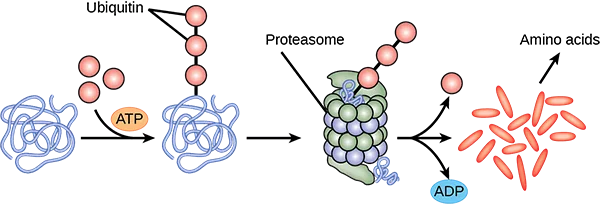
The addition of a ubiquitin group to a protein marks that protein for degradation. Ubiquitin acts like a flag indicating that the protein lifespan is complete. These proteins are moved to the proteasome, an organelle that functions to remove proteins, to be degraded (see the diagram below). One way to control gene expression, therefore, is to alter the longevity of the protein.
Extended description
A left-to-right diagram with four stages connected by black arrows. Stage 1: a loosely coiled blue protein strand sits beside three separate pink circles and an orange oval labeled ‘ATP.’ Stage 2: the same coiled protein now carries a straight chain of pink circles rising from it, labeled ‘Ubiquitin.’ Stage 3: an arrow carries the tagged protein into a barrel-shaped structure of green and purple subunits labeled ‘Proteasome.’ Stage 4: two arrows leave the proteasome — one to a blue oval labeled ‘ADP’ and a released pink circle, the other to a cluster of short orange rod shapes labeled ‘Amino acids.’
Summary
Changing the status of the RNA or the protein itself can affect the amount of protein, the function of the protein, or how long it is found in the cell. To translate the protein, a protein initiator complex must assemble on the RNA. Modifications (such as phosphorylation) of proteins in this complex can prevent proper translation from occurring. Once a protein has been synthesized, it can be modified (phosphorylated, acetylated, methylated, or ubiquitinated). These post-translational modifications can greatly impact the stability, degradation, or function of the protein.
Key terms
- eukaryotic initiation factor-2 (eIF-2) — protein that binds first to an mRNA to initiate translation
- guanosine diphosphate (GDP) — molecule that is left after the energy is used to start translation (Source note: the source glossary says “guanine diphosphate”; GDP is guanosine diphosphate, as this page’s GTP entry and the rest of this book name the nucleotide.)
- guanosine triphosphate (GTP) — energy-providing molecule that binds to eIF-2 and is needed for translation
- initiation complex — protein complex containing eIF-2 that starts translation
- large 60S ribosomal subunit — second, larger ribosomal subunit that binds to the RNA to translate it into protein
- proteasome — organelle that degrades proteins
- small 40S ribosomal subunit — ribosomal subunit that binds to the RNA to translate it into protein
Practice
Understand the process of translation and discuss its key factors
The energy-providing molecule that binds to eIF-2 and is needed for translation is called ________.
It is the high-energy molecule the eIF-2 protein must bind before the initiation complex can form.The protein complex containing eIF-2 that starts translation is called the ________.
This is the same complex whose assembly is blocked when eIF-2 carries a phosphate group.Alternative forms of a protein can be beneficial or harmful to a cell. What do you think would happen if too much of an alternative protein bound to the 3′ UTR of an RNA and caused it to degrade?
Show model answer
Did your answer mention:
Describe how the initiation complex controls translation
A scientist mutates eIF-2 to eliminate its GTP hydrolysis capability. How would this mutated form of eIF-2 alter translation?
Re-read what GTP hydrolysis normally triggers in the sequence — it is the step that lets a specific ribosomal subunit join the complex.A scientist discovers a virus encoding a Protein X that degrades a subunit of the eIF4F complex. Knowing that this virus transcribes its own mRNAs in the cytoplasm of human cells, why would Protein X be an effective virulence factor?
Show model answer
Did your answer mention:
The protein initiation factor that binds first to an mRNA to initiate translation is ________.
Its binding to GTP is required before the complex can dock on the small ribosomal subunit.Explain the different ways in which the post-translational control of gene expression takes place
Post-translational modifications of proteins can affect which of the following?
Recall the phosphorylation self-check below: because proteins are involved in every stage of gene regulation, modifying one can reach chromatin, transcription, and more.Protein modification can alter gene expression in many ways. Describe how phosphorylation of proteins can alter gene expression.
Show model answer
Did your answer mention:
Changes in epigenetic modifications alter the accessibility and transcription of DNA. Describe how environmental stimuli, such as ultraviolet light exposure, could modify gene expression.
Show model answer
Did your answer mention:
This section is adapted from Biology 2e, Section 16.6: Eukaryotic Translational and Post-translational Gene Regulation by Mary Ann Clark, Jung Choi, Matthew Douglas, and OpenStax, © OpenStax, licensed under CC BY-NC-SA 4.0. Access the original for free at openstax.org. Changes: figures re-encoded as WebP; Figure_16_06_01 re-kinded from the manifest’s file-extension guess of “photo” to “diagram” after inspection (its JPEG source is a colored line drawing, not a photograph); its source alt, a letter-spaced text-to-speech spelling (“lower case e lower case I upper case F dash 2…”), rewritten from the image, with a longdesc added since the two phosphorylation states are not carried by the caption; a longdesc also added to Figure_16_06_02 walking its four-stage degradation sequence; the note wrapping the Visual Connection question rendered as its mediafigure (kept eager as the first figure) immediately followed by a self-check carrying the source solution; the print cross-reference to the first figure changed to “see the diagram below” since figures are not numbered here; source apostrophes in “5’” normalized to the Unicode prime (5′); the end-of-section Review Questions and Critical Thinking Questions adapted into the closing interactive Practice block (multiple choice and self-check respectively); two key-term recall items (GTP, the initiation complex) and one term-identification recall item (eIF-2) added from the glossary; rubric checkpoints added to each self-check, decomposing its model answer (the source solution) into check-off clauses with no new claims; and the post-translational-modification Review Question re-keyed from the source’s “protein function” to “all of the above”, because the module’s own phosphorylation solution states that modifying a protein can alter accessibility to the chromosome and transcription-factor function — so the source’s other options are also true by the module’s own text (reported as a source defect). One key term is corrected with a visible Source note: GDP is guanosine diphosphate, matching the GTP entry beside it, not “guanine diphosphate” (erratum 404).