Applying Genomics
By the end of this section, you will be able to:
- Explain pharmacogenomics
- Define polygenic
Introducing DNA sequencing and whole genome sequencing projects, particularly the Human Genome project, has expanded the applicability of DNA sequence information. Many fields, such as metagenomics, pharmacogenomics, and mitochondrial genomics are using genomics. Understanding and finding cures for diseases is the most common application of genomics.
Predicting Disease Risk at the Individual Level
Predicting disease risk involves screening currently healthy individuals by genome analysis at the individual level. Health care professionals can recommend intervention with lifestyle changes and drugs before disease onset. However, this approach is most applicable when the problem resides within a single gene defect. Such defects only account for approximately 5 percent of diseases in developed countries. Most of the common diseases, such as heart disease, are multi-factored or polygenic, which is a phenotypic characteristic that involves two or more genes, and also involve environmental factors such as diet. In April 2010, scientists at Stanford University published the genome analysis of a healthy individual (Stephen Quake, a scientist at Stanford University, who had his genome sequenced. The analysis predicted his propensity to acquire various diseases. The medical team performed a risk assessment to analyze Quake’s percentage of risk for 55 different medical conditions. The team found a rare genetic mutation, which showed him to be at risk for sudden heart attack. The results also predicted that Quake had a 23 percent risk of developing prostate cancer and a 1.4 percent risk of developing Alzheimer’s. The scientists used databases and several publications to analyze the genomic data. Even though genomic sequencing is becoming more affordable and analytical tools are becoming more reliable, researchers still must address ethical issues surrounding genomic analysis at a population level.
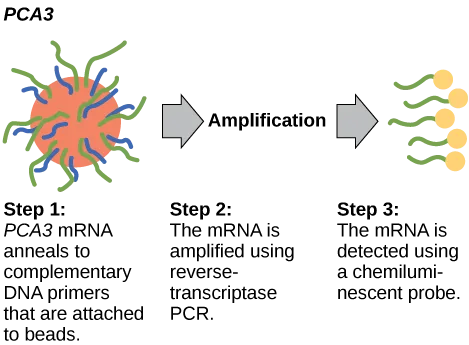
Extended description
Left to right: Step 1 shows an orange bead with short blue strands (the attached DNA primers) and longer green strands (PCA3 mRNA annealed to them) radiating from all around it. A gray arrow leads to the bold label “Amplification” — Step 2, where the mRNA is amplified using reverse-transcriptase PCR. A second gray arrow leads to Step 3: five loose green strands, no longer attached to a bead, each capped at one end with a small yellow circle, representing the mRNA detected using a chemiluminescent probe.
In 2011, the United States Preventative Services Task Force recommended against using the PSA test to screen healthy people for prostate cancer. Their recommendation is based on evidence that screening does not reduce the risk of death from prostate cancer. Prostate cancer often develops very slowly and does not cause problems, while the cancer treatment can have severe side effects. The PCA3 test is more accurate, but screening may still result in people who would not have been harmed by the cancer itself suffering side effects from treatment. What do you think? Should healthy people receive prostate cancer screenings using the PCA3 or PSA test? Should people in general receive screenings to find out if they have a genetic risk for cancer or other diseases?
Show model answer
Did your answer mention:
Pharmacogenomics and Toxicogenomics
Pharmacogenomics, or toxicogenomics, involves evaluating drug effectiveness and safety on the basis of information from an individual’s genomic sequence. We can study genomic responses to drugs using experimental animals (such as laboratory rats or mice) or live cells in the laboratory before embarking on studies with humans. Studying changes in gene expression could provide information about the transcription profile in the drug’s presence, which we can use as an early indicator of the potential for toxic effects. For example, genes involved in cellular growth and controlled cell death, when disturbed, could lead to cancerous cell growth. Genome-wide studies can also help to find new genes involved in drug toxicity. Medical professionals can use personal genome sequence information to prescribe medications that will be most effective and least toxic on the basis of the individual patient’s genotype. The gene signatures may not be completely accurate, but medical professionals can test them further before pathologic symptoms arise.
Microbial Genomics: Metagenomics
Traditionally, scholars have taught microbiology with the view that it is best to study microorganisms under pure culture conditions. This involves isolating a single cell type and culturing it in the laboratory. Because microorganisms can go through several generations in a matter of hours, their gene expression profiles adapt to the new laboratory environment very quickly. In addition, the vast majority of bacterial species resist culturing in isolation. Most microorganisms do not live as isolated entities, but in microbial communities or biofilms. For all of these reasons, pure culture is not always the best way to study microorganisms. Metagenomics is the study of the collective genomes of multiple species that grow and interact in an environmental niche. Metagenomics can be used to identify new species more rapidly and to analyze the effect of pollutants on the environment (see the figure below).
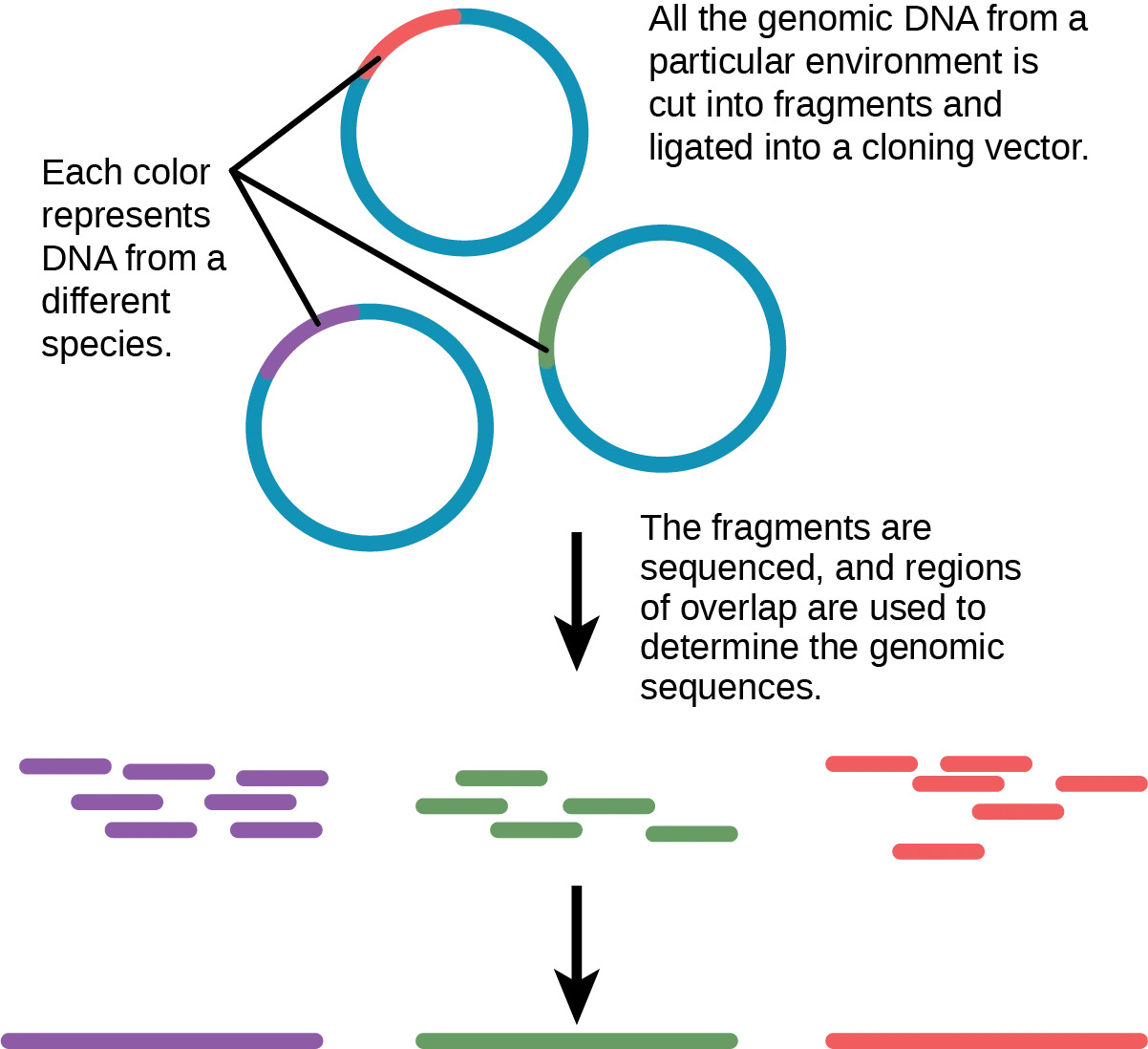
Extended description
Three thin blue circles (genomic DNA molecules), each carrying one colored arc — red, purple, and green respectively — labeled “Each color represents DNA from a different species,” with a caption reading “All the genomic DNA from a particular environment is cut into fragments and ligated into a cloning vector.” An arrow points down to three rows of short bars in matching colors — purple, green, and red, left to right — captioned “The fragments are sequenced, and regions of overlap are used to determine the genomic sequences.” A second arrow points down from each row to a single longer bar in the same color, representing the reconstructed genomic sequence determined for that species.
Microbial Genomics: Creation of New Biofuels
Knowledge of the genomics of microorganisms is being used to find better ways to harness biofuels from algae and cyanobacteria. The primary sources of fuel today are coal, oil, wood, and other plant products, such as ethanol. Although plants are renewable resources, there is still a need to find more alternative renewable sources of energy to meet our population’s energy demands. The microbial world is one of the largest resources for genes that encode new enzymes and produce new organic compounds, and it remains largely untapped. Microorganisms are used to create products, such as enzymes that are used in research, antibiotics, and other antimicrobial mechanisms. Microbial genomics is helping to develop diagnostic tools, improved vaccines, new disease treatments, and advanced environmental cleanup techniques.
Mitochondrial Genomics
Mitochondria are intracellular organelles that contain their own DNA. Mitochondrial DNA mutates at a rapid rate and scientists often use it to study evolutionary relationships. Another feature that makes studying the mitochondrial genome interesting is that the mitochondrial DNA in most multicellular organisms passes from the mother during the fertilization process. For this reason, scientists often use mitochondrial genomics to trace genealogy.
Experts have used information and clues from DNA samples at crime scenes as evidence in court cases, and they have used genetic markers in forensic analysis. Genomic analysis has also become useful in this field. The first publication showcasing the first use of genomics in forensics came out in 2001. It was a collaborative attempt between academic research institutions and the FBI to solve the mysterious cases of anthrax communicated via the US Postal Service. Using microbial genomics, researchers determined that the culprit used a specific anthrax strain in all the mailings.
Genomics in Agriculture
Genomics can reduce the trials and failures involved in scientific research to a certain extent, which could improve agricultural crop yield quality and quantity. Linking traits to genes or gene signatures helps improve crop breeding to generate hybrids with the most desirable qualities. Scientists use genomic data to identify desirable traits, and then transfer those traits to a different organism. Researchers are discovering how genomics can improve agricultural production’s quality and quantity. For example, scientists could use desirable traits to create a useful product or enhance an existing product, such as making a drought-sensitive crop more tolerant of the dry season.
Summary
Imagination is the only barrier to the applicability of genomics. Researchers are applying genomics to most fields of biology. They use it for personalized medicine, prediction of disease risks at an individual level, studying drug interactions before conducting clinical trials, and studying microorganisms in the environment as opposed to the laboratory. They are also applying it to developments such as generating new biofuels, genealogical assessment using mitochondria, advances in forensic science, and improvements in agriculture.
Key terms
- metagenomics — study of multiple species’ collective genomes that grow and interact in an environmental niche
- pharmacogenomics — study of drug interactions with the genome or proteome; also called toxicogenomics
- polygenic — phenotypic characteristic caused by two or more genes
- pure culture — growth of a single cell type in the laboratory
Practice
Explain pharmacogenomics
Evaluating drug effectiveness and safety on the basis of information from an individual’s genomic sequence is called ________.
This term opens the section that follows disease-risk prediction, and it is the study of drug interactions with the genome or proteome.According to the section summary, before conducting clinical trials, researchers apply genomics to study ________.
This is the same kind of interaction pharmacogenomics evaluates for effectiveness and safety before a drug reaches human trials.How can genomics be used to predict disease risk and treatment options?
Show model answer
Did your answer mention:
Genomics can be used on a personal level to:
The section’s own subsection on this topic describes screening currently healthy individuals by genome analysis.Define polygenic
A phenotypic characteristic caused by two or more genes is called ________.
The prefix “poly-” means “many”; this is the section’s word for a multi-factored trait like heart disease.The study of the collective genomes of multiple species that grow and interact together in an environmental niche is called ________.
This approach replaced the older practice of studying one isolated species at a time.Growth of a single cell type in the laboratory is called ________.
This is the traditional way microbiology was taught before researchers turned to studying whole microbial communities.Genomics can be used in agriculture to:
Check whether the section supports every listed use — new hybrids, disease resistance, yield — or only some of them.Explain why metagenomics is probably the most revolutionary application of genomics.
Show model answer
Did your answer mention:
This section is adapted from Biology 2e, Section 17.4: Applying Genomics by Mary Ann Clark, Jung Choi, Matthew Douglas, and OpenStax, © OpenStax, licensed under CC BY-NC-SA 4.0. Access the original for free at openstax.org. Changes: both figures re-encoded as WebP, kept as “diagram” per the manifest’s guess (confirmed on inspection — both are line-art illustrations, not photographs); Figure_B17_02_02’s source alt, a letter-spaced screen-reader spelling (“The P C A 3 test occurs in three steps…”), rewritten as a plain visual description with a longdesc added for its three-step method; Figure_B17_06_01’s source alt, a narrative walkthrough rather than a visual description, split into a concise alt plus a longdesc walking the circles, arrows, and fragment bars as drawn; the trailing figure cross-reference “(Figure 17.16)” changed to “(see the figure below)” since figures are not numbered here; the note wrapping the Visual Connection question (Figure 17.15/PCA3) kept in the body as the figure plus a self-check, its question taken from the note’s own discussion paragraph and its model answer from the module’s keyed solution, which states there is no single right answer; the end-of-section Review Questions and Critical Thinking Questions adapted into the closing interactive Practice block; the Review Question “Genomics can be used on a personal level to:” corrected from the module’s keyed solution (“A,” decrease transplant rejection) to option B, “predict genetic diseases that a person may have inherited” — the module never mentions transplant rejection outside this exercise, while its own text teaches option B directly (“Predicting disease risk involves screening currently healthy individuals… The analysis predicted his propensity to acquire various diseases”); four key-term recall items (metagenomics, pharmacogenomics, polygenic, pure culture) added from the glossary; one further summary-derived cloze text-in (“drug interactions,” from the Section Summary’s own sentence on pre-clinical-trial applications) added to raise the “Explain pharmacogenomics” group to the book’s floor, since the module’s two Review Questions and two Critical Thinking Questions test the chapter’s broader genomics applications rather than either of this section’s two narrow objectives; and rubric checkpoints added to every self-check (in the body and in Practice), decomposing each model answer into check-off clauses with no new claims.