Evolution and the Origin of Species
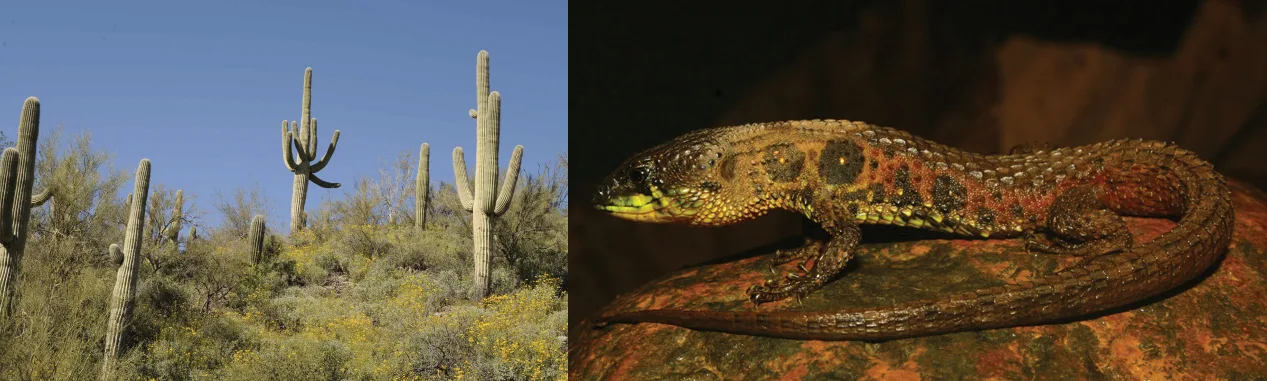
All living organisms, from bacteria to baboons to blueberries, evolved at some point from a different species. Although it may seem that living things today stay much the same, that is not the case—evolution is an ongoing process.
The theory of evolution is the unifying theory of biology, meaning it is the framework within which biologists ask questions about the living world. Its power is that it provides direction for predictions about living things that are borne out in ongoing experiments. The Ukrainian-born American geneticist Theodosius Dobzhansky famously wrote that “nothing makes sense in biology except in the light of evolution” (Theodosius Dobzhansky, “Biology, Molecular and Organismic,” American Zoologist 4, no. 4 (1964): 449). He meant that the tenet that all life has evolved and diversified from a common ancestor is the foundation from which we approach all questions in biology.
Sections
- Understanding Evolution — how scientists arrived at the present-day theory of evolution, what adaptation and convergent and divergent evolution are, what homologous and vestigial structures reveal about common ancestry, and common misconceptions about the theory.
- Formation of New Species — how scientists define and distinguish species, the genetic variables and prezygotic and postzygotic reproductive barriers that separate them, and how allopatric and sympatric speciation and adaptive radiation give rise to new species.
- Reconnection and Speciation Rates — what happens when diverging species meet again in a hybrid zone, and the two models — gradual speciation and punctuated equilibrium — for how fast speciation occurs.
This chapter is adapted from Biology 2e, Chapter 18: Evolution and the Origin of Species by Mary Ann Clark, Jung Choi, Matthew Douglas, and OpenStax, © OpenStax, licensed under CC BY-NC-SA 4.0. Access the original for free at openstax.org. Each section page records its own changes from the source. Changes: the chapter-opening photograph is the source’s, re-encoded for the web, with its source alt kept since it already says what each panel shows; the footnoted Dobzhansky citation kept as a parenthetical after the sentence it supports rather than as a footnote marker.