Understanding Evolution
By the end of this section, you will be able to:
- Describe how scientists developed the present-day theory of evolution
- Define adaptation
- Explain convergent and divergent evolution
- Describe homologous and vestigial structures
- Discuss misconceptions about the theory of evolution
Evolution by natural selection describes a mechanism for how species change over time. Scientists, philosophers, researchers, and others had made suggestions and debated this topic well before Darwin began to explore this idea. Classical Greek philosopher Plato emphasized in his writings that species were static and unchanging, yet there were also ancient Greeks who expressed evolutionary ideas. In the eighteenth century, naturalist Georges-Louis Leclerc Comte de Buffon reintroduced ideas about the evolution of animals and observed that various geographic regions have different plant and animal populations, even when the environments are similar. Some at this time also accepted that there were extinct species.
Also during the eighteenth century, James Hutton, a Scottish geologist and naturalist, proposed that geological change occurred gradually by accumulating small changes from processes operating like they are today over long periods of time. This contrasted with the predominant view that the planet’s geology was a consequence of catastrophic events occurring during a relatively brief past. Nineteenth century geologist Charles Lyell popularized Hutton’s view. A friend to Darwin. Lyell’s ideas were influential on Darwin’s thinking: Lyell’s notion of the greater age of Earth gave more time for gradual change in species, and the process of change provided an analogy for this change. In the early nineteenth century, Jean-Baptiste Lamarck published a book that detailed a mechanism for evolutionary change. We now refer to this mechanism as an inheritance of acquired characteristics by which the environment causes modifications in an individual, or offspring could use or disuse of a structure during its lifetime, and thus bring about change in a species. While many discredited this mechanism for evolutionary change, Lamarck’s ideas were an important influence on evolutionary thought.
Charles Darwin and Natural Selection
In the mid-nineteenth century, two naturalists, Charles Darwin and Alfred Russel Wallace, independently conceived and described the actual mechanism for evolution. Importantly, each naturalist spent time exploring the natural world on expeditions to the tropics. From 1831 to 1836, Darwin traveled around the world on H.M.S. Beagle, including stops in South America, Australia, and the southern tip of Africa. Wallace traveled to Brazil to collect insects in the Amazon rainforest from 1848 to 1852 and to the Malay Archipelago from 1854 to 1862. Darwin’s journey, like Wallace’s later journeys to the Malay Archipelago, included stops at several island chains, the last being the Galápagos Islands west of Ecuador. On these islands, Darwin observed species of organisms on different islands that were clearly similar, yet had distinct differences. For example, the ground finches inhabiting the Galápagos Islands comprised several species with a unique beak shape (see the illustration below). The species on the islands had a graded series of beak sizes and shapes with very small differences between the most similar. He observed that these finches closely resembled another finch species on the South American mainland. Darwin imagined that the island species might be species modified from one of the original mainland species. Upon further study, he realized that each finch’s varied beaks helped the birds acquire a specific type of food. For example, seed-eating finches had stronger, thicker beaks for breaking seeds, and insect-eating finches had spear-like beaks for stabbing their prey.
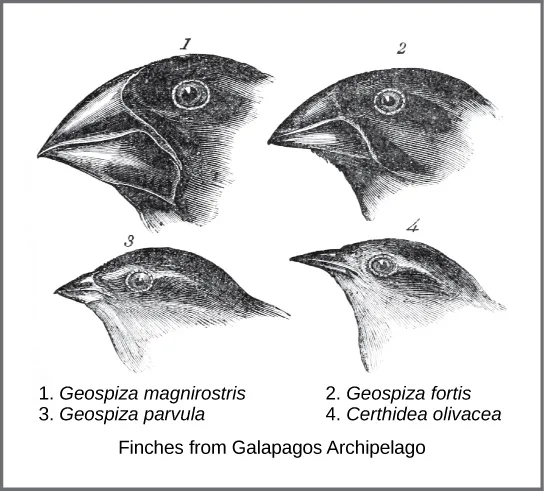
Extended description
Four numbered finch-head engravings in a two-by-two grid, each with the eye circled: 1, Geospiza magnirostris, has the largest and thickest, most strongly curved beak; 2, Geospiza fortis, has a similarly shaped but smaller and less pronounced beak; 3, Geospiza parvula, has a small, slender, gently curved beak; 4, Certhidea olivacea, has the thinnest, straightest, most pointed beak. A caption beneath the illustrations reads ‘Finches from Galapagos Archipelago.’
Wallace and Darwin both observed similar patterns in other organisms and they independently developed the same explanation for how and why such changes could take place. Darwin called this mechanism natural selection. Natural selection, or “survival of the fittest,” is the more prolific reproduction of individuals with favorable traits that survive environmental change because of those traits. This leads to evolutionary change.
For example, Darwin observed a population of giant tortoises in the Galápagos Archipelago to have longer necks than those that lived on other islands with dry lowlands. These tortoises were “selected” because they could reach more leaves and access more food than those with short necks. In times of drought when fewer leaves would be available, those that could reach more leaves had a better chance to eat and survive than those that couldn’t reach the food source. Consequently, long-necked tortoises would be more likely to be reproductively successful and pass the long-necked trait to their offspring. Over time, only long-necked tortoises would be present in the population.
Natural selection, Darwin argued, was an inevitable outcome of three principles that operated in nature. First, most characteristics of organisms are inherited, or passed from parent to offspring. Although no one, including Darwin and Wallace, knew how this happened at the time, it was a common understanding. Second, more offspring are produced than are able to survive, so resources for survival and reproduction are limited. The capacity for reproduction in all organisms outstrips the availability of resources to support their numbers. Thus, there is competition for those resources in each generation. Both Darwin and Wallace’s understanding of this principle came from reading economist Thomas Malthus’ essay that explained this principle in relation to human populations. Third, offspring vary among each other in regard to their characteristics and those variations are inherited. Darwin and Wallace reasoned that offspring with inherited characteristics which allow them to best compete for limited resources will survive and have more offspring than those individuals with variations that are less able to compete. Because characteristics are inherited, these traits will be better represented in the next generation. This will lead to change in populations over generations in a process that Darwin called descent with modification. Ultimately, natural selection leads to greater adaptation of the population to its local environment. It is the only mechanism known for adaptive evolution.
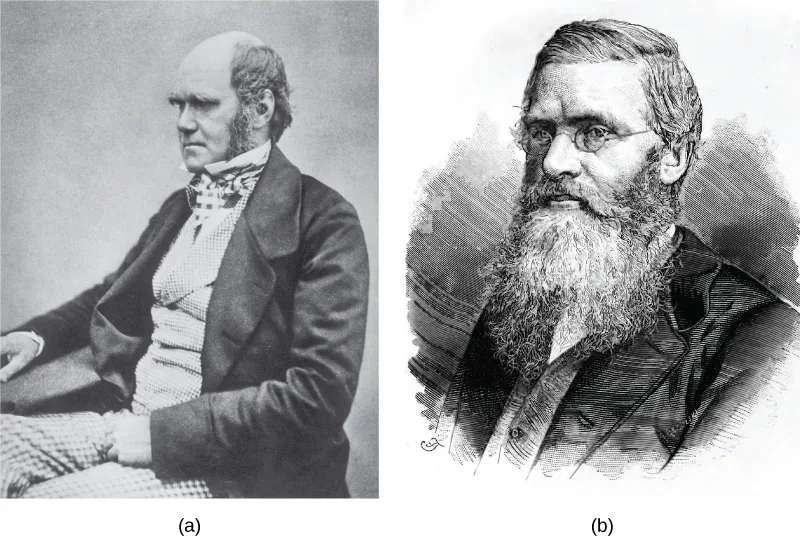
In 1858, Darwin and Wallace (see the portraits below) presented papers at the Linnean Society in London that discussed the idea of natural selection. The following year Darwin’s book, On the Origin of Species, was published. His book outlined in considerable detail his arguments for evolution by natural selection.
Studies of evolution by natural selection are difficult to conduct, as they require analyses of several generations of the investigated species in order to document the changes pointing to evolutionary change. The Galápagos finches are an excellent example. Peter and Rosemary Grant and their colleagues have studied Galápagos finch populations every year since 1973 (Source note: the source says 1976; the Grants’ Daphne Major study began in 1973 (Grant and Grant, Science 296:707).) and have provided important evidence of natural selection. The Grants found changes from one generation to the next in beak shape distribution with the medium ground finch on the Galápagos island of Daphne Major. The birds have inherited a variation in their bill shape with some having wide deep bills and others having thinner bills. During a period in which rainfall was higher than normal because of an El Niño, there was a lack of large hard seeds of which the large-billed birds ate; however, there was an abundance of the small soft seeds which the small-billed birds ate. Therefore, the small-billed birds were able to survive and reproduce. In the years following this El Niño, the Grants measured beak sizes in the population and found that the average bill size was smaller. Since bill size is an inherited trait, parents with smaller bills had more offspring and the bill evolved into a much smaller size. As conditions improved in 1987 and larger seeds became more available, the trend toward smaller average bill size ceased.
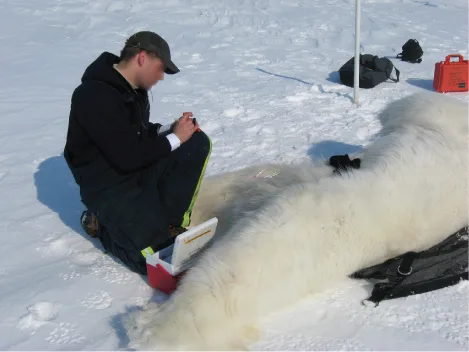
Career Connection. Field Biologist. Many people hike, explore caves, scuba dive, or climb mountains for recreation. People often participate in these activities hoping to see wildlife. Experiencing the outdoors can be incredibly enjoyable and invigorating. What if your job entailed working in the wilderness? Field biologists by definition work outdoors in the “field.” The term field in this case refers to any location outdoors, even under water. A field biologist typically focuses research on a certain species, group of organisms, or a single habitat (see the photo below).
One objective of many field biologists includes discovering new, unrecorded species. Not only do such findings expand our understanding of the natural world, but they also lead to important innovations in fields such as medicine and agriculture. Plant and microbial species, in particular, can reveal new medicinal and nutritive knowledge. Other organisms can play key roles in ecosystems or if rare require protection. When discovered, researchers can use these important species as evidence for environmental regulations and laws.
Processes and Patterns of Evolution
Natural selection can only take place if there is variation, or differences, among individuals in a population. Importantly, these differences must have some genetic basis; otherwise, the selection will not lead to change in the next generation. This is critical because nongenetic reasons can cause variation among individuals such as an individual’s height because of better nutrition rather than different genes.
Genetic diversity in a population comes from two main mechanisms: mutation and sexual reproduction. Mutation, a change in DNA, is the ultimate source of new alleles, or new genetic variation in any population. The genetic changes that mutation causes can have one of three outcomes on the phenotype. A mutation affects the organism’s phenotype in a way that gives it reduced fitness—lower likelihood of survival or fewer offspring. A mutation may produce a phenotype with a beneficial effect on fitness. Many mutations will also have no effect on the phenotype’s fitness. We call these neutral mutations. Mutations may also have a whole range of effect sizes on the organism’s fitness that expresses them in their phenotype, from a small effect to a great effect. Sexual reproduction also leads to genetic diversity: when two parents reproduce, unique combinations of alleles assemble to produce the unique genotypes and thus phenotypes in each offspring.
We call a heritable trait that helps an organism’s survival and reproduction in its present environment an adaptation. Scientists describe groups of organisms adapting to their environment when a genetic variation occurs over time that increases or maintains the population’s “fit” to its environment. A platypus’s webbed feet are an adaptation for swimming. A snow leopard’s thick fur is an adaptation for living in the cold. A cheetah’s fast speed is an adaptation for catching prey.
Whether or not a trait is favorable depends on the current environmental conditions. The same traits are not always selected because environmental conditions can change. For example, consider a plant species that grew in a moist climate and did not need to conserve water. Large leaves were selected because they allowed the plant to obtain more energy from the sun. Large leaves require more water to maintain than small leaves, and the moist environment provided favorable conditions to support large leaves. After thousands of years, the climate changed, and the area no longer had excess water. The direction of natural selection shifted so that plants with small leaves were selected because those populations were able to conserve water to survive the new environmental conditions.
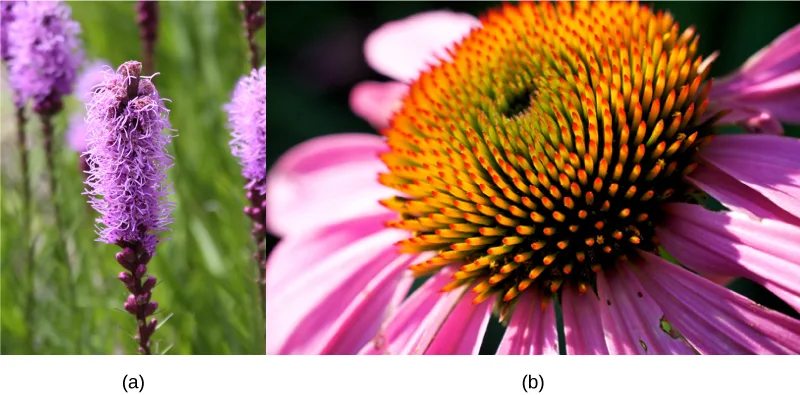
The evolution of species has resulted in enormous variation in form and function. Sometimes, evolution gives rise to groups of organisms that become tremendously different from each other. We call two species that evolve in diverse directions from a common point divergent evolution. We can see such divergent evolution in the forms of the reproductive organs of flowering plants which share the same basic anatomies; however, they can look very different as a result of selection in different physical environments and adaptation to different kinds of pollinators (see the photos below).
In other cases, similar phenotypes evolve independently in distantly related species. For example, flight has evolved in both bats and insects, and they both have structures we refer to as wings, which are adaptations to flight. However, bat and insect wings have evolved from very different original structures. We call this phenomenon convergent evolution, where similar traits evolve independently in species that do not share a recent common ancestry. The trait in the two species came to be similar in structure and have the same function, flying, but did so separately from each other.
These physical changes occur over enormous time spans and help explain how evolution occurs. Natural selection acts on individual organisms, which can then shape an entire species. Although natural selection may work in a single generation on an individual, it can take thousands or even millions of years for an entire species’ genotype to evolve. It is over these large time spans that life on earth has changed and continues to change.
Evidence of Evolution
The evidence for evolution is compelling and extensive. Looking at every level of organization in living systems, biologists see the signature of past and present evolution. Darwin dedicated a large portion of his book, On the Origin of Species, to identifying patterns in nature that were consistent with evolution, and since Darwin, our understanding has become clearer and broader.
Fossils
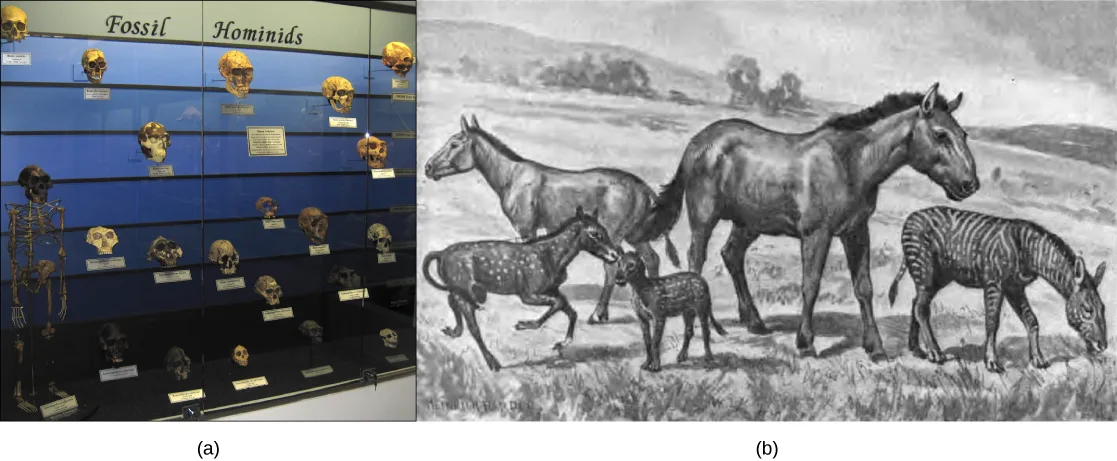
Fossils provide solid evidence that organisms from the past are not the same as those today, and fossils show the gradual evolutionary changes over time. Scientists determine the age of fossils and categorize them from all over the world to determine when the organisms lived relative to each other. The resulting fossil record tells the story of the past and shows the evolution of form over millions of years. For example, scientists have recovered highly detailed records showing the evolution of humans and horses, shown in the photo and illustration below. The whale flipper shares a similar morphology to bird and mammal appendages, illustrated further below, indicating that these species share a common ancestor.
Extended description
Panel (a): a glass display case labeled ‘Fossil Hominids,’ with rows of skull casts mounted on the back wall from bottom to top, oldest to newest, each with a small identifying label, and an articulated skeleton standing at the lower left. Panel (b): five illustrated horse-lineage animals in a grassy field under a hazy sky — a partly visible animal at the far left edge, a medium-sized plain animal behind it, a small striped foal in front, the largest and most horse-like animal at center with a dark mane, and a smaller striped, zebra-like animal at the right with its head down, grazing.
Anatomy and Embryology
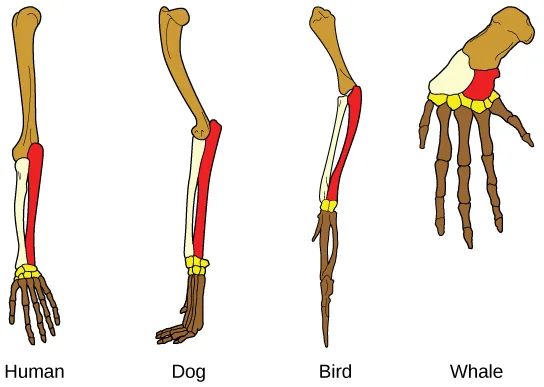
Another type of evidence for evolution is the presence of structures in organisms that share the same basic form. For example, the bones in human, dog, bird, and whale appendages all share the same overall construction, shown below, resulting from their origin in a common ancestor’s appendages. Over time, evolution led to changes in the bones’ shapes and sizes in different species, but they have maintained the same overall layout. Scientists call these synonymous parts homologous structures.
Extended description
Each of the four limbs uses the same color key: a single tan bone at the top, a red-and-white pair of bones below it, yellow wrist bones, and brown digit bones. Human: long, straight bones ending in five slender, evenly spaced fingers. Dog: shorter, more angled bones ending in a compact paw with close-set digits. Bird: a long, thin lower pair of bones ending in slender, spread toes. Whale: short, broad upper and lower bones opening into a wide, fan-shaped flipper made of long, closely spaced digit bones.
Some structures exist in organisms that have no apparent function at all, and appear to be residual parts from a past common ancestor. We call these unused structures without function vestigial structures. Other examples of vestigial structures are wings on flightless birds, leaves on some cacti, and hind leg bones in whales. Not all similarities represent homologous structures. As explained in Determining Evolutionary Relationships, when similar characteristics occur because of environmental constraints and not due to a close evolutionary relationship, it is an analogy or homoplasy. For example, insects use wings to fly like bats and birds, but the wing structure and embryonic origin are completely different. These are analogous structures. On the other side, the bird and bat wings are homologous because the bones are inherited from a common ancestor, while the wings themselves are analogous as they evolved independently.
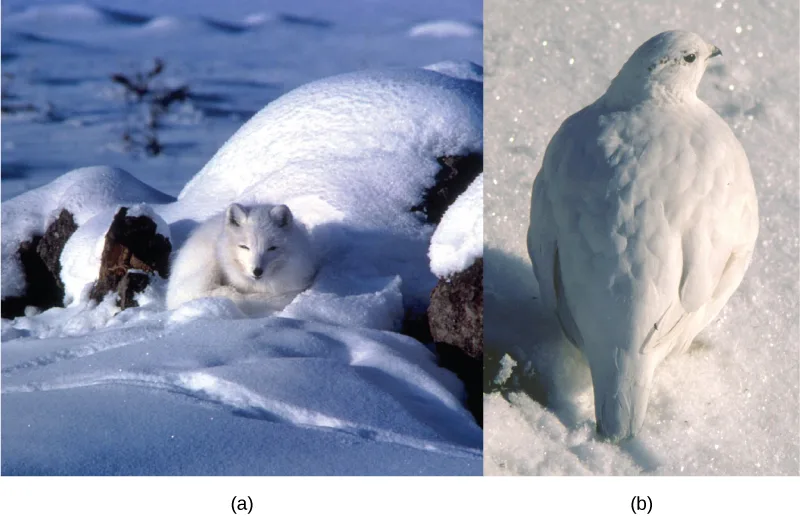
Another piece of evidence of evolution is the convergence of form in organisms that share similar environments. For example, species of unrelated animals, such as the arctic fox and ptarmigan, living in the arctic region have been selected for seasonal white phenotypes during winter to blend with the snow and ice (see the photos below). These similarities occur not because of common ancestry, but because of similar selection pressures—the benefits of predators not seeing them.
Embryology, the study of the anatomy of an organism’s development to its adult form, also provides evidence of relatedness between now widely divergent groups of organisms. Mutational tweaking in the embryo can have such magnified consequences in the adult that embryo formation tends to be conserved. As a result, structures that are absent in some groups often appear in their embryonic forms and disappear when they reach the adult or juvenile form. For example, all vertebrate embryos, including humans, exhibit gill slits and tails at some point in their early development. These disappear in the adults of terrestrial groups but adult forms of aquatic groups such as fish and some amphibians maintain them. Great ape embryos, including humans, have a tail structure during their development that they lose when they are born.
Biogeography
The geographic distribution of organisms on the planet follows patterns that we can explain best by evolution in conjunction with tectonic plate movement over geological time. Broad groups that evolved before the supercontinent Pangaea broke up (about 200 million years ago) are distributed worldwide. Groups that evolved since the breakup appear uniquely in regions of the planet, such as the unique flora and fauna of northern continents that formed from the supercontinent Laurasia and of the southern continents that formed from the supercontinent Gondwana. The presence of members of the plant family Proteaceae in Australia, southern Africa, and South America indicates that their ancestors were predominant on the supercontinent Gondwana prior to its breaking up.
Marsupial diversification in Australia and the absence of other mammals reflect Australia’s long isolation. Australia has an abundance of endemic species—species found nowhere else—which is typical of islands whose isolation by expanses of water prevents species from migrating. Over time, these species diverge evolutionarily into new species that look very different from their ancestors that may exist on the mainland. Australia’s marsupials, the Galápagos’ finches, and many species on the Hawaiian Islands are all unique to their one point of origin, yet they display distant relationships to ancestral species on mainlands.
Molecular Biology
Like anatomical structures, the molecular structures of life reflect descent with modification. DNA’s universality reflects evidence of a common ancestor for all of life. Fundamental divisions in life between the genetic code, DNA replication, and expression are reflected in major structural differences in otherwise conservative structures such as ribosome components and membrane structures. In general, the relatedness of groups of organisms is reflected in the similarity of their DNA sequences—exactly the pattern that we would expect from descent and diversification from a common ancestor.
DNA sequences have also shed light on some of the mechanisms of evolution. For example, it is clear that the evolution of new functions for proteins commonly occurs after gene duplication events that allow freely modifying one copy by mutation, selection, or drift (changes in a population’s gene pool resulting from chance), while the second copy continues to produce a functional protein.
Misconceptions of Evolution
Although the theory of evolution generated some controversy when Darwin first proposed it, biologists almost universally accepted it, particularly younger biologists, within 20 years after publication of On the Origin of Species. Nevertheless, the theory of evolution is a difficult concept and misconceptions about how it works abound.
Evolution Is Just a Theory
Critics of the theory of evolution dismiss its importance by purposefully confounding the everyday usage of the word “theory” with the way scientists use the word. In science, we understand a “theory” to be a body of thoroughly tested and verified explanations for a set of observations of the natural world. Scientists have a theory of the atom, a theory of gravity, and the theory of relativity, each which describes understood facts about the world. In the same way, the theory of evolution describes facts about the living world. As such, a theory in science has survived significant efforts to discredit it by scientists. In contrast, a “theory” in common vernacular is a word meaning a guess or suggested explanation. This meaning is more akin to the scientific concept of “hypothesis.” When critics of evolution say it is “just a theory,” they are implying that there is little evidence supporting it and that it is still in the process of rigorous testing. This is a mischaracterization.
Individuals Evolve
Evolution is the change in a population’s genetic composition over time, specifically over generations, resulting from differential reproduction of individuals with certain alleles. Individuals do change over their lifetime, obviously, but this is development and involves changes programmed by the set of genes the individual acquired at birth in coordination with the individual’s environment. When thinking about the evolution of a characteristic, it is probably best to think about the change of the average value of the characteristic in the population over time. For example, when natural selection leads to bill-size change in medium ground finches in the Galápagos, this does not mean that individual bills on the finches are changing. If one measures the average bill size among all individuals in the population at one time and then measures them in the population several years later, this average value will be different as a result of evolution. Although some individuals may survive from the first time to the second, they will still have the same bill size; however, there will be many new individuals who contribute to the shift in average bill size.
Evolution Explains the Origin of Life
It is a common misunderstanding that evolution includes an explanation of life’s origins. Some of the theory’s critics believe that it cannot explain the origin of life. The theory does not try to explain the origin of life. The theory of evolution explains how populations change over time and how life diversifies the origin of species. It does not shed light on the beginnings of life including the origins of the first cells, which define life. Importantly, biologists believe that the presence of life on Earth precludes the possibility that the events that led to life on Earth can repeat themselves because the intermediate stages would immediately become food for existing living things.
However, once a mechanism of inheritance was in place in the form of a molecule like DNA either within a cell or pre-cell, these entities would be subject to the principle of natural selection. More effective reproducers would increase in frequency at the expense of inefficient reproducers. While evolution does not explain the origin of life, it may have something to say about some of the processes operating once pre-living entities acquired certain properties.
Organisms Evolve on Purpose
Statements such as “organisms evolve in response to a change in an environment” are quite common, but such statements can lead to two types of misunderstandings. First, do not interpret the statement to mean that individual organisms evolve. The statement is shorthand for “a population evolves in response to a changing environment.” However, a second misunderstanding may arise by interpreting the statement to mean that the evolution is somehow intentional. A changed environment results in some individuals in the population, those with particular phenotypes, benefiting and therefore producing proportionately more offspring than other phenotypes. This results in change in the population if the characteristics are genetically determined.
It is also important to understand that the variation that natural selection works on is already in a population and does not arise in response to an environmental change. For example, applying antibiotics to a population of bacteria will, over time, select a population of bacteria that are resistant to antibiotics. The resistance, which a gene causes, did not arise by mutation because of applying the antibiotic. The gene for resistance was already present in the bacteria’s gene pool, likely at a low frequency. The antibiotic, which kills the bacterial cells without the resistance gene, strongly selects individuals that are resistant, since these would be the only ones that survived and divided. Experiments have demonstrated that mutations for antibiotic resistance do not arise as a result of antibiotic application.
In a larger sense, evolution is not goal directed. Species do not become “better” over time. They simply track their changing environment with adaptations that maximize their reproduction in a particular environment at a particular time. Evolution has no goal of making faster, bigger, more complex, or even smarter species, despite the commonness of this kind of language in popular discourse. What characteristics evolve in a species are a function of the variation present and the environment, both of which are constantly changing in a nondirectional way. A trait that fits in one environment at one time may well be fatal at some point in the future. This holds equally well for insect and human species.
Summary
Evolution is the process of adaptation through mutation, natural selection, and genetic drift which allows more desirable characteristics to pass to the next generation. Over time, populations evolve more characteristics that are beneficial to their survival. For living organisms to adapt and change to environmental pressures, genetic variation must be present. With genetic variation, individuals have differences in form and function that allow some to survive certain conditions better than others. These organisms pass their favorable traits to their offspring. Eventually, environments change, and what was once a desirable, advantageous trait may become an undesirable trait and organisms may further evolve. Evolution may be convergent with similar traits evolving in multiple species or divergent with diverse traits evolving in multiple species that came from a common ancestor. We can observe evidence of evolution by means of DNA code and the fossil record, and also by the existence of homologous and vestigial structures.
Key terms
- adaptation — heritable trait or behavior in an organism that aids in its survival and reproduction in its present environment
- convergent evolution — process by which groups of organisms independently evolve to similar forms
- divergent evolution — process by which groups of organisms evolve in diverse directions from a common point
- homologous structures — parallel structures in diverse organisms that have a common ancestor
- natural selection — reproduction of individuals with favorable genetic traits that survive environmental change because of those traits, leading to evolutionary change
- variation — genetic differences among individuals in a population
- vestigial structure — physical structure present in an organism but that has no apparent function and appears to be from a functional structure in a distant ancestor
Practice
Describe how scientists developed the present-day theory of evolution
Which scientific concept did Charles Darwin and Alfred Wallace independently discover?
It is the mechanism, described as “survival of the fittest,” that Darwin outlined in On the Origin of Species.Which of the following situations will lead to natural selection?
Check whether every listed scenario involves individuals with a trait-based edge in survival or reproduction.If a person scatters a handful of garden pea plant seeds in one area, how would natural selection work in this situation?
Show model answer
Did your answer mention:
The more prolific reproduction of individuals with favorable traits that survive environmental change because of those traits, leading to evolutionary change, is called ________.
Darwin and Wallace proposed it as the mechanism of adaptive evolution; Darwin’s alternative phrase for it names ’the fittest.'Define adaptation
Which description is an example of a phenotype?
A phenotype is an observable characteristic, whether physical or behavioral — check which options describe something you could observe.A heritable trait or behavior that helps an organism’s survival and reproduction in its present environment is called an ________.
A platypus’s webbed feet and a cheetah’s speed are both examples.Genetic differences among individuals in a population are called ________.
Natural selection can only act on this kind of difference when it has a genetic basis.Explain convergent and divergent evolution
Which situation is most likely an example of convergent evolution?
Check whether every listed pair evolved its shared trait independently, without a recent common ancestor.The process by which groups of organisms independently evolve to similar forms is called ________.
Bat and insect wings are an example — both fly, but their wing structures evolved from very different original structures.The process by which groups of organisms evolve in diverse directions from a common point is called ________.
The very different-looking reproductive organs of the dense blazing star and the purple coneflower are an example, since both flowers share a basic morphology inherited from a common ancestor.Describe homologous and vestigial structures
Why do scientists consider vestigial structures evidence for evolution?
Show model answer
Did your answer mention:
Parallel structures in diverse organisms that share a common ancestor are called ________.
The bones in a human arm, a dog leg, a bird wing, and a whale flipper are examples — the same layout, inherited from one ancestor.A physical structure with no apparent function, present because a distant ancestor’s version of it did have one, is called a ________.
Wings on flightless birds and hind leg bones in whales are examples.Discuss misconceptions about the theory of evolution
How does the scientific meaning of “theory” differ from the common vernacular meaning?
Show model answer
Did your answer mention:
Explain why the statement that a monkey is more evolved than a mouse is incorrect.
Show model answer
Did your answer mention:
According to this section, a “theory” in everyday, non-scientific usage is closest to which other scientific concept?
The section names the scientific concept that this vernacular meaning is “more akin to” directly.This section is adapted from Biology 2e, Section 18.1: Understanding Evolution by Mary Ann Clark, Jung Choi, Matthew Douglas, and OpenStax, © OpenStax, licensed under CC BY-NC-SA 4.0. Access the original for free at openstax.org. Changes: figures re-encoded as WebP; Figure_18_01_01-beaks, Figure_18_01_05-4164, and Figure_18_01_06-9f9f re-kinded from the manifest’s file-extension “photo” guess to “diagram” after inspection (the first is an engraved illustration, not a photograph; the second is a photo-and-illustration panel whose drawn horse-lineage half carries the teaching point about size variation; the third is a drawn, color-coded forelimb-bone comparison); a longdesc added for Figure_18_01_01-beaks (its printed species numbers and names are not carried by the one-line caption), Figure_18_01_05-4164 (the arrangement of the museum display and the five horse-lineage animals is not carried by the caption), and Figure_18_01_06-9f9f (the bone color-coding across the four limbs is not carried by the caption); the bare or vague source alts for Figure_18_01_02ab, Figure_18_01_03-0b39, Figure_18_01_04ab-e353, and Figure_18_01_07ab rewritten from the images; the Field Biologist note rendered as a Career Connection callout with its embedded figure kept inside it; the two interactive notes rendered as Link to Learning callouts with descriptive link text (“a video exploring the bones in the human body,” “a site addressing common misconceptions”) in place of the source’s bare “video” and “site”; the cross-reference to the not-yet-authored section Determining Evolutionary Relationships kept as plain prose with no link, and its accompanying figure reference (to a figure in that other chapter) dropped since the figure is not on this page; two forward figure references reworded as “shown below”/“illustrated further below” since figures are not numbered here; the end-of-section Review Questions and Critical Thinking Questions adapted into the closing interactive Practice block (multiple choice and self-check respectively); seven key-term recall items added from the glossary (natural selection, adaptation, variation, convergent evolution, divergent evolution, homologous structures, vestigial structure); rubric checkpoints added to each self-check, decomposing its model answer (the source solution) into check-off clauses with no new claims; and one multiple choice written locally under “Discuss misconceptions about the theory of evolution,” keyed to its third option, since no source exercise or glossary term in this section tests that objective as an auto-graded item — it is built strictly from the section’s own sentence naming “hypothesis” as the scientific concept closest to the vernacular meaning of “theory.” One date is corrected with a visible Source note: the Grants’ finch study began in 1973, not 1976 (erratum 409).