Formation of New Species
By the end of this section, you will be able to:
- Define species and describe how scientists identify species as different
- Describe genetic variables that lead to speciation
- Identify prezygotic and postzygotic reproductive barriers
- Explain allopatric and sympatric speciation
- Describe adaptive radiation
Although all life on earth shares various genetic similarities, only certain organisms combine genetic information by sexual reproduction and have offspring that can then successfully reproduce. Scientists call such organisms members of the same biological species.
Species and the Ability to Reproduce
A species is a group of individual organisms that interbreed and produce fertile, viable offspring. According to this definition, one species is distinguished from another when, in nature, it is not possible for matings between individuals from each species to produce fertile offspring.
Members of the same species share both external and internal characteristics, which develop from their DNA. The closer relationship two organisms share, the more DNA they have in common, just like people and their families. People’s DNA is likely to be more like their father or mother’s DNA than their cousin or grandparent’s DNA. Organisms of the same species have the highest level of DNA alignment and therefore share characteristics and behaviors that lead to successful reproduction.
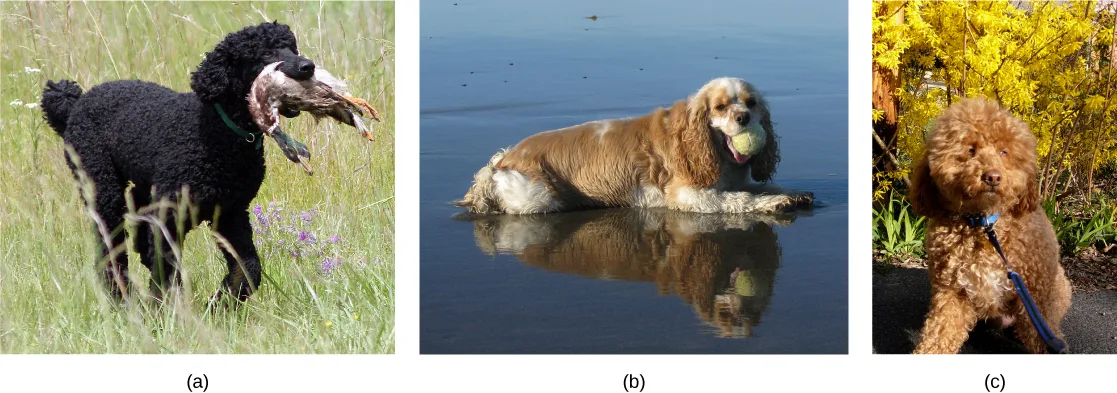
Species’ appearance can be misleading in suggesting an ability or inability to mate. For example, even though domestic dogs (Canis lupus familiaris) display phenotypic differences, such as size, build, and coat, most dogs can interbreed and produce viable puppies that can mature and sexually reproduce (see the photos below).
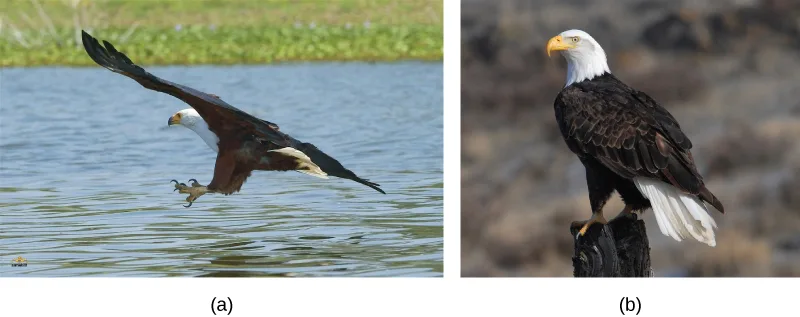
In other cases, individuals may appear similar although they are not members of the same species. For example, even though bald eagles (Haliaeetus leucocephalus) and African fish eagles (Haliaeetus vocifer) are both birds and eagles, each belongs to a separate species group (see the photos below). If humans were to artificially intervene and fertilize a bald eagle’s egg with an African fish eagle’s sperm and a chick did hatch, that offspring, called a hybrid (a cross between two species), would probably be infertile—unable to successfully reproduce after it reached maturity. Different species may have different genes that are active in development; therefore, it may not be possible to develop a viable offspring with two different sets of directions. Thus, even though hybridization may take place, the two species still remain separate.
Populations of species share a gene pool: a collection of all the gene variants in the species. Again, the basis to any changes in a group or population of organisms must be genetic for this is the only way to share and pass on traits. When variations occur within a species, they can only pass to the next generation along two main pathways: asexual reproduction or sexual reproduction. The change will pass on asexually simply if the reproducing cell possesses the changed trait. For the changed trait to pass on by sexual reproduction, a gamete, such as a sperm or egg cell, must possess the changed trait. In other words, sexually-reproducing organisms can experience several genetic changes in their body cells, but if these changes do not occur in a sperm or egg cell, the changed trait will never reach the next generation. Only heritable traits can evolve. Therefore, reproduction plays a paramount role for genetic change to take root in a population or species. In short, organisms must be able to reproduce with each other to pass new traits to offspring.
Speciation
The biological definition of species, which works for sexually reproducing organisms, is a group of actual or potential interbreeding individuals. There are exceptions to this rule. Many species are similar enough that hybrid offspring are possible and may often occur in nature, but for the majority of species this rule generally holds. The presence in nature of hybrids between similar species suggests that they may have descended from a single interbreeding species, and the speciation process may not yet be completed.
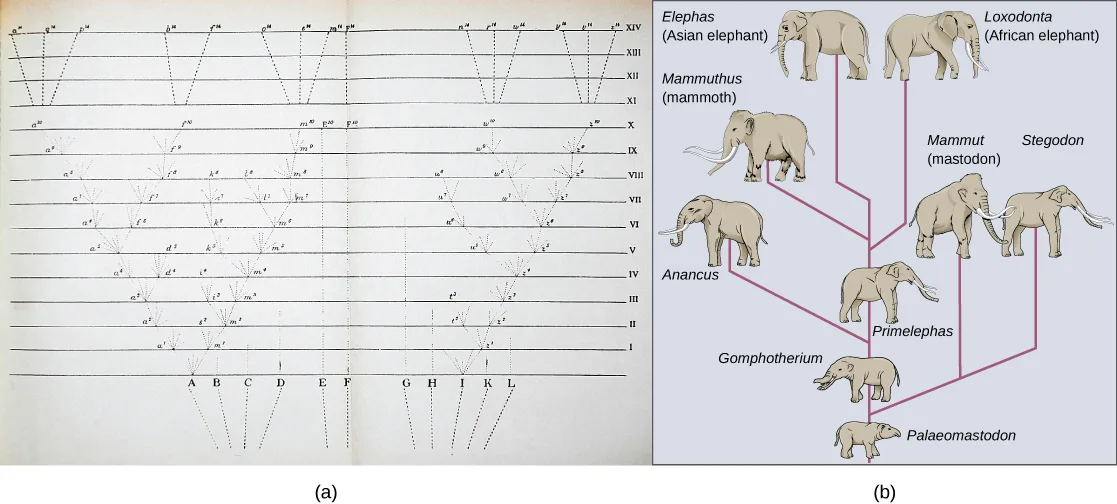
Given the extraordinary diversity of life on the planet there must be mechanisms for speciation: the formation of two species from one original species. Darwin envisioned this process as a branching event and diagrammed the process in the only illustration in On the Origin of Species (see panel (a) below). Compare this illustration to the diagram of elephant evolution (panel (b)), which shows that as one species changes over time, it branches to form more than one new species, repeatedly, as long as the population survives or until the organism becomes extinct.
Extended description
Panel (a): a scanned two-page spread from Darwin’s manuscript. Vertical dashed lines rise from eleven lettered starting points, labeled A through L, at the bottom of the page; horizontal rows up the page are labeled with Roman numerals I through XIV. Some lines run straight from the bottom row to the top without branching; others fork repeatedly at successive rows; some stop partway when a branch fails to continue. Near the top, several branch points give rise to more than a dozen individually labeled endpoints in the final row. Panel (b): a colored diagram tracing modern elephant evolution. At the base is Palaeomastodon, drawn as a small tusked animal; a line rises to Gomphotherium. From the Gomphotherium node a branch runs rightward and splits into two sibling lines ending side by side at Mammut (the mastodon) and Stegodon. The main line continues upward toward Primelephas, giving off a branch to Anancus on the left along the way. Above Primelephas the line splits a final time: one branch ends at Mammuthus (the mammoth), and the other forks into Elephas, the Asian elephant, and Loxodonta, the African elephant, each shown as a full-body illustration at the top of the tree.
For speciation to occur, two new populations must form from one original population and they must evolve in such a way that it becomes impossible for individuals from the two new populations to interbreed. Biologists have proposed mechanisms by which this could occur that fall into two broad categories. Allopatric speciation (allo- = “other”; -patric = “homeland”) involves geographic separation of populations from a parent species and subsequent evolution. Sympatric speciation (sym- = “same”; -patric = “homeland”) involves speciation occurring within a parent species remaining in one location.
Biologists think of speciation events as the splitting of one ancestral species into two descendant species. There is no reason why more than two species might not form at one time except that it is less likely and we can conceptualize multiple events as single splits occurring close in time.
Allopatric Speciation
A geographically continuous population has a gene pool that is relatively homogeneous. Gene flow, the movement of alleles across a species’ range, is relatively free because individuals can move and then mate with individuals in their new location. Thus, an allele’s frequency at one end of a distribution will be similar to the allele’s frequency at the other end. When populations become geographically discontinuous, it prevents alleles’ free-flow. When that separation lasts for a period of time, the two populations are able to evolve along different trajectories. Thus, their allele frequencies at numerous genetic loci gradually become increasingly different as new alleles independently arise by mutation in each population. Typically, environmental conditions, such as climate, resources, predators, and competitors for the two populations will differ causing natural selection to favor divergent adaptations in each group.
Isolation of populations leading to allopatric speciation can occur in a variety of ways: a river forming a new branch, erosion creating a new valley, a group of organisms traveling to a new location without the ability to return, or seeds floating over the ocean to an island. The nature of the geographic separation necessary to isolate populations depends entirely on the organism’s biology and its potential for dispersal. If two flying insect populations took up residence in separate nearby valleys, chances are, individuals from each population would fly back and forth continuing gene flow. However, if a new lake divided two rodent populations continued gene flow would be unlikely; therefore, speciation would be more likely.
Biologists group allopatric processes into two categories: dispersal and vicariance. Dispersal is when a few members of a species move to a new geographical area, and vicariance is when a natural situation arises to physically divide organisms.
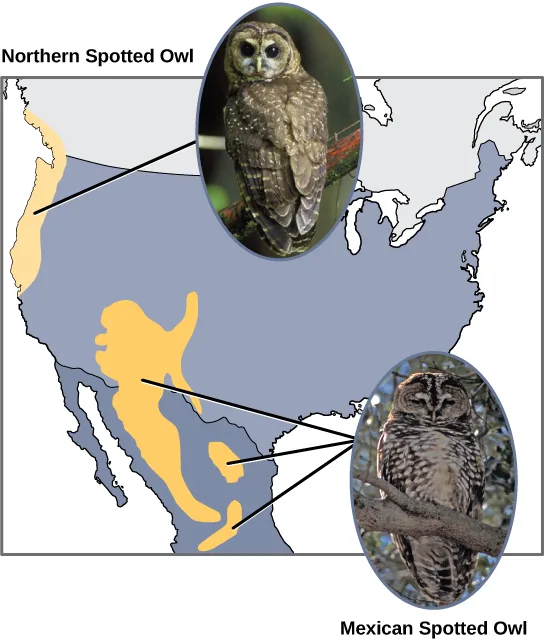
Scientists have documented numerous cases of allopatric speciation taking place. For example, along the west coast of the United States, two separate spotted owl subspecies exist. The northern spotted owl has genetic and phenotypic differences from its close relative: the Mexican spotted owl, which lives in the south (see the map below).
Extended description
Two irregular tan-colored regions are shaded on a blue map of the western United States and northern Mexico. The northern spotted owl’s region runs in a narrow band down the Pacific coast from Washington through Oregon into northern California, labeled ‘Northern Spotted Owl’ with a line to a circular inset photo of the owl at upper left. The Mexican spotted owl’s region is a broader, disconnected patch across Arizona, New Mexico, and into Mexico, labeled ‘Mexican Spotted Owl’ with three lines pointing from different parts of the region to a circular inset photo of the owl at lower right.
Additionally, scientists have found that the further the distance between two groups that once were the same species, the more likely it is that speciation will occur. This seems logical because as the distance increases, the various environmental factors would likely have less in common than locations in close proximity. Consider the two owls: in the north, the climate is cooler than in the south. The types of organisms in each ecosystem differ, as do their behaviors and habits. Also, the hunting habits and prey choices of the southern owls vary from the northern owls. These variances can lead to evolved differences in the owls, and speciation likely will occur.
Adaptive Radiation
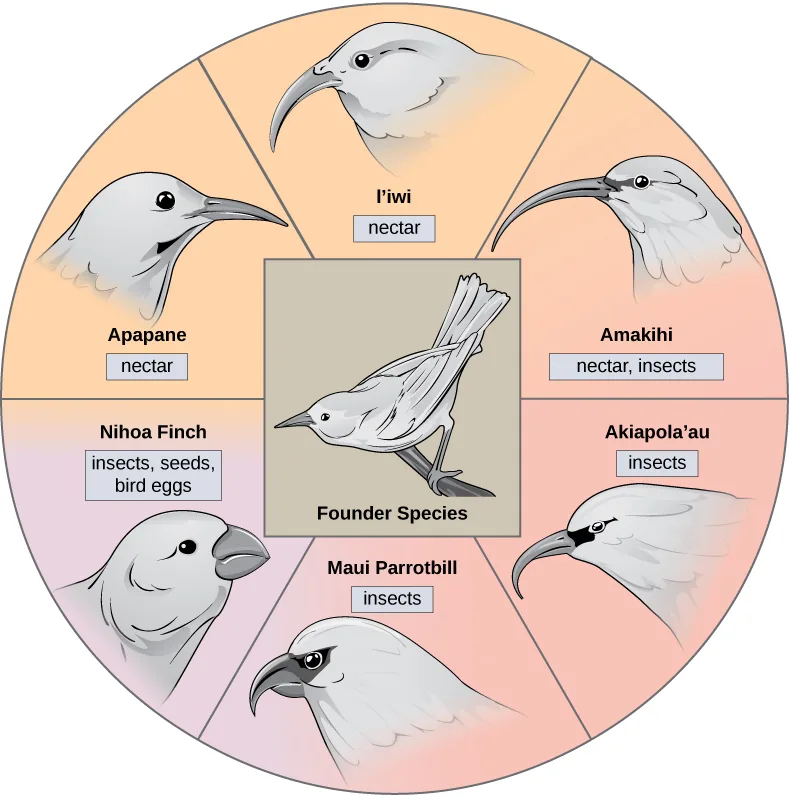
In some cases, a population of one species disperses throughout an area, and each finds a distinct niche or isolated habitat. Over time, the varied demands of their new lifestyles lead to multiple speciation events originating from a single species. We call this adaptive radiation because many adaptations evolve from a single point of origin; thus, causing the species to radiate into several new ones. Island archipelagos like the Hawaiian Islands provide an ideal context for adaptive radiation events because water surrounds each island which leads to geographical isolation for many organisms. The Hawaiian honeycreeper illustrates one example of adaptive radiation. From a single species, the founder species, numerous species have evolved, including the six shown below.
Extended description
Six wedge-shaped sections form a ring around a central square panel labeled ‘Founder Species,’ which shows a plain grey songbird. Clockwise from the top: I’iwi has a long, thin, downward-curved beak and eats nectar. Amakihi has a shorter, slightly curved beak and eats nectar and insects. Akiapola’au has a long curved upper mandible paired with a short straight lower mandible and eats insects. Maui Parrotbill has a thick, hooked, parrot-like beak and eats insects. Nihoa Finch has a short, deep, conical beak and eats insects, seeds, and bird eggs. Apapane has a medium curved beak and eats nectar.
Notice the differences in the species’ beaks in the diagram above. Evolution in response to natural selection based on specific food sources in each new habitat led to evolution of a different beak suited to the specific food source. The seed-eating bird has a thicker, stronger beak which is suited to break hard nuts. The nectar-eating birds have long beaks to dip into flowers to reach the nectar. The insect-eating birds have beaks like swords, appropriate for stabbing and impaling insects. Darwin’s finches are another example of adaptive radiation in an archipelago.
Sympatric Speciation
Can divergence occur if no physical barriers are in place to separate individuals who continue to live and reproduce in the same habitat? The answer is yes. We call the process of speciation within the same space sympatric. The prefix “sym” means same, so “sympatric” means “same homeland” in contrast to “allopatric” meaning “other homeland.” Scientists have proposed and studied many mechanisms.
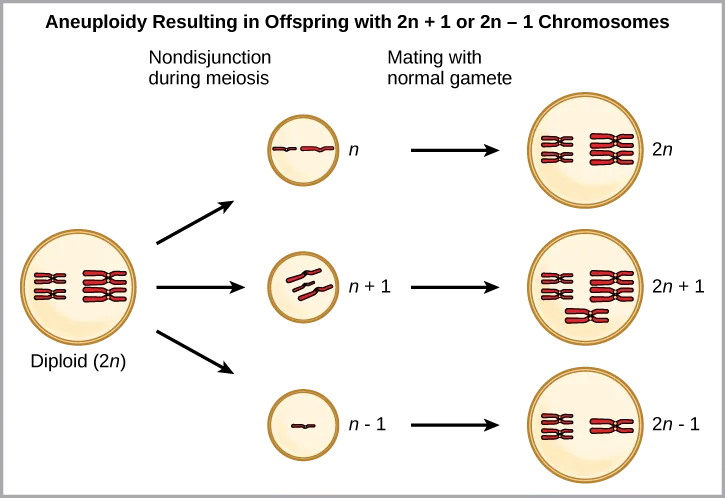
One form of sympatric speciation can begin with a serious chromosomal error during cell division. In a normal cell division event chromosomes replicate, pair up, and then separate so that each new cell has the same number of chromosomes. However, sometimes the pairs separate and the end cell product has extra sets of chromosomes in a condition that we call polyploidy (see the figure below).
Extended description
The diploid parent cell at left is drawn with two chromosome pairs, labeled ‘Diploid (2n).’ Three arrows labeled ‘Nondisjunction during meiosis’ lead to three gametes: the top gamete holds one chromosome pair and is labeled n; the middle gamete holds an extra chromosome and is labeled n+1; the bottom gamete is missing a chromosome and is labeled n-1. A second set of arrows, labeled ‘Mating with normal gamete,’ leads from each of these to a resulting cell: the top cell, labeled 2n, mirrors the original diploid parent; the middle cell, labeled 2n+1, carries one extra chromosome beyond the normal set; the bottom cell, labeled 2n-1, is missing one chromosome from the normal set.
Which is most likely to survive, offspring with 2n+1 chromosomes or offspring with 2n-1 chromosomes?
Show model answer
Did your answer mention:
Polyploidy is a condition in which a cell or organism has an extra set, or sets, of chromosomes. Scientists have identified two main types of polyploidy that can lead to reproductive isolation of an individual in the polyploidy state. Reproductive isolation is the inability to interbreed. In some cases, a polyploid individual will have two or more complete sets of chromosomes from its own species in a condition that we call autopolyploidy (see the figure below). The prefix “auto-” means “self,” so the term means multiple chromosomes from one’s own species. Polyploidy results from an error in meiosis in which all of the chromosomes move into one cell instead of separating.
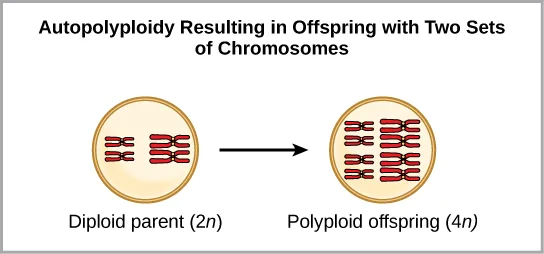
For example, if a plant species with 2n = 6 produces autopolyploid gametes that are also diploid (2n = 6, when they should be n = 3), the gametes now have twice as many chromosomes as they should have. These new gametes will be incompatible with the normal gametes that this plant species produces. However, they could either self-pollinate or reproduce with other autopolyploid plants with gametes having the same diploid number. In this way, sympatric speciation can occur quickly by forming offspring with 4n that we call a tetraploid. These individuals would immediately be able to reproduce only with those of this new kind and not those of the ancestral species.
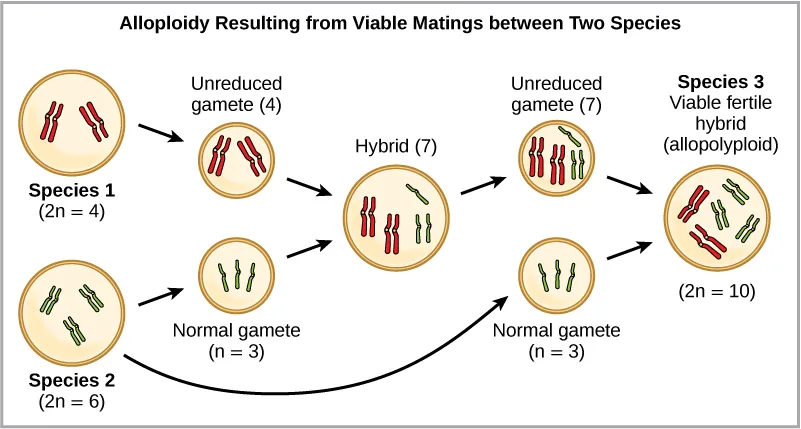
The other form of polyploidy occurs when individuals of two different species reproduce to form a viable offspring that we call an allopolyploid. The prefix “allo-” means “other” (recall from allopatric): therefore, an allopolyploid occurs when gametes from two different species combine. The figure below illustrates one possible way an allopolyploid can form. Notice how it takes two generations, or two reproductive acts, before the viable fertile hybrid results.
Extended description
Two starting cells sit at the left: Species 1 (2n=4) contains two red chromosome pairs, and Species 2 (2n=6) contains three green chromosome pairs. An arrow from Species 1 leads to an ‘Unreduced gamete (4)’ cell holding all four red chromosomes; an arrow from Species 2 leads to a ‘Normal gamete (n=3)’ cell holding three green chromosomes. These two gametes combine at a ‘Hybrid (7)’ cell containing four red and three green chromosomes. From the hybrid, an arrow leads to a second ‘Unreduced gamete (7)’ cell with the same seven mixed chromosomes. A second ‘Normal gamete (n=3)’ cell from Species 2, reached by a long curved arrow from the Species 2 cell and containing three green chromosomes, combines with that unreduced gamete to form the final cell at right, labeled ‘Species 3, Viable fertile hybrid (allopolyploid), 2n=10,’ which contains ten chromosomes: four red and six green.
The cultivated forms of wheat, cotton, and tobacco plants are all allopolyploids. Although polyploidy occurs occasionally in animals, it takes place most commonly in plants. (Animals with any of the types of chromosomal aberrations that we describe here are unlikely to survive and produce normal offspring.) Scientists have discovered more than half of all plant species studied relate back to a species evolved through polyploidy. With such a high rate of polyploidy in plants, some scientists hypothesize that this mechanism takes place more as an adaptation than as an error.
Reproductive Isolation
Given enough time, the genetic and phenotypic divergence between populations will affect characters that influence reproduction: if individuals of the two populations were brought together, mating would be less likely, but if mating occurred, offspring would be nonviable or infertile. Many types of diverging characters may affect the reproductive isolation, the ability to interbreed, of the two populations.
Reproductive isolation can take place in a variety of ways. Scientists organize them into two groups: prezygotic barriers and postzygotic barriers. Recall that a zygote is a fertilized egg: the first cell of an organism’s development that reproduces sexually. Therefore, a prezygotic barrier is a mechanism that blocks reproduction from taking place. This includes barriers that prevent fertilization when organisms attempt reproduction. A postzygotic barrier occurs after zygote formation. This includes organisms that don’t survive the embryonic stage and those that are born sterile.
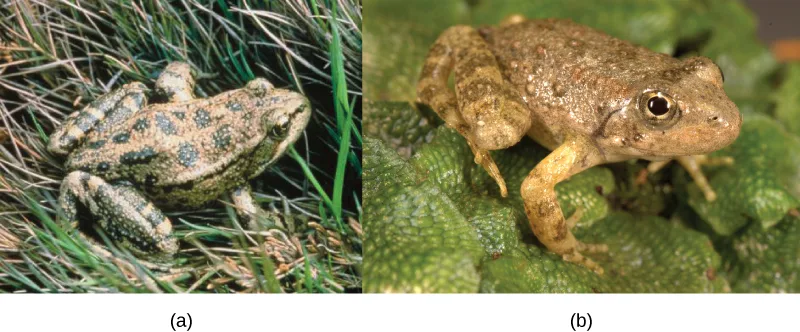
Some types of prezygotic barriers prevent reproduction entirely. Many organisms only reproduce at certain times of the year, often just annually. Differences in breeding schedules, which we call temporal isolation, can act as a form of reproductive isolation. For example, two frog species inhabit the same area, but one reproduces from January to March; whereas, the other reproduces from March to May (see the photos below).
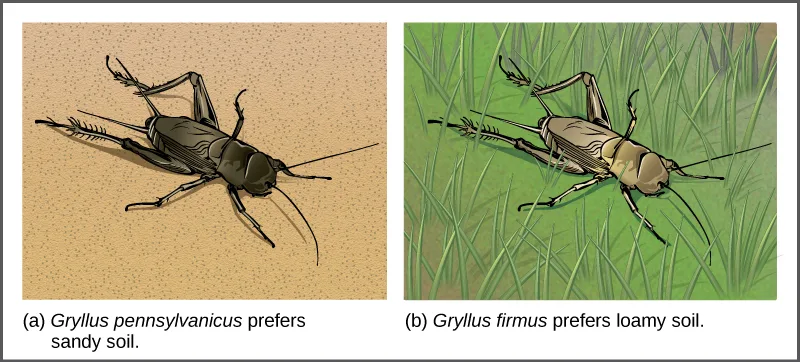
In some cases, populations of a species move or are moved to a new habitat and take up residence in a place that no longer overlaps with the same species’ other populations. We call this situation habitat isolation. Reproduction with the parent species ceases, and a new group exists that is now reproductively and genetically independent. For example, a cricket population that was divided after a flood could no longer interact with each other. Over time, natural selection forces, mutation, and genetic drift will likely result in the two groups diverging (see the illustrations below).
Behavioral isolation occurs when the presence or absence of a specific behavior prevents reproduction. For example, male fireflies use specific light patterns to attract females. Various firefly species display their lights differently. If a male of one species tried to attract the female of another, she would not recognize the light pattern and would not mate with the male.
Other prezygotic barriers work when differences in their gamete cells (eggs and sperm) prevent fertilization from taking place. We call this a gametic barrier. Similarly, in some cases closely related organisms try to mate, but their reproductive structures simply do not fit together. For example, damselfly males of different species have differently shaped reproductive organs. If one species tries to mate with the female of another, their body parts simply do not fit together (see the illustrations below).

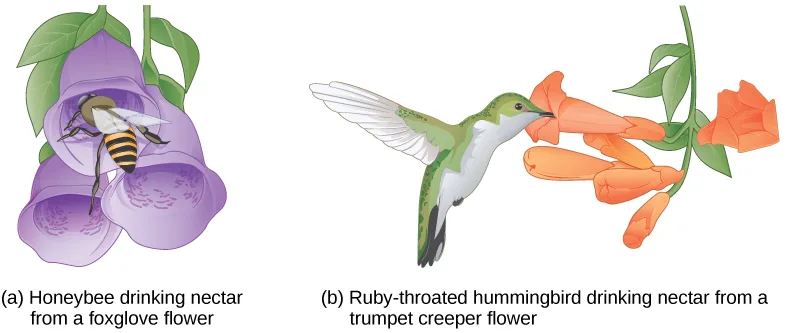
In plants, certain structures aimed to attract one type of pollinator simultaneously prevent a different pollinator from accessing the pollen. The tunnel through which an animal must access nectar can vary widely in length and diameter, which prevents the plant from cross-pollinating with a different species (see the illustrations below).
When fertilization takes place and a zygote forms, postzygotic barriers can prevent reproduction. Hybrid individuals in many cases cannot form normally in the womb and simply do not survive past the embryonic stages. We call this hybrid inviability because the hybrid organisms simply are not viable. In another postzygotic situation, reproduction leads to hybrid birth and growth that is sterile. Therefore, the organisms are unable to reproduce offspring of their own. We call this hybrid sterility.
Habitat Influence on Speciation
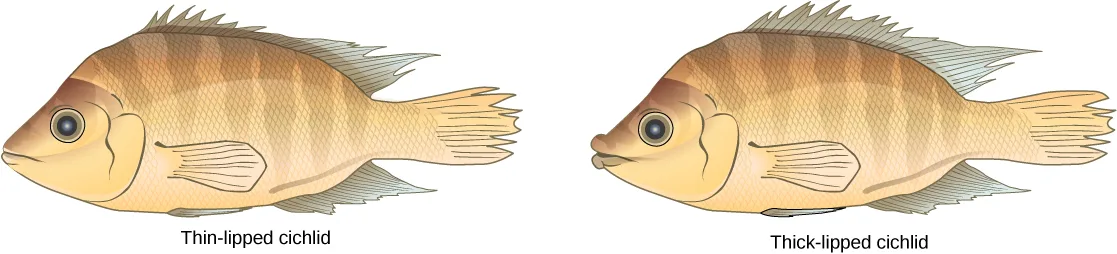
Sympatric speciation may also take place in ways other than polyploidy. For example, consider a fish species that lives in a lake. As the population grows, competition for food increases. Under pressure to find food, suppose that a group of these fish had the genetic flexibility to discover and feed off another resource that other fish did not use. What if this new food source was located at a different depth of the lake? Over time, those feeding on the second food source would interact more with each other than the other fish; therefore, they would breed together as well. Offspring of these fish would likely behave as their parents: feeding and living in the same area and keeping separate from the original population. If this group of fish continued to remain separate from the first population, eventually sympatric speciation might occur as more genetic differences accumulated between them.
This scenario does play out in nature, as do others that lead to reproductive isolation. One such place is Lake Victoria in Africa, famous for its sympatric speciation of cichlid fish. Researchers have found hundreds of sympatric speciation events in these fish, which have not only happened in great number, but also over a short period of time. The illustration below shows this type of speciation among a cichlid fish population in Nicaragua. In this locale, two types of cichlids live in the same geographic location but have come to have different morphologies that allow them to eat various food sources.
Summary
Speciation occurs along two main pathways: geographic separation (allopatric speciation) and through mechanisms that occur within a shared habitat (sympatric speciation). Both pathways isolate a population reproductively in some form. Mechanisms of reproductive isolation act as barriers between closely related species, enabling them to diverge and exist as genetically independent species. Prezygotic barriers block reproduction prior to formation of a zygote; whereas, postzygotic barriers block reproduction after fertilization occurs. For a new species to develop, something must introduce a reproductive barrier. Sympatric speciation can occur through errors in meiosis that form gametes with extra chromosomes (polyploidy). Autopolyploidy occurs within a single species; whereas, allopolyploidy occurs between closely related species.
Key terms
- adaptive radiation — speciation when one species radiates to form several other species
- allopatric speciation — speciation that occurs via geographic separation
- allopolyploid — polyploidy formed between two related, but separate species
- aneuploidy — condition of a cell having an extra chromosome or missing a chromosome for its species
- autopolyploid — polyploidy formed within a single species
- behavioral isolation — type of reproductive isolation that occurs when a specific behavior or lack of one prevents reproduction from taking place
- dispersal — allopatric speciation that occurs when a few members of a species move to a new geographical area
- gametic barrier — prezygotic barrier occurring when closely related individuals of different species mate, but differences in their gamete cells (eggs and sperm) prevent fertilization from taking place
- habitat isolation — reproductive isolation resulting when species’ populations move or are moved to a new habitat, taking up residence in a place that no longer overlaps with the same species’ other populations
- hybrid — offspring of two closely related individuals, not of the same species
- postzygotic barrier — reproductive isolation mechanism that occurs after zygote formation
- prezygotic barrier — reproductive isolation mechanism that occurs before zygote formation
- reproductive isolation — situation that occurs when a species is reproductively independent from other species; behavior, location, or reproductive barriers may cause this to happen
- speciation — formation of a new species
- species — group of populations that interbreed and produce fertile offspring
- sympatric speciation — speciation that occurs in the same geographic space
- temporal isolation — differences in breeding schedules that can act as a form of prezygotic barrier leading to reproductive isolation
- vicariance — allopatric speciation that occurs when something in the environment separates organisms of the same species into separate groups
Practice
Define species and describe how scientists identify species as different
Which reproductive combination produces hybrids?
A hybrid is defined as offspring of two closely related individuals that are not of the same species.A group of populations that interbreed and produce fertile offspring is called a(n) ________.
The word is spelled the same whether it refers to one such group or many.The offspring of two closely related individuals that are not of the same species is called a(n) ________.
A bald eagle × African fish eagle cross would produce one; a poodle × cocker spaniel cross would not, since both are the same species.Describe genetic variables that lead to speciation
What is the main difference between autopolyploid and allopolyploid?
One type combines extra chromosomes from a single species; the other combines chromosomes from two different species.Why can polyploidy individuals lead to speciation fairly quickly?
Show model answer
Did your answer mention:
Polyploidy formed within a single species, rather than between two species, is called a(n) ________.
The prefix “auto-” means “self.”Identify prezygotic and postzygotic reproductive barriers
Which condition is the basis for a species to be reproductively isolated from other members?
Reproductive isolation is defined as the inability to interbreed — think about what that prevents.Which situation is not an example of a prezygotic barrier?
A prezygotic barrier blocks reproduction before a zygote forms; producing infertile offspring means fertilization already happened.A reproductive isolation mechanism that occurs before zygote formation is called a(n) ________.
Its name comes from the prefix meaning “before.”A reproductive isolation mechanism that occurs after zygote formation is called a(n) ________.
Hybrid inviability and hybrid sterility are both examples of this kind of barrier.Explain allopatric and sympatric speciation
Which situation would most likely lead to allopatric speciation?
Allopatric speciation begins with a geographic barrier that physically divides a population.What is the main difference between dispersal and vicariance?
Dispersal is members of a species moving to a new place; vicariance is a natural event that divides them where they already are.Which variable increases the likelihood of allopatric speciation taking place more quickly?
The section’s spotted owl example explains why greater distance means the environmental conditions two populations face have less in common.Two species of fish had recently undergone sympatric speciation. The males of each species had a different coloring through which the females could identify and choose a partner from her own species. After some time, pollution made the lake so cloudy that it was hard for females to distinguish colors. What might take place in this situation?
Show model answer
Did your answer mention:
Describe adaptive radiation
Why do island chains provide ideal conditions for adaptive radiation to occur?
Show model answer
Did your answer mention:
Multiple new species evolving from a single ancestral species that has spread into different isolated habitats is called ________.
The Hawaiian honeycreepers, each with a different beak shape and food source, are the section’s example.According to this section, many adaptations evolving from a single point of origin, causing a species to radiate into several new species, describes which process?
This is exactly the sentence the section uses to define the term, just before it names it.This section is adapted from Biology 2e, Section 18.2: Formation of New Species by Mary Ann Clark, Jung Choi, Matthew Douglas, and OpenStax, © OpenStax, licensed under CC BY-NC-SA 4.0. Access the original for free at openstax.org. Changes: figures re-encoded as WebP; nine of the section’s thirteen figures re-kinded from the manifest’s file-extension guess of “photo” to “diagram” after inspection — every JPEG figure that turned out to be a scanned historical sketch, an illustrated map, or hand-drawn artwork rather than a photograph of a living organism (only the dog, eagle, and frog photographs, plus the PNG aneuploidy diagram, matched the manifest’s own guess); a plain descriptive alt written from each image, since several source alts under-described what the image actually draws; a longdesc added to the Darwin sketch/elephant-evolution figure, the spotted-owl range map, the honeycreeper wheel, and both the aneuploidy and allopolyploidy flow diagrams, since none of their panel-by-panel content is carried by its caption alone; every cross-reference to a numbered print figure reworded as a descriptive reference (“see the photos below,” “the diagram above”) since figures are not numbered here; the interactive note rendered as a Link to Learning callout with descriptive anchor text in place of the source’s bare “video”; the note wrapping the aneuploidy Visual Connection question kept in the body immediately after its figure, rendered as a self-check since the source keys it to a prose solution rather than a lettered option; the end-of-section Review Questions and Critical Thinking Questions adapted into the closing interactive Practice block (multiple choice and self-check respectively); six key-term recall items (species, hybrid, autopolyploid, prezygotic barrier, postzygotic barrier, adaptive radiation) added from the glossary; rubric checkpoints added to each self-check, decomposing its model answer (the source solution) into check-off clauses with no new claims; and one multiple choice written locally under “Describe adaptive radiation,” strictly from the section’s own sentence defining the term, since none of the module’s seven keyed Review Questions test that objective.