Reconnection and Speciation Rates
By the end of this section, you will be able to:
- Describe pathways of species evolution in hybrid zones
- Explain the two major theories on rates of speciation
Speciation occurs over a span of evolutionary time, so when a new species arises, there is a transition period during which the closely related species continue to interact.
Reconnection
After speciation, two species may recombine or even continue interacting indefinitely. Individual organisms will mate with any nearby individual with whom they are capable of breeding. We call an area where two closely related species continue to interact and reproduce, forming hybrids a hybrid zone. Over time, the hybrid zone may change depending on the fitness of the hybrids and the reproductive barriers (see the figure below). If the hybrids are less fit than the parents, speciation reinforcement occurs, and the species continue to diverge until they can no longer mate and produce viable offspring. If reproductive barriers weaken, fusion occurs and the two species become one. Barriers remain the same if hybrids are fit and reproductive: stability may occur and hybridization continues.
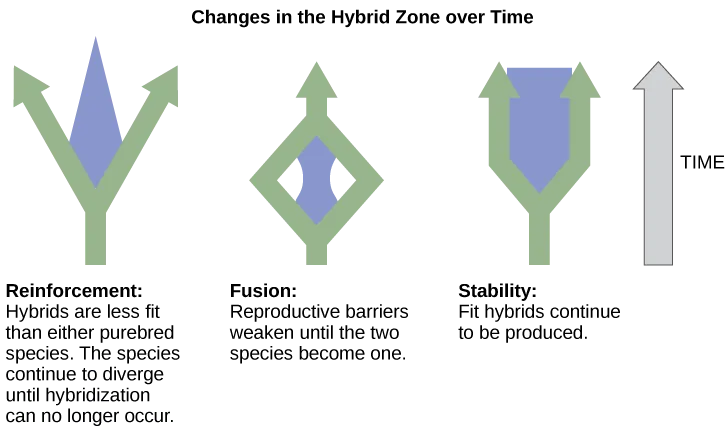
Extended description
Left to right: a green Y-shaped pair of arrows angling outward and upward from a common base, with a blue triangular wedge nested between the two arms, its point near the top and its wide base near where the arms join — labeled ‘Reinforcement: Hybrids are less fit than either purebred species. The species continue to diverge until hybridization can no longer occur.’ Center: two green arrows angling inward from the base to a single point, continuing upward as one arrowhead, with a blue lens (vesica) shape at the point where the arms meet — labeled ‘Fusion: Reproductive barriers weaken until the two species become one.’ Right: a green shape whose two arms separate only briefly before rejoining into one wide upward arrow, with a blue rectangular band filling the width of the rejoined section — labeled ‘Stability: Fit hybrids continue to be produced.’ Far right: a plain grey arrow pointing straight up, labeled ‘TIME.’
If two species eat a different diet but one of the food sources is eliminated and both species are forced to eat the same foods, what change in the hybrid zone is most likely to occur?
Show model answer
Did your answer mention:
Hybrids can be either less fit than the parents, more fit, or about the same. Usually hybrids tend to be less fit; therefore, such reproduction diminishes over time, nudging the two species to diverge further in a process we call reinforcement. Scientists use this term because the hybrids’ low success reinforces the original speciation. If the hybrids are as fit or more fit than the parents, the two species may fuse back into one species (see the figure above). Scientists have also observed that sometimes two species will remain separate but also continue to interact to produce some individuals. Scientists classify this as stability because no real net change is taking place.
Varying Rates of Speciation
Scientists around the world study speciation, documenting observations both of living organisms and those found in the fossil record. As their ideas take shape and as research reveals new details about how life evolves, they develop models to help explain speciation rates. In terms of how quickly speciation occurs, we can observe two current patterns: gradual speciation model and punctuated equilibrium model.
In the gradual speciation model, species diverge gradually over time in small steps. In the punctuated equilibrium model, a new species undergoes changes quickly from the parent species, and then remains largely unchanged for long periods of time afterward (see the figure below). We call this early change model punctuated equilibrium, because it begins with a punctuated or periodic change and then remains in balance afterward. While punctuated equilibrium suggests a faster tempo, it does not necessarily exclude gradualism.
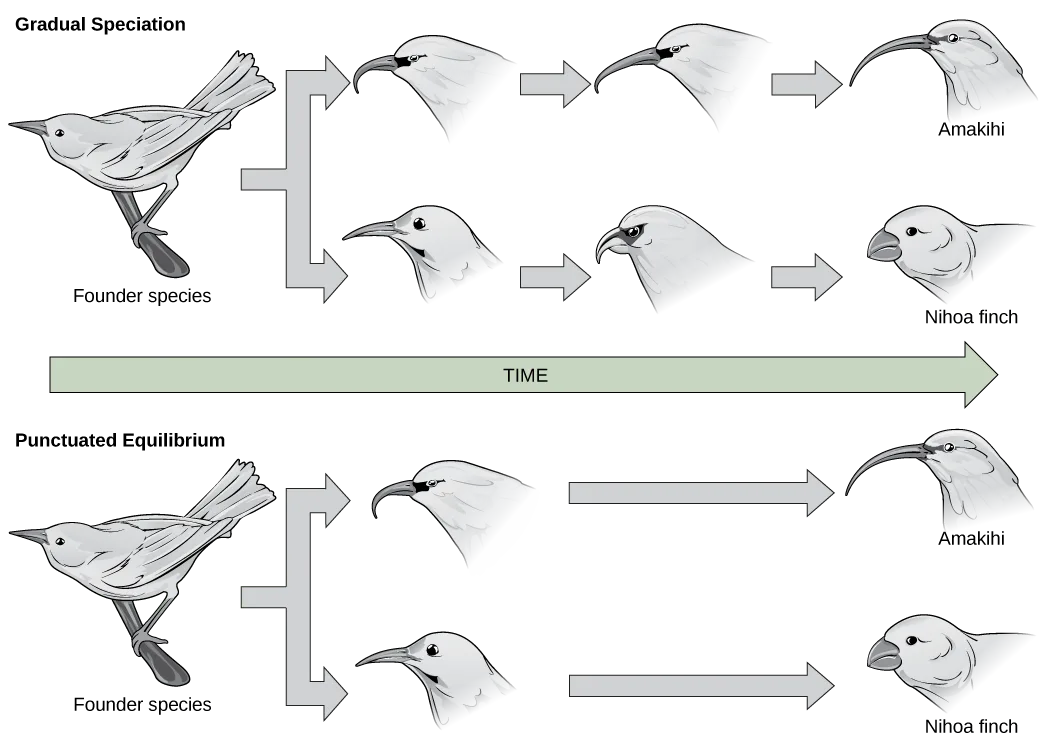
Extended description
Top row, labeled ‘Gradual Speciation’: a grey founder bird on the left, its beak short and stout, feeds into a bracket that splits into two grey arrows, one going up and one going down. Each arrow leads through three sequential bird-head close-ups connected by short grey arrows: the upper lineage’s beak lengthens and curves further at each step, ending at a head labeled ‘Amakihi’ with a long, thin, downward-hooked beak; the lower lineage’s beak shortens and thickens at each step, ending at a head labeled ‘Nihoa finch’ with a short, deep, nearly straight beak. A wide green arrow labeled ‘TIME’ spans the full row beneath both lineages. Bottom row, labeled ‘Punctuated Equilibrium’: the same founder bird and split bracket lead to a single head per lineage that already shows the final hooked or straight beak shape, then one long grey arrow with no intermediate heads carries each lineage across to the same ‘Amakihi’ and ‘Nihoa finch’ labels.
Which of the following statements is false?
Punctuated equilibrium starts with a rapid environmental change hitting a small, isolated population — pair that with the wrong population size or climate and you have the false statement.The primary influencing factor on changes in speciation rate is environmental conditions. Under some conditions, selection occurs quickly or radically. Consider a species of snails that had been living with the same basic form for many thousands of years. Layers of their fossils would appear similar for a long time. When a change in the environment takes place—such as a drop in the water level—a small number of organisms are separated from the rest in a brief period of time, essentially forming one large and one tiny population. The tiny population faces new environmental conditions. Because its gene pool quickly became so small, any variation that surfaces and that aids in surviving the new conditions becomes the predominant form.
Summary
Speciation is not a precise division: overlap between closely related species can occur in areas called hybrid zones. Organisms reproduce with other similar organisms. The fitness of these hybrid offspring can affect the two species’ evolutionary path. Scientists propose two models for the rate of speciation: one model illustrates how a species can change slowly over time. The other model demonstrates how change can occur quickly from a parent generation to a new species. Both models continue to follow natural selection patterns.
Key terms
- gradual speciation model — model that shows how species diverge gradually over time in small steps
- hybrid zone — area where two closely related species continue to interact and reproduce, forming hybrids
- punctuated equilibrium — model for rapid speciation that can occur when an event causes a small portion of a population to be cut off from the rest of the population
- reinforcement — continued speciation divergence between two related species due to low fitness of hybrids between them
Practice
Describe pathways of species evolution in hybrid zones
Which term is used to describe the continued divergence of species based on the low fitness of hybrid offspring?
It is the term the section uses for hybrids’ low success driving the two species further apart.Describe a situation where hybrid reproduction would cause two species to fuse into one.
Show model answer
Did your answer mention:
The area where two closely related species continue to interact and reproduce with each other, producing offspring with mixed traits, is called a ________.
It is where reinforcement, fusion, or stability plays out after speciation.The continued divergence between two related species, driven by the low fitness of their hybrid offspring, is called ________.
It is the process that keeps pushing two species further apart rather than letting them fuse.Explain the two major theories on rates of speciation
Which components of speciation would be least likely to be a part of punctuated equilibrium?
Punctuated equilibrium begins when a small population is cut off from the rest — think about what an isolated population would not keep.What do both rate of speciation models have in common?
Show model answer
Did your answer mention:
The theory that species diverge slowly, changing in small increments over time, is called the ________.
It is the opposite tempo from a model with a rapid burst of change.The model for rapid speciation that can occur when an event isolates a small portion of a population from the rest is called ________.
It begins with a periodic burst of change and then holds steady afterward.This section is adapted from Biology 2e, Section 18.3: Reconnection and Speciation Rates by Mary Ann Clark, Jung Choi, Matthew Douglas, and OpenStax, © OpenStax, licensed under CC BY-NC-SA 4.0. Access the original for free at openstax.org. Changes: figures re-encoded as WebP (both kinds matched the manifest’s “diagram” guess after inspection); an extended description added to both figures, since neither the arrow diagram’s shapes, colors, and printed labels, nor the beak diagram’s arrows and intermediate steps, are fully carried by its caption; the two feature boxes wrapping the Visual Connection questions rendered as, respectively, the first figure plus a self-check (the source keys it as open-ended prose) and the second figure plus a multiple choice (the source keys a lettered option), both kept in the body; the source’s own cross-reference for the fusion sentence in Reconnection — which in both the CNXML and the printed page points at the beak-speciation-rate figure rather than the hybrid-zone figure whose own fusion panel illustrates the sentence — redirected to a descriptive reference to the hybrid-zone figure above it; the interactive note rendered as a Link to Learning callout with its URL kept; the end-of-section Review Questions and Critical Thinking Questions adapted into the closing interactive Practice block (multiple choice and self-check respectively); four key-term recall items added from the glossary; and rubric checkpoints added to every self-check, in the body and in Practice, decomposing its model answer (the source solution) into check-off clauses with no new claims.