The Evolution of Populations
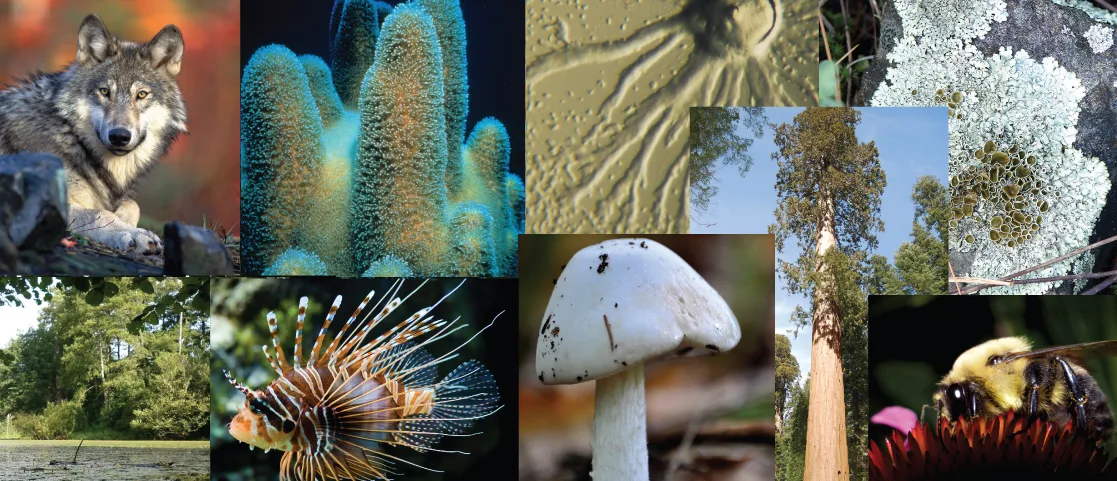
All life on Earth is related. Evolutionary theory states that humans, beetles, plants, and bacteria all share a common ancestor, but that billions of years of evolution have shaped each of these organisms into the forms we see today. Scientists consider evolution a key concept to understanding life. Natural selection acts to promote traits and behaviors that increase an organism’s chances of survival and reproduction, while eliminating those traits and behaviors that are detrimental to the organism. However, natural selection can only, as its name implies, select—it cannot create. We can attribute novel traits and behaviors to another evolutionary force—mutation. Mutation and other sources of variation among individuals, as well as the evolutionary forces that act upon them, alter populations and species. This combination of processes has led to the world of life we see today.
Sections
- Population Evolution — how population genetics and the Hardy-Weinberg principle describe the evolution of populations and species, from small-scale changes among individuals to large-scale changes over paleontological time.
- Population Genetics — the genetic and environmental sources of variation in a population, and how natural selection, genetic drift, gene flow, mutation, and nonrandom mating each change a population’s allele frequencies.
- Adaptive Evolution — the different ways natural selection can shape a population — including stabilizing, directional, and diversifying selection — and the different outcomes each produces for a population’s variation.
This chapter is adapted from Biology 2e, Chapter 19: The Evolution of Populations by Mary Ann Clark, Jung Choi, Matthew Douglas, and OpenStax, © OpenStax, licensed under CC BY-NC-SA 4.0. Access the original for free at openstax.org. Each section page records its own changes from the source. Changes: the chapter-opening photograph is the source’s, re-encoded for the web, with its source alt rewritten from the image — the source alt names ten organisms for a nine-photo collage, double-naming the teal colony its own credit line calls “coral” as both “a cucumber-shaped protozoan” and “a sea sponge”.