Phylogenies and the History of Life
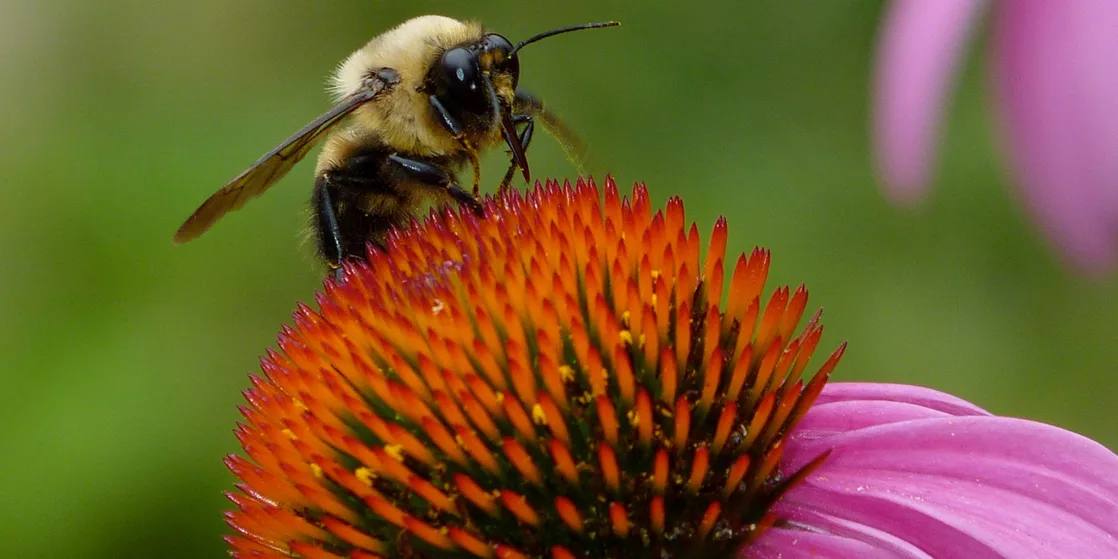
This bee and Echinacea flower, shown above, could not look more different, yet they are related, as are all living organisms on Earth. By following pathways of similarities and changes—both visible and genetic—scientists seek to map the evolutionary past of how life developed from single-celled organisms to the tremendous collection of creatures that have germinated, crawled, floated, swum, flown, and walked on this planet.
Sections
- Organizing Life on Earth — why a comprehensive classification system is needed, the levels of the taxonomic hierarchy, how systematics and taxonomy relate to phylogeny, and what a phylogenetic tree’s components represent.
- Determining Evolutionary Relationships — how scientists compare homologous and analogous traits, and how cladistics and the principle of maximum parsimony use those traits to build phylogenetic trees.
- Perspectives on the Phylogenetic Tree — how horizontal gene transfer moves genes across species, and how the web and ring models of phylogenetic relationships have challenged the original single-trunk tree concept.
This chapter is adapted from Biology 2e, Chapter 20: Phylogenies and the History of Life by Mary Ann Clark, Jung Choi, Matthew Douglas, and OpenStax, © OpenStax, licensed under CC BY-NC-SA 4.0. Access the original for free at openstax.org. Each section page records its own changes from the source. Changes: the chapter-opening photograph is the source’s, re-encoded for the web, with its source alt kept since it already says what the photo shows; the source’s in-text parenthetical figure reference ("(Figure 20.1)") is rendered as “shown above” since this site does not number figures.