Determining Evolutionary Relationships
By the end of this section, you will be able to:
- Compare homologous and analogous traits
- Discuss the purpose of cladistics
- Describe maximum parsimony
Scientists must collect accurate information that allows them to make evolutionary connections among organisms. Similar to detective work, scientists must use evidence to uncover the facts. In the case of phylogeny, evolutionary investigations focus on two types of evidence: morphologic (form and function) and genetic.
Two Options for Similarities
In general, organisms that share similar physical features and genomes are more closely related than those that do not. We refer to such features that overlap both morphologically (in form) and genetically as homologous structures. They stem from developmental similarities that are based on evolution. For example, the bones in bat and bird wings have homologous structures. This is an example of morphological homology (see the figure below).
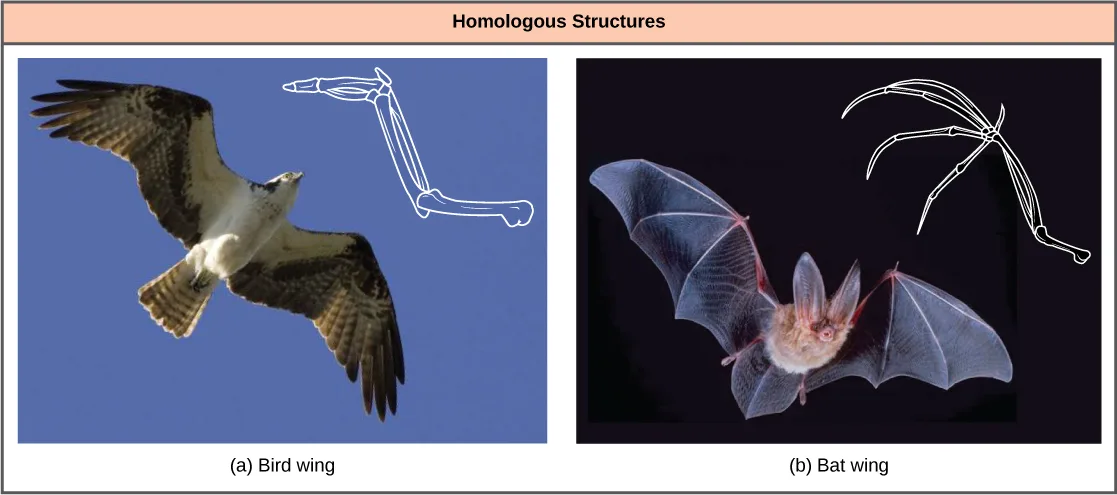
Notice it is not simply a single bone, but rather a grouping of several bones arranged in a similar way. The more complex the feature, the more likely any kind of overlap is due to a common evolutionary past. Imagine two people from different countries both inventing a car with all the same parts and in exactly the same arrangement without any previous or shared knowledge. That outcome would be highly improbable. However, if two people both invented a hammer, we can reasonably conclude that both could have the original idea without the help of the other. The same relationship between complexity and shared evolutionary history is true for homologous structures in organisms.
Misleading Appearances
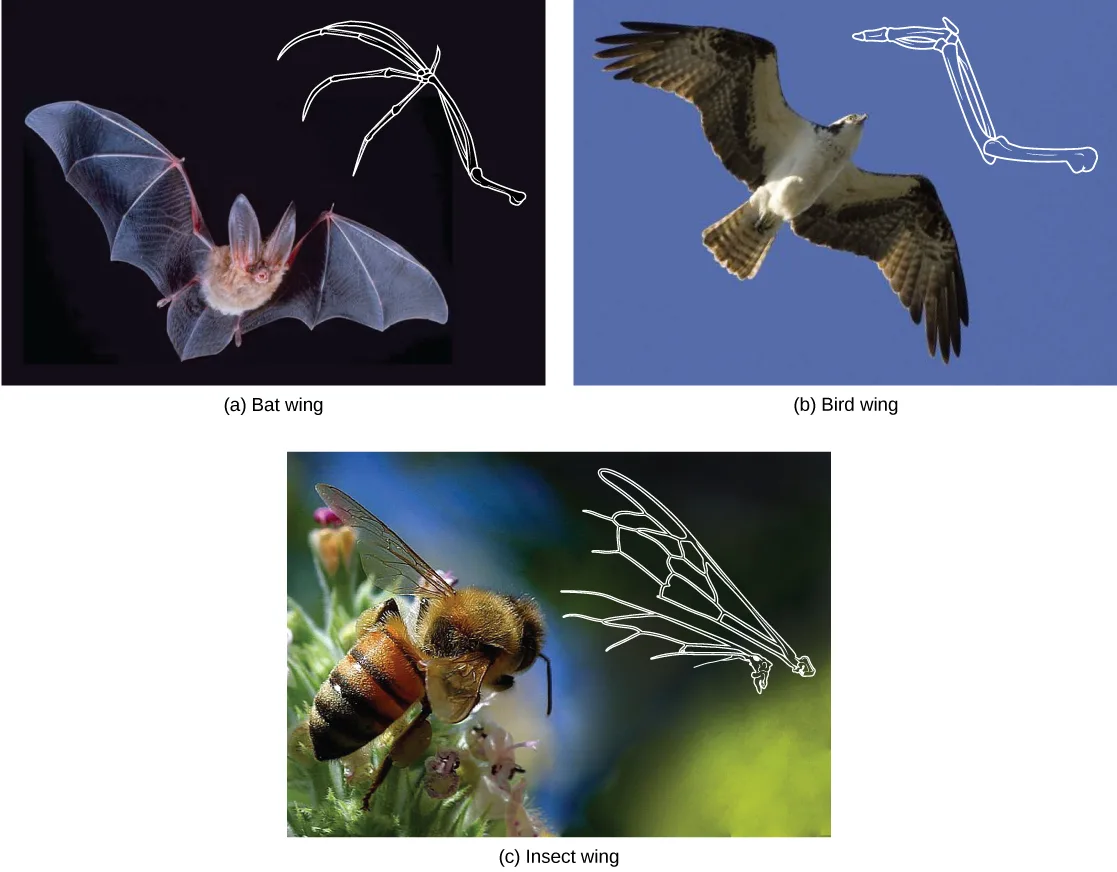
Some organisms may be very closely related, even though a minor genetic change caused a major morphological difference to make them look quite different. Similarly, unrelated organisms may be distantly related, but appear very much alike. This usually happens because both organisms share common adaptations that evolved within similar environmental conditions. When similar characteristics occur because of environmental constraints and not due to a close evolutionary relationship, it is an analogy or homoplasy. For example, insects use wings to fly like bats and birds, but the wing structure and embryonic origin is completely different. These are analogous structures (see the figure below). On the other side, the bird and bat wings are homologous because the bones are inherited from a common ancestor, while the wings themselves are analogous as they evolved independently.
Similar traits can be either homologous or analogous. Homologous structures share a similar embryonic origin. Analogous organs have a similar function. For example, the bones in a whale’s front flipper are homologous to the bones in the human arm. These structures are not analogous. A butterfly or bird’s wings are analogous but not homologous. Scientists must determine which type of similarity a feature exhibits to decipher the organisms’ phylogeny.
Molecular Comparisons
The advancement of DNA technology has given rise to molecular systematics, which is use of molecular data in taxonomy and biological geography (biogeography). New computer programs not only confirm many earlier classified organisms, but also uncover previously made errors. As with physical characteristics, even the DNA sequence can be tricky to read in some cases. For some situations, two very closely related organisms can appear unrelated if a mutation occurred that caused a shift in the genetic code. Inserting or deleting a mutation would move each nucleotide base over one place, causing two similar codes to appear unrelated.
Sometimes two segments of DNA code in distantly related organisms randomly share a high percentage of bases in the same locations, causing these organisms to appear closely related when they are not. For both of these situations, computer technologies help identify the actual relationships, and, ultimately, the coupled use of both morphologic and molecular information is more effective in determining phylogeny.
Evolution Connection. Why Does Phylogeny Matter? Evolutionary biologists could list many reasons why understanding phylogeny is important to everyday life in human society. For botanists, phylogeny acts as a guide to discovering new plants that can be used to benefit people. Think of all the ways humans use plants—food, medicine, and clothing are a few examples. If a plant contains a compound that is effective in treating cancer, scientists might want to examine all of the compounds for other useful drugs.
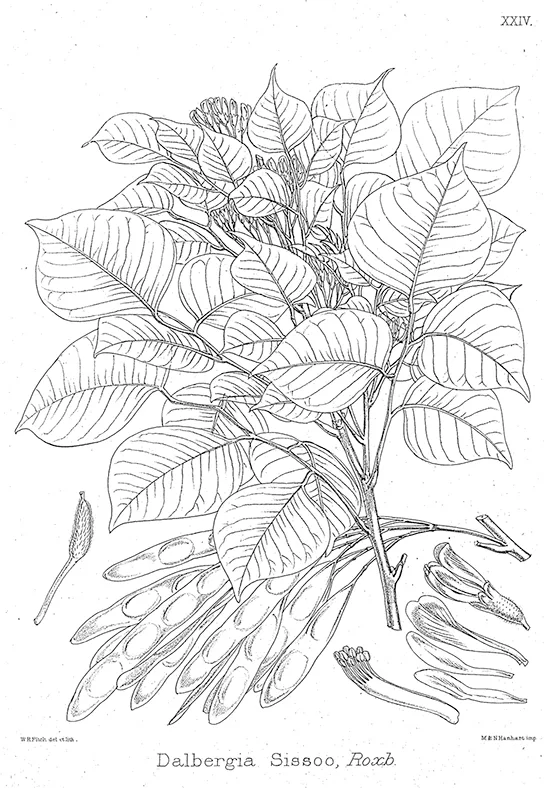
A research team in China identified a DNA segment that they thought to be common to some medicinal plants in the family Fabaceae (the legume family) (see the illustration below). They worked to identify which species had this segment. After testing plant species in this family, the team found a DNA marker (a known location on a chromosome that enabled them to identify the species) present. Then, using the DNA to uncover phylogenetic relationships, the team could identify whether a newly discovered plant was in this family and assess its potential medicinal properties.
Building Phylogenetic Trees
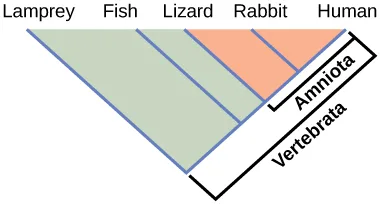
How do scientists construct phylogenetic trees? After they sort the homologous and analogous traits, scientists often organize the homologous traits using cladistics. This system sorts organisms into clades: groups of organisms that descended from a single ancestor. For example, in the figure below, all the organisms in the orange region evolved from a single ancestor that had amniotic eggs. Consequently, these organisms also have amniotic eggs and make a single clade, or a monophyletic group. Clades must include all descendants from a branch point.
Extended description
The tree’s single root sits at the bottom center. From the root, a line runs up and to the left, ending at the Lamprey tip. A second line — the spine — runs from the same root up and to the right, ending at the Human tip; along its way it sheds three branch points, each higher than the last. At the lowest of the three, a line parallel to the Lamprey line breaks off up and to the left to the Fish tip. Above that, a second parallel line breaks off to the Lizard tip. Above that, a third parallel line breaks off to the Rabbit tip, after which the spine continues on to Human. Reading the tips left to right: Lamprey, Fish, Lizard, Rabbit, Human. A pale green region shades the entire tree and is bracketed beneath as Vertebrata, spanning all five tips. A smaller, darker orange region is nested inside it, shading the branches from the Lizard branch point onward and bracketed beneath as Amniota, spanning Lizard, Rabbit, and Human only.
Which animals in this figure belong to a clade that includes animals with hair? Which evolved first, hair or the amniotic egg?
Show model answer
Did your answer mention:
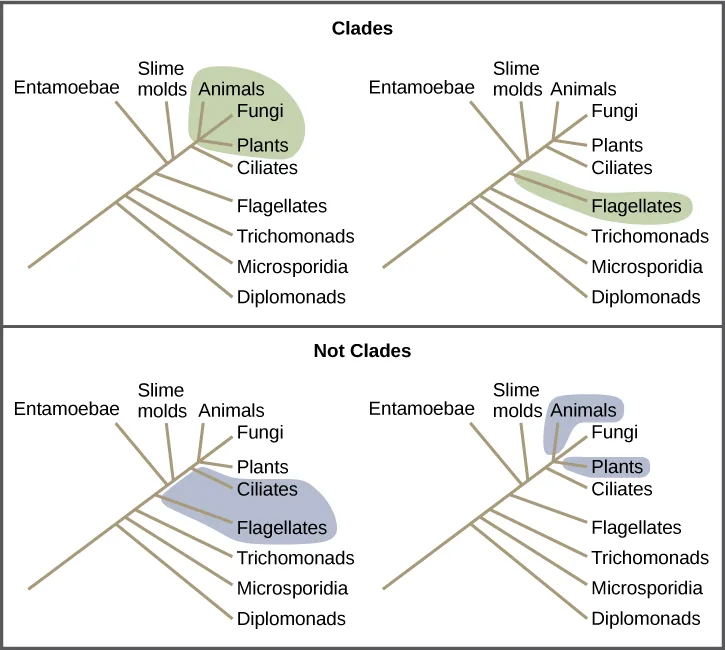
Clades can vary in size depending on which branch point one references. The important factor is that all organisms in the clade or monophyletic group stem from a single point on the tree. You can remember this because monophyletic breaks down into “mono,” meaning one, and “phyletic,” meaning evolutionary relationship. The figure below shows various clade examples. Notice how each clade comes from a single point; whereas, the non-clade groups show branches that do not share a single point.
Extended description
All four panels share one tree shape: a single trunk runs from a root at the lower left up to the upper right, and along it, nearest the root first, branch points lead off in order to Diplomonads, Microsporidia, Trichomonads, Flagellates, Entamoebae, Slime molds, and Ciliates, before the trunk ends in one final branch point that splits three ways into Animals, Fungi, and Plants. Top-left panel (‘Clades’): Animals, Fungi, and Plants, which share that final branch point, are all shaded as one clade. Top-right panel (‘Clades’): only Flagellates is shaded, shown as a clade of one. Bottom-left panel (‘Not Clades’): Flagellates and Ciliates are shaded together even though they branch off the trunk at different points. Bottom-right panel (‘Not Clades’): Animals and Plants are shaded together while Fungi, which shares their branch point, is left unshaded.
What is the largest clade in this diagram?
Show model answer
Did your answer mention:
Shared Characteristics
Organisms evolve from common ancestors and then diversify. Scientists use the phrase “descent with modification” because even though related organisms have many of the same characteristics and genetic codes, changes occur. This pattern repeats as one goes through the phylogenetic tree of life:
- A change in an organism’s genetic makeup leads to a new trait which becomes prevalent in the group.
- Many organisms descend from this point and have this trait.
- New variations continue to arise: some are adaptive and persist, leading to new traits.
- With new traits, a new branch point is determined (go back to step 1 and repeat).
If a characteristic is found in the ancestor of a group, it is considered a shared ancestral character because all of the organisms in the taxon or clade have that trait. The vertebrate in the Vertebrata figure above is a shared ancestral character. Now consider the amniotic egg characteristic in that same figure. Only some of the organisms in that figure have this trait, and to those that do, it is called a shared derived character because this trait derived at some point but does not include all of the ancestors in the tree.
The tricky aspect to shared ancestral and shared derived characters is that these terms are relative. We can consider the same trait one or the other depending on the particular diagram that we use. Returning to that figure, note that the amniotic egg is a shared ancestral character for lizards, rabbits, and humans, while having hair is a shared derived character only for humans and rabbits. For the Amniotes as a group, however, the amniotic egg is a shared derived character that is not seen in fish. These terms help scientists distinguish between clades in building phylogenetic trees.
Choosing the Right Relationships
Imagine being the person responsible for organizing all department store items properly—an overwhelming task. Organizing the evolutionary relationships of all life on Earth proves much more difficult: scientists must span enormous blocks of time and work with information from long-extinct organisms. Trying to decipher the proper connections, especially given the presence of homologies and analogies, makes the task of building an accurate tree of life extraordinarily difficult. Add to that advancing DNA technology, which now provides large quantities of genetic sequences for researchers to use and analyze. Taxonomy is a subjective discipline: many organisms have more than one connection to each other, so each taxonomist will decide the order of connections.
To aid in the tremendous task of describing phylogenies accurately, scientists often use the concept of maximum parsimony, which means that events occurred in the simplest, most obvious way. For example, if a group of people entered a forest preserve to hike, based on the principle of maximum parsimony, one could predict that most would hike on established trails rather than forge new ones.
For scientists deciphering evolutionary pathways, the same idea is used: the pathway of evolution probably includes the fewest major events that coincide with the evidence at hand. Starting with all of the homologous traits in a group of organisms, scientists look for the most obvious and simple order of evolutionary events that led to the occurrence of those traits.
Link to Learning. Visit a site explaining how researchers use maximum parsimony to build phylogenetic trees.
These tools and concepts are only a few strategies scientists use to tackle the task of revealing the evolutionary history of life on Earth. Recently, newer technologies have uncovered surprising discoveries with unexpected relationships, such as the fact that people seem to be more closely related to fungi than fungi are to plants. Sound unbelievable? As the information about DNA sequences grows, scientists will become closer to mapping the evolutionary history of all life on Earth.
Summary
To build phylogenetic trees, scientists must collect accurate information that allows them to make evolutionary connections between organisms. Using morphologic and molecular data, scientists work to identify homologous characteristics and genes. Similarities between organisms can stem either from shared evolutionary history (homologies) or from separate evolutionary paths (analogies). Scientists can use newer technologies to help distinguish homologies from analogies. After identifying homologous information, scientists use cladistics to organize these events as a means to determine an evolutionary timeline. They then apply the concept of maximum parsimony, which states that the order of events probably occurred in the most obvious and simple way with the least amount of steps. For evolutionary events, this would be the path with the least number of major divergences that correlate with the evidence.
Key terms
- analogy — (also, homoplasy) characteristic that is similar between organisms by convergent evolution, not due to the same evolutionary path
- cladistics — system to organize homologous traits to describe phylogenies
- homology — similarity in characteristics resulting from a shared ancestry
- maximum parsimony — applying the simplest, most obvious way with the least number of steps
- molecular systematics — technique using molecular evidence to identify phylogenetic relationships
- monophyletic group — (also, clade) organisms that share a single ancestor
- shared ancestral character — describes a characteristic on a phylogenetic tree that all organisms on the tree share
- shared derived character — describes a characteristic on a phylogenetic tree that only a certain clade of organisms share
Practice
Compare homologous and analogous traits
Which statement about analogies is correct?
Re-read the definition of analogy — what causes two organisms to end up with a similar trait despite no close evolutionary relationship?Dolphins and fish have similar body shapes. Is this feature more likely a homologous or analogous trait?
Show model answer
Did your answer mention:
A characteristic that is similar between organisms because of convergent evolution, rather than a shared evolutionary path, is called ________.
Bat, bird, and insect wings all serve the same function but did not evolve from a shared ancestor.Similarity in characteristics resulting from a shared ancestry is called ________.
Bat and bird wings share this kind of similarity because both evolved from the same ancestral forelimb bones.A technique that uses DNA sequence data to identify phylogenetic relationships is called ________.
It compares DNA rather than physical form to work out relationships between organisms.Discuss the purpose of cladistics
What do scientists use to apply cladistics?
Cladistics sorts organisms based on features that stem from a shared evolutionary past, not independently evolved ones.What is true about organisms that are a part of the same clade?
A clade is defined by descent, not by how similar the organisms look today.Why is it so important for scientists to distinguish between homologous and analogous characteristics before building phylogenetic trees?
Show model answer
Did your answer mention:
The system used to organize homologous traits in order to describe phylogenies is called ________.
It sorts organisms into clades — groups that descended from a single ancestor.A set of organisms all descended from a single common ancestor is called a ________.
Vertebrata and Amniota, in the tree figure, are both examples.A trait on a phylogenetic tree that every organism on the tree has in common is called a ________.
In the Vertebrata figure, having a vertebral column is this kind of trait for every tip shown.A trait that arose at some point along a phylogenetic tree and belongs only to one particular clade is called a ________.
In the Vertebrata figure, the amniotic egg is this kind of trait for lizards, rabbits, and humans, but not fish or lampreys.Describe maximum parsimony
Why do scientists apply the concept of maximum parsimony?
Maximum parsimony predicts the simplest, most obvious pathway of events — think about what that pathway is used to build.Describe maximum parsimony.
Show model answer
Did your answer mention:
The concept of explaining evolutionary events in the simplest, most obvious way, using the fewest possible steps, is called ________.
Think of a group of hikers following established trails rather than forging new ones.This section is adapted from Biology 2e, Section 20.2: Determining Evolutionary Relationships by Mary Ann Clark, Jung Choi, Matthew Douglas, and OpenStax, © OpenStax, licensed under CC BY-NC-SA 4.0. Access the original for free at openstax.org. Changes: figures re-encoded as WebP; all five figures (Figure_20_02_01-5b8b, Figure_20_02_02-6526, Figure_20_02_03-eb43, Figure_20_02_04-43b5, Figure_20_02_05) re-kinded from the manifest’s file-extension “photo” guess to “diagram” after inspection (the first two are photographs overlaid with a line-drawn bone-structure diagram that carries the homology/analogy teaching point; the third is a line-engraved botanical illustration, not a photograph; the last two are drawn cladograms); a longdesc added for Figure_20_02_04-43b5 and Figure_20_02_05 (the root, branch order, and tip labels of each cladogram are not carried by the caption); the alts for all five figures rewritten from the images, since the source alts either used the word “analogous” loosely in a way that could be confused with this section’s technical distinction, or were too terse to carry what each panel shows; the two interactive notes rendered as Link to Learning callouts with descriptive link text (“a site with examples of how appearances can be misleading…,” “a site explaining how researchers use maximum parsimony…”) in place of the source’s bare “website”; the “Why Does Phylogeny Matter?” evolution note rendered as an Evolution Connection callout with its embedded figure kept inside it; the two visual-connection notes rendered as their mediafigure immediately followed by a self-check carrying the source’s own solution, with rubric checkpoints decomposing each model answer into check-off clauses with no new claims; the inline forward/backward figure references reworded as “the figure below”/“the figure above”/“that same figure” since figures are not numbered here; the end-of-section Review Questions and Critical Thinking Questions adapted into the closing interactive Practice block (multiple choice and self-check respectively); eight key-term recall items added from the glossary (analogy, homology, molecular systematics, cladistics, monophyletic group, shared ancestral character, shared derived character, maximum parsimony); and rubric checkpoints added to each self-check, decomposing its model answer (the source solution) into check-off clauses with no new claims.