Viruses
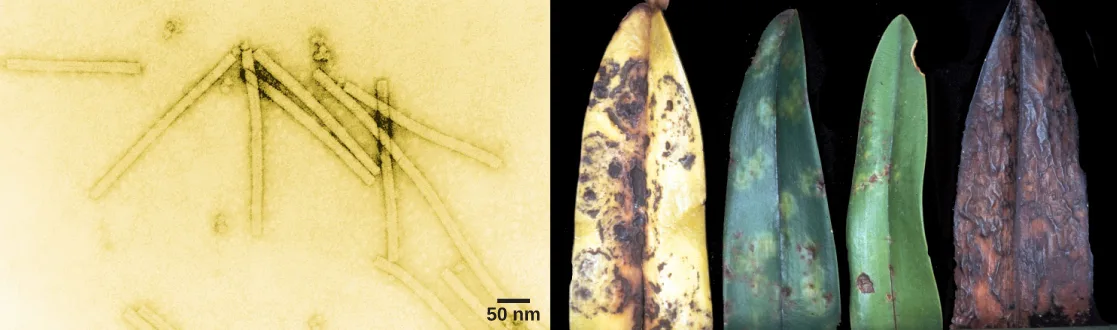
Viruses are noncellular parasitic entities that cannot be classified within any kingdom. They can infect organisms as diverse as bacteria, plants, and animals. In fact, viruses exist in a sort of netherworld between a living organism and a nonliving entity. Living things grow, metabolize, and reproduce. In contrast, viruses are not cellular, do not have a metabolism or grow, and cannot divide by cell division. Viruses can copy, or replicate themselves; however, they are entirely dependent on resources derived from their host cells to produce progeny viruses—which are assembled in their mature form. No one knows exactly when or how viruses evolved or from what ancestral source because viruses have not left a fossil record. Some virologists contend that modern viruses are a mosaic of bits and pieces of nucleic acids picked up from various sources along their respective evolutionary paths.
Sections
- Viral Evolution, Morphology, and Classification — how viruses were discovered and are detected, the three hypotheses for their origin, the capsid-and-genome structure and basic shapes of virions, and the older classification systems and the Baltimore system based on how a virus makes its mRNA.
- Virus Infections and Hosts — the six steps of viral replication, the lytic and lysogenic cycles of bacteriophages, how plant and animal viruses spread and cause disease, and the acute, chronic, and latent courses an animal infection can take.
- Prevention and Treatment of Viral Infections — vaccines and how they prevent infection, the antiviral drugs that treat active disease, and the emerging uses of viruses themselves in gene therapy, oncolytic treatment, and phage therapy.
- Other Acellular Entities: Prions and Viroids — the misfolded prion proteins behind transmissible spongiform encephalopathies and the small circular RNA viroids that infect plants.
This chapter is adapted from Biology 2e, Chapter 21: Viruses by Mary Ann Clark, Jung Choi, Matthew Douglas, and OpenStax, © OpenStax, licensed under CC BY-NC-SA 4.0. Access the original for free at openstax.org. Each section page records its own changes from the source. Changes: the chapter-opening image is the source’s, re-encoded for the web, with its source alt kept since it already says what the photomicrograph and photo show; the source’s introduction paragraph does not reference the opening figure inline, so no parenthetical figure-reference rendering was needed.