Prevention and Treatment of Viral Infections
By the end of this section, you will be able to:
- Identify major viral illnesses that affect humans
- Compare vaccinations and anti-viral drugs as medical approaches to viruses
Viruses cause a variety of diseases in animals, including humans, ranging from the common cold to potentially fatal illnesses like meningitis. These diseases can be treated by antiviral drugs or by vaccines; however, some viruses, such as HIV, are capable both of avoiding the immune response and of mutating within the host organism to become resistant to antiviral drugs.
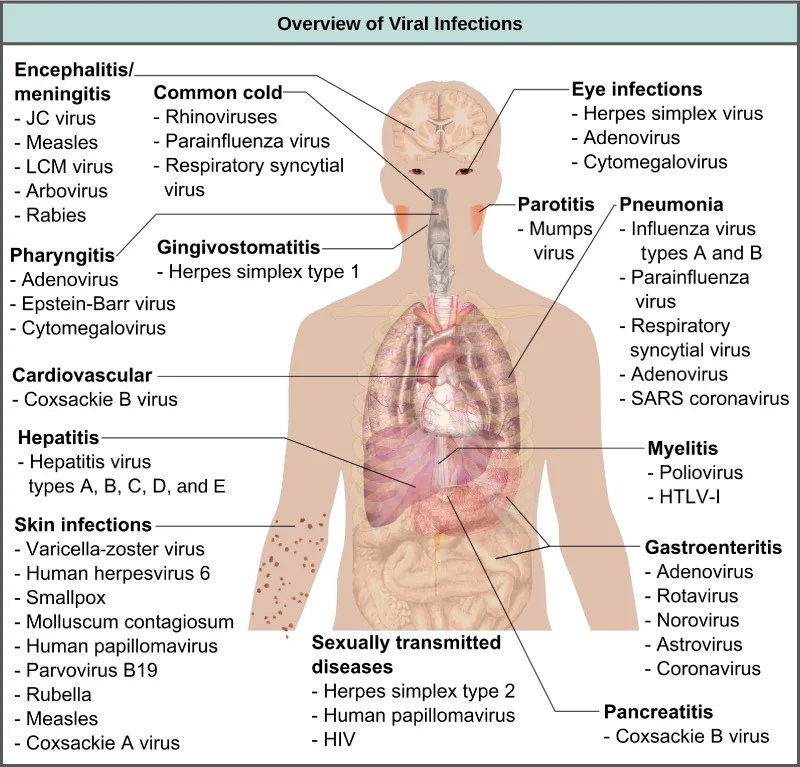
Extended description
A human body outline under the banner ‘Overview of Viral Infections,’ with labeled lines running from named conditions to the body region each affects. At the head: ‘Encephalitis/meningitis’ (JC virus, measles, LCM virus, arbovirus, rabies) and ‘Common cold’ (rhinoviruses, parainfluenza virus, respiratory syncytial virus) point to the brain and nose; ‘Eye infections’ (herpes simplex virus, adenovirus, cytomegalovirus) point to the eyes; ‘Pharyngitis’ (adenovirus, Epstein-Barr virus, cytomegalovirus) and ‘Gingivostomatitis’ (herpes simplex type 1) point to the throat and mouth; ‘Parotitis’ (mumps virus) points to the neck. At the torso: ‘Pneumonia’ (influenza virus types A and B, parainfluenza virus, respiratory syncytial virus, adenovirus, SARS coronavirus) points to the lungs; ‘Cardiovascular’ (coxsackie B virus) points to the heart; ‘Hepatitis’ (hepatitis virus types A, B, C, D, and E) points to the liver; ‘Skin infections’ (varicella-zoster virus, human herpesvirus 6, smallpox, molluscum contagiosum, human papillomavirus, parvovirus B19, rubella, measles, coxsackie A virus) points to a rash on the arm; ‘Myelitis’ (poliovirus, HTLV-I) points to the spinal cord; ‘Gastroenteritis’ (adenovirus, rotavirus, norovirus, astrovirus, coronavirus) and ‘Pancreatitis’ (coxsackie B virus) point to the digestive tract; ‘Sexually transmitted diseases’ (herpes simplex type 2, human papillomavirus, HIV) points to the reproductive organs.
Vaccines for Prevention
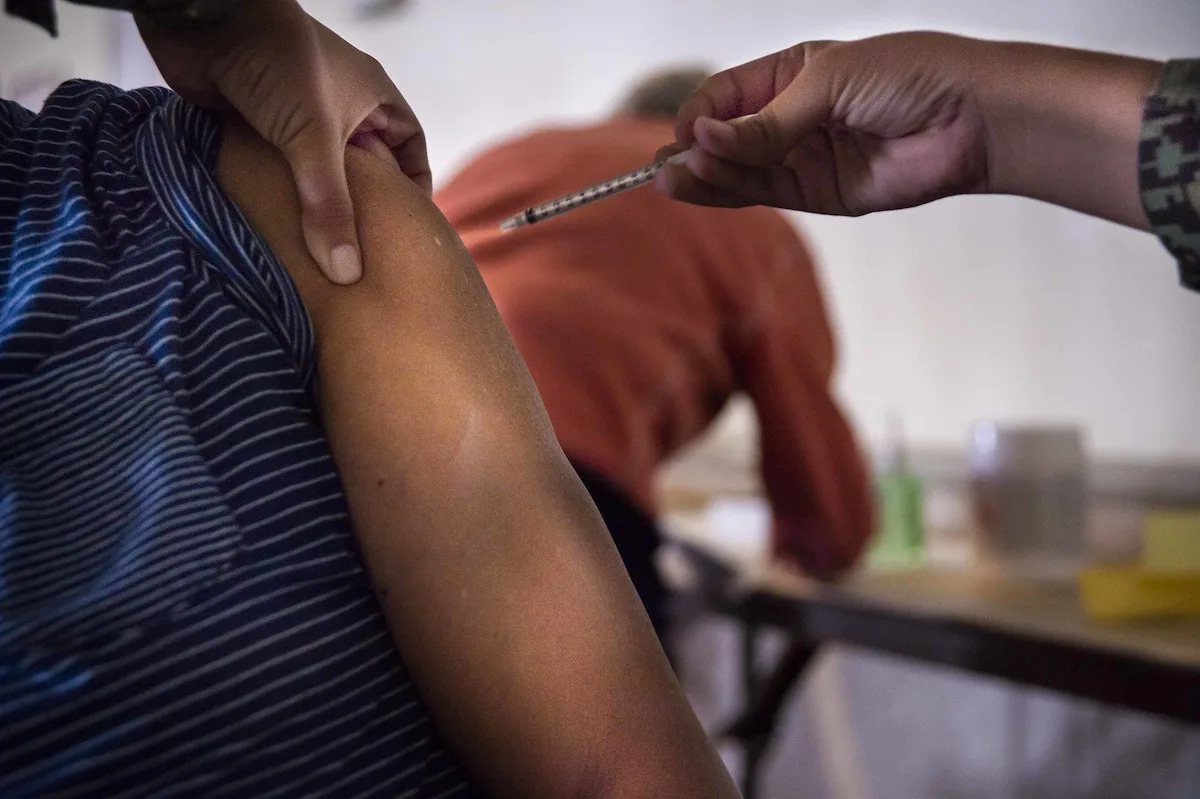
The primary method of controlling viral disease is by vaccination, which is intended to prevent outbreaks by building immunity to a virus or virus family. Vaccines may be prepared using live viruses, killed viruses, or molecular subunits of the virus. Note that the killed viral vaccines and subunit viruses are both incapable of causing disease, nor is there any valid evidence that vaccinations contribute to autism.
Live viral vaccines are designed in the laboratory to cause few symptoms in recipients while giving them protective immunity against future infections. Polio was one disease that represented a milestone in the use of vaccines. Polio epidemics occurred with increasing frequency and impact as the twentieth century progressed, becoming a terrifying and tragic event each summer. Tens of thousands of people died and many more were paralyzed; children made up a large portion of the victims. Using killed virus tested on HeLa cell line (originally obtained from Henrietta Lacks and then mass produced to meet the need), Jonas Salk developed a successful vaccine. Mass immunization campaigns in the 1950s (killed vaccine) and 1960s (live vaccine) significantly reduced the incidence of the disease. The success of the polio vaccine paved the way for the routine dispensation of childhood vaccines against measles, mumps, rubella, chickenpox, and other diseases.
The issue with using live vaccines (which are usually more effective than killed vaccines), is the low but significant danger that these viruses will revert to their disease-causing form by back mutations. Live vaccines are usually made by attenuating (weakening) the “wild-type” (disease-causing) virus by growing it in the laboratory in tissues or at temperatures different from what the virus is accustomed to in the host. Adaptations to these new cells or temperatures induce mutations in the genomes of the virus, allowing it to grow better in the laboratory while inhibiting its ability to cause disease when reintroduced into conditions found in the host. These attenuated viruses thus still cause infection, but they do not grow very well, allowing the immune response to develop in time to prevent major disease. Back mutations occur when the vaccine undergoes mutations in the host such that it readapts to the host and can again cause disease, which can then be spread to other humans in an epidemic. This type of scenario happened as recently as 2007 in Nigeria where mutations in a polio vaccine led to an epidemic of polio in that country.
Some vaccines are in continuous development because certain viruses, such as influenza and HIV, have a high mutation rate compared to that of other viruses and normal host cells. With influenza, mutations in the surface molecules of the virus help the organism evade the protective immunity that may have been obtained in a previous influenza season, making it necessary for individuals to get vaccinated every year. Other viruses, such as those that cause the childhood diseases measles, mumps, and rubella, mutate so infrequently that the same vaccine is used year after year.
Vaccines and Antiviral Drugs for Treatment
In some cases, vaccines can be used to treat an active viral infection. The concept behind this is that by giving the vaccine, immunity is boosted without adding more disease-causing virus. In the case of rabies, a fatal neurological disease transmitted via the saliva of rabies virus-infected animals, the progression of the disease from the time of the animal bite to the time it enters the central nervous system may be two weeks or longer. This is enough time to vaccinate individuals who suspect that they have been bitten by a rabid animal, and their boosted immune response is sufficient to prevent the virus from entering nervous tissue. Thus, the potentially fatal neurological consequences of the disease are averted, and the individual only has to recover from the infected bite. This approach is also being used for the treatment of Ebola, one of the fastest and most deadly viruses on Earth. Transmitted by bats and great apes, this disease can cause death in 70 to 90 percent of infected humans within two weeks. Using newly developed vaccines that boost the immune response in this way, there is hope that affected individuals will be better able to control the virus, potentially saving a greater percentage of infected persons from a rapid and very painful death.
Another way of treating viral infections is the use of antiviral drugs. Because viruses use the resources of the host cell for replication and the production of new virus proteins, it is difficult to block their activities without damaging the host. For many years, scientists thought that drugs capable of impacting viruses would be too toxic for the body to endure. To meet this challenge, researcher Gertrude Elion sought to develop drugs that would target only the virus through processes such as inhibiting only viral DNA replication. For example, some of her medicines focused on purines, while others affected DNA polymerase. (Elion has 45 patents ranging from antivirals to immunosuppressants to cancer drugs.) However, we do have some effective antiviral drugs, such as those used to treat HIV and influenza. Some antiviral drugs are specific for a particular virus and others have been used to control and reduce symptoms for a wide variety of viral diseases. For most viruses, antiviral drugs can inhibit the virus by blocking the actions of one or more of its proteins. It is important to note that the targeted proteins be encoded by viral genes and that these molecules are not present in a healthy host cell. In this way, viral growth is inhibited without damaging the host. Elion’s work with George Hitchings (Source note: the source prints “Hitchens”; the 1988 Nobel laureate is George H. Hitchings.) not only led to direct treatments, but, more importantly, changed the entire methodology of drug development. By targeting specific aspects of tumor cells, viruses, and bacteria, they laid the groundwork for many of today’s most common and important medicines, used to help millions of people each year. They were awarded the Nobel Prize in 1988.
Antivirals have been developed to treat genital herpes (herpes simplex II) and influenza. For genital herpes, drugs such as acyclovir, developed by Elion, can reduce the number and duration of episodes of active viral disease, during which patients develop viral lesions in their skin cells. As the virus remains latent in nervous tissue of the body for life, this drug is not curative but can make the symptoms of the disease more manageable. For influenza, drugs like Tamiflu (oseltamivir) can reduce the duration of “flu” symptoms by one or two days, but the drug does not prevent symptoms entirely. Tamiflu works by inhibiting an enzyme (viral neuraminidase) that allows new virions to leave their infected cells. Thus, Tamiflu inhibits the spread of virus from infected to uninfected cells. Other antiviral drugs, such as Ribavirin, have been used to treat a variety of viral infections, although its mechanism of action against certain viruses remains unclear.
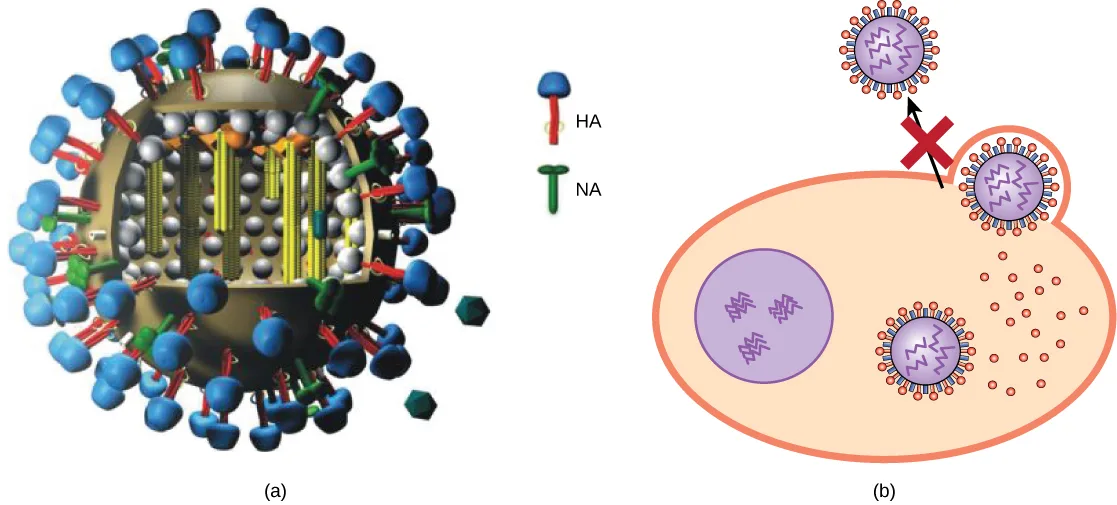
Extended description
Panel (a): a spherical influenza virus drawn in cutaway, its brown envelope cut open to show yellow coiled genome segments and grey spheres inside; the outside is covered in HA (hemagglutinin) spikes, each a blue mushroom-shaped cap on a red stalk, and fewer green T-shaped NA (neuraminidase) spikes. A small key to the right labels one blue-capped red spike ‘HA’ and one green spike ‘NA.’ Panel (b): a peach-colored oval host cell with a purple nucleus containing purple squiggles of viral genome. Three virions, each a purple circle ringed with small orange and blue spikes, appear at three positions: one inside the cytoplasm at lower right beside a scatter of small orange dots (new viral components), one budding outward through the cell membrane at upper right, and one fully outside the cell above it. A black arrow runs from the budding virion up toward the free virion, and a large red X crosses that arrow to show neuraminidase inhibition blocking the virus from being released.
By far, the most successful use of antivirals has been in the treatment of the retrovirus HIV, which causes a disease that, if untreated, is usually fatal within 10 to 12 years after infection. Anti-HIV drugs have been able to control viral replication to the point that individuals receiving these drugs survive for a significantly longer time than the untreated.
A particular challenge with HIV is its tendency to mutate quickly within the body of an individual patient. This leads to individual drug resistance, and requires a different treatment strategy than many other diseases. David Ho was among the first to propose and develop a method to treat multiple mutations of HIV at the same time. Ho’s efforts were a turning point in fighting AIDS. Anti-HIV drugs inhibit viral replication at many different phases of the HIV replicative cycle. Drugs have been developed that inhibit the fusion of the HIV viral envelope with the plasma membrane of the host cell (fusion inhibitors), the conversion of its RNA genome into double-stranded DNA (reverse transcriptase inhibitors, like AZT), the integration of the viral DNA into the host genome (integrase inhibitors), and the processing of viral proteins (protease inhibitors).
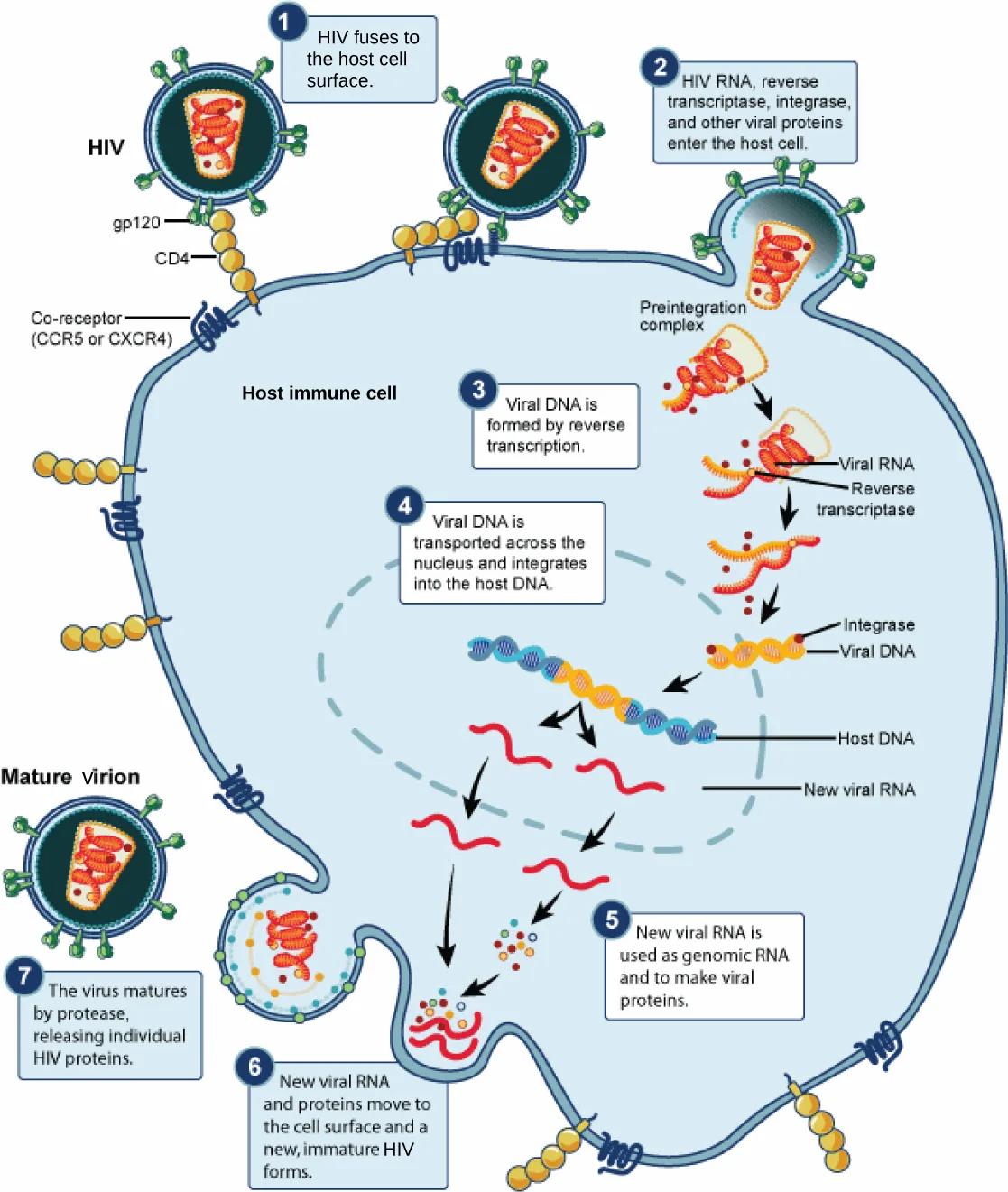
Extended description
Seven numbered steps trace the HIV life cycle around a large host immune cell. At upper left, HIV particles labeled with gp120 approach the cell’s CD4 receptor and a co-receptor (CCR5 or CXCR4); step 1 marks HIV fusing to the host cell surface. Step 2, at upper right, shows viral RNA, reverse transcriptase, integrase, and other viral proteins entering the cell inside a preintegration complex. An arrow leads down through step 3, where reverse transcriptase converts viral RNA into viral DNA, to step 4, where the viral DNA crosses into the nucleus, shown as a dashed oval, and integrates into the host DNA strand. Arrows lead from the integrated DNA to new viral RNA strands, step 5, used both as genomic RNA and to make viral proteins. Step 6, at lower center, shows new viral RNA and proteins moving to the cell surface, forming an immature HIV particle budding from the membrane. At lower left, step 7 shows the mature virion after a protease has released individual HIV proteins, completing the cycle.
Unfortunately, when any of these drugs are used individually, the high mutation rate of the virus allows it to easily and rapidly develop resistance to the drug, limiting the drug’s effectiveness. The breakthrough in the treatment of HIV was the development of HAART, highly active anti-retroviral therapy, which involves a mixture of different drugs, sometimes called a drug “cocktail.” By attacking the virus at different stages of its replicative cycle, it is much more difficult for the virus to develop resistance to multiple drugs at the same time. Still, even with the use of combination HAART therapy, there is concern that, over time, the virus will develop resistance to this therapy. Thus, new anti-HIV drugs are constantly being developed with the hope of continuing the battle against this highly fatal virus.
Everyday Connection. Applied Virology.
The study of viruses has led to the development of a variety of new ways to treat non-viral diseases. Viruses have been used in gene therapy. Gene therapy is used to treat genetic diseases such as severe combined immunodeficiency (SCID), a heritable, recessive disease in which children are born with severely compromised immune systems. One common type of SCID is due to the lack of an enzyme, adenosine deaminase (ADA), which breaks down purine bases. To treat this disease by gene therapy, bone marrow cells are taken from a SCID patient and the ADA gene is inserted. This is where viruses come in, and their use relies on their ability to penetrate living cells and bring genes in with them. Viruses such as adenovirus, an upper-respiratory human virus, are modified by the addition of the ADA gene, and the virus then transports this gene into the cell. The modified cells, now capable of making ADA, are then given back to the patients in the hope of curing them. Gene therapy using viruses as carriers of genes (viral vectors), although still experimental, holds promise for the treatment of many genetic diseases. Still, many technological problems need to be solved for this approach to be a viable method for treating genetic disease.
Another medical use for viruses relies on their specificity and ability to kill the cells they infect. Oncolytic viruses are engineered in the laboratory specifically to attack and kill cancer cells. A genetically modified adenovirus known as H101 has been used since 2005 in clinical trials in China to treat head and neck cancers. The results have been promising, with a greater short-term response rate to the combination of chemotherapy and viral therapy than to chemotherapy treatment alone. This ongoing research may herald the beginning of a new age of cancer therapy, where viruses are engineered to find and specifically kill cancer cells, regardless of where in the body they may have spread.
A third use of viruses in medicine relies on their specificity and involves using bacteriophages in the treatment of bacterial infections. Bacterial diseases have been treated with antibiotics since the 1940s. However, over time, many bacteria have evolved resistance to antibiotics. A good example is methicillin-resistant Staphylococcus aureus (MRSA, pronounced “mersa”), an infection commonly acquired in hospitals. This bacterium is resistant to a variety of antibiotics, making it difficult to treat. The use of bacteriophages specific for such bacteria would bypass their resistance to antibiotics and specifically kill them. Although phage therapy is in use in the Republic of Georgia to treat antibiotic-resistant bacteria, its use to treat human diseases has not been approved in most countries. However, the safety of the treatment was confirmed in the United States when the U.S. Food and Drug Administration approved spraying meats with bacteriophages to destroy the food pathogen Listeria. As more and more antibiotic-resistant strains of bacteria evolve, the use of bacteriophages might be a potential solution to the problem, and the development of phage therapy is of much interest to researchers worldwide.
Summary
Viruses cause a variety of diseases in humans. Many of these diseases can be prevented by the use of viral vaccines, which stimulate protective immunity against the virus without causing major disease. Viral vaccines may also be used in active viral infections, boosting the ability of the immune system to control or destroy the virus. A series of antiviral drugs that target enzymes and other protein products of viral genes have been developed and used with mixed success. Combinations of anti-HIV drugs have been used to effectively control the virus, extending the lifespans of infected individuals. Viruses have many uses in medicines, such as in the treatment of genetic disorders, cancer, and bacterial infections.
Key terms
- attenuation — weakening of a virus during vaccine development
- back mutation — when a live virus vaccine reverts back to its disease-causing phenotype
- gene therapy — treatment of genetic disease by adding genes, using viruses to carry the new genes inside the cell
- oncolytic virus — virus engineered to specifically infect and kill cancer cells
- phage therapy — treatment of bacterial diseases using bacteriophages specific to a particular bacterium
- vaccine — weakened solution of virus components, viruses, or other agents that produce an immune response
Practice
Identify major viral illnesses that affect humans
A patient presents at the clinic with an acute viral infection. Assays that analyze the viral life cycle classify the virus into Group V with a segmented genome. Which virus is the most likely diagnosis for the patient?
Baltimore Group V viruses carry negative-sense single-stranded RNA; among these four, only one packages its genome in multiple separate segments.According to this section, which viral disease is transmitted by bats and great apes and can cause death in 70 to 90 percent of infected humans within two weeks?
This section names the same two animal groups as the disease’s carriers and gives its very high short-term fatality rate.Viruses cause a variety of ________ in humans, according to the section summary.
The opening sentence of the section summary names what viruses cause.Compare vaccinations and anti-viral drugs as medical approaches to viruses
Which of the following is NOT used to treat active viral disease?
This section names vaccines and antiviral drugs — acyclovir among them — as treatments for active viral infection; one option does not act on viruses at all.Vaccines ________.
Match this to the glossary definition of a vaccine.Why is immunization after being bitten by a rabid animal so effective and why aren’t people vaccinated for rabies like dogs and cats are?
Show model answer
Did your answer mention:
The vaccine Gardasil that targets human papilloma virus (HPV), the etiological agent of genital warts, was developed after the anti-HPV medication podofilox. Why would doctors still want a vaccine created after anti-viral medications were available?
Show model answer
Did your answer mention:
A weakened preparation of virus components, viruses, or other agents that produces an immune response is called a ________.
It may be made from live, killed, or subunit forms of a pathogen.The deliberate weakening of a virus during vaccine development is called ________.
This is the noun form of the verb the section uses for growing a virus under conditions different from the host to weaken it.A live virus vaccine reverting to its disease-causing form is known as a ________.
This is what let a 2007 Nigerian polio vaccine cause an epidemic.Treating an inherited disease by using viruses to carry replacement DNA into cells is called ________.
SCID patients treated this way receive bone marrow cells modified to produce the missing ADA enzyme.A laboratory-engineered agent that specifically infects and kills cancer cells is called a(n) ________.
The modified adenovirus H101, used in China against head and neck cancers, is an example.Treating a bacterial infection with viruses that target one specific type of bacterium is called ________.
This is in use in the Republic of Georgia, and it was confirmed safe when the FDA approved spraying it on meats to destroy Listeria.This section is adapted from Biology 2e, Section 21.3: Prevention and Treatment of Viral Infections by Mary Ann Clark, Jung Choi, Matthew Douglas, and OpenStax, © OpenStax, licensed under CC BY-NC-SA 4.0. Access the original for free at openstax.org. Changes: figures re-encoded as WebP; Figure_21_03_01-70a3 and Figure_21_03_04-16dd re-kinded from the manifest’s file-extension “photo” guess to “diagram” (both are labeled illustrations, not photographs), and Figure_21_03_03ab likewise re-kinded to “diagram”; the source alt text for Figure_21_03_01-70a3 and Figure_21_03_04-16dd, each well over 600 characters, shortened to a concise alt with the full labeled walk-through moved into a longdesc; the source alt for Figure_21_03_03ab rewritten from the image (the source alt does not name the surface proteins the key labels) and a longdesc added, since panel (b)’s blocked-release step is not carried by its caption; the two feature boxes (the interactive note and the everyday note) rendered as, respectively, a Link to Learning callout with descriptive link text and an Everyday Connection callout keeping its title; the end-of-section Review Questions and Critical Thinking Questions adapted into the closing interactive Practice block (multiple choice and self-check respectively); one locally written multiple choice (Ebola transmission and fatality rate) added under the first objective, built strictly from the section’s own sentence, since only one source Review Question maps to that objective; one summary-derived text-recall item (diseases) added under the first objective from the section summary’s opening sentence; six key-term recall items (vaccine, attenuation, back mutation, gene therapy, oncolytic virus, phage therapy) added from the glossary under the second objective; rubric checkpoints added to each self-check, decomposing its model answer (the source solution) into check-off clauses with no new claims; the rabies self-check’s model answer corrected from “a week” to “two weeks or longer” for the time a rabies infection takes to reach the central nervous system, matching what the section’s own body text states, rather than the shorter figure printed in the source solution (reported as a source defect); in the same Review Question set, the “NOT used to treat active viral disease” item’s distractor “Phage therapy” replaced with “Acyclovir,” because the section itself presents phage therapy as a treatment for bacterial, not viral, infection — leaving the source item with two supportable answers — while acyclovir is named in the section as a drug against active viral disease (reported as a source defect); and the “back mutation” key term’s “it disease-causing phenotype” corrected to “its” (reported as a source defect). One name is corrected with a visible Source note: George Hitchings, Elion’s Nobel co-laureate, where the source prints “Hitchens” (erratum 413).