Other Acellular Entities: Prions and Viroids
By the end of this section, you will be able to:
- Describe prions and their basic properties
- Define viroids and their targets of infection
Prions and viroids are pathogens (agents with the ability to cause disease) that have simpler structures than viruses but, in the case of prions, still can produce deadly diseases.
Prions
Prions, so-called because they are proteinaceous, are infectious particles—smaller than viruses—that contain no nucleic acids (neither DNA nor RNA). Historically, the idea of an infectious agent that did not use nucleic acids was considered impossible, but pioneering work by Nobel Prize-winning biologist Stanley Prusiner has convinced the majority of biologists that such agents do indeed exist.
Fatal neurodegenerative diseases, such as kuru in humans and bovine spongiform encephalopathy (BSE) in cattle (commonly known as “mad cow disease”) were shown to be transmitted by prions. The disease was spread by the consumption of meat, nervous tissue, or internal organs between members of the same species. Kuru, native to humans in Papua New Guinea, was spread from human to human via ritualistic cannibalism. BSE, originally detected in the United Kingdom, was spread between cattle by the practice of including cattle nervous tissue in feed for other cattle. Individuals with kuru and BSE show symptoms of loss of motor control and unusual behaviors, such as uncontrolled bursts of laughter with kuru, followed by death. Kuru was controlled by inducing the population to abandon its ritualistic cannibalism.
On the other hand, BSE was initially thought to only affect cattle. Cattle dying of the disease were shown to have developed lesions or “holes” in the brain, causing the brain tissue to resemble a sponge. Later on in the outbreak, however, it was shown that a similar encephalopathy in humans, known as variant Creutzfeldt-Jakob disease (CJD), could be acquired from eating beef from animals infected with BSE, sparking bans by various countries on the importation of British beef and causing considerable economic damage to the British beef industry (see the diagram below). BSE still exists in various areas, and although a rare disease, individuals that acquire CJD are difficult to treat. The disease can be spread from human to human by blood, so many countries have banned blood donation from regions associated with BSE.
The cause of spongiform encephalopathies, such as kuru and BSE, is an infectious structural variant of a normal cellular protein called PrP (prion protein). It is this variant that constitutes the prion particle. PrP exists in two forms, PrPc, the normal form of the protein, and PrPsc, the infectious form. Once introduced into the body, the PrPsc contained within the prion binds to PrPc and converts it to PrPsc. This leads to an exponential increase of the PrPsc protein, which aggregates. PrPsc is folded abnormally, and the resulting conformation (shape) is directly responsible for the lesions seen in the brains of infected cattle. Thus, although not without some detractors among scientists, the prion seems likely to be an entirely new form of infectious agent, the first one found whose transmission is not reliant upon genes made of DNA or RNA.
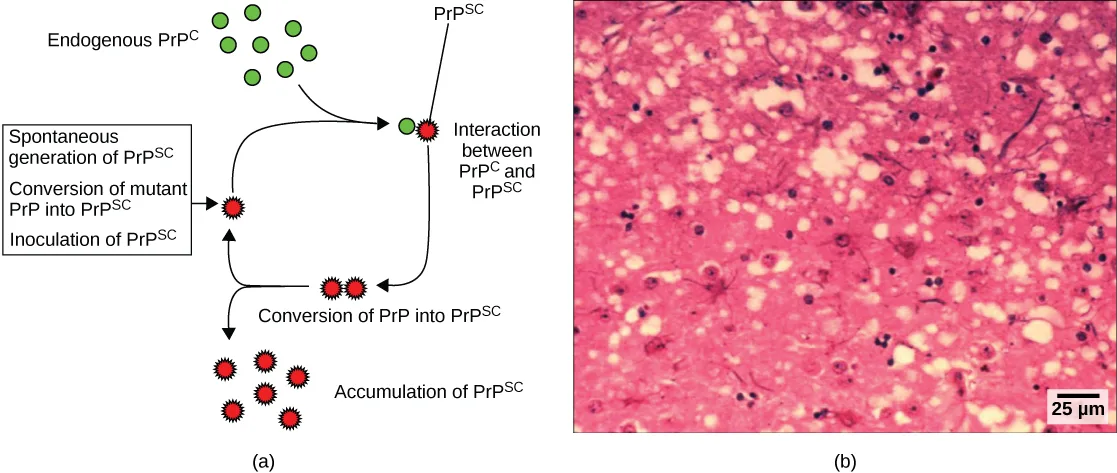
Extended description
Panel (a) is a cyclic flow diagram of green dots (PrPc) and red spiky dots (PrPsc) connected by curved arrows. A cluster of green dots at upper left is labeled ‘Endogenous PrPc’; a single dot at upper middle is labeled ‘PrPsc.’ Both lead into a green-and-red dot at right labeled ‘Interaction between PrPc and PrPsc.’ At left, a boxed list names three ways PrPsc can arise — ‘Spontaneous generation of PrPsc,’ ‘Conversion of mutant PrP into PrPsc,’ and ‘Inoculation of PrPsc’ — with an arrow leading right to a red spiky dot. An arrow connects that dot up to the interaction node, and another arrow leads down from the interaction node to a red spiky dot labeled ‘Conversion of PrP into PrPsc,’ which arrows back into the boxed dot, closing the loop, and also arrows down and left to a cluster of red spiky dots labeled ‘Accumulation of PrPsc.’ Panel (b) is a light micrograph of pink-stained brain tissue filled with round, pale vacuoles of varying size among small dark purple nuclei, with a black scale bar reading ‘25 µm’ at the lower right.
Viroids
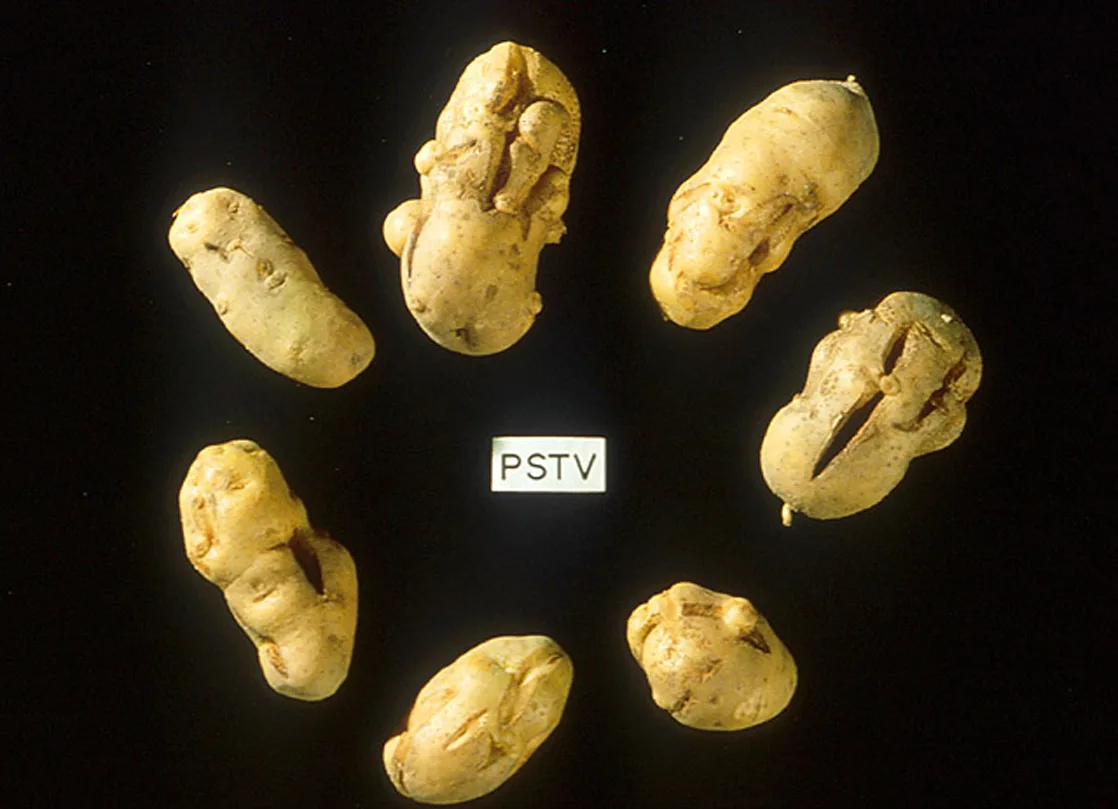
Viroids are plant pathogens: small, single-stranded, circular RNA particles that are much simpler than a virus. They do not have a capsid or outer envelope, but like viruses can reproduce only within a host cell. Viroids do not, however, manufacture any proteins, and they only produce a single, specific RNA molecule. Human diseases caused by viroids have yet to be identified.
Viroids are known to infect plants (see the photo below) and are responsible for crop failures and the loss of millions of dollars in agricultural revenue each year. Some of the plants they infect include potatoes, cucumbers, tomatoes, chrysanthemums, avocados, and coconut palms.
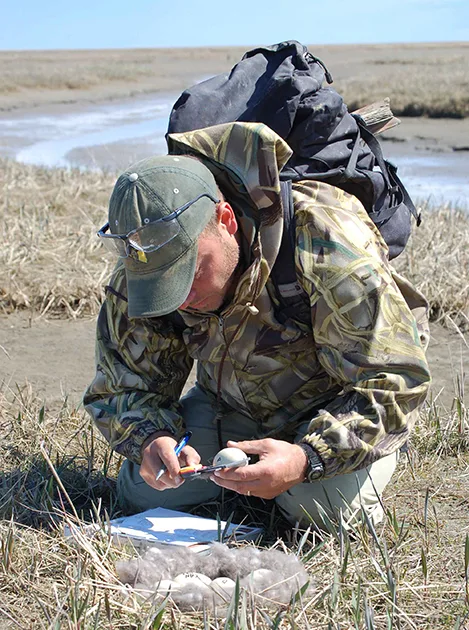
Career Connection. Virologist. Virology is the study of viruses, and a virologist is an individual trained in this discipline. Training in virology can lead to many different career paths. Virologists are actively involved in academic research and teaching in colleges and medical schools. Some virologists treat patients or are involved in the generation and production of vaccines. They might participate in epidemiologic studies (see the photo below) or become science writers, to name just a few possible careers.
If you think you may be interested in a career in virology, find a mentor in the field. Many large medical centers have departments of virology, and smaller hospitals usually have virology labs within their microbiology departments. Volunteer in a virology lab for a semester or work in one over the summer. Discussing the profession and getting a first-hand look at the work will help you decide whether a career in virology is right for you. The American Society of Virology’s website is a good resource for information regarding training and careers in virology.
Summary
Prions are infectious agents that consist of protein, but no DNA or RNA, and seem to produce their deadly effects by duplicating their shapes and accumulating in tissues. They are thought to contribute to several progressive brain disorders, including mad cow disease and Creutzfeldt-Jakob disease. Viroids are single-stranded RNA pathogens that infect plants. Their presence can have a severe impact on the agriculture industry.
Key terms
- pathogen — agent with the ability to cause disease
- prion — infectious particle that consists of proteins that replicate without DNA or RNA
- PrPc — normal prion protein
- PrPsc — infectious form of a prion protein
- viroid — plant pathogen that produces only a single, specific RNA
Practice
Describe prions and their basic properties
Which of the following is not associated with prions?
Prions are proteinaceous — think about what kind of molecule they contain none of.Prions are responsible for variant Creutzfeldt-Jakob Disease, which has resulted in over 100 human deaths in Great Britain during the last 10 years. How do humans contract this disease?
Show model answer
Did your answer mention:
An agent with the ability to cause disease is called a ________.
The section’s opening sentence uses this general term for both prions and viroids.An infectious particle that consists of protein and replicates without DNA or RNA is called a ________.
The first of the two acellular agents this section covers — a misfolded protein with no nucleic acid at all.Define viroids and their targets of infection
Which statement is true of viroids?
Recall what viroids do and do not have, compared with a virus.How are viroids like viruses?
Show model answer
Did your answer mention:
A botanist notices that a tomato plant looks diseased. How could the botanist confirm that the agent causing disease is a viroid, and not a virus?
Show model answer
Did your answer mention:
A plant pathogen that produces only a single, specific RNA molecule is called a ________.
The second of the two acellular agents this section covers; it infects plants only.This section is adapted from Biology 2e, Section 21.4: Other Acellular Entities: Prions and Viroids by Mary Ann Clark, Jung Choi, Matthew Douglas, and OpenStax, © OpenStax, licensed under CC BY-NC-SA 4.0. Access the original for free at openstax.org. Changes: figures re-encoded as WebP; Figure_21_04_01ab re-kinded from the manifest’s file-extension “photo” guess to “diagram” since its panel (a) is a labeled flow diagram that carries the teaching point, paired with a micrograph in panel (b); a longdesc added for Figure_21_04_01ab, since the cyclic pathway of labeled nodes and arrows it draws is not carried by its caption; the source alt for Figure_21_04_01ab, a letter-spaced screen-reader spelling (“P r P,” “P r P superscript lowercase s lowercase c”), rewritten as a plain description from the image; three prose cross-references to numbered figures (“Figure 21.17,” “Figure 21.18,” “Figure 21.19”) reworded as “see the diagram below” or “see the photo below” since figures are not numbered here; the Career Connection note rendered as a callout with its embedded figure kept inside it, and its title kept in italics after the bold feature name; PrPc and PrPsc set as HTML superscripts throughout, normalizing the source’s stray internal spaces; the end-of-section Review Questions and Critical Thinking Questions adapted into the closing interactive Practice block (multiple choice and self-check respectively); three key-term recall items (pathogen, prion, viroid) added from the glossary; rubric checkpoints added to each self-check, decomposing its model answer (the source solution) into check-off clauses with no new claims.