Prokaryotic Metabolism
By the end of this section, you will be able to:
- Identify the macronutrients needed by prokaryotes, and explain their importance
- Describe the ways in which prokaryotes get energy and carbon for life processes
- Describe the roles of prokaryotes in the carbon and nitrogen cycles
Prokaryotes are metabolically diverse organisms. In many cases, a prokaryote may be placed into a species clade by its defining metabolic features: Can it metabolize lactose? Can it grow on citrate? Does it produce H₂S? Does it ferment carbohydrates to produce acid and gas? Can it grow under anaerobic conditions? Since metabolism and metabolites are the product of enzyme pathways, and enzymes are encoded in genes, the metabolic capabilities of a prokaryote are a reflection of its genome. There are many different environments on Earth with various energy and carbon sources, and variable conditions to which prokaryotes may be able to adapt. Prokaryotes have been able to live in every environment from deep-water volcanic vents to Antarctic ice by using whatever energy and carbon sources are available. Prokaryotes fill many niches on Earth, including involvement in nitrogen and carbon cycles, photosynthetic production of oxygen, decomposition of dead organisms, and thriving as parasitic, commensal, or mutualistic organisms inside multicellular organisms, including humans. The very broad range of environments that prokaryotes occupy is possible because they have diverse metabolic processes.
Needs of Prokaryotes
The diverse environments and ecosystems on Earth have a wide range of conditions in terms of temperature, available nutrients, acidity, salinity, oxygen availability, and energy sources. Prokaryotes are very well equipped to make their living out of a vast array of nutrients and environmental conditions. To live, prokaryotes need a source of energy, a source of carbon, and some additional nutrients.
Macronutrients
Cells are essentially a well-organized assemblage of macromolecules and water. Recall that macromolecules are produced by the polymerization of smaller units called monomers. For cells to build all of the molecules required to sustain life, they need certain substances, collectively called nutrients. When prokaryotes grow in nature, they must obtain their nutrients from the environment. Nutrients that are required in large amounts are called macronutrients, whereas those required in smaller or trace amounts are called micronutrients. Just a handful of elements are considered macronutrients—carbon, hydrogen, oxygen, nitrogen, phosphorus, and sulfur. (A mnemonic for remembering these elements is the acronym CHONPS.)
Why are these macronutrients needed in large amounts? They are the components of organic compounds in cells, including water. Carbon is the major element in all macromolecules: carbohydrates, proteins, nucleic acids, lipids, and many other compounds. Carbon accounts for about 50 percent of the composition of the cell. In contrast, nitrogen represents only 12 percent of the total dry weight of a typical cell. Nitrogen is a component of proteins, nucleic acids, and other cell constituents. Most of the nitrogen available in nature is either atmospheric nitrogen (N₂) or another inorganic form. Diatomic (N₂) nitrogen, however, can be converted into an organic form only by certain microorganisms, called nitrogen-fixing organisms. Both hydrogen and oxygen are part of many organic compounds and of water. Phosphorus is required by all organisms for the synthesis of nucleotides and phospholipids. Sulfur is part of the structure of some amino acids such as cysteine and methionine, and is also present in several vitamins and coenzymes. Other important macronutrients are potassium (K), magnesium (Mg), calcium (Ca), and sodium (Na). Although these elements are required in smaller amounts, they are very important for the structure and function of the prokaryotic cell.
Micronutrients
In addition to these macronutrients, prokaryotes require various metallic elements in small amounts. These are referred to as micronutrients or trace elements. For example, iron is necessary for the function of the cytochromes involved in electron-transport reactions. Some prokaryotes require other elements—such as boron (B), chromium (Cr), and manganese (Mn)—primarily as enzyme cofactors.
The Ways in Which Prokaryotes Obtain Energy
Prokaryotes are classified both by the way they obtain energy, and by the carbon source they use for producing organic molecules. These categories are summarized in the table below. Prokaryotes can use different sources of energy to generate the ATP needed for biosynthesis and other cellular activities. Phototrophs (or phototrophic organisms) obtain their energy from sunlight. Phototrophs trap the energy of light using chlorophylls, or in a few cases, bacterial rhodopsin. (Rhodopsin-using phototrophs, oddly, are phototrophic, but not photosynthetic, since they do not fix carbon.) Chemotrophs (or chemosynthetic organisms) obtain their energy from chemical compounds. Chemotrophs that can use organic compounds as energy sources are called chemoorganotrophs. Those that can use inorganic compounds, like sulfur or iron compounds, as energy sources are called chemolithotrophs.
Energy-producing pathways may be either aerobic, using oxygen as the terminal electron acceptor, or anaerobic, using either simple inorganic compounds or organic molecules as the terminal electron acceptor. Since prokaryotes lived on Earth for nearly a billion years before photosynthesis produced significant amounts of oxygen for aerobic respiration, many species of both Bacteria and Archaea are anaerobic and their metabolic activities are important in the carbon and nitrogen cycles discussed below.
The Ways in Which Prokaryotes Obtain Carbon
Prokaryotes not only can use different sources of energy, but also different sources of carbon compounds. Autotrophic prokaryotes synthesize organic molecules from carbon dioxide. In contrast, heterotrophic prokaryotes obtain carbon from organic compounds. To make the picture more complex, the terms that describe how prokaryotes obtain energy and carbon can be combined. Thus, photoautotrophs use energy from sunlight, and carbon from carbon dioxide and water, whereas chemoheterotrophs obtain both energy and carbon from an organic chemical source. Chemolithoautotrophs obtain their energy from inorganic compounds, and they build their complex molecules from carbon dioxide. Finally, prokaryotes that get their energy from light, but their carbon from organic compounds, are photoheterotrophs. The table below summarizes carbon and energy sources in prokaryotes.
Carbon and Energy Sources in Prokaryotes
| Energy Source | Electron Source | Carbon Source | Nutritional Type |
|---|---|---|---|
| Light (phototroph) | Organic material (organotroph) | Organic material (heterotroph) | Photoorganoheterotroph |
| Carbon dioxide (autotroph) | |||
| Inorganic material (lithotroph) | Organic material (heterotroph) | ||
| Carbon dioxide (autotroph) | Photolithoautotroph | ||
| Chemicals (chemotroph) | Organic material (organotroph) | Organic material (heterotroph) | Chemoorganoheterotroph |
| Carbon dioxide (autotroph) | |||
| Inorganic material (lithotroph) | Organic material (heterotroph) | Chemolithoheterotroph | |
| Carbon dioxide (autotroph) | Chemolithoautotroph |
Role of Prokaryotes in Ecosystems
Prokaryotes are ubiquitous: There is no niche or ecosystem in which they are not present. Prokaryotes play many roles in the environments they occupy. The roles they play in the carbon and nitrogen cycles are vital to life on Earth. In addition, the current scientific consensus suggests that metabolically interactive prokaryotic communities may have been the basis for the emergence of eukaryotic cells.
Prokaryotes and the Carbon Cycle
Carbon is one of the most important macronutrients, and prokaryotes play an important role in the carbon cycle. The carbon cycle traces the movement of carbon from inorganic to organic compounds and back again. Carbon is cycled through Earth’s major reservoirs: land, the atmosphere, aquatic environments, sediments and rocks, and biomass. In a way, the carbon cycle echoes the role of the “four elements” first proposed by the ancient Greek philosopher, Empedocles: fire, water, earth, and air. Carbon dioxide is removed from the atmosphere by land plants and marine prokaryotes, and is returned to the atmosphere via the respiration of chemoorganotrophic organisms, including prokaryotes, fungi, and animals. Although the largest carbon reservoir in terrestrial ecosystems is in rocks and sediments, that carbon is not readily available.
Participants in the carbon cycle are roughly divided among producers, consumers, and decomposers of organic carbon compounds. The primary producers of organic carbon compounds from CO₂ are land plants and photosynthetic bacteria. A large amount of available carbon is found in living land plants. A related source of carbon compounds is humus, which is a mixture of organic materials from dead plants and prokaryotes that have resisted decomposition. (The term “humus,” by the way, is the root of the word “human.”) Consumers such as animals and other heterotrophs use organic compounds generated by producers and release carbon dioxide to the atmosphere. Other bacteria and fungi, collectively called decomposers, carry out the breakdown (decomposition) of plants and animals and their organic compounds. Most carbon dioxide in the atmosphere is derived from the respiration of microorganisms that decompose dead animals, plants, and humus.
In aqueous environments and their anoxic sediments, there is another carbon cycle taking place. In this case, the cycle is based on one-carbon compounds. In anoxic sediments, prokaryotes, mostly archaea, produce methane (CH₄). This methane moves into the zone above the sediment, which is richer in oxygen and supports bacteria called methane oxidizers that oxidize methane to carbon dioxide, which then returns to the atmosphere.
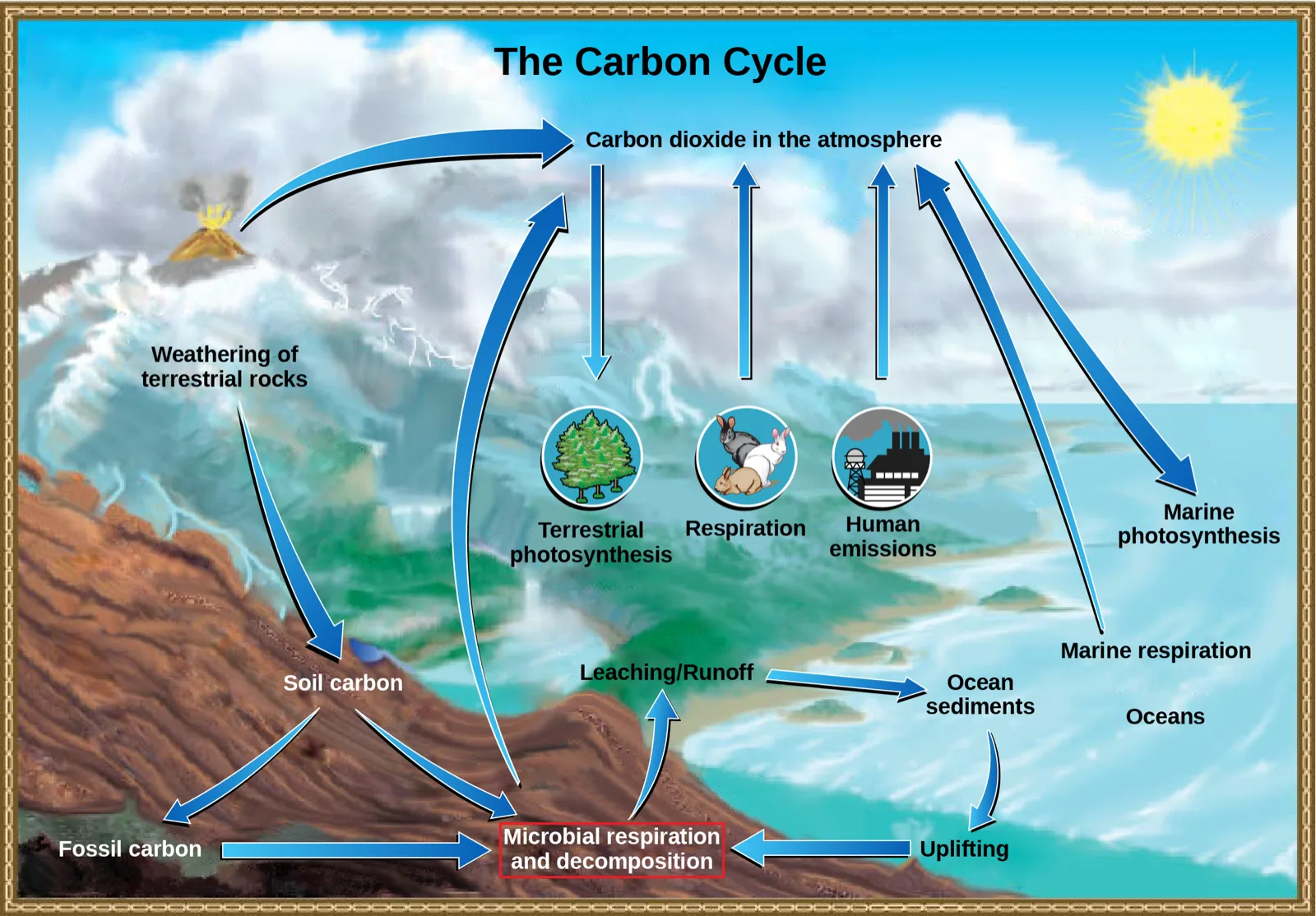
Extended description
At upper left, an erupting volcano sends an arrow up into a banner reading ‘Carbon dioxide in the atmosphere’ at the top of the scene; the sun is drawn at upper right. Below the banner, three circular icons sit in a row: a tree icon labeled ‘Terrestrial photosynthesis’ with an arrow pointing down from the atmosphere into it; a pair of rabbits labeled ‘Respiration’ with an arrow pointing up from it into the atmosphere; and a factory icon labeled ‘Human emissions’ with an arrow pointing up into the atmosphere. Two more arrows connect the atmosphere to the ocean at the right: one points down toward ‘Marine photosynthesis’ and one points up from ‘Marine respiration.’ At lower left, ‘Weathering of terrestrial rocks’ has an arrow down to ‘Soil carbon.’ From ‘Soil carbon,’ arrows branch down to ‘Fossil carbon’ and to a red-outlined box labeled ‘Microbial respiration and decomposition,’ which also receives an arrow from ‘Fossil carbon’ and sends an arrow labeled ‘Leaching/Runoff’ to ‘Ocean sediments.’ ‘Ocean sediments’ has an arrow down to ‘Uplifting,’ which arrows back into ‘Microbial respiration and decomposition.’ A long curved arrow rises from ‘Microbial respiration and decomposition’ back up to the ‘Carbon dioxide in the atmosphere’ banner, closing the cycle.
Prokaryotes and the Nitrogen Cycle
Nitrogen is a very important element for life because it is a major constituent of proteins and nucleic acids. It is a macronutrient, and in nature, it is recycled from organic compounds to ammonia, ammonium ions, nitrate, nitrite, and nitrogen gas by many processes, many of which are carried out only by prokaryotes. As illustrated below, prokaryotes are key to the nitrogen cycle. The largest pool of nitrogen available in the terrestrial ecosystem is gaseous nitrogen (N₂) from the air, but this nitrogen is not usable by plants, which are primary producers. Gaseous nitrogen is transformed, or “fixed” into more readily available forms, such as ammonia (NH₃), through the process of nitrogen fixation. Nitrogen-fixing bacteria include Azotobacter in soil and the ubiquitous photosynthetic cyanobacteria. Some nitrogen fixing bacteria, like Rhizobium, live in symbiotic relationships in the roots of legumes. Another source of ammonia is ammonification, the process by which ammonia is released during the decomposition of nitrogen-containing organic compounds. The ammonium ion is progressively oxidized by different species of bacteria in a process called nitrification. The nitrification process begins with the conversion of ammonium to nitrite (NO₂⁻), and continues with the conversion of nitrite to nitrate. Nitrification in soils is carried out by bacteria belonging to the genera Nitrosomas, Nitrobacter, and Nitrospira. Most nitrogen in soil is in the form of ammonium (NH₄⁺) or nitrate (NO₃⁻). Ammonia and nitrate can be used by plants or converted to other forms.
Ammonia released into the atmosphere, however, represents only 15 percent of the total nitrogen released; the rest is as N₂ and N₂O (nitrous oxide). Ammonia is catabolized anaerobically by some prokaryotes, yielding N₂ as the final product. Denitrifying bacteria reverse the process of nitrification, reducing the nitrate from soils to gaseous compounds such as N₂O, NO, and N₂.
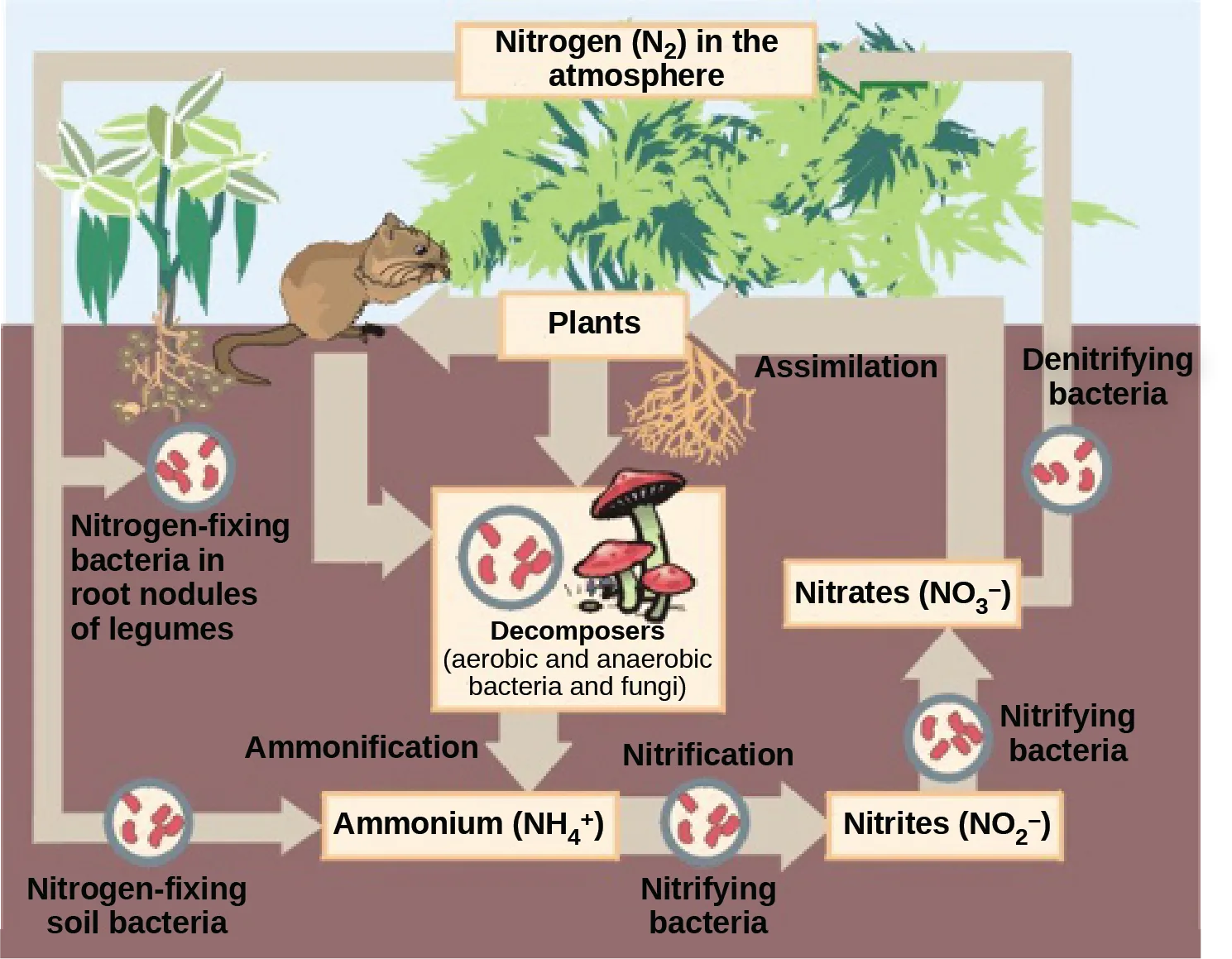
Extended description
A banner across the top reads ‘Nitrogen (N₂) in the atmosphere,’ above a strip of sky with plants and a small rodent, over a brown soil cross-section below. At far left, a bacteria icon labeled ‘Nitrogen-fixing bacteria in root nodules of legumes’ sits beside a legume plant, fed by an arrow that runs down the left edge from the atmosphere banner. Below it, a second bacteria icon labeled ‘Nitrogen-fixing soil bacteria,’ fed by the same left-edge line from the atmosphere, arrows right into a box labeled ‘Ammonium (NH₄⁺).’ A central box labeled ‘Decomposers (aerobic and anaerobic bacteria and fungi)’ receives an arrow down from a ‘Plants’ box above it and sends an arrow down, labeled ‘Ammonification,’ into the ‘Ammonium (NH₄⁺)’ box. From ‘Ammonium (NH₄⁺),’ an arrow through a ‘Nitrifying bacteria’ icon, labeled ‘Nitrification,’ leads right to a ‘Nitrites (NO₂⁻)’ box, then through a second ‘Nitrifying bacteria’ icon up to a ‘Nitrates (NO₃⁻)’ box. From ‘Nitrates (NO₃⁻),’ one arrow labeled ‘Assimilation’ points up-left back into the ‘Plants’ box, and another points up-right through a ‘Denitrifying bacteria’ icon and along the top border back into the atmosphere banner, completing the cycle.
Which of the following statements about the nitrogen cycle is false?
Three of these options describe nitrogen fixation, ammonification, and denitrification as the section presents them; the fourth reverses which two nitrogen forms nitrification actually connects.Summary
As the oldest living inhabitants of Earth, prokaryotes are also the most metabolically diverse; they flourish in many different environments with various energy and carbon sources, variable temperature, pH, pressure, oxygen and water availability. Nutrients required in large amounts are called macronutrients, whereas those required in trace amounts are called micronutrients or trace elements. Macronutrients include C, H, O, N, P, S, K, Mg, Ca, and Na. In addition to these macronutrients, prokaryotes require various metallic elements for growth and enzyme function. Prokaryotes use different sources of energy to assemble macromolecules from smaller molecules. Phototrophs obtain their energy from sunlight, whereas chemotrophs obtain energy from chemical compounds. Energy-producing pathways may be either aerobic or anaerobic.
Prokaryotes play roles in the carbon and nitrogen cycles. Producers capture carbon dioxide from the atmosphere and convert it to organic compounds. Consumers (animals and other chemoorganotrophic organisms) use organic compounds generated by producers and release carbon dioxide into the atmosphere by respiration. Carbon dioxide is also returned to the atmosphere by the microbial decomposers of dead organisms. Nitrogen also cycles in and out of living organisms, from organic compounds to ammonia, ammonium ions, nitrite, nitrate, and nitrogen gas. Prokaryotes are essential for most of these conversions. Gaseous nitrogen is transformed into ammonia through nitrogen fixation. Ammonia is anaerobically catabolized by some prokaryotes, yielding N₂ as the final product. Nitrification is the conversion of ammonium into nitrite. Nitrification in soils is carried out by bacteria. Denitrification is also performed by bacteria and transforms nitrate from soils into gaseous nitrogen compounds, such as N₂O, NO, and N₂.
Key terms
- aerobic — organisms that use oxygen
- ammonification — process by which ammonia is released during the decomposition of nitrogen-containing organic compounds
- autotroph — organism that produces organic molecules from small inorganic compounds
- chemotroph — organism that obtains energy from chemical compounds
- decomposer — organism that carries out the decomposition of dead organisms
- denitrification — transformation of nitrate from soil to gaseous nitrogen compounds such as N₂O, NO, and N₂
- heterotroph — organism that obtains energy from organic molecules
- nitrification — conversion of ammonium into nitrite and nitrate in soils
- nitrogen fixation — process by which gaseous nitrogen is transformed, or “fixed” into more readily available forms such as ammonia
Practice
Identify the macronutrients needed by prokaryotes, and explain their importance
Which of the following elements is not a micronutrient?
Boron, chromium, and manganese are needed only in small amounts as enzyme cofactors; this element is needed in much larger amounts.Why are macronutrients such as carbon, hydrogen, oxygen, nitrogen, phosphorus, and sulfur needed in large amounts?
Ask what role these elements play in the cell itself, as opposed to the roles the section gives iron, boron, chromium, and manganese.Nutrients required in large amounts are called ________, whereas those required in trace amounts are called micronutrients or trace elements.
Carbon, hydrogen, oxygen, nitrogen, phosphorus, and sulfur — remembered by the acronym CHONPS — are examples.Describe the ways in which prokaryotes get energy and carbon for life processes
Prokaryotes that obtain their energy from chemical compounds are called ________.
The Greek root here refers to chemical compounds, not light or an unusual growth requirement.Cyanobacteria harness energy from the sun through photosynthesis, and oxidize water to provide electrons for energy generation. Thus, we classify cyanobacteria as ________.
The question names two things: their energy source (light) and their electron source (water, an inorganic compound) — it says nothing here about their carbon source.Think about the conditions (temperature, light, pressure, and organic and inorganic materials) that you may find in a deep-sea hydrothermal vent. What type of prokaryotes, in terms of their metabolic needs (autotrophs, phototrophs, chemotrophs, etc.), would you expect to find there?
Show model answer
Did your answer mention:
An organism that produces organic molecules from small inorganic compounds is called a(n) ________.
This is the opposite nutritional strategy from an organism that must obtain carbon from organic compounds.An organism that obtains energy from organic molecules is called a(n) ________.
This is the opposite nutritional strategy from an organism that synthesizes its own organic molecules from carbon dioxide.Organisms that use oxygen are described as ________.
Its energy pathway uses oxygen as the terminal electron acceptor.Describe the roles of prokaryotes in the carbon and nitrogen cycles
Ammonification is the process by which ________.
The other three options describe nitrification, denitrification, and nitrogen fixation, in that order.Plants use carbon dioxide from the air and are therefore called ________.
This is the same role photosynthetic bacteria play at the start of the carbon cycle.Farmers continually rotate the crops grown in different fields to maintain nutrients in the soil. How would planting soybeans in a field the year after the field was used to grow carrots help maintain nitrogen in the soil?
Show model answer
Did your answer mention:
Imagine a region of soil became contaminated, killing bacteria that decompose dead plants and animals. How would this affect the carbon cycle in the area? Be specific in stating where carbon would accumulate in the cycle.
Show model answer
Did your answer mention:
An organism that carries out the decomposition of dead organisms is called a ________.
Both bacteria and fungi that break down dead plants and animals share this name.The process by which gaseous N₂ is transformed, or ‘fixed,’ into more readily available forms such as ammonia is called ________.
Bacteria such as Azotobacter and Rhizobium carry out this process.The process by which ammonia is released during the decomposition of nitrogen-containing organic compounds is called ________.
This is one source of soil ammonia, alongside nitrogen fixation.The conversion of ammonium into nitrite and nitrate in soils is called ________.
This two-step process is carried out by different groups of nitrifying bacteria.The transformation of nitrate from soil into gaseous nitrogen compounds such as N₂O, NO, and N₂ is called ________.
This process reverses nitrification, returning nitrogen to the atmosphere.This section is adapted from Biology 2e, Section 22.3: Prokaryotic Metabolism by Mary Ann Clark, Jung Choi, Matthew Douglas, and OpenStax, © OpenStax, licensed under CC BY-NC-SA 4.0. Access the original for free at openstax.org. Changes: figures re-encoded as WebP, kind set to “diagram” for both after inspection; the over-600-character source alt for Figure_B22_03_01 rewritten to a concise description with its walk-through moved into longdesc, and the screen-reader-spelled source alt for Figure_B22_03_02 (“upper case N 2,” “upper N upper H 4 plus sign”) rewritten to a plain description, with a longdesc added for both (their labeled nodes and arrows are not carried by the one-line captions); the Carbon and Energy Sources in Prokaryotes table (whose CNXML id, tab-ch22-02-01, duplicates 22.2’s own table id — a source oddity, unrelated in content) transcribed complete as a Markdown table, its spanning title row set as a bold line above it, with the print’s blank cells kept blank; ion charges set in Unicode sub/superscript, number-then-sign order (NH₄⁺, NO₂⁻, NO₃⁻, N₂, H₂S, CH₄); a glossary-recall textin for nitrogen fixation phrased with “N₂” rather than the word “nitrogen” so the answer’s own word does not appear in the prompt; one Critical Thinking selfcheck’s “Responses will vary.” preamble dropped as scaffolding, keeping the substantive model answer; a typo in the deep-sea-vent Critical Thinking solution (“chemolitotrophs”) corrected to “chemolithotrophs,” matching the term as used earlier in the section; a grammar typo in the soil-contamination Critical Thinking question (“How would this effect the carbon cycle”) corrected to “affect”; rubric checkpoints added to each self-check, decomposing its model answer (the source solution) into check-off clauses with no new claims; the Review Questions and Critical Thinking Questions adapted into the closing interactive Practice block (multiple choice and self-check respectively), and the Visual Connection Question kept as a multiplechoice immediately after its figure in the body; eight key-term recall items added from the glossary; and, to bring the first objective’s group to this book’s practice floor, one summary-derived cloze textin item (macronutrients) and one multiple choice built from the section’s own macronutrients paragraph, asking why those elements are needed in large amounts, with distractors drawn from the roles the same section gives micronutrients and atmospheric nitrogen.