Fungi
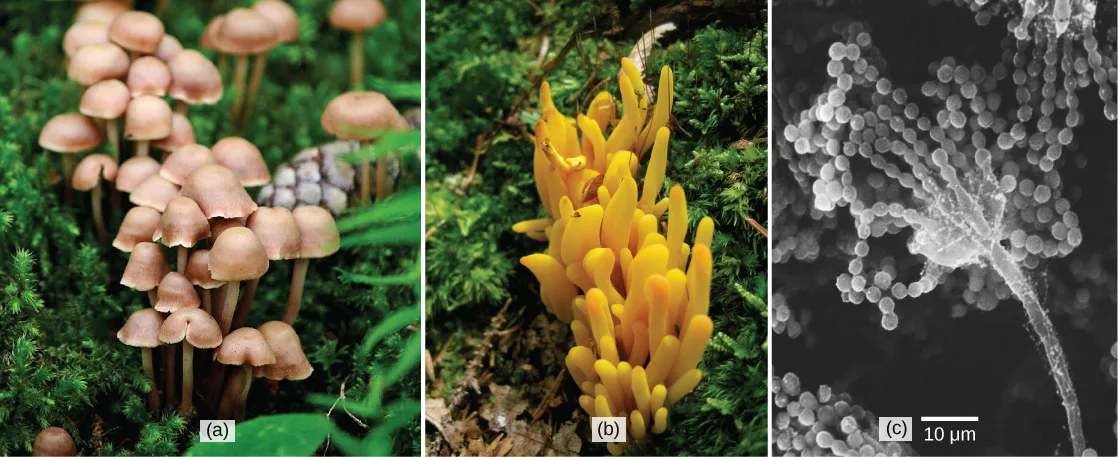
The word fungus comes from the Latin word for mushrooms. Indeed, the familiar mushroom is a reproductive structure used by many types of fungi. However, there are also many fungus species that don’t produce mushrooms at all. Being eukaryotes, a typical fungal cell contains a true nucleus and many membrane-bound organelles. The kingdom Fungi includes an enormous variety of living organisms. While scientists have identified about 155,000 species of fungi, this is only a fraction of the more than 5 million species of fungus likely present on Earth. Edible mushrooms, yeasts, black mold, and the producer of the antibiotic penicillin, Penicillium notatum, are all members of the kingdom Fungi, which belongs to the domain Eukarya.
Sections
- Characteristics of Fungi — the traits shared by fungi, the hyphae and mycelium, how fungi feed as heterotrophs, and their asexual and sexual reproduction.
- Classifications of Fungi — the five major phyla (chytrids, conjugated fungi, sac fungi, club fungi, and glomeromycetes), their representative species, and their patterns of reproduction.
- Ecology of Fungi — fungi as decomposers and recyclers, their mutualisms with plant roots and with photosynthetic partners in lichens, and their partnerships with insects.
- Fungal Parasites and Pathogens — fungal diseases of plants and of humans, and why antifungal therapy is hampered by the similarity between fungal and animal cells.
- Importance of Fungi in Human Life — fungi in the balance of the environment, in agriculture and food and beverage preparation, in the chemical and pharmaceutical industries, and as model organisms.
This chapter is adapted from Biology 2e, Chapter 24: Fungi by Mary Ann Clark, Jung Choi, Matthew Douglas, and OpenStax, © OpenStax, licensed under CC BY-NC-SA 4.0. Access the original for free at openstax.org. Each section page records its own changes from the source. Changes: the chapter-opening image is the source’s, re-encoded for the web; its source alt described the three panels as “Left/Middle/Right” rather than by the caption’s own (a)/(b)/(c) lettering, so the alt was rewritten to name each lettered panel while keeping what it described (the mushroom’s cap and stalk, the coral fungus’s lobed shape, the micrograph’s branching spore chains and scale bar); the caption’s italicized genus name is set in italics per the source’s own markup, though the vendored manifest’s plain-text caption field does not carry it; the source’s introduction paragraph does not reference the opening figure inline, so no parenthetical figure-reference rendering was needed; the source’s own <emphasis> markup (the word “fungus” and the species name Penicillium notatum) is italicized per house style.