Ecology of Fungi
By the end of this section, you will be able to:
- Describe the role of fungi in various ecosystems
- Describe mutualistic relationships of fungi with plant roots and photosynthetic organisms
- Describe the beneficial relationship between some fungi and insects
Fungi play a crucial role in the constantly changing “balance” of ecosystems. They colonize most habitats on Earth, preferring dark, moist conditions. They can thrive in seemingly hostile environments, such as the tundra, thanks to a most successful symbiosis with photosynthetic organisms like algae to produce lichens. Within their communities, fungi are not as obvious as are large animals or tall trees. Like bacteria, they act behind the scenes as major decomposers. With their versatile metabolism, fungi break down organic matter, which would otherwise not be recycled.
Habitats
Although fungi are primarily associated with humid and cool environments that provide a supply of organic matter, they colonize a surprising diversity of habitats, from seawater to human skin and mucous membranes. Chytrids are found primarily in aquatic environments. Other fungi, such as Coccidioides immitis, which causes pneumonia when its spores are inhaled, thrive in the dry and sandy soil of the southwestern United States. Fungi that parasitize coral reefs live in the ocean. However, most members of the Kingdom Fungi grow on the forest floor, where the dark and damp environment is rich in decaying debris from plants and animals. In these environments, fungi play a major role as decomposers and recyclers, making it possible for members of the other kingdoms to be supplied with nutrients and live.
Decomposers and Recyclers
The food web would be incomplete without organisms that decompose organic matter (see the photo below). Some elements—such as nitrogen and phosphorus—are required in large quantities by biological systems, and yet are not abundant in the environment. The action of fungi releases these elements from decaying matter, making them available to other living organisms. Trace elements present in low amounts in many habitats are essential for growth, and would remain tied up in rotting organic matter if fungi and bacteria did not return them to the environment via their metabolic activity.
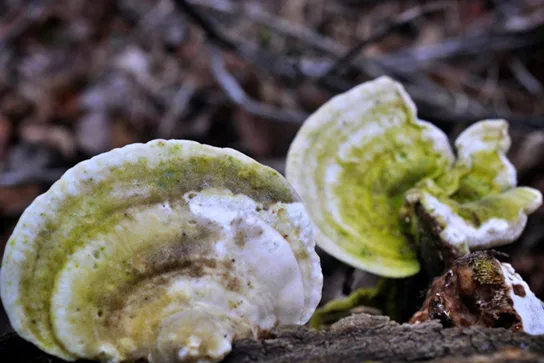
The ability of fungi to degrade many large and insoluble molecules is due to their mode of nutrition. As seen earlier, digestion precedes ingestion. Fungi produce a variety of exoenzymes to digest nutrients. The enzymes are either released into the substrate or remain bound to the outside of the fungal cell wall. Large molecules are broken down into small molecules, which are transported into the cell by a system of protein carriers embedded in the cell membrane. Because the movement of small molecules and enzymes is dependent on the presence of water, active growth depends on a relatively high percentage of moisture in the environment.
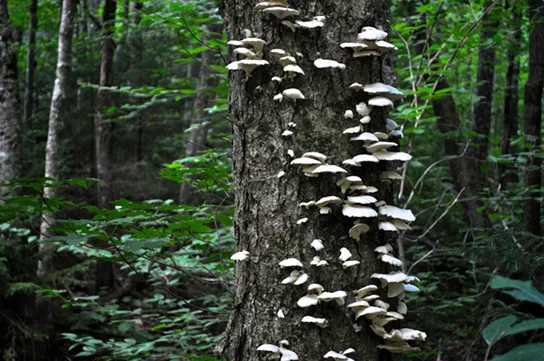
As saprobes, fungi help maintain a sustainable ecosystem for the animals and plants that share the same habitat. In addition to replenishing the environment with nutrients, fungi interact directly with other organisms in beneficial, and sometimes damaging, ways (see the photo below).
Mutualistic Relationships
Symbiosis is the ecological interaction between two organisms that live together. This definition does not describe the type or quality of the interaction. When both members of the association benefit, the symbiotic relationship is called mutualistic. Fungi form mutualistic associations with many types of organisms, including cyanobacteria, algae, plants, and animals.
Fungus/Plant Mutualism
One of the most remarkable associations between fungi and plants is the establishment of mycorrhizae. Mycorrhiza, which is derived from the Greek words myco meaning fungus and rhizo meaning root, refers to the fungal partner of a mutualistic association between vascular plant roots and their symbiotic fungi. Nearly 90 percent of all vascular plant species have mycorrhizal partners. In a mycorrhizal association, the fungal mycelia use their extensive network of hyphae and large surface area in contact with the soil to channel water and minerals from the soil into the plant. In exchange, the plant supplies the products of photosynthesis to fuel the metabolism of the fungus.
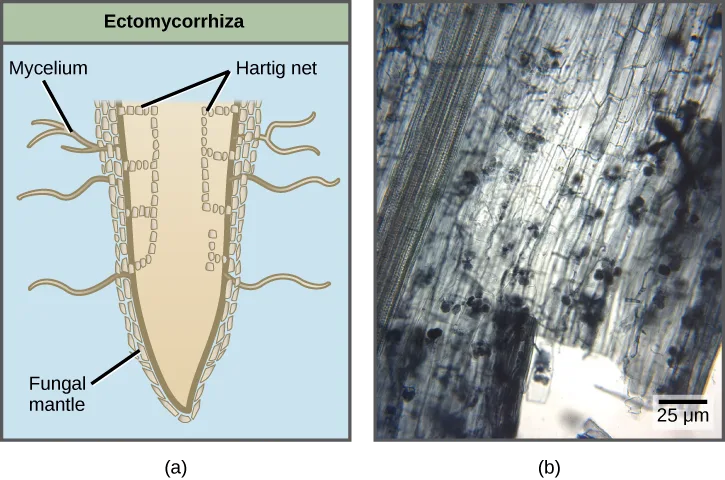
There are several basic types of mycorrhizae. Ectomycorrhizae (“outside” mycorrhizae) depend on fungi enveloping the roots in a sheath (called a mantle). Hyphae grow from the mantle into the root and envelope the outer layers of the root cells in a network of hyphae called a Hartig net (see the diagram below). The fungal partner can belong to the Ascomycota, Basidiomycota or Zygomycota. Endomycorrhizae (“inside” mycorrhizae), also called arbuscular mycorrhizae, are produced when the fungi grow inside the root in a branched structure called an arbuscule (from the Latin for “little trees”). The fungal partners of endomycorrhizal associates all belong to the Glomeromycota. The fungal arbuscules penetrate root cells between the cell wall and the plasma membrane and are the site of the metabolic exchanges between the fungus and the host plant (see the diagram and photo below). Orchids rely on a third type of mycorrhiza. Orchids are epiphytes that typically produce very small airborne seeds without much storage to sustain germination and growth. Their seeds will not germinate without a mycorrhizal partner (usually a Basidiomycete). After nutrients in the seed are depleted, fungal symbionts support the growth of the orchid by providing necessary carbohydrates and minerals. Some orchids continue to be mycorrhizal throughout their life cycle.
Extended description
Panel (a) is a labeled diagram titled ‘Ectomycorrhiza’: a root tip is sheathed on the outside by a tan fungal mantle, with mycelium threads radiating outward from the mantle into the surrounding space, and rows of hyphae — labeled the Hartig net — extending inward from the mantle between the outer layers of root cells, running straight down and branching toward the root’s outside. Panel (b) is a light micrograph of a root cross-section showing arbuscular mycorrhiza as dense, dark, branching fungal clusters within the root tissue, with a 25 µm scale bar in the lower right corner.
If symbiotic fungi were absent from the soil, what impact do you think this would have on plant growth?
Show model answer
Did your answer mention:
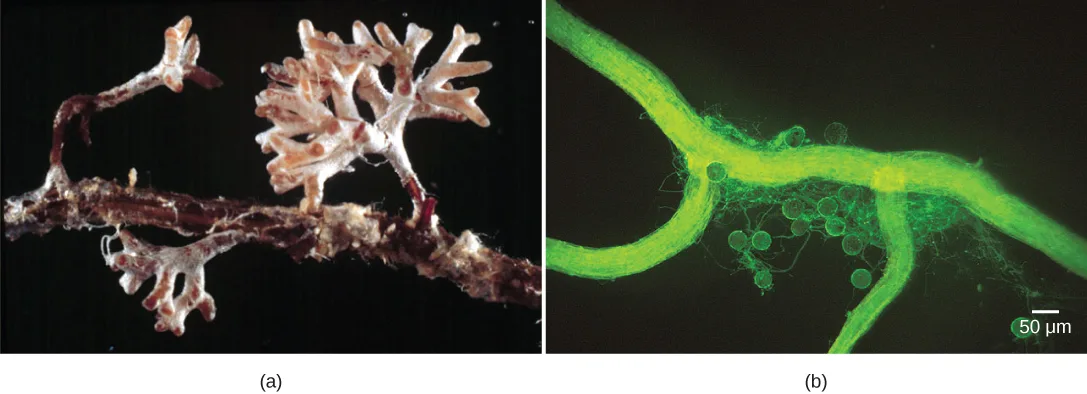
Other examples of fungus–plant mutualism include the endophytes: fungi that live inside tissue without damaging the host plant. Endophytes release toxins that repel herbivores, or confer resistance to environmental stress factors, such as infection by microorganisms, drought, or heavy metals in soil.
Evolution Connection. Coevolution of Land Plants and Mycorrhizae. As we have seen, mycorrhizae are the fungal partners of a mutually beneficial symbiotic association that coevolved between roots of vascular plants and fungi. A well-supported theory proposes that fungi were instrumental in the evolution of the root system in plants and contributed to the success of Angiosperms. The bryophytes (mosses and liverworts), which are considered the most ancestral plants and the first to survive and adapt on land, have simple underground rhizoids, rather than a true root system, and therefore cannot survive in dry areas. However, some bryophytes have arbuscular mycorrhizae and some do not.
True roots first appeared in the ancestral vascular plants: Vascular plants that developed a system of thin extensions from their roots would have had a selective advantage over nonvascular plants because they had a greater surface area of contact with the fungal partners than did the rhizoids of mosses and liverworts. The first true roots would have allowed vascular plants to obtain more water and nutrients in the ground.
Fossil records indicate that fungi actually preceded the invasion of ancestral freshwater plants onto dry land. The first association between fungi and photosynthetic organisms on land involved moss-like plants and endophytes. These early associations developed before roots appeared in plants. Slowly, the benefits of the endophyte and rhizoid interactions for both partners led to present-day mycorrhizae: About 90 percent of today’s vascular plants have associations with fungi in their rhizosphere.
The fungi involved in mycorrhizae display many characteristics of ancestral fungi; they produce simple spores, show little diversification, do not have a sexual reproductive cycle, and cannot live outside of a mycorrhizal association. The plants benefited from the association because mycorrhizae allowed them to move into new habitats and allowed the increased uptake of nutrients, which gave them an enormous selective advantage over plants that did not establish symbiotic relationships.
Lichens
Lichens display a range of colors and textures (see the photo below) and can survive in the most unusual and hostile habitats. They cover rocks, gravestones, tree bark, and the ground in the tundra where plant roots cannot penetrate. Lichens can survive extended periods of drought, when they become completely desiccated, and then rapidly become active once water is available again.
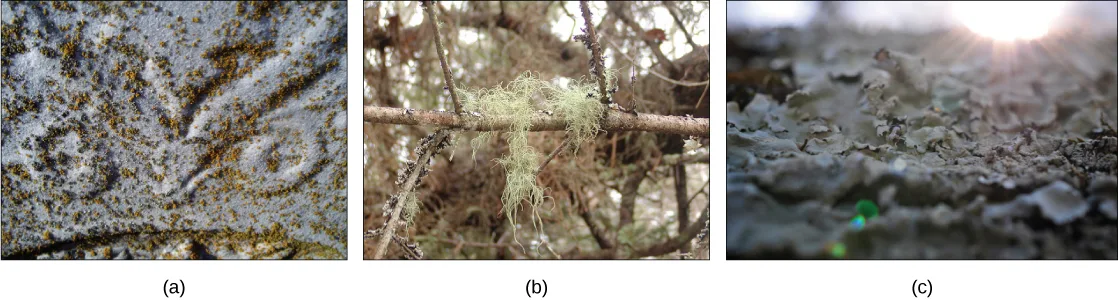
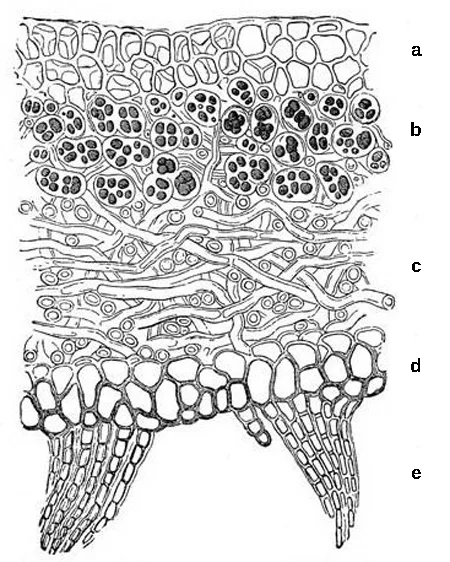
It is important to note that lichens are not a single organism, but rather another wonderful example of a mutualism, in which a fungus (usually a member of the Ascomycota or Basidiomycota) lives in a physical and physiological relationship with a photosynthetic organism (a eukaryotic alga or a prokaryotic cyanobacterium) (see the diagram below). Generally, neither the fungus nor the photosynthetic organism can survive alone outside of the symbiotic relationship. The body of a lichen, referred to as a thallus, is formed of hyphae wrapped around the photosynthetic partner. The photosynthetic organism provides carbon and energy in the form of carbohydrates. Some cyanobacteria additionally fix nitrogen from the atmosphere, contributing nitrogenous compounds to the association. In return, the fungus supplies minerals and protection from dryness and excessive light by encasing the algae in its mycelium. The fungus also attaches the lichen to its substrate.
Extended description
From top to bottom the drawing shows: (a) a dense band of tightly packed, roughly hexagonal fungal-hyphae cells forming the upper cortex; (b) a band of larger, clustered dark circular cells — the photosynthetic algal cells — wrapped in a mesh of thinner fungal hyphae, the algal zone; (c) a looser, tangled mesh of thread-like fungal hyphae with no algal cells, the medulla; (d) a second dense band of packed hexagonal cells matching the upper cortex, the lower cortex; and (e) thin, finger-like hyphal threads projecting downward from the lower cortex, the rhizines anchoring the thallus to its substrate.
The thallus of lichens grows very slowly, expanding its diameter a few millimeters per year. Both the fungus and the alga participate in the formation of dispersal units, called soredia—clusters of algal cells surrounded by mycelia. Soredia are dispersed by wind and water and form new lichens.
Lichens are extremely sensitive to air pollution, especially to abnormal levels of nitrogenous and sulfurous compounds. The U.S. Forest Service and National Park Service can monitor air quality by measuring the relative abundance and health of the lichen population in an area. Lichens fulfill many ecological roles. Caribou and reindeer eat lichens, and they provide cover for small invertebrates that hide in the mycelium. In the production of textiles, weavers used lichens to dye wool for many centuries until the advent of synthetic dyes. The pigments used in litmus paper are also extracted from lichens.
Fungus/Animal Mutualism
Fungi have evolved mutualisms with numerous insects in Phylum Arthropoda: joint-legged invertebrates with a chitinous exoskeleton. Arthropods depend on the fungus for protection from predators and pathogens, while the fungus obtains nutrients and a way to disseminate spores into new environments. The association between species of Basidiomycota and scale insects is one example. The fungal mycelium covers and protects the insect colonies. The scale insects foster a flow of nutrients from the parasitized plant to the fungus.
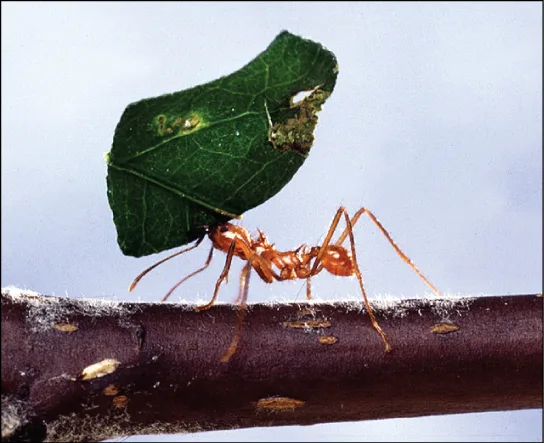
In a second example, leaf-cutter ants of Central and South America literally farm fungi. They cut disks of leaves from plants and pile them up in subterranean gardens (see the photo below). Fungi are cultivated in these disk gardens, digesting the cellulose in the leaves that the ants cannot break down. Once smaller sugar molecules are produced and consumed by the fungi, the fungi in turn become a meal for the ants. The insects also patrol their garden, preying on competing fungi. Both ants and fungi benefit from this mutualistic association. The fungus receives a steady supply of leaves and freedom from competition, while the ants feed on the fungi they cultivate.
Fungivores
Animal dispersal is important for some fungi because an animal may carry fungal spores considerable distances from the source. Fungal spores are rarely completely degraded in the gastrointestinal tract of an animal, and many are able to germinate when they are passed in the feces. Some “dung fungi” actually require passage through the digestive system of herbivores to complete their lifecycle. The black truffle—a prized gourmet delicacy—is the fruiting body of an underground ascomycete. Almost all truffles are ectomycorrhizal, and are usually found in close association with trees. Animals eat truffles and disperse the spores. In Italy and France, truffle hunters use female pigs to sniff out truffles (female pigs are attracted to truffles because the fungus releases a volatile compound closely related to a pheromone produced by male pigs.)
Summary
Fungi have colonized nearly all environments on Earth, but are frequently found in cool, dark, moist places with a supply of decaying material. Fungi are saprobes that decompose organic matter. Many successful mutualistic relationships involve a fungus and another organism. Many fungi establish complex mycorrhizal associations with the roots of plants. Some ants farm fungi as a supply of food. Lichens are a symbiotic relationship between a fungus and a photosynthetic organism, usually an alga or cyanobacterium. The photosynthetic organism provides energy from stored carbohydrates, while the fungus supplies minerals and protection. Some animals that consume fungi help disseminate spores over long distances.
Key terms
- arbuscular mycorrhiza — mycorrhizal association in which the fungal hyphae enter the root cells and form extensive networks
- ectomycorrhiza — mycorrhizal fungi that surround the roots with a mantle and have a Hartig net that extends into the roots between cells
- lichen — close association of a fungus with a photosynthetic alga or bacterium that benefits both partners
- mycorrhiza — mutualistic association between fungi and vascular plant roots
- soredia — clusters of algal cells and mycelia that allow lichens to propagate
Practice
Describe the role of fungi in various ecosystems
Why are fungi important decomposers?
Re-read the Decomposers and Recyclers section: what specifically happens to nutrients that were tied up in dead matter?Consider an ecosystem where all the fungi not involved in mycorrhizae are eliminated. How would this affect nitrogen intake by plants?
Decomposer fungi release nitrogen from dead matter before mycorrhizal fungi can channel it into plant roots — what happens to that supply if the decomposers are gone?Fungi are ________ that decompose organic matter.
The Decomposers and Recyclers section uses this term for an organism that absorbs nutrients from dead and decaying matter.Describe mutualistic relationships of fungi with plant roots and photosynthetic organisms
What term describes the close association of a fungus with the root of a tree?
This is the term defined earlier in the section as the fungal partner of a mutualistic association between vascular plant roots and their symbiotic fungi.A mutualistic association between fungi and vascular plant roots is called a ________.
This is the Greek-derived term (myco- fungus, rhizo- root) for the fungal partner in this relationship.Mycorrhizal fungi that surround plant roots with a mantle and send hyphae into the root to form a Hartig net are called ________.
Its name reflects that the fungal mantle stays outside the root cells, rather than entering them.A mycorrhizal association in which fungal hyphae enter the plant’s root cells and form extensive branched networks is called a(n) ________.
This is the type of mycorrhiza whose fungal partners all belong to the Glomeromycota.Why does protection from light actually benefit the photosynthetic partner in lichens?
Show model answer
Did your answer mention:
A close association between a fungus and a photosynthetic alga or bacterium that benefits both partners is called a ________.
This symbiotic partnership can survive extreme drought by becoming completely desiccated.The clusters of algal cells and mycelia that allow lichens to spread and form new lichens are called ________.
These dispersal units are carried away from the parent lichen by wind and water.Ecologists often attempt to introduce new plants to restore degraded land. In an arid climate, scientists recommend introducing plants with arbuscular mycorrhizae. How would the mycorrhizae increase the plants’ survival compared to plants without mycorrhizae?
Show model answer
Did your answer mention:
Describe the beneficial relationship between some fungi and insects
Ambrosia bark beetles carry Ambrosiella fungal spores to trees, then bore holes and lay their eggs with the fungus. When the new larvae hatch, they eat the fungus that has germinated in the holes. Describe how this relationship can be classified as mutualistic.
Show model answer
Did your answer mention:
Some ________ farm fungi as a supply of food.
This insect is described in the Fungus/Animal Mutualism section as literally cultivating fungi in underground gardens.Which insects form a mutualism with a species of Basidiomycota, in which the fungal mycelium covers and protects the insect colonies while the insects foster a flow of nutrients from a parasitized plant to the fungus?
Re-read the Fungus/Animal Mutualism section’s first example, where the insects draw nutrients from a host plant to feed the fungus.This section is adapted from Biology 2e, Section 24.3: Ecology of Fungi by Mary Ann Clark, Jung Choi, Matthew Douglas, and OpenStax, © OpenStax, licensed under CC BY-NC-SA 4.0. Access the original for free at openstax.org. Changes: figures re-encoded as WebP, with kind confirmed against each image — six of the seven matched the manifest’s guess, and Figure_24_03_06 was re-kinded from the manifest’s guessed “photo” to “diagram,” since it is a labeled line drawing of a lichen cross-section rather than a photograph; Figure_24_03_03’s source alt (647 characters, over the 600-character limit) was shortened to name what the figure teaches, with its panel-by-panel walk-through moved into a longdesc, and Figure_24_03_06 was given a fresh alt plus a longdesc walking its five labeled layers top to bottom, since its source alt closely duplicated the caption’s own listing of the five parts; inline cross-references to numbered figures (“Figure 24.19,” etc.) changed to descriptive phrases (“see the photo below,” “see the diagram below”) since figures are not numbered here; the two interactive-class notes rendered as Link to Learning callouts with descriptive link text and the source’s own openstax.org short URLs; the Evolution Connection note rendered as a callout with its bold name and italic title; the Visual Connection question kept in the body immediately after its figure and rendered as a self-check, since the source keys it with a prose solution rather than a lettered option; the three Review Questions and three Critical Thinking Questions adapted into the closing interactive Practice block (multiple choice and self-check respectively); rubric checkpoints added to every self-check, including the body Visual Connection self-check, decomposing each model answer (the source solution) into check-off clauses with no new claims; five key-term recall items (mycorrhiza, ectomycorrhiza, arbuscular mycorrhiza, lichen, soredia) added from the glossary; two summary-derived text-in clozes added (“saprobes” under the first objective, “ants” under the third), since the module’s own Review and Critical Thinking Questions leave those two objectives thin; and one multiple choice written locally under the third objective (scale insects, keyed second, not first), built strictly from the Fungus/Animal Mutualism section’s own sentences on the Basidiomycota–scale-insect association, since only one source exercise (the Ambrosia-beetle Critical Thinking question) addresses fungus/insect mutualism — disclosed in the ledger.