Fungal Parasites and Pathogens
By the end of this section, you will be able to:
- Describe some fungal parasites and pathogens of plants
- Describe the different types of fungal infections in humans
- Explain why antifungal therapy is hampered by the similarity between fungal and animal cells
Parasitism describes a symbiotic relationship in which one member of the association benefits at the expense of the other. Both parasites and pathogens harm the host; however, pathogens cause disease, damage to host tissues or physiology, whereas parasites usually do not, but can cause serious damage and death by competition for nutrients or other resources. Commensalism occurs when one member benefits without affecting the other.
Plant Parasites and Pathogens
The production of sufficient high-quality crops is essential to human existence. Unfortunately, plant diseases have ruined many crops throughout human agricultural history, sometimes creating widespread famine. Many plant pathogens are fungi that cause tissue decay and the eventual death of the host (see below). In addition to destroying plant tissue directly, some plant pathogens spoil crops by producing potent toxins that can further damage and kill the host plant. Fungi are also responsible for food spoilage and the rotting of stored crops. For example, the fungus Claviceps purpurea causes ergot, a disease of cereal crops (especially of rye). Although the fungus reduces the yield of cereals, the effects of the ergot’s alkaloid toxins on humans and animals are of much greater significance. In animals, the disease is referred to as ergotism. The most common signs and symptoms are convulsions, hallucination, gangrene, and loss of milk in cattle. The active ingredient of ergot is lysergic acid, which is a precursor of the drug LSD. Smuts, rusts, and powdery or downy mildew are other examples of common fungal pathogens that affect crops.
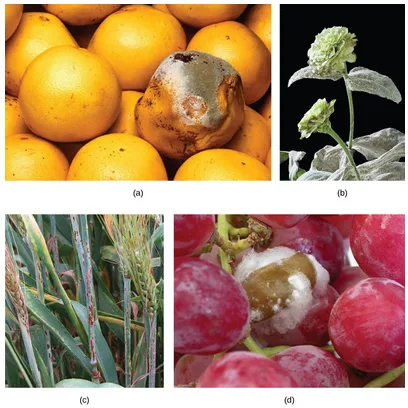
Aflatoxins are toxic, carcinogenic compounds released by fungi of the genus Aspergillus. Periodically, harvests of nuts and grains are tainted by aflatoxins, leading to massive recall of produce. This sometimes ruins producers and causes food shortages in developing countries.
Animal and Human Parasites and Pathogens
Fungi can affect animals, including humans, in several ways. A mycosis is a fungal disease that results from infection and direct damage due to the growth and infiltration of the fungus. Fungi attack animals directly by colonizing and destroying tissues. Mycotoxicosis is the poisoning of humans (and other animals) by foods contaminated by fungal toxins (mycotoxins). Mycetismus specifically describes the ingestion of preformed toxins in poisonous mushrooms. In addition, individuals who display hypersensitivity to molds and spores may develop strong and dangerous allergic reactions. Fungal infections are generally very difficult to treat because, unlike bacteria, fungi are eukaryotes. Antibiotics only target prokaryotic cells, whereas compounds that kill fungi also harm the eukaryotic animal host.
Many fungal infections are superficial; that is, they occur on the animal’s skin. Termed cutaneous (“skin”) mycoses, they can have devastating effects. For example, the decline of the world’s frog population in recent years is caused (in part) by the chytrid fungus Batrachochytrium dendrobatidis. This deadly fungus infects the skin of frogs and presumably interferes with cutaneous gaseous exchange, which is essential for amphibian survival. Similarly, more than a million bats in the United States have been killed by white-nose syndrome, which appears as a white ring around the mouth of the bat. It is caused by the cold-loving fungus Pseudogymnoascus destructans, which disseminates its deadly spores in caves where bats hibernate. Mycologists are researching the transmission, mechanism, and control of P. destructans to stop its spread.
Fungi that cause the superficial mycoses of the epidermis, hair, and nails rarely spread to the underlying tissue (see below). These fungi are often misnamed “dermatophytes”, from the Greek words dermis meaning skin and phyte meaning plant, although they are not plants. Dermatophytes are also called “ringworms” because of the red ring they cause on skin. They secrete extracellular enzymes that break down keratin (a protein found in hair, skin, and nails), causing conditions such as athlete’s foot and jock itch. These conditions are usually treated with over-the-counter topical creams and powders, and are easily cleared. More persistent superficial mycoses may require prescription oral medications.
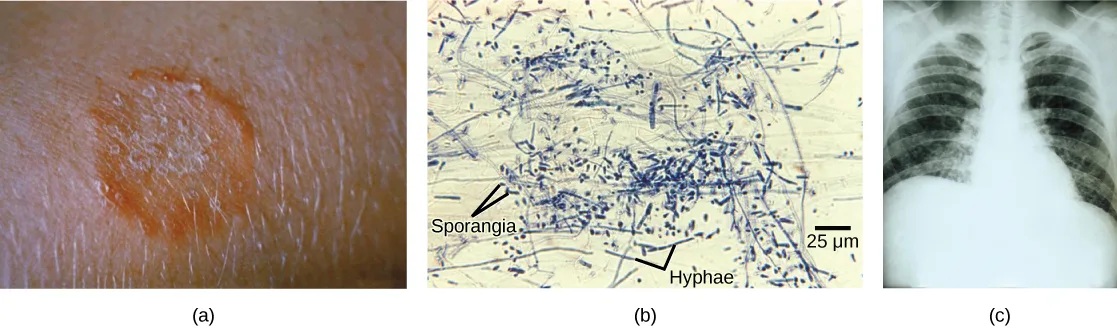
Systemic mycoses spread to internal organs, most commonly entering the body through the respiratory system. For example, coccidioidomycosis (often called valley fever) is commonly found in the southwestern United States, but as far north as Washington, where the fungus resides in the dust. Once inhaled, the spores develop in the lungs and cause symptoms similar to those of tuberculosis. Histoplasmosis is caused by the dimorphic fungus Histoplasma capsulatum. In its human host, Histoplasma grows as a yeast, causing pulmonary infections, and in rarer cases, swelling of the membranes of the brain and spinal cord. Treatment of these and many other fungal diseases requires the use of antifungal medications that have serious side effects.
Opportunistic mycoses are fungal infections that are either common in all environments, or part of the normal biota. They mainly affect individuals who have a compromised immune system. Patients in the late stages of AIDS suffer from opportunistic mycoses that can be life threatening. The yeast Candida sp., a common member of the natural biota, can grow unchecked and infect the vagina or mouth (oral thrush) if the pH of the surrounding environment, the person’s immune defenses, or the normal population of bacteria are altered.
Mycetismus can occur when poisonous mushrooms are eaten. It causes a number of human fatalities during mushroom-picking season. Many edible fruiting bodies of fungi resemble highly poisonous relatives, and amateur mushroom hunters are cautioned to carefully inspect their harvest and avoid eating mushrooms of doubtful origin. The adage “there are bold mushroom pickers and old mushroom pickers, but are there no old, bold mushroom pickers” is unfortunately true.
Scientific Method Connection. Dutch Elm Disease
Question: Do trees resistant to Dutch elm disease secrete antifungal compounds?
Hypothesis: Construct a hypothesis that addresses this question.
Background: Dutch elm disease is a fungal infestation that affects many species of elm (Ulmus) in North America. The fungus infects the vascular system of the tree, which blocks water flow within the plant and mimics drought stress. Accidently introduced to the United States in the early 1930s, it decimated American elm shade trees across the continent. It is caused by the fungus Ophiostoma ulmi. The elm bark beetle acts as a vector and transmits the disease from tree to tree. Many European and Asiatic elms are less susceptible to the disease than are American elms.
Test the hypothesis: A researcher testing this hypothesis might do the following. Inoculate several Petri plates containing a medium that supports the growth of fungi with fragments of Ophiostoma mycelium. Cut (with a metal punch) several disks from the vascular tissue of susceptible varieties of American elms and resistant European and Asiatic elms. Include control Petri plates inoculated with mycelia without plant tissue to verify that the medium and incubation conditions do not interfere with fungal growth. As a positive control, add paper disks impregnated with a known fungicide to Petri plates inoculated with the mycelium.
Incubate the plates for a set number of days to allow fungal growth and spreading of the mycelium over the surface of the plate. Record the diameter of the zone of clearing, if any, around the tissue samples and the fungicide control disk.
Record your observations in the following table.
Results of Antifungal Testing of Vascular Tissue from Different Species of Elm
| Disk | Zone of Inhibition (mm) |
|---|---|
| Distilled Water | |
| Fungicide | |
| Tissue from Susceptible Elm #1 | |
| Tissue from Susceptible Elm #2 | |
| Tissue from Resistant Elm #1 | |
| Tissue from Resistant Elm #2 |
Analyze the data and report the results. Compare the effect of distilled water to the fungicide. These are negative and positive controls that validate the experimental setup. The fungicide should be surrounded by a clear zone where the fungus growth was inhibited. Is there a difference among different species of elm?
Draw a conclusion: Was there antifungal activity as expected from the fungicide? Did the results support the hypothesis? If not, how can this be explained? There are several possible explanations.
Summary
Fungi establish parasitic relationships with plants and animals. Fungal diseases can decimate crops and spoil food during storage. Compounds produced by fungi can be toxic to humans and other animals. Mycoses are infections caused by fungi. Superficial mycoses affect the skin, whereas systemic mycoses spread through the body. Fungal infections are difficult to cure, since fungi, like their hosts, are eukaryotic, and cladistically related closely to Kingdom Animalia.
Key terms
- commensalism — symbiotic relationship in which one member benefits while the other member is not affected
- mycetismus — ingestion of toxins in poisonous mushrooms
- mycosis — fungal infection
- mycotoxicosis — poisoning by a fungal toxin released in food
- parasitism — symbiotic relationship in which one member of the association benefits at the expense of the other
Practice
Describe some fungal parasites and pathogens of plants
A fungus that climbs up a tree reaching higher elevation to release its spores in the wind and does not receive any nutrients from the tree or contribute to the tree’s welfare is described as a ________.
The tree is neither harmed nor helped. Rule out the two options that require harm to the host and the one that requires both partners to benefit.Explain how the Red Queen Hypothesis describes the continuously evolving relationship between red grapes and Botrytis cinerea.
Show model answer
Did your answer mention:
A symbiotic relationship in which one member of the association benefits at the expense of the other is called ________.
This relationship harms one member while benefiting the other — the opposite of commensalism, defined in the same sentence.A symbiotic relationship in which one member benefits while the other member is not affected is called ________.
Unlike parasitism, which harms one member, this relationship leaves the unaffected member neither helped nor harmed.Describe the different types of fungal infections in humans
A fungal infection that affects nails and skin is classified as ________.
This kind of mycosis stays limited to outer body surfaces, unlike an infection that spreads to internal organs.Why can superficial mycoses in humans lead to bacterial infections?
Show model answer
Did your answer mention:
A fungal disease that results from infection and direct damage due to the growth and infiltration of a fungus is called a ________.
This general term covers both the superficial and the systemic fungal diseases described in this section.The poisoning of humans and other animals by foods contaminated with fungal toxins is called ________.
This differs from eating a poisonous mushroom directly — here, the danger comes from toxins already present in contaminated food.The ingestion of preformed toxins in poisonous mushrooms is called ________.
Unlike eating food contaminated by fungal toxins already in it, this term specifically means eating a poisonous mushroom itself.Explain why antifungal therapy is hampered by the similarity between fungal and animal cells
The targets for anti-fungal drugs are much more limited than antibiotics or anti-viral medications. Why?
Fungi and animals are both eukaryotes, unlike prokaryotic bacteria — think about what that similarity means for a drug that must avoid harming the host’s own cells.Fungal infections are difficult to cure, since fungi, like their hosts, are ________, and cladistically related closely to Kingdom Animalia.
Antibiotics work by targeting a kind of cell that fungi are not — the same kind of cell that fungi share with their animal or plant hosts.Antifungal therapy is difficult to develop because compounds that kill fungal cells also often:
Antibiotics only affect prokaryotic cells; think about what an antifungal compound cannot avoid affecting instead, given what kind of cells fungi and animals both have.This section is adapted from Biology 2e, Section 24.4: Fungal Parasites and Pathogens by Mary Ann Clark, Jung Choi, Matthew Douglas, and OpenStax, © OpenStax, licensed under CC BY-NC-SA 4.0. Access the original for free at openstax.org. Changes: figures re-encoded as WebP; Figure_B24_04_01abcd re-kinded from the manifest’s file-extension “diagram” guess to “photo” after inspection (all four panels are photographs of infected plants and produce, not drawings); both figures’ bare source alts (“Part A is a photo of…”) rewritten from the images, folding in the printed sporangia/hyphae labels and 25-micrometer scale bar visible in Figure_24_04_02abc’s panel (b), which the source alt omitted; the Scientific Method Connection’s blank data-collection table (Results of Antifungal Testing of Vascular Tissue from Different Species of Elm) transcribed as a Markdown table with its title as a bold line above it and its data cells left empty for the learner to fill in, with no practice item built from it; the end-of-section Review Questions and Critical Thinking Questions adapted into the closing interactive Practice block (multiple choice and self-check respectively); rubric checkpoints added to each self-check, decomposing its model answer (the source solution) into check-off clauses with no new claims; five key-term recall items added from the glossary; one summary-derived recall item (eukaryotic) added under the antifungal-therapy objective from the section summary’s own sentence; and one locally written multiple choice (compounds that kill fungal cells also harming the eukaryotic host) added under the same objective, built strictly from the section’s own sentence and disclosed in the ledger, since only one Review Question and one summary sentence test that objective.