Importance of Fungi in Human Life
By the end of this section, you will be able to:
- Describe the importance of fungi to the balance of the environment
- Summarize the role of fungi in agriculture and food and beverage preparation
- Describe the importance of fungi in the chemical and pharmaceutical industries
- Discuss the role of fungi as model organisms
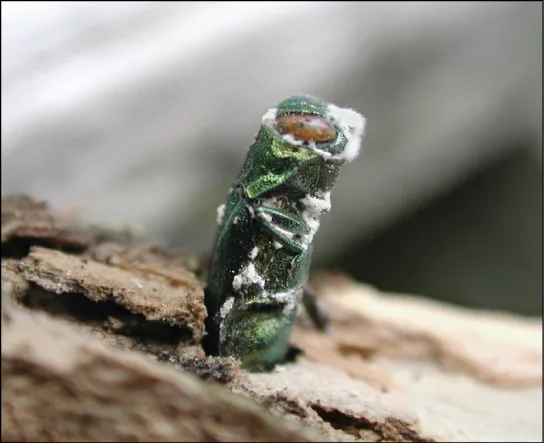
Although we often think of fungi as organisms that cause disease and rot food, they are vitally important to human life on many levels. As we have seen, fungi influence the well-being of human populations on a large scale because they are part of the nutrient cycle in ecosystems. They have other ecosystem roles as well. As animal pathogens, fungi help to control the population of damaging pests. These fungi are very specific to the insects they attack, and do not infect other animals or plants. Fungi are currently under investigation as potential microbial insecticides, with several already on the market. For example, the fungus Beauveria bassiana is being tested as a possible biological control agent for the recent spread of emerald ash borer a beetle that feeds on ash trees. It has been released in Michigan, Illinois, Indiana, Ohio, West Virginia, and Maryland (see the photo below).
The mycorrhizal relationship between fungi and plant roots is essential for the productivity of farm land. Without the fungal partner in root systems, 80–90 percent of trees and grasses would not survive. Mycorrhizal fungal inoculants are available as soil amendments from gardening supply stores and are promoted by supporters of organic agriculture, but there is little evidence as to the effectiveness.
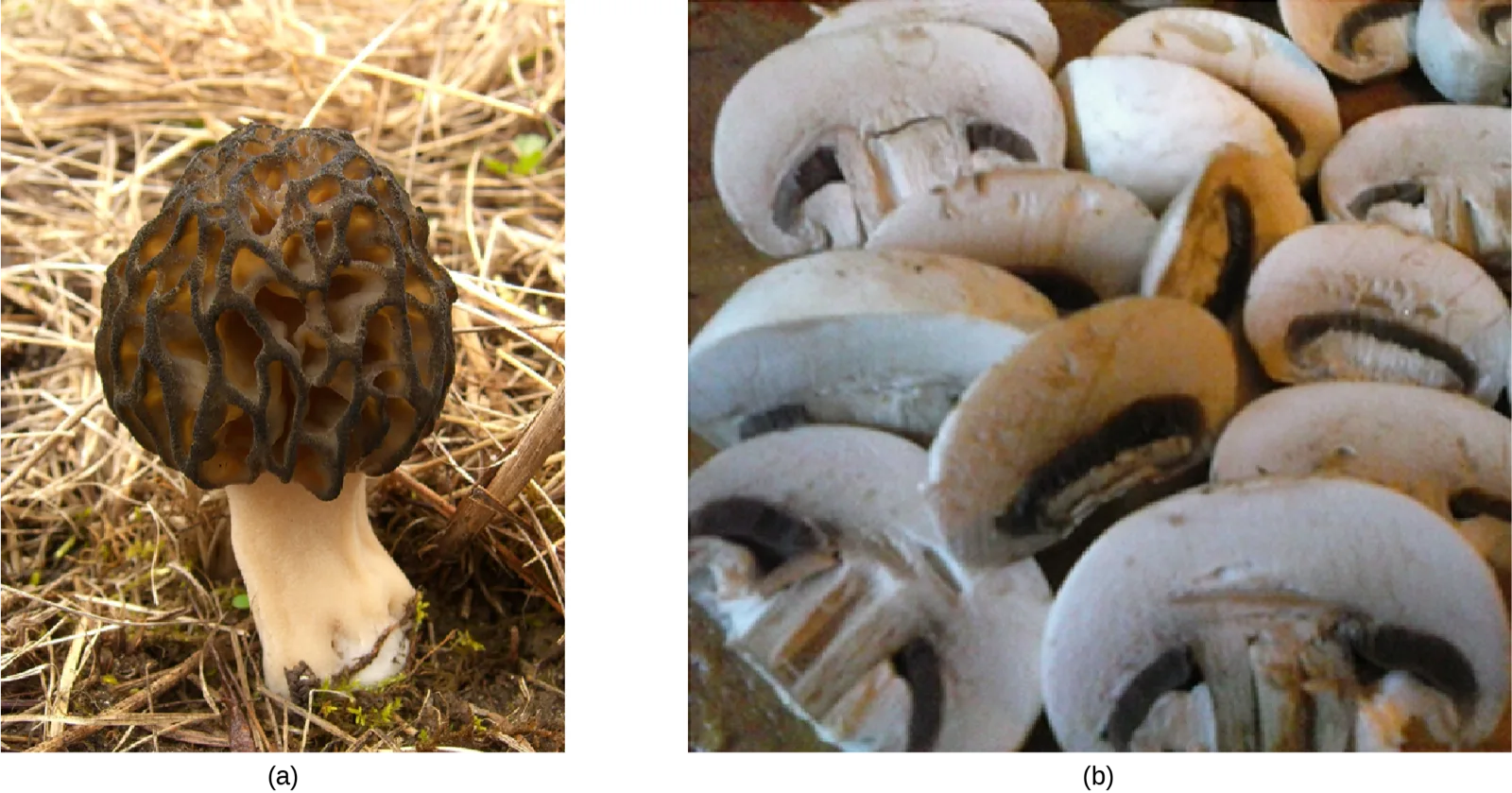
We also eat some types of fungi. Mushrooms figure prominently in the human diet. Morels, shiitake mushrooms, chanterelles, and truffles are considered delicacies (see the photo below). The humble meadow mushroom, Agaricus campestris, appears in many dishes. Molds of the genus Penicillium ripen many cheeses. They originate in the natural environment such as the caves of Roquefort, France, where wheels of sheep milk cheese are stacked in order to capture the molds responsible for the blue veins and pungent taste of the cheese.
Fermentation—of grains to produce beer, and of fruits to produce wine—is an ancient art that humans in most cultures have practiced for millennia. Wild yeasts are acquired from the environment and used to ferment sugars into CO₂ and ethyl alcohol under anaerobic conditions. It is now possible to purchase isolated strains of wild yeasts from different wine-making regions. Louis Pasteur was instrumental in developing a reliable strain of brewer’s yeast, Saccharomyces cerevisiae, for the French brewing industry in the 1870s. (Source note: the source says “the late 1850s”; Pasteur’s brewing studies followed the Franco-Prussian War, with Études sur la bière published in 1876 and his beer-making patent granted in 1873.) This was one of the first examples of biotechnology patenting.
Many secondary metabolites of fungi are of great commercial importance. Antibiotics are naturally produced by fungi to kill or inhibit the growth of bacteria, limiting their competition in the natural environment. Important antibiotics, such as penicillin and the cephalosporins, are isolated from fungi. Valuable drugs isolated from fungi include the immunosuppressant drug cyclosporine (which reduces the risk of rejection after organ transplant), the precursors of steroid hormones, and ergot alkaloids used to stop bleeding. Psilocybin is a compound found in fungi such as Psilocybe semilanceata and Gymnopilus junonius, which have been used for their hallucinogenic properties by various cultures for thousands of years.
As simple eukaryotic organisms, fungi are important model research organisms. Many advances in modern genetics were achieved by the use of the red bread mold Neurospora crassa. Additionally, many important genes originally discovered in S. cerevisiae served as a starting point in discovering analogous human genes. As a eukaryotic organism, the yeast cell produces and modifies proteins in a manner similar to human cells, as opposed to the bacterium Escherichia coli, which lacks the internal membrane structures and enzymes to tag proteins for export. This makes yeast a much better organism for use in recombinant DNA technology experiments. Like bacteria, yeasts grow easily in culture, have a short generation time, and are amenable to genetic modification.
Summary
Fungi are important to everyday human life. Fungi are important decomposers in most ecosystems. Mycorrhizal fungi are essential for the growth of most plants. Fungi, as food, play a role in human nutrition in the form of mushrooms, and also as agents of fermentation in the production of bread, cheeses, alcoholic beverages, and numerous other food preparations. Secondary metabolites of fungi are used as medicines, such as antibiotics and anticoagulants. Fungi are model organisms for the study of eukaryotic genetics and metabolism.
Practice
Describe the importance of fungi to the balance of the environment
Why are fungal insecticides an attractive alternative to chemical pesticides for growing food crops?
Compare what each option claims fungal insecticides can do against what the section says about their safety and specificity.How would treating an area of a forest with a broad-spectrum fungicide alter the carbon and nitrogen cycles in the area?
Show model answer
Did your answer mention:
Fungi are important ________ in most ecosystems.
This is the role fungi play at the very start of a food web’s breakdown side — turning dead matter back into reusable nutrients.Summarize the role of fungi in agriculture and food and beverage preparation
Yeast is a facultative anaerobe. This means that alcohol fermentation takes place only if:
Facultative anaerobes switch to fermentation only when a particular gas is missing from their surroundings.Historically, artisanal breads were produced by capturing wild yeasts from the air. Prior to the development of modern yeast strains, the production of artisanal breads was long and laborious because many batches of dough ended up being discarded. Can you explain this fact?
Show model answer
Did your answer mention:
Fungi, as food, play a role in human nutrition in the form of ________, and also as agents of fermentation in the production of bread, cheeses, alcoholic beverages, and numerous other food preparations.
Named earlier in this section as delicacies such as morels and truffles.Describe the importance of fungi in the chemical and pharmaceutical industries
Fungi naturally produce antibiotics in order to ________.
The section explains what the antibiotics do for the fungus in its own natural environment, not what people use them for.Secondary metabolites of fungi are used as medicines, such as ________ and anticoagulants.
Penicillin and the cephalosporins, named in the secondary-metabolites paragraph, are examples of this drug class.The immunosuppressant drug isolated from fungi that lowers the risk of organ-transplant rejection is ________.
Named in the paragraph about secondary metabolites, alongside steroid-hormone precursors and ergot alkaloids.Discuss the role of fungi as model organisms
The advantage of yeast cells over bacterial cells to express human proteins is that:
Which option concerns how the cell processes proteins internally, rather than growth speed or ease of genetic manipulation?Many advances in modern genetics were achieved by the use of the red bread mold ________.
Named in the model-organisms paragraph beside the yeast whose genes led researchers to analogous human genes.Fungi are ________ for the study of eukaryotic genetics and metabolism.
This is the section’s closing description of what fungi are to researchers, not what fungi do in soil or on insects.This section is adapted from Biology 2e, Section 24.5: Importance of Fungi in Human Life by Mary Ann Clark, Jung Choi, Matthew Douglas, and OpenStax, © OpenStax, licensed under CC BY-NC-SA 4.0. Access the original for free at openstax.org. Changes: figures re-encoded as WebP; Figure B24.05.02’s alt text rewritten from the manifest’s terse “Part a … Part b …” phrasing to a plain description of each photographed panel, and its kind corrected from the manifest’s diagram guess to photo (both panels are photographs, not diagrams); two inline print figure cross-references (“Figure 24.28”, “Figure 24.29”) changed to descriptive phrases (“see the photo below”) since figures are not numbered here; the fermentation paragraph’s CO2 set as Unicode CO₂; this module has no glossary, so its “Key terms” heading is omitted; the three Review Questions and two Critical Thinking Questions adapted into the closing interactive Practice block (multiple choice and self-check respectively); four cloze text-recall and select-the-term multiple-choice items added from the section summary, and three items added from the section’s own prose in place of the usual glossary-derived recall items — text-recall items for the immunosuppressant drug cyclosporine and the red bread mold Neurospora crassa, and a multiple choice on why fungi produce antibiotics, with distractors drawn from the other fungal-product roles the same paragraphs name; rubric checkpoints added to each self-check, decomposing its model answer (the source solution) into check-off clauses with no new claims. One date is corrected with a visible Source note: Pasteur’s brewer’s-yeast work and patent date to the 1870s, not the late 1850s (erratum 417).