Seedless Plants
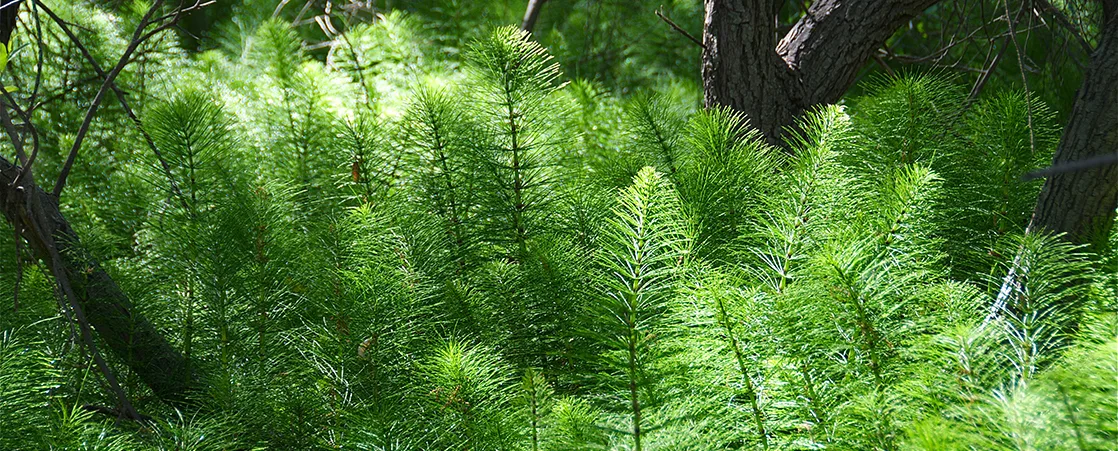
An incredible variety of seedless plants populates the terrestrial landscape. Mosses may grow on a tree trunk, and horsetails may display their jointed stems and spindly leaves across the forest floor. Today, seedless plants represent only a small fraction of the plants in our environment; yet, 300 million years ago, seedless plants dominated the landscape and grew in the enormous swampy forests of the Carboniferous period. Their decomposition created large deposits of coal that we mine today.
Current evolutionary thought holds that all plants—some green algae as well as land plants—are monophyletic; that is, they are descendants of a single common ancestor. The evolutionary transition from water to land imposed severe constraints on plants. They had to develop strategies to avoid drying out, to disperse reproductive cells in air, for structural support, and for capturing and filtering sunlight. While seed plants have developed adaptations that allow them to populate even the most arid habitats on Earth, full independence from water did not happen in all plants. Most seedless plants still require a moist environment for reproduction.
Sections
- Early Plant Life — the challenges of life on land, the adaptations that let plants colonize it, and the timeline of plant evolution and its impact on other living things.
- Green Algae: Precursors of Land Plants — the traits green algae share with land plants, why charophytes are their closest algal relatives, and how DNA comparisons reshape the phylogeny.
- Bryophytes — the shared characteristics of bryophytes, the distinguishing traits of liverworts, hornworts, and mosses, their land adaptations, and the bryophyte life cycle.
- Seedless Vascular Plants — the vascular tissue, roots, and leaves that first appear in seedless tracheophytes, the club mosses, horsetails, whisk ferns, and true ferns, the fern life cycle, and the role of seedless plants in the ecosystem.
This chapter is adapted from Biology 2e, Chapter 25: Seedless Plants by Mary Ann Clark, Jung Choi, Matthew Douglas, and OpenStax, © OpenStax, licensed under CC BY-NC-SA 4.0. Access the original for free at openstax.org. Each section page records its own changes from the source. Changes: the chapter-opening image is the source’s, re-encoded for the web, with its source alt kept since it already says what the single photo shows; the caption’s italicized genus name is set in italics per the source’s own markup, though the vendored manifest’s plain-text caption field does not carry it; the source’s introduction paragraphs do not reference the opening figure inline, so no parenthetical figure-reference rendering was needed.