Bryophytes
By the end of this section, you will be able to:
- Identify the main characteristics of bryophytes
- Describe the distinguishing traits of liverworts, hornworts, and mosses
- Chart the development of land adaptations in the bryophytes
- Describe the events in the bryophyte lifecycle
Bryophytes are the closest extant relatives of early terrestrial plants. The first bryophytes (liverworts) most likely appeared in the Ordovician period, about 450 million years ago. Because they lack lignin and other resistant structures, the likelihood of bryophytes forming fossils is rather small. Some spores protected by sporopollenin have survived and are attributed to early bryophytes. By the Silurian period (435 MYA), however, vascular plants had spread through the continents. This compelling fact is used as evidence that non-vascular plants must have preceded the Silurian period.
More than 25,000 species of bryophytes thrive in mostly damp habitats, although some live in deserts. They constitute the major flora of inhospitable environments like the tundra, where their small size and tolerance to desiccation offer distinct advantages. They generally lack lignin and do not have actual tracheids (xylem cells specialized for water conduction). Rather, water and nutrients circulate inside specialized conducting cells. Although the term non-tracheophyte is more accurate, bryophytes are commonly called non-vascular plants.
In a bryophyte, all the conspicuous vegetative organs—including the photosynthetic leaf-like structures, the thallus (“plant body”), stem, and the rhizoid that anchors the plant to its substrate—belong to the haploid organism or gametophyte. The male gametes formed by bryophytes swim with a flagellum, so fertilization is dependent on the presence of water. The bryophyte embryo also remains attached to the parent plant, which protects and nourishes it. The sporophyte that develops from the embryo is barely noticeable. The sporangium—the multicellular sexual reproductive structure in which meiosis produces haploid spores—is present in bryophytes and absent in the majority of algae. This is also a characteristic of land plants.
The bryophytes are divided into three phyla: the liverworts or Marchantiophyta, the hornworts or Anthocerotophyta, and the mosses or true Bryophyta.
Liverworts
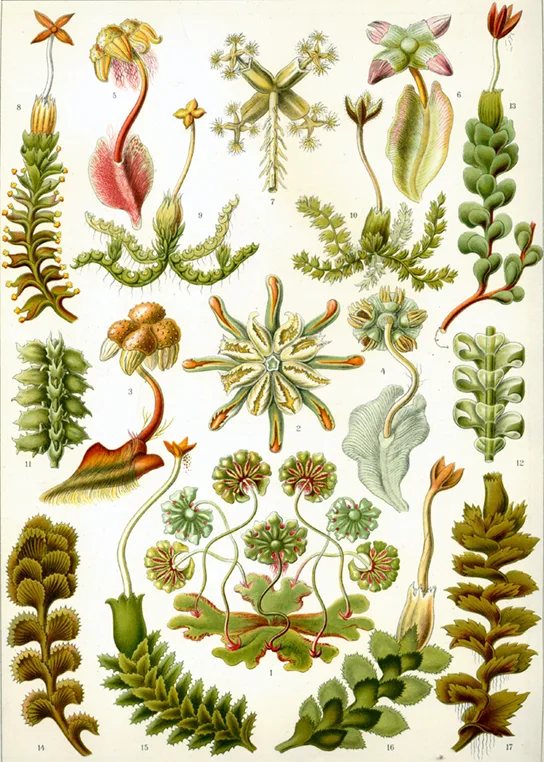
Liverworts (Marchantiophyta) are currently classified as the plants most closely related to the ancestor of vascular plants that adapted to terrestrial environments. In fact, liverworts have colonized every terrestrial habitat on Earth and diversified to more than 7000 existing species (pictured below). Lobate liverworts form a flat thallus, with lobes that have a vague resemblance to the lobes of the liver (pictured below), which accounts for the name given to the phylum. Leafy liverworts have tiny leaflike structures attached to a stalk. Several leafy liverworts are shown below.
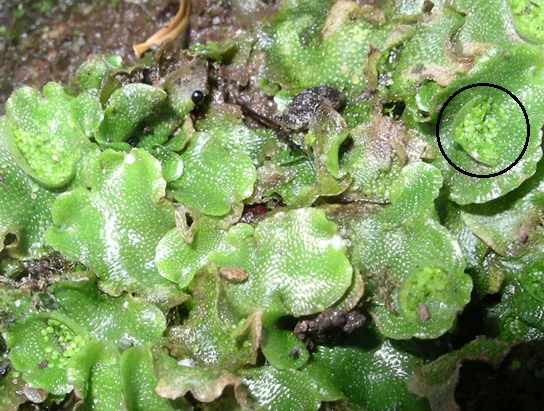
Openings in the thallus that allow the movement of gases may be observed in liverworts (pictured above). However, these are not stomata, because they do not actively open and close by the action of guard cells. Instead, the thallus takes up water over its entire surface and has no cuticle to prevent desiccation, which explains their preferred wet habitats. The figure below represents the lifecycle of a lobate liverwort. Haploid spores germinate into flattened thalli attached to the substrate by thin, single-celled filaments. Stalk-like structures (gametophores) grow from the thallus and carry male and female gametangia, which may develop on separate, individual plants, or on the same plant, depending on the species. Flagellated male gametes develop within antheridia (male gametangia). The female gametes develop within archegonia (female gametangia). Once released, the male gametes swim with the aid of their flagella to an archegonium, and fertilization ensues. The zygote grows into a small sporophyte still contained in the archegonium. The diploid zygote will give rise, by meiosis, to the next generation of haploid spores, which can be disseminated by wind or water. In many liverworts, spore dispersal is facilitated by elaters—long single cells that suddenly change shape as they dry out and throw adjacent spores out of the spore capsule. Liverwort plants can also reproduce asexually, by the breaking of “branches” or the spreading of leaf fragments called gemmae. In this latter type of reproduction, the gemmae—small, intact, complete pieces of plant that are produced in a cup on the surface of the thallus (shown above and in the life cycle below)—are splashed out of the cup by raindrops. The gemmae then land nearby and develop into gametophytes.
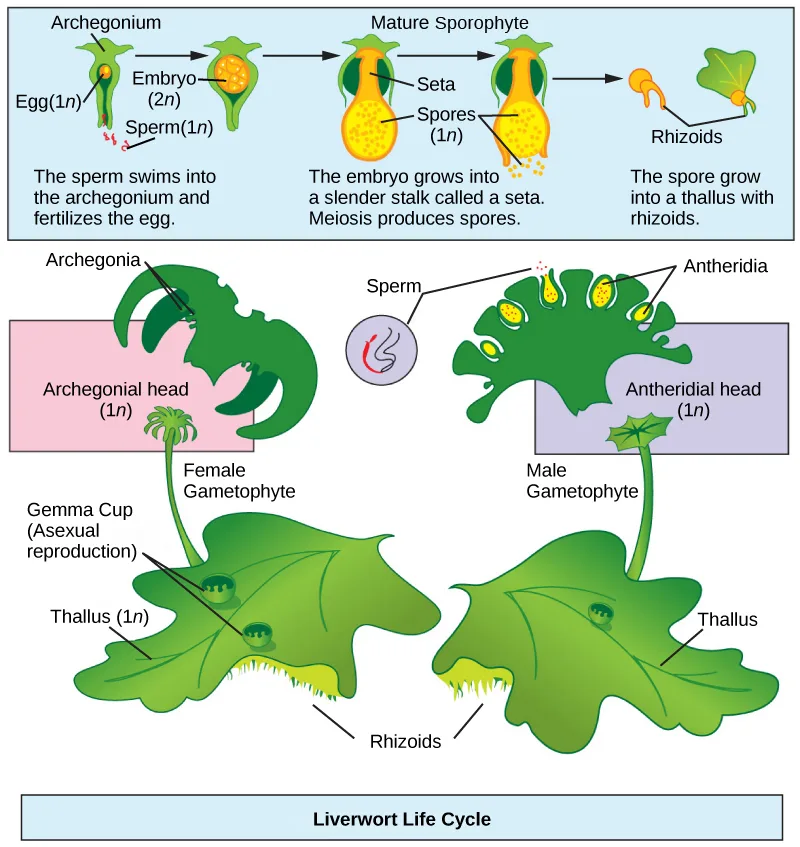
Extended description
The top strip runs left to right in three captioned panels. The first, labeled ‘Archegonium,’ shows Sperm (1n) and an Egg (1n) inside a flask-shaped archegonium, captioned ‘The sperm swims into the archegonium and fertilizes the egg,’ producing an Embryo (2n). The second panel, labeled ‘Mature Sporophyte,’ shows the same structure enlarged with a Seta and Spores (1n) inside it, captioned ‘The embryo grows into a slender stalk called a seta. Meiosis produces spores.’ An arrow leads to the third panel, showing scattered Rhizoids and a small thallus, captioned ‘The spore grow into a thallus with rhizoids.’ Below this strip, two separate plants are drawn side by side. On the left, a Female Gametophyte: an Archegonial head (1n) with finger-like Archegonia at the top of a slender stalk, rising from a broad, lobed Thallus (1n) that carries a Gemma Cup (labeled ‘Asexual reproduction’) and Rhizoids at its base. On the right, a Male Gametophyte: an Antheridial head (1n) studded with Antheridia, with a Sperm cell shown in a small circle between the two heads, rising from its own lobed thallus with Rhizoids at its base. A bar across the bottom reads ‘Liverwort Life Cycle.’
Hornworts
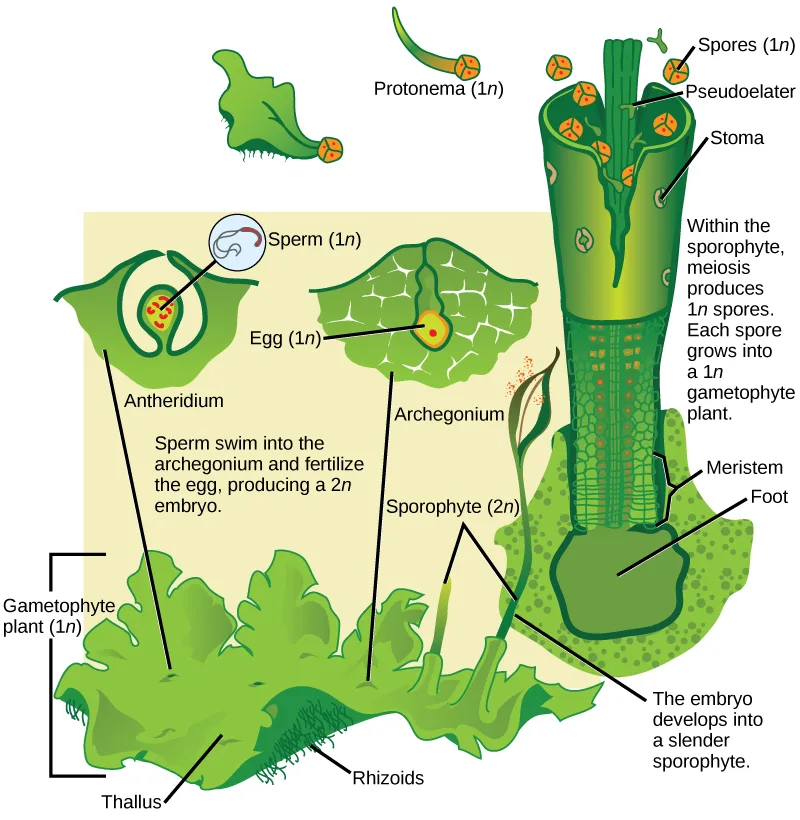
The defining characteristic of the hornworts (Anthocerotophyta) is the narrow, pipe-like sporophyte. Hornworts have colonized a variety of habitats on land, although they are never far from a source of moisture. The short, blue-green gametophyte is the dominant phase of the life cycle of a hornwort. The sporophytes emerge from the parent gametophyte and continue to grow throughout the life of the plant (pictured below).
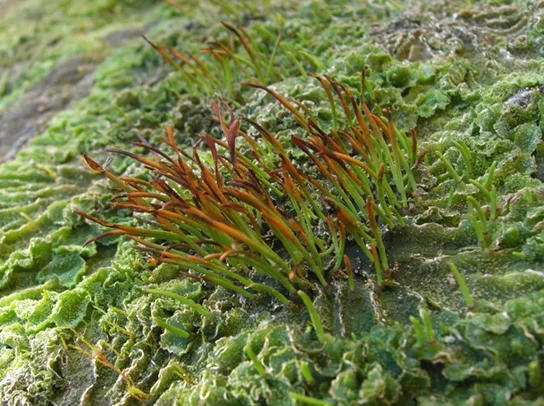
Stomata (air pores that can be opened and closed) appear in the hornworts and are abundant on the sporophyte. Photosynthetic cells in the thallus each contain a single chloroplast. Meristem cells at the base of the plant keep dividing and adding to the height of the sporophyte. This growth pattern is unique to the hornworts. Many hornworts establish symbiotic relationships with cyanobacteria that fix nitrogen from the environment.
The lifecycle of hornworts (pictured below) follows the general pattern of alternation of generations. The gametophytes grow as flat thalli on the soil with embedded male and female gametangia. Flagellated sperm swim to the archegonia and fertilize eggs. The zygote develops into a long and slender sporophyte that eventually splits open down the side, releasing spores. Thin branched cells called pseudoelaters surround the spores and help propel them farther in the environment. The haploid spores germinate and give rise to the next generation of gametophytes.
Extended description
At upper left, a small curved shoot labeled ‘Protonema (1n)’ carries a round spore case. The main illustration below shows a flat, lobed gametophyte thallus labeled ‘Gametophyte plant (1n)’ with ‘Thallus’ and ‘Rhizoids’ at its base. Two cutaway circles rise from the thallus: at left an ‘Antheridium’ containing coiled ‘Sperm (1n)’, and at right an ‘Archegonium’ containing an ‘Egg (1n)’, joined by a small ‘Sperm (1n)’ circle between them and the caption ‘Sperm swim into the archegonium and fertilize the egg, producing a 2n embryo.’ From the thallus, a ‘Sporophyte (2n)’ label points to a short emerging shoot captioned ‘The embryo develops into a slender sporophyte,’ which continues upward into the tall mature sporophyte at upper right. That sporophyte is labeled top to bottom ‘Spores (1n),’ ‘Pseudoelater,’ and ‘Stoma,’ its split tip shown releasing round spore clusters, with ‘Meristem’ and ‘Foot’ labeled near its base and a caption reading ‘Within the sporophyte, meiosis produces 1n spores. Each spore grows into a 1n gametophyte plant.’
Mosses
The mosses are the most numerous of the non-vascular plants. More than 10,000 species of mosses have been catalogued. Their habitats vary from the tundra, where they are the main vegetation, to the understory of tropical forests. In the tundra, the mosses’ shallow rhizoids allow them to fasten to a substrate without penetrating the frozen soil. Mosses slow down erosion, store moisture and soil nutrients, and provide shelter for small animals as well as food for larger herbivores, such as the musk ox. Mosses are very sensitive to air pollution and are used to monitor air quality. They are also sensitive to copper salts, so these salts are a common ingredient of compounds marketed to eliminate mosses from lawns.
Mosses form diminutive gametophytes, which are the dominant phase of the lifecycle. Green, flat structures with a simple midrib—resembling true leaves, but lacking stomata and vascular tissue—are attached in a spiral to a central stalk. Mosses have stomata only on the sporophyte. Water and nutrients are absorbed directly through the leaflike structures of the gametophyte. Some mosses have small branches. A primitive conductive system that carries water and nutrients runs up the gametophyte’s stalk, but does not extend into the leaves. Additionally, mosses are anchored to the substrate—whether it is soil, rock, or roof tiles—by multicellular rhizoids, precursors of roots. They originate from the base of the gametophyte, but are not the major route for the absorption of water and minerals. The lack of a true root system explains why it is so easy to rip moss mats from a tree trunk. The mosses therefore occupy a threshold position between other bryophytes and the vascular plants.
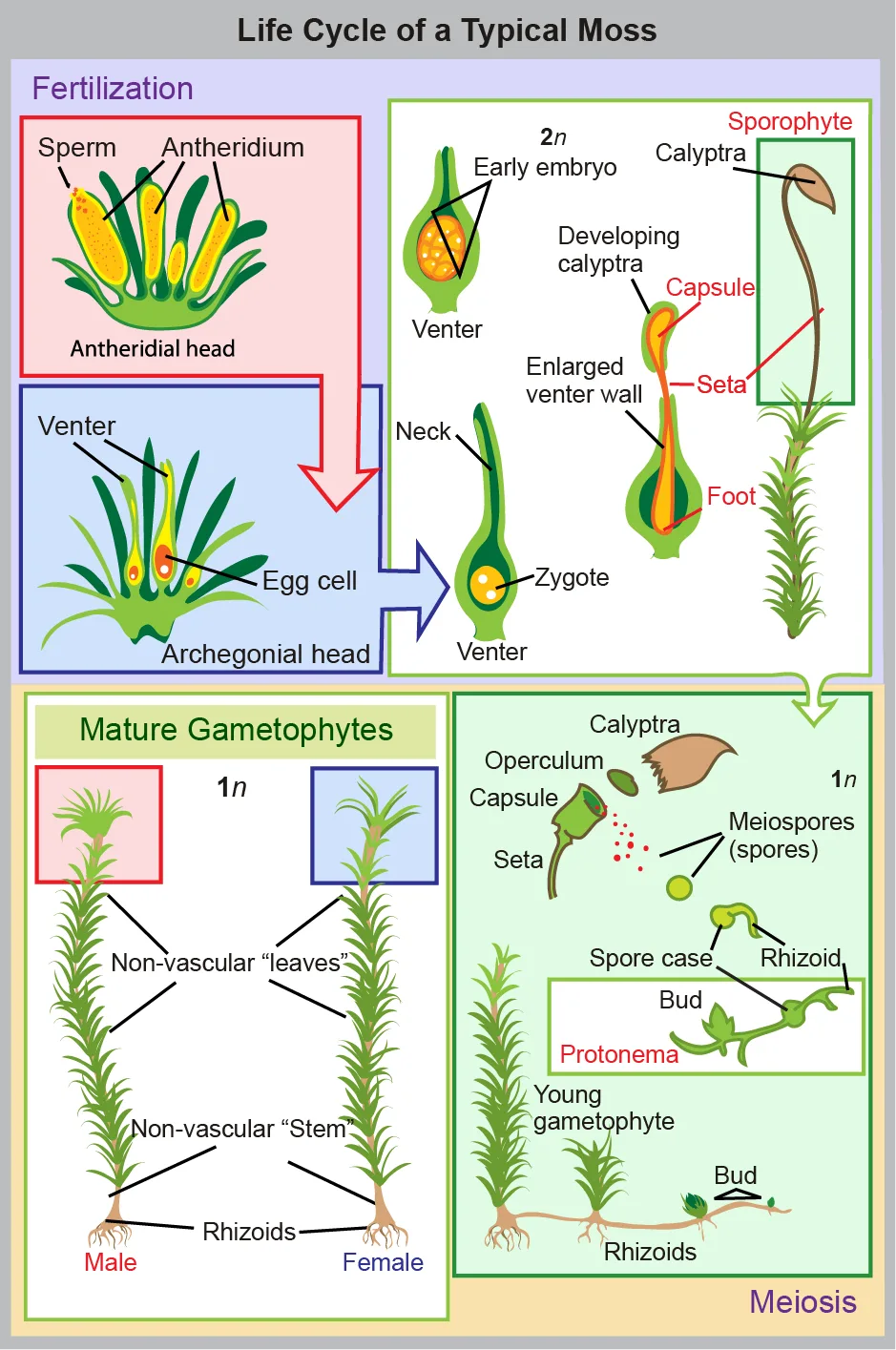
The moss lifecycle follows the pattern of alternation of generations as shown below. The most familiar structure is the haploid gametophyte, which germinates from a haploid spore and forms first a protonema—usually, a tangle of single-celled filaments that hug the ground. Cells akin to an apical meristem actively divide and give rise to a gametophore, consisting of a photosynthetic stem and foliage-like structures. Male and female gametangia develop at the tip of separate gametophores. The antheridia (male organs) produce many sperm, whereas the archegonia (the female organs) each form a single egg at the base (venter) of a flask-shaped structure. The archegonium produces attractant substances and at fertilization, the sperm swims down the neck to the venter and unites with the egg inside the archegonium. The zygote, protected by the archegonium, divides and grows into a sporophyte, still attached by its foot to the gametophyte.
Extended description
The diagram is titled ‘Life Cycle of a Typical Moss’ and divided into four boxes joined by arrows. Top left, a pink box labeled ‘Fertilization’ shows an Antheridial head with Sperm and Antheridium above a blue box showing an Archegonial head with a Venter and Egg cell; a red arrow leads from the antheridial box down to the archegonial box. Top right, a 2n panel of cutaway drawings: the blue arrow from the archegonial box enters at its lower left, at a Zygote in the Venter beside a Neck; above the zygote sits an Early embryo (2n) in the Venter; to the right a stage labeled Developing calyptra, Enlarged venter wall, Capsule, Seta, and Foot; and at the far right a tall mature Sporophyte plant, boxed in green, labeled with a Seta, a Capsule, and a brown Calyptra capping its tip. The blue arrow connects the archegonial box to this panel, and a curved green arrow runs from the mature Sporophyte box down into the bottom-right box. Bottom left, a box labeled ‘Mature Gametophytes’ (1n) shows two moss shoots side by side, labeled Male and Female, each with Non-vascular ’leaves’ at the top and a Non-vascular ‘Stem’ above Rhizoids at the base. Bottom right, a box labeled ‘Meiosis’ (1n) shows the sporophyte’s Capsule with its Operculum lifting off beside the Calyptra, releasing red-dot Meiospores (spores); these lead to a Spore case with a Rhizoid, into a boxed inset labeled ‘Protonema’ containing a Bud; from there, a Young gametophyte grows, its Rhizoids extending along the ground to a further Bud.
Which of the following statements about the moss life cycle is false?
In the Meiosis panel, trace what actually grows into the bud and young gametophyte after the spores are released.The moss sporophyte is dependent on the gametophyte for nutrients. The slender seta (plural, setae), as seen below, contains tubular cells that transfer nutrients from the base of the sporophyte (the foot) to the sporangium or capsule.
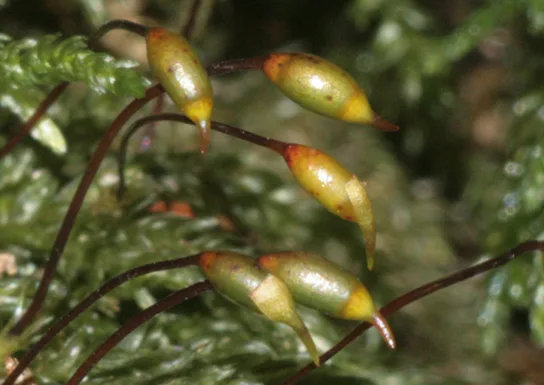
Spore mother cells in the sporangium undergo meiosis to produce haploid spores. The sporophyte has several features that protect the developing spores and aid in their dispersal. The calyptra, derived from the walls of the archegonium, covers the sporangium. A structure called the operculum is at the tip of the spore capsule. The calyptra and operculum fall off when the spores are ready for dispersal. The peristome, tissue around the mouth of the capsule, is made of triangular, close-fitting units like little “teeth.” The peristome opens and closes, depending on moisture levels, and periodically releases spores.
Summary
Seedless non-vascular plants are small, having the gametophyte as the dominant stage of the lifecycle. Without a vascular system and roots, they absorb water and nutrients on all their exposed surfaces. Collectively known as bryophytes, the three main groups include the liverworts, the hornworts, and the mosses. Liverworts are the most primitive plants and are closely related to the first land plants. Hornworts developed stomata and possess a single chloroplast per cell. Mosses have simple conductive cells and are attached to the substrate by rhizoids. They colonize harsh habitats and can regain moisture after drying out. The moss sporangium is a complex structure that allows release of spores away from the parent plant.
Key terms
- capsule — case of the sporangium in mosses.
- gemma — (plural, gemmae) leaf fragment that spreads for asexual reproduction.
- hornworts — group of non-vascular plants in which stomata appear.
- liverworts — most primitive group of the non-vascular plants.
- mosses — group of bryophytes in which a primitive conductive system appears.
- peristome — tissue that surrounds the opening of the capsule and allows periodic release of spores.
- protonema — tangle of single-celled filaments that forms from the haploid spore.
- rhizoids — thin filaments that anchor the plant to the substrate.
- seta — stalk that supports the capsule in mosses.
Practice
Identify the main characteristics of bryophytes
Which of the following structures is not found in bryophytes?
Bryophytes anchor themselves with thin filamentous rhizoids instead of this true vascular-plant organ.In areas where it rains often, mosses grow on roofs. How do mosses survive on roofs without soil?
Show model answer
Did your answer mention:
The thin filaments that anchor a bryophyte to its substrate are called ________.
Mosses’ shallow versions of this structure let them fasten to frozen tundra soil without penetrating it.Describe the distinguishing traits of liverworts, hornworts, and mosses
Why do mosses grow well in the Arctic tundra?
Think about what the mosses’ shallow rhizoids let them do on frozen ground.What are the three classes of bryophytes?
Show model answer
Did your answer mention:
The group of non-vascular plants in which stomata appear is called the ________.
This phylum’s narrow, pipe-like sporophyte keeps growing throughout the life of the plant, and its thallus cells each hold a single chloroplast.The most primitive group of the non-vascular plants is called the ________.
This group’s flat, lobed thallus gave the phylum its name, since the lobes vaguely resemble those of an organ.Chart the development of land adaptations in the bryophytes
Stomata appear in which group of plants?
This group’s sporophyte is abundantly covered in these openable, closable air pores. Rule out the algae, the group whose pores are not true stomata, and the generation of another group that the section says lacks them.Describe two adaptations that are present in mosses, but not hornworts or liverworts, which reflect steps of evolution toward land plants.
Show model answer
Potential answers include:
- Mosses exhibit a primitive conductive system in their stalks that transports nutrients and water.
- Mosses exhibit a more complex, multicellular rhizoid system.
Did your answer mention:
The group of bryophytes in which a primitive conductive system appears is called the ________.
This group occupies a threshold position between the other bryophytes and the vascular plants.Describe the events in the bryophyte lifecycle
The chromosome complement in a moss protonema is:
The protonema germinates directly from a spore, before any fertilization has occurred.A botanist travels to an area that has experienced a long, severe drought. While examining the bryophytes in the area, they notice that many are in the same life-cycle stage. Which life-cycle stage should be the most common?
This is the dominant, longer-lived stage of the bryophyte life cycle, tolerant of desiccation.Bryophytes form a monophyletic group that transitions between green algae and vascular plants. Describe at least one similarity and one difference between bryophyte reproduction and green algae reproduction.
Show model answer
Similarities include:
- Sexual reproduction is dependent upon water in which the male gamete swims.
- The haploid organism is the dominant part of the life cycle.
Differences include:
- Bryophyte gametangia protect the gametes and the growing embryo.
- Bryophytes make sporangium to produce spores.
Did your answer mention:
The tangle of single-celled filaments that forms from a haploid moss spore is called a ________.
Cells akin to an apical meristem divide within this tangle and give rise to the gametophore.This section is adapted from Biology 2e, Section 25.3: Bryophytes by Mary Ann Clark, Jung Choi, Matthew Douglas, and OpenStax, © OpenStax, licensed under CC BY-NC-SA 4.0. Access the original for free at openstax.org. Changes: figures re-encoded as WebP with a custom alt written from each image rather than reusing the source’s own long, walk-through-style alt text; four figures re-kinded after inspection — Figure_25_03_01, Figure_B25_03_03, and Figure_25_03_05 from the manifest’s file-extension “photo” guess to “diagram” (a hand-drawn 1904 illustration plate and two labeled life-cycle schematics, none of them captured photographs), and Figure_B25_03_10 from “diagram” to “photo” (an actual photograph of a liverwort thallus); a longdesc added to the three life-cycle diagrams (Figure_B25_03_03, Figure_25_03_05, Figure_B25_03_06) whose arrows, ploidy labels, and box structure are not carried by their one-line captions; the Liverworts section’s cross-reference for where gemmae are pictured, printed in both the module and the PDF as “Figure 25.11 and Figure 25.12,” corrected to point to the liverwort life-cycle diagram and the Lunularia photo (where a gemma cup is actually shown, circled) rather than Figure 25.12, the unrelated hornwort-sporophyte photo — reported as a source defect; the Critical Thinking model answer’s “gametotangia” (nowhere else in the module, which otherwise spells the term “gametangia” six times) corrected to “gametangia” — reported as a source defect; the note wrapping the moss life-cycle Visual Connection rendered as its figure followed by a multiple choice, kept in the body; the end-of-section Review Questions and Critical Thinking Questions adapted into the closing interactive Practice block (multiple choice and self-check respectively); rubric checkpoints added to each self-check, decomposing its model answer (the source solution) into check-off clauses with no new claims; five key-term recall items (rhizoids, hornworts, liverworts, mosses, protonema) added from the glossary; the Review Question “Stomata appear in which group of plants?” keeps its source key “hornworts” but its distractor “mosses” is replaced with “moss gametophytes”, because the section’s own sentence “Mosses have stomata only on the sporophyte” made “mosses” a second correct answer — reported as a source defect.