Seed Plants
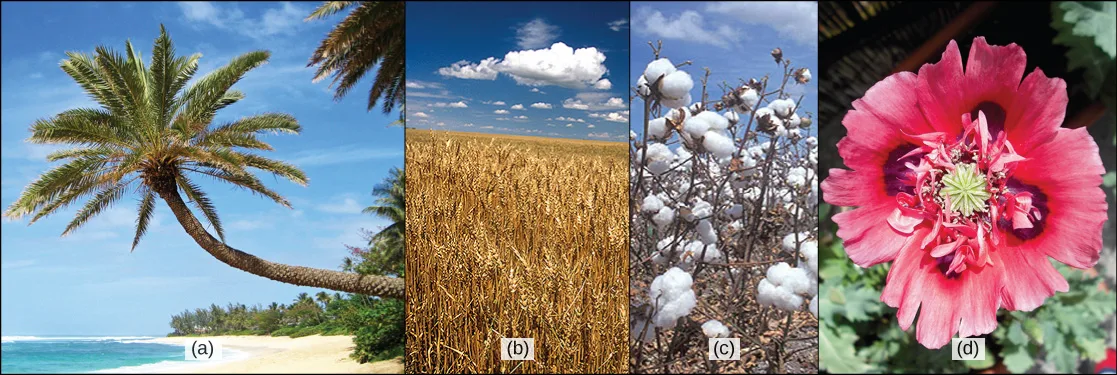
The lush palms on tropical shorelines do not depend on water for the dispersal of their pollen, fertilization, or the survival of the zygote—unlike mosses, liverworts, and ferns living within the same terrain. These palms are seed plants, which have broken free from the need to rely on water for their reproductive needs. The seed plants play an integral role in all aspects of life on the planet, shaping the physical terrain, influencing the climate, and maintaining life as we know it. For millennia, human societies have depended on seed plants for nutrition and medicinal compounds. Somewhat more recently, seed plants have served as a source of manufactured products such as timber and paper, dyes, and textiles. As an example, multiple uses have been found for each of the plants shown above. Palms provide materials including rattans, oils, and dates. Grains like wheat are grown to feed both human and animal populations or fermented to produce alcoholic beverages. The fruit of the cotton flower is harvested as a boll, with its fibers transformed into clothing or pulp for paper. The showy opium poppy is valued both as an ornamental flower and as a source of potent opiate compounds.
Sections
- Evolution of Seed Plants — the two innovations, pollen and the seed, that freed seed plants from needing water to reproduce, when seed plants arose and gymnosperms became dominant, and the significance of angiosperms bearing flowers and fruit.
- Gymnosperms — the naked seeds and other traits of gymnosperms, the geological era they dominated and the conditions they were adapted to, the four modern-day gymnosperm groups, and a typical gymnosperm life cycle.
- Angiosperms — why angiosperms dominate most terrestrial ecosystems, the parts of a flower and their functions, the angiosperm and gymnosperm life cycles, and the similarities and differences between monocots and eudicots.
- The Role of Seed Plants — how animal interactions like pollination have driven angiosperm diversity, the ways pollination occurs, and the roles plants play in ecosystems and the threat deforestation poses to plant biodiversity.
This chapter is adapted from Biology 2e, Chapter 26: Seed Plants by Mary Ann Clark, Jung Choi, Matthew Douglas, and OpenStax, © OpenStax, licensed under CC BY-NC-SA 4.0. Access the original for free at openstax.org. Each section page records its own changes from the source. Changes: the chapter-opening image is the source’s, re-encoded for the web, with its source alt kept since it already names each lettered panel; the source’s introduction paragraph refers to the figure only descriptively (“the plants shown above”), never by a print number, so no rendering change was needed there.