Gymnosperms
By the end of this section, you will be able to:
- Discuss the type of seeds produced by gymnosperms, as well as other characteristics of gymnosperms
- Identify the geological era dominated by the gymnosperms and describe the conditions to which they were adapted
- List the four groups of modern-day gymnosperms and provide examples of each
- Describe the life cycle of a typical gymnosperm
Gymnosperms, meaning “naked seeds,” are a diverse group of seed plants. According to the “anthophyte” hypothesis, the angiosperms are a sister group of one group of gymnosperms (the Gnetales), which makes the gymnosperms a paraphyletic group. Paraphyletic groups are those in which not all descendants of a single common ancestor are included in the group. However, the “netifer” hypothesis suggests that the gnetophytes are sister to the conifers, making the gymnosperms monophyletic and sister to the angiosperms. Further molecular and anatomical studies may clarify these relationships. Characteristics of the gymnosperms include naked seeds, separate female and male gametophytes, pollen cones and ovulate cones, pollination by wind and insects, and tracheids (which transport water and solutes in the vascular system).
Gymnosperm seeds are not enclosed in an ovary; rather, they are only partially sheltered by modified leaves called sporophylls. You may recall the term strobilus (plural = strobili) describes a tight arrangement of sporophylls around a central stalk, as seen in pine cones. Some seeds are enveloped by sporophyte tissues upon maturation. The layer of sporophyte tissue that surrounds the megasporangium, and later, the embryo, is called the integument.
Gymnosperms were the dominant phylum in the Mesozoic era. They are adapted to live where fresh water is scarce during part of the year, or in the nitrogen-poor soil of a bog. Therefore, they are still the prominent phylum in the coniferous biome or taiga, where the evergreen conifers have a selective advantage in cold and dry weather. Evergreen conifers continue low levels of photosynthesis during the cold months, and are ready to take advantage of the first sunny days of spring. One disadvantage is that conifers are more susceptible than deciduous trees to leaf infestations because most conifers do not lose their leaves all at once. They cannot, therefore, shed parasites and restart with a fresh supply of leaves in spring.
The life cycle of a gymnosperm involves alternation of generations, with a dominant sporophyte in which reduced male and female gametophytes reside. All gymnosperms are heterosporous. The male and female reproductive organs can form in cones or strobili. Male and female sporangia are produced either on the same plant, described as monoecious (“one home” or bisexual), or on separate plants, referred to as dioecious (“two homes” or unisexual) plants. The life cycle of a conifer will serve as our example of reproduction in gymnosperms.
Life Cycle of a Conifer
Pine trees are conifers (coniferous = cone bearing) and carry both male and female sporophylls on the same mature sporophyte. Therefore, they are monoecious plants. Like all gymnosperms, pines are heterosporous and generate two different types of spores (male microspores and female megaspores). Male and female spores develop in different strobili, with small male cones and larger female cones. In the male cones, or staminate cones, the microsporocytes undergo meiosis and the resultant haploid microspores give rise to male gametophytes or “pollen grains” by mitosis. Each pollen grain consists of just a few haploid cells enclosed in a tough wall reinforced with sporopollenin. In the spring, large amounts of yellow pollen are released and carried by the wind. Some gametophytes will land on a female cone. Pollination is defined as the initiation of pollen tube growth. The pollen tube develops slowly, and the generative cell in the pollen grain produces two haploid sperm or generative nuclei by mitosis. At fertilization, one of the haploid sperm nuclei will unite with the haploid nucleus of an egg cell.
Female cones, or ovulate cones, contain two ovules per scale. Each ovule has a narrow passage that opens near the base of the sporophyll. This passage is the micropyle, through which a pollen tube will later grow. One megaspore mother cell, or megasporocyte, undergoes meiosis in each ovule. Three of the four cells break down; only a single surviving cell will develop into a female multicellular gametophyte, which encloses archegonia (an archegonium is a reproductive organ that contains a single large egg). As the female gametophyte begins to develop, a sticky pollination drop traps windblown pollen grains near the opening of the micropyle. A pollen tube is formed and grows toward the developing gametophyte. One of the generative or sperm nuclei from the pollen tube will enter the egg and fuse with the egg nucleus as the egg matures. Upon fertilization, the diploid egg will give rise to the embryo, which is enclosed in a seed coat of tissue from the parent plant. Although several eggs may be formed and even fertilized, there is usually a single surviving embryo in each ovule. Fertilization and seed development is a long process in pine trees: it may take up to two years after pollination. The seed that is formed contains three generations of tissues: the seed coat that originates from the sporophyte tissue, the gametophyte tissue that will provide nutrients, and the embryo itself.
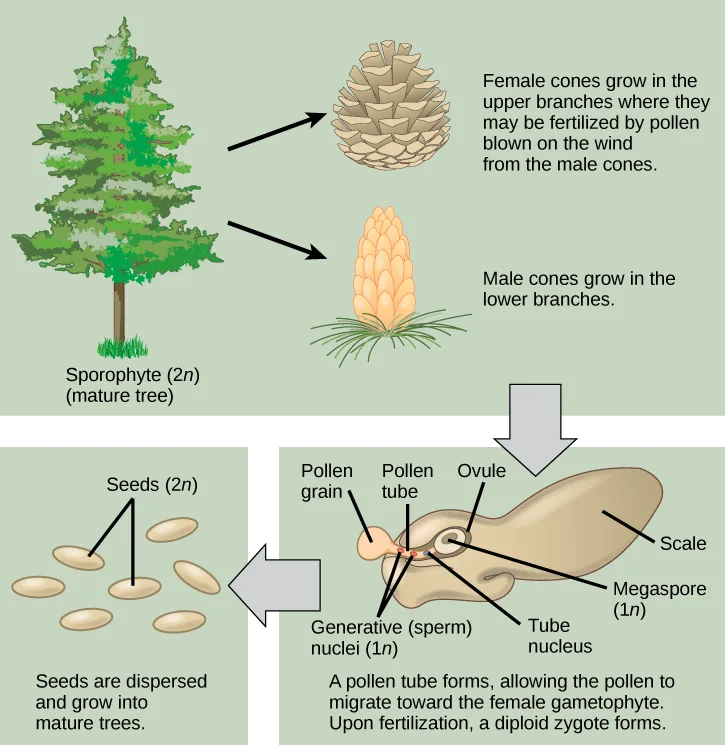
The figure below illustrates the life cycle of a conifer. The sporophyte (2n) phase is the longest phase in the life of a gymnosperm. The gametophytes (1n)—produced by microspores and megaspores—are reduced in size. It may take more than a year between pollination and fertilization while the pollen tube grows towards the growing female gametophyte (1n), which develops from a single megaspore. The slow growth of the pollen tube allows the female gametophyte time to produce eggs (1n).
Extended description
Three panels — one wide panel across the top and two below — read clockwise starting at the top. Top panel: a mature pine tree labeled ‘Sporophyte (2n) (mature tree),’ with two black arrows pointing right — the upper arrow to a rounded, scaly female cone captioned ‘Female cones grow in the upper branches where they may be fertilized by pollen blown on the wind from the male cones,’ and the lower arrow to an elongated, cream-colored male cone captioned ‘Male cones grow in the lower branches.’ A large gray arrow points down from this panel to the lower-right panel: a cutaway of a cone scale labeled, left to right, ‘Pollen grain,’ ‘Pollen tube,’ and ‘Ovule,’ with ‘Generative (sperm) nuclei (1n)’ and ‘Tube nucleus’ naming structures inside the pollen tube, ‘Megaspore (1n)’ inside the ovule, and ‘Scale’ naming the woody structure itself; captioned ‘A pollen tube forms, allowing the pollen to migrate toward the female gametophyte. Upon fertilization, a diploid zygote forms.’ A second gray arrow points left from this panel to the lower-left panel: a scatter of oval seeds labeled ‘Seeds (2n),’ captioned ‘Seeds are dispersed and grow into mature trees’ — closing the cycle back to the mature tree at upper left.
At what stage does the diploid zygote form?
Look for the step in the diagram where the male nucleus carried by the pollen tube finally reaches and combines with the female nucleus.Diversity of Gymnosperms
Modern gymnosperms are classified into four phyla. Coniferophyta, Cycadophyta, and Ginkgophyta are similar in their pattern of seed development and also in their production of secondary cambium (cells that generate the vascular system of the trunk or stem and are partially specialized for water transportation). However, the three phyla are not closely related phylogenetically to each other. Gnetophyta are considered the closest group to angiosperms because they produce true xylem tissue, with vessels as well as the tracheids found in the rest of the gymnosperms. It is possible that vessel elements arose independently in the two groups.
Conifers (Coniferophyta)
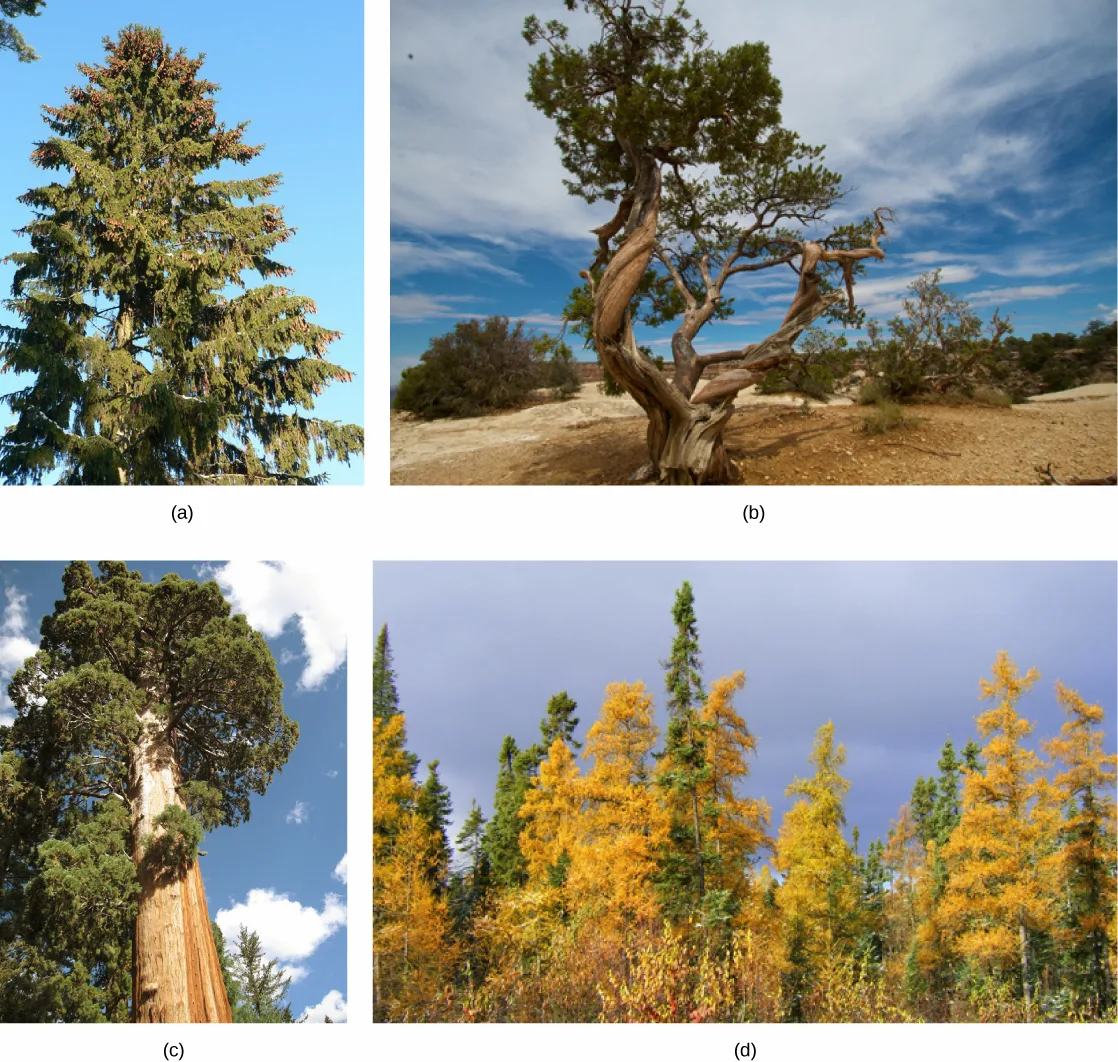
Conifers are the dominant phylum of gymnosperms, with the greatest variety of species (pictured below). Typical conifers are tall trees that bear scale-like or needle-like leaves. Water evaporation from leaves is reduced by their narrow shape and a thick cuticle. Snow easily slides off needle-shaped leaves, keeping the snow load light, thus reducing broken branches. Such adaptations to cold and dry weather explain the predominance of conifers at high altitudes and in cold climates. Conifers include familiar evergreen trees such as pines, spruces, firs, cedars, sequoias, and yews. A few species are deciduous and lose their leaves in fall. The bald cypress, dawn redwood, European larch and the tamarack (panel d, below) are examples of deciduous conifers. Many coniferous trees are harvested for paper pulp and timber. The wood of conifers is more primitive than the wood of angiosperms; it contains tracheids, but no vessel elements, and is therefore referred to as “soft wood.”
Cycads
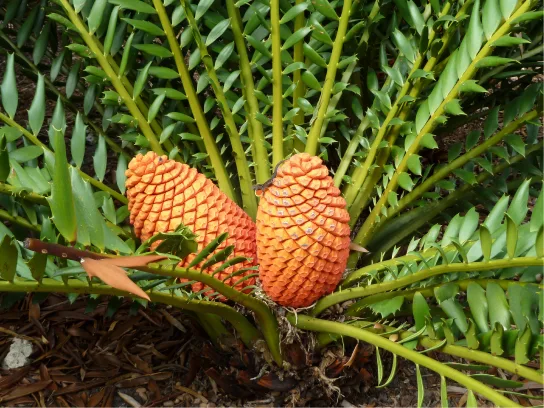
Cycads thrive in mild climates, and are often mistaken for palms because of the shape of their large, compound leaves. Cycads bear large strobili or cones (pictured below), and may be pollinated by beetles rather than wind, which is unusual for a gymnosperm. Large cycads dominated the landscape during the age of dinosaurs in the Mesozoic, but only a hundred or so smaller species persisted to modern times. They face possible extinction, and several species are protected through international conventions. Because of their attractive shape, they are often used as ornamental plants in gardens in the tropics and subtropics.
Ginkgophytes
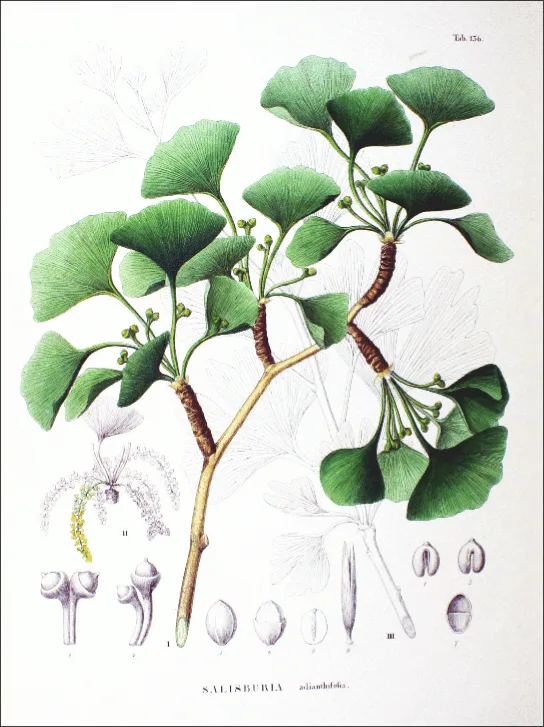
The single surviving species of the ginkgophytes group is Ginkgo biloba (pictured below). Its fan-shaped leaves—unique among seed plants because they feature a dichotomous venation pattern—turn yellow in autumn and fall from the tree. For centuries, G. biloba was cultivated by Chinese Buddhist monks in monasteries, which ensured its preservation. It is planted in public spaces because it is unusually resistant to pollution. Male and female organs are produced on separate plants. Typically, gardeners plant only male trees because the seeds produced by the female plant have an off-putting smell of rancid butter.
Gnetophytes
The phylogenetic position of the gnetophytes is not currently resolved. Their possession of vessel elements suggests they are the closest relative to modern angiosperms. However, molecular analysis places them closer to the conifers. The three living genera are quite dissimilar: Ephedra, Gnetum, and Welwitschia (pictured below), which may indicate that the group is not monophyletic. Like angiosperms, they have broad leaves. Ephedra (panel a, below) occurs in dry areas of the West Coast of the United States and Mexico. Ephedra’s small, scale-like leaves are the source of the compound ephedrine, which is used in medicine as a potent decongestant. Because ephedrine is similar to amphetamines, both in chemical structure and neurological effects, its use is restricted to prescription drugs. Gnetum species (panel b, below) are found in some parts of Africa, South America, and Southeast Asia, and include trees, shrubs and vines. Welwitschia (panel c, below) is found in the Namib desert, and is possibly the oddest member of the group. It produces only two leaves, which grow continuously throughout the life of the plant (some plants are hundreds of years old). Like the ginkgos, Welwitschia produces male and female gametes on separate plants.
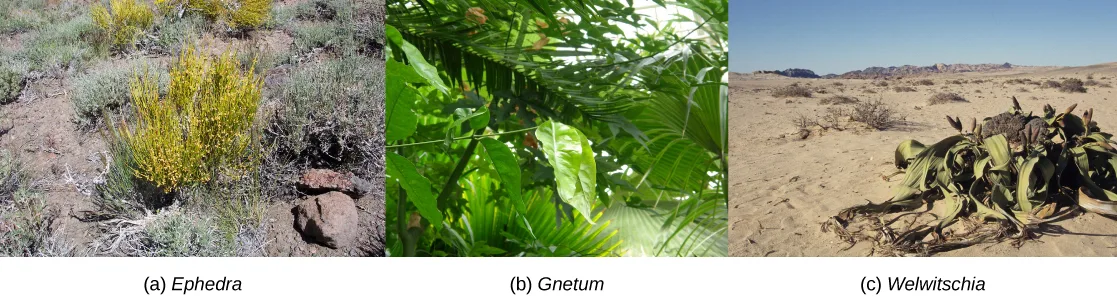
Summary
Gymnosperms are heterosporous seed plants that produce naked seeds. They appeared in the Paleozoic period and were the dominant plant life during the Mesozoic. Modern-day gymnosperms belong to four phyla. The largest phylum, Coniferophyta, is represented by conifers, the predominant plants at high altitude and latitude. Cycads (phylum Cycadophyta) resemble palm trees and grow in tropical climates. Ginkgophyta is represented today by a single species, Ginkgo biloba. The last phylum, Gnetophyta, is a diverse group of plants that produce vessel elements in their wood.
Key terms
- conifer — dominant phylum of gymnosperms with the greatest variety of trees.
- cycad — gymnosperm that grows in tropical climates and resembles a palm tree; member of the phylum Cycadophyta.
- dioecious — describes a species in which the male and female reproductive organs are carried on separate specimens.
- ginkgophyte — gymnosperm with one extant species, the Ginkgo biloba: a tree with fan-shaped leaves.
- gnetophyte — gymnosperm shrub with varied morphological features that produces vessel elements in its woody tissues; the phylum includes the genera Ephedra, Gnetum, and Welwitschia.
- gymnosperm — seed plant with naked seeds (seeds exposed on modified leaves or in cones).
- integument — layer of sporophyte tissue that surrounds the megasporangium, and later, the embryo.
- megasporocyte — megaspore mother cell; the diploid cell that undergoes meiosis to produce the megaspores, one of which develops into the female gametophyte in a heterosporous plant. (Source note: the source glossary calls it a spore; this section’s own text says the megasporocyte undergoes meiosis to produce the spores.)
- microsporocyte — microspore mother cell; the diploid cell that undergoes meiosis to produce the microspores, which develop into male gametophytes in a heterosporous plant. (Source note: the source glossary calls it a spore; this section’s own text says the microsporocytes undergo meiosis and the resulting microspores give rise to the male gametophytes.)
- monoecious — describes a species in which the male and female reproductive organs are on the same plant.
- ovulate cone — cone containing two ovules per scale.
- paraphyletic group — not all descendants of a single common ancestor are included in the group.
- strobilus — plant structure with a tight arrangement of sporophylls around a central stalk, as seen in cones or flowers; the male strobilus produces pollen, and the female strobilus produces eggs.
Practice
Discuss the type of seeds produced by gymnosperms, as well as other characteristics of gymnosperms
Which of the following traits characterizes gymnosperms?
Angiosperms, not gymnosperms, have flowers whose ovaries thicken into fruit after fertilization — rule those two options out first.A seed plant with naked seeds exposed on modified leaves or in cones is called a(n) ________.
Its name comes from the Greek for “naked seed.”The layer of sporophyte tissue that surrounds the megasporangium, and later the embryo, is called the ________.
This tissue layer becomes part of the mature seed coat.A tight arrangement of sporophylls around a central stalk, as seen in cones, is called a ________.
Pine cones are a familiar example of this structure.Identify the geological era dominated by the gymnosperms and describe the conditions to which they were adapted
In the northern forests of Siberia, a tall tree is most likely a:
Cold, dry taiga forests favor the phylum whose thick cuticle and needle-shaped leaves reduce water loss and shed snow easily.The Mediterranean landscape along the sea shore is dotted with pines and cypresses. The weather is not cold, and the trees grow at sea level. What evolutionary adaptation of conifers makes them suitable to the Mediterranean climate?
Show model answer
Did your answer mention:
Gymnosperms appeared in the ________ period and were the dominant plant life during the Mesozoic era.
This era comes before the Mesozoic, during which the gymnosperms’ dominance later peaked.List the four groups of modern-day gymnosperms and provide examples of each
What are the four modern-day phyla of gymnosperms?
Show model answer
Did your answer mention:
The dominant phylum of gymnosperms with the greatest variety of trees is called the ________.
This phylum includes pines, spruces, firs, cedars, sequoias, and yews.A gymnosperm that grows in tropical climates and resembles a palm tree, and belongs to the phylum Cycadophyta, is called a(n) ________.
Its large cones may be pollinated by beetles instead of wind, which is unusual for a gymnosperm.A gymnosperm of the group that has only one extant species, a tree with fan-shaped leaves, is called a(n) ________.
Its one living species is cultivated in monasteries and city parks partly for its resistance to pollution.Describe the life cycle of a typical gymnosperm
Megasporocytes will eventually produce which of the following?
Megasporocytes are the mother cells of the megaspores, the larger of the gymnosperm’s two spore types.What is the ploidy of the following structures: gametophyte, seed, spore, sporophyte?
The gametophyte and the spore it germinates from share the same ploidy; the seed encloses the embryo, whose ploidy matches the sporophyte’s.A species in which the male and female reproductive organs are carried on the same plant is called ________.
Pine trees, which carry both male and female cones on one mature sporophyte, are an example.A species in which the male and female reproductive organs are carried on separate plants is called ________.
Ginkgo biloba and Welwitschia, whose male and female organs grow on different individuals, are examples of this kind of species.The diploid mother cell that undergoes meiosis inside the ovule to produce the large spores of a heterosporous plant is called a ________.
This is the larger of the two mother cells; the smaller one, which produces male gametophytes, is prefixed ‘micro-’ instead.This section is adapted from Biology 2e, Section 26.2: Gymnosperms by Mary Ann Clark, Jung Choi, Matthew Douglas, and OpenStax, © OpenStax, licensed under CC BY-NC-SA 4.0. Access the original for free at openstax.org. Changes: figures re-encoded as WebP; Figure_26_02_04 re-kinded from the manifest’s file-extension “photo” guess to “diagram” after inspection (it is a colored 19th-century botanical illustration plate, not a captured photograph); a longdesc added to the conifer life-cycle diagram (Figure_26_02_01) walking its three panels, its four arrows, and its ploidy labels in the clockwise reading order the arrows draw, since neither the caption nor the source alt carries the panel layout or the labeled structures; the two interactive notes (a seed-production video, a Welwitschia video) rendered as Link to Learning callouts with descriptive link text in place of the source’s bare “Watch this video”; the Visual Connection note rendered as its figure followed by a multiple choice, kept in the body; the end-of-section Review Questions and Critical Thinking Questions adapted into the closing interactive Practice block (multiple choice and self-check respectively); rubric checkpoints added to each self-check, decomposing its model answer (the source solution) into check-off clauses with no new claims; nine key-term recall items (gymnosperm, integument, strobilus, conifer, cycad, ginkgophyte, monoecious, dioecious, megasporocyte) added from the glossary to round out each objective’s group; and one summary-derived cloze textin added under the second objective, naming the Paleozoic period from the section summary’s own sentence, since the module’s single Critical Thinking item for that objective left the group under the book’s floor; the gnetophyte figure’s source alt describes the Welwitschia crown as bearing “pink buds”, which the photograph does not show (its crown carries brown, dry, cone-like growths) — the alt here describes what is visible, and the source alt is reported as a defect (erratum 319). Two key terms are corrected with visible Source notes: the megasporocyte and microsporocyte are the diploid mother cells that undergo meiosis to make spores, as the section’s own text says, not spores themselves (erratum 423).