Animal Phylogeny
By the end of this section, you will be able to:
- Interpret the metazoan phylogenetic tree
- Describe the types of data that scientists use to construct and revise animal phylogeny
- List some of the relationships within the modern phylogenetic tree that have been discovered as a result of modern molecular data
Biologists strive to understand the evolutionary history and relationships of members of the animal kingdom, and all of life, for that matter. The study of phylogeny (the branching sequence of evolution) aims to determine the evolutionary relationships between phyla. Currently, most biologists divide the animal kingdom into 35 to 40 phyla. Scientists develop phylogenetic trees, which serve as hypotheses about which species have evolved from which ancestors.
Recall that until recently, only morphological characteristics and the fossil record were used to determine phylogenetic relationships among animals. Scientific understanding of the distinctions and hierarchies between anatomical characteristics provided much of this knowledge. Used alone, however, this information can be misleading. Morphological characteristics (such as skin color, body shape, etc.) may evolve multiple times, and independently, through evolutionary history. Analogous characteristics may appear similar between animals, but their underlying evolution may be very different. With the advancement of molecular technologies, modern phylogenetics is now informed by genetic and molecular analyses, in addition to traditional morphological and fossil data. With a growing understanding of genetics, the animal evolutionary tree has changed substantially and continues to change as new DNA and RNA analyses are performed on additional animal species.
Constructing an Animal Phylogenetic Tree
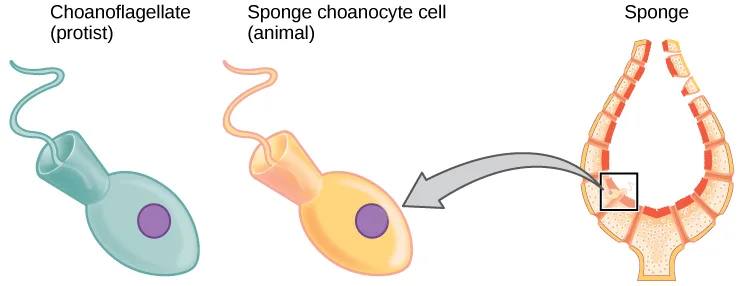
The current understanding of evolutionary relationships among animal, or Metazoa, phyla begins with the distinction between animals with true differentiated tissues, called Eumetazoa, and animal phyla that do not have true differentiated tissues, such as the sponges (Porifera) and the Placozoa. Similarities between the feeding cells of sponges (choanocytes) and choanoflagellate protists (pictured below) have been used to suggest that Metazoa evolved from a common ancestral organism that resembled the modern colonial choanoflagellates.
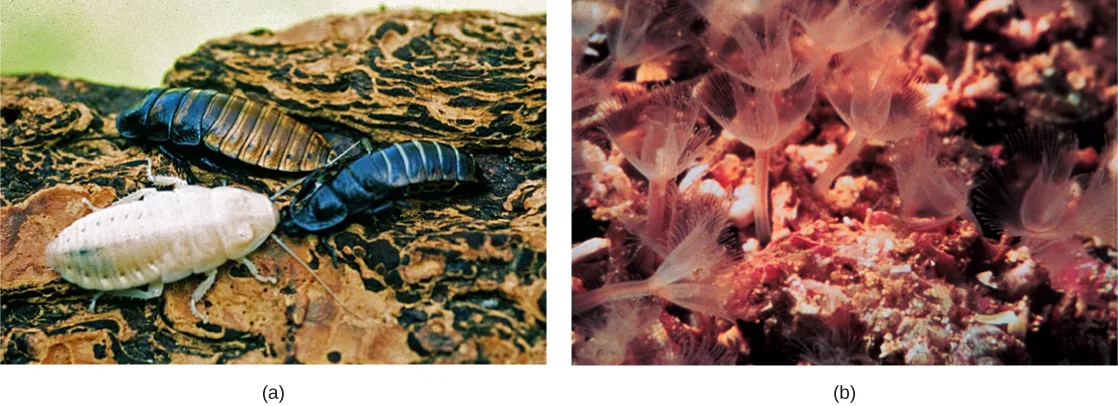
Eumetazoa are subdivided into radially symmetrical animals and bilaterally symmetrical animals, and are thus classified into the clades Bilateria and Radiata, respectively. As mentioned earlier, the cnidarians and ctenophores are animal phyla with true radial, biradial, or rotational symmetry. All other Eumetazoa are members of the Bilateria clade. The bilaterally symmetrical animals are further divided into deuterostomes (including chordates and echinoderms) and two distinct clades of protostomes (including ecdysozoans and lophotrochozoans, pictured below). Ecdysozoa includes nematodes and arthropods; they are so named for a commonly found characteristic among the group: the physiological process of exoskeletal molting followed by the “stripping” of the outer cuticular layer, called ecdysis. Lophotrochozoa is named for two structural features, each common to certain phyla within the clade. Some lophotrochozoan phyla are characterized by a larval stage called trochophore larvae, and other phyla are characterized by the presence of a feeding structure called a lophophore (thus, the shorter term, “lopho-trocho-zoa”).
Link to Learning
Explore an interactive tree of life here. Zoom in and out and click to learn more about the organisms and their evolutionary relationships.
Modern Advances in Phylogenetic Understanding Come from Molecular Analyses
The phylogenetic groupings are continually being debated and refined by evolutionary biologists. Each year, new evidence emerges that further alters the relationships described by a phylogenetic tree diagram.
Nucleic acid and protein analyses have greatly modified and refined the modern phylogenetic animal tree. These data come from a variety of molecular sources, such as mitochondrial DNA, nuclear DNA, ribosomal RNA (rRNA), and certain cellular proteins. Many evolutionary relationships in the modern tree have only recently been determined from the molecular evidence. For example, a previously classified group of animals called lophophorates, which included brachiopods and bryozoans, were long-thought to be primitive deuterostomes. Extensive molecular analysis using rRNA data found these animals are actually protostomes, more closely related to annelids and mollusks. This discovery allowed for the distinction of the protostome clade Lophotrochozoa. Molecular data have also shed light on some differences within the lophotrochozoan group, and the placement of the Platyhelminthes is particularly problematic. Some scientists believe that the phyla Platyhelminthes and Rotifera should actually belong to their own clade of protostomes termed Platyzoa.
Molecular research similar to the discoveries that brought about the distinction of the lophotrochozoan clade has also revealed a dramatic rearrangement of the relationships between mollusks, annelids, arthropods, and nematodes, and as a result, a new ecdysozoan clade was formed. Due to morphological similarities in their segmented body types, annelids and arthropods were once thought to be closely related. However, molecular evidence has revealed that arthropods are actually more closely related to nematodes, now comprising the ecdysozoan clade, and annelids are more closely related to mollusks, brachiopods, and other phyla in the lophotrochozoan clade. These two clades now make up the protostomes.
Another change to former phylogenetic groupings because of modern molecular analyses includes the emergence of an entirely new phylum of worm called Acoelomorpha. These acoel flatworms were long thought to belong to the phylum Platyhelminthes because of their similar “flatworm” morphology. However, molecular analyses revealed this to be a false relationship and originally suggested that acoels represented living species of some of the earliest divergent bilaterians. More recent research into the acoelomorphs has called this hypothesis into question and suggested that the acoels are more closely related to deuterostomes. The placement of this new phylum remains disputed, but scientists agree that with sufficient molecular data, their true phylogeny will be determined.
Another example of phylogenetic reorganization involves the identification of the Ctenophora as the basal clade of the animal kingdom. Ctenophora, or comb jellies, were once considered to be a sister group of the Cnidaria, and the sponges (Porifera) were placed as the basal animal group, sister to other animals. The presence of nerve and muscle cells in both the Ctenophores and the Cnidaria and their absence in the Porifera strengthened this view of the relationships among simple animal forms. However, recent molecular analysis has shown that many of the genes that support neural development in other animals are absent from the Ctenophore genome. The muscle cells are restricted to the mouth and tentacles and are derived from cells in the mesoglea. The mitochondrial genome of the Ctenophores is small and lacks many genes found in other animal mitochondrial genomes. These features plus the absence of Hox genes from the Ctenophores have been used to argue that the Ctenophores should be considered basal or as a sister group of the Porifera, and that the evolution of specialized nerve and muscle tissue may have occurred more than once in the history of animal life. Although Ctenophores have been shown as basal to other animals in the phylogeny presented earlier in this chapter, debate on this issue is likely to continue as Ctenophores are more closely studied.
Changes to the phylogenetic tree can be difficult to track and understand, and are evidence of the process of science. Data and analytical methods play a significant role in the development of phylogenies. For this reason – because molecular analysis and reanalysis are not complete – we cannot necessarily dismiss a former phylogenetic tree as inaccurate. A recent reanalysis of molecular evidence by an international group of evolutionary biologists refuted the proposition that comb jellies are the phylogenetically oldest extant metazoan group. The study, which relied on more sophisticated methods of analyzing the original genetic data, reaffirms the traditional view that the sponges were indeed the first phylum to diverge from the common ancestor of metazoans. The ongoing discussion concerning the location of sponges and comb jellies on the animal “family tree” is an example of what drives science forward.
Summary
Scientists are interested in the evolutionary history of animals and the evolutionary relationships among them. There are three main sources of data that scientists use to create phylogenetic evolutionary tree diagrams that illustrate such relationships: morphological information (which includes developmental morphologies), fossil record data, and, most recently, molecular data. The details of the modern phylogenetic tree change frequently as new data are gathered, and molecular data has recently contributed to many substantial modifications of the understanding of relationships between animal phyla.
Key terms
- Ecdysozoa — clade of protostomes that exhibit exoskeletal molting (ecdysis).
- Eumetazoa — group of animals with true differentiated tissues.
- Lophotrochozoa — clade of protostomes that exhibit a trochophore larvae stage or a lophophore feeding structure.
- Metazoa — group containing all animals.
- Parazoa — group of animals without true differentiated tissues.
Practice
Interpret the metazoan phylogenetic tree
Consulting the modern phylogenetic tree of animals, which of the following would not constitute a clade?
A clade must contain a common ancestor and every one of its descendants; the Eumetazoa clade splits into exactly the other three groups listed, so one of the four options falls outside Eumetazoa altogether.The group containing all animals is called ________.
This is the formal name for the animal kingdom as a whole, from sponges to chordates, before it is split into any smaller clades.The group of animals with true differentiated tissues is called ________.
This subgroup of the animal kingdom excludes the sponges and the Placozoa, which lack this feature.The group of animals without true differentiated tissues is called ________.
Sponges belong to this group, which sits outside the clade of animals with true tissues.Describe the types of data that scientists use to construct and revise animal phylogeny
As with the emergence of the Acoelomorpha phylum, it is common for ____ data to misplace animals in close relation to other species, whereas ____ data often reveals a different and more accurate evolutionary relationship.
Recall which category of evidence grouped the acoel flatworms with the true flatworms by outward appearance alone, and which category of evidence later distinguished them as their own phylum.How is it that morphological data alone might lead scientists to group animals into erroneous evolutionary relationships?
Show model answer
Did your answer mention:
Morphological information, fossil record data, and, most recently, ________ are the three main sources of data scientists use to construct phylogenetic tree diagrams.
This newest of the three sources draws on DNA, RNA, and protein comparisons rather than anatomy or preserved remains.List some of the relationships within the modern phylogenetic tree that have been discovered as a result of modern molecular data
Which of the following is thought to be the most closely related to the common animal ancestor?
Bacteria are prokaryotes, and fungi and plants have body plans very different from a single flagellated cell; think about which domain’s single-celled organisms this feeding cell most resembles.Describe at least two major changes to the animal phylogenetic tree that have come about due to molecular or genetic findings.
Show model answer
Did your answer mention:
The clade of protostomes whose members periodically shed and replace their exoskeleton is called ________.
This clade includes the nematodes and the arthropods.The clade of protostomes whose members have a trochophore larval stage or a lophophore feeding structure is called ________.
This clade’s name combines the terms for its two defining structures, one larval and one an adult feeding organ.This section is adapted from Biology 2e, Section 27.3: Animal Phylogeny by Mary Ann Clark, Jung Choi, Matthew Douglas, and OpenStax, © OpenStax, licensed under CC BY-NC-SA 4.0. Access the original for free at openstax.org. Changes: figures re-encoded as WebP; Figure_27_03_01 re-kinded from the manifest’s file-extension “photo” guess to kind="diagram" (it is a hand-drawn, labeled comparison illustration, not a photograph), and its alt rewritten from the source’s own alt — which said “the two cells appear identical” and named only two images and misspelled “protist” as “protest” — to describe all three drawn elements (the choanoflagellate, the isolated choanocyte, and the sponge cross-section with its highlighted cell and connecting arrow); the two interactive Link to Learning notes rendered as callouts with descriptive link text in place of the source’s bare “tree” and “video”; the module’s internal cross-reference to “Chapter 27.2” (a <link> with no visible section number, rendered here as “the phylogeny presented earlier in this chapter” since sections are not cross-referenced by number in this build) reworded accordingly; the end-of-section Review Questions and Critical Thinking Questions adapted into the closing interactive Practice block (multiple choice and self-check respectively); rubric checkpoints added to each self-check, decomposing its model answer (the source solution) into check-off clauses with no new claims; the module has no Visual Connection item; five key-term recall items (Ecdysozoa, Eumetazoa, Lophotrochozoa, Metazoa, Parazoa) added from the glossary, and one cloze text-in built from the Section Summary’s sentence naming the three sources of phylogenetic data, to round out the second objective’s group; the opening paragraph’s parenthetical cross-reference to the animal phylogeny figure of the previous section (a figure this page does not carry) dropped.