The Evolutionary History of the Animal Kingdom
By the end of this section, you will be able to:
- Describe the features that characterized the earliest animals and approximately when they appeared on earth
- Explain the significance of the Cambrian period for animal evolution and the changes in animal diversity that took place during that time
- Describe some of the unresolved questions surrounding the Cambrian explosion
- Discuss the implications of mass animal extinctions that have occurred in evolutionary history
Many questions regarding the origins and evolutionary history of the animal kingdom continue to be researched and debated, as new fossil and molecular evidence change prevailing theories. Some of these questions include the following: How long have animals existed on Earth? What were the earliest members of the animal kingdom, and what organism was their common ancestor? While animal diversity increased during the Cambrian period of the Paleozoic era, 530 million years ago, modern fossil evidence suggests that primitive animal species existed much earlier.
Pre-Cambrian Animal Life
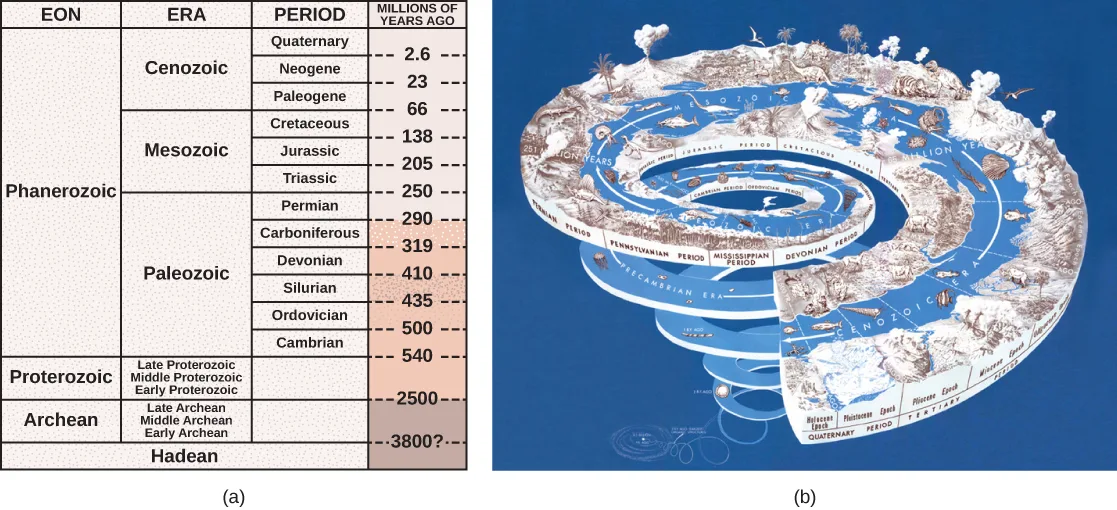
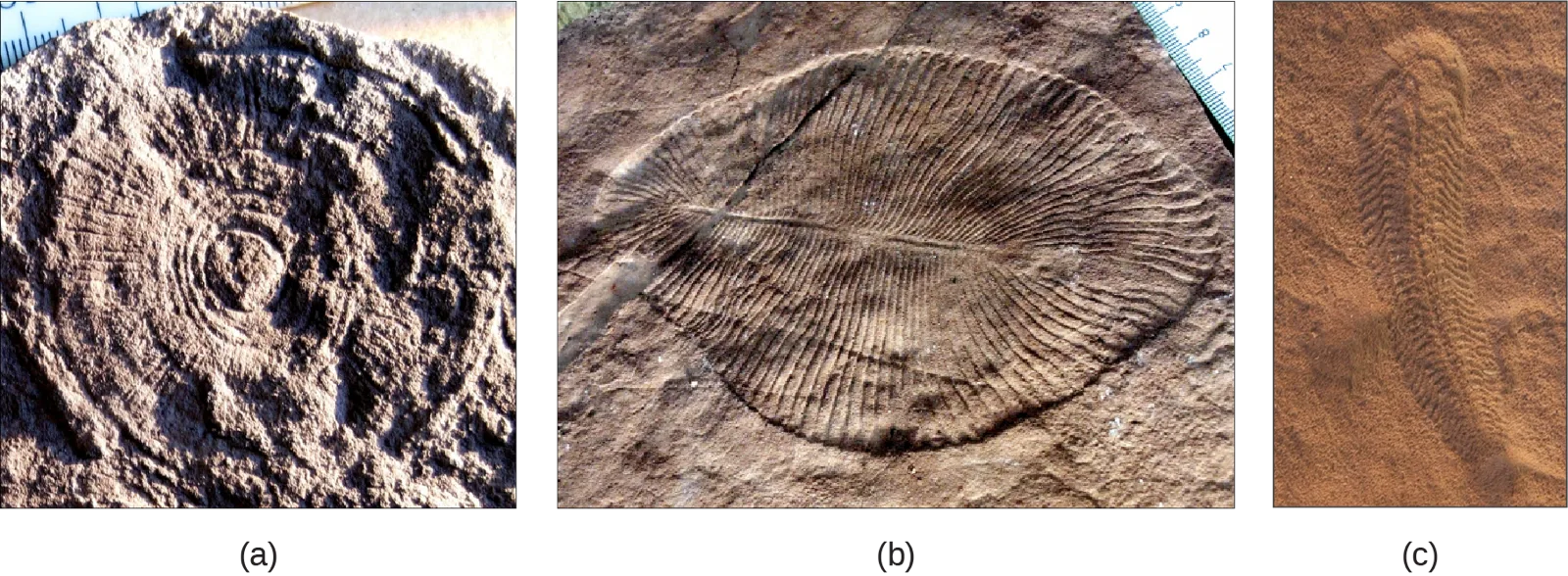
The time before the Cambrian period is known as the Ediacaran Period (from about 635 million years ago to 543 million years ago), the final period of the late Proterozoic Neoproterozoic Era (below). Ediacaran fossils were first found in the Ediacaran hills of Southern Australia. There are no living representatives of these species, which have left impressions that look like those of feathers or coins (below). It is believed that early animal life, termed Ediacaran biota, evolved from protists at this time.
Extended description
Panel (a) is a four-column table: Eon, Era, Period, and Millions of Years Ago. Reading bottom to top: the Hadean eon (no era or period given, boundary about 3,800? million years ago), then the Archean eon, divided into Early, Middle, and Late Archean eras (boundary 2,500 million years ago), then the Proterozoic eon, divided into Early, Middle, and Late Proterozoic eras (boundary 540 million years ago), then the Phanerozoic eon, split into three eras that are further divided into periods: the Paleozoic era holds the Cambrian (540), Ordovician (500), Silurian (435), Devonian (410), Carboniferous (319), and Permian (290) periods; the Mesozoic era holds the Triassic (250), Jurassic (205), and Cretaceous (138) periods; and the Cenozoic era holds the Paleogene (66), Neogene (23), and Quaternary (2.6) periods at the top. Panel (b) draws the same span as a spiral ramp that widens as it winds upward from a Precambrian band near the center through labeled Paleozoic, Mesozoic, and Cenozoic bands to the Quaternary at the outer top; small illustrations of algae, early invertebrates, fish, plants, dinosaurs, and mammals sit along the ramp in the order they arose, growing more numerous and varied toward the top.
Most Ediacaran biota were just a few mm or cm long, but some of the feather-like forms could reach lengths of over a meter. Recently there has been increasing scientific evidence suggesting that more varied and complex animal species lived during this time, and likely even before the Ediacaran period.
Fossils believed to represent the oldest animals with hard body parts were recently discovered in South Australia. These sponge-like fossils, named Coronacollina acula, date back as far as 560 million years, and are believed to show the existence of hard body parts and spicules that extended 20–40 cm from the thimble-shaped body (estimated about 5 cm long). Other fossils from the Ediacaran period are shown below.
Another recent fossil discovery may represent the earliest animal species ever found. While the validity of this claim is still under investigation, these primitive fossils appear to be small, one-centimeter long, sponge-like creatures, irregularly shaped and with internal tubes or canals. These ancient fossils from South Australia date back 650 million years, actually placing the putative animal before the great ice age that marked the transition between the Cryogenian period and the Ediacaran period. Until this discovery, most scientists believed that there was no animal life prior to the Ediacaran period. Many scientists now believe that animals may in fact have evolved during the Cryogenian period.
The Cambrian Explosion of Animal Life
If the fossils of the Ediacaran and Cryogenian periods are enigmatic, those of the following Cambrian period are far less so, and include body forms similar to those living today. The Cambrian period, occurring between approximately 542–488 million years ago, marks the most rapid evolution of new animal phyla and animal diversity in Earth’s history. The rapid diversification of animals that appeared during this period, including most of the animal phyla in existence today, is often referred to as the Cambrian explosion (below). Animals resembling echinoderms, mollusks, worms, arthropods, and chordates arose during this period. What may have been a top predator of this period was an arthropod-like creature named Anomalocaris, over a meter long, with compound eyes and spiky tentacles. Obviously, all these Cambrian animals already exhibited complex structures, so their ancestors must have existed much earlier.
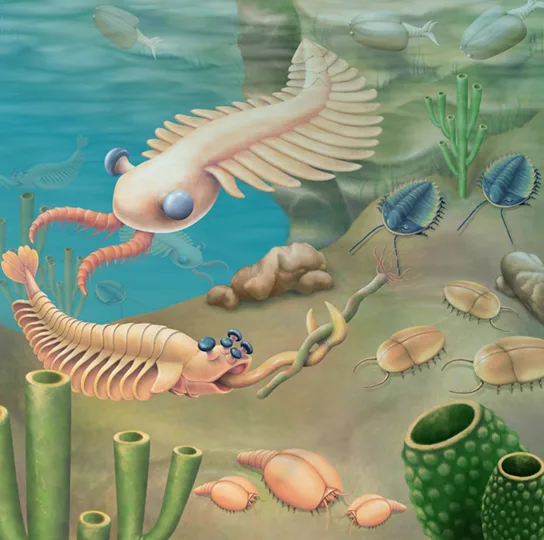
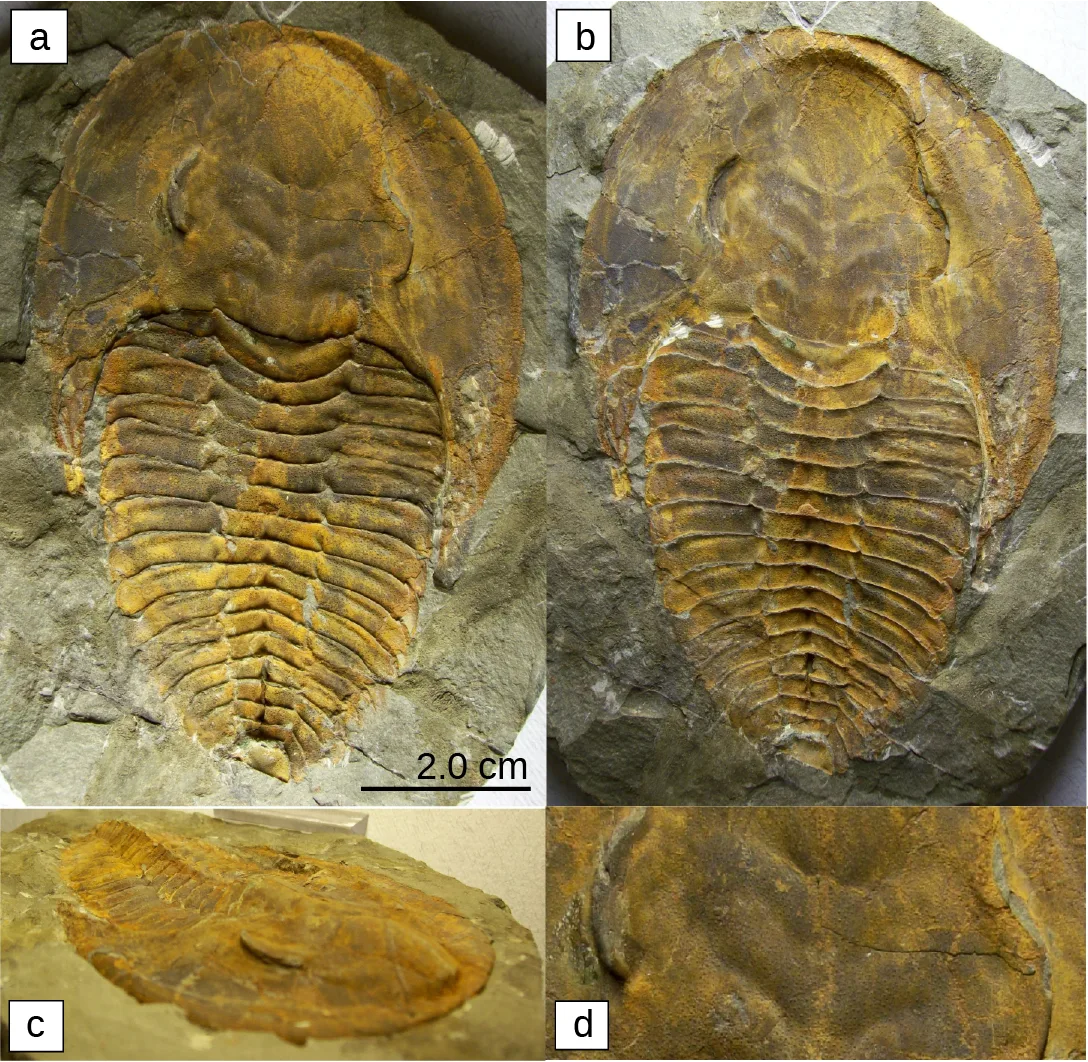
One of the most dominant species during the Cambrian period was the trilobite, an arthropod that was among the first animals to exhibit a sense of vision (below). Trilobites were somewhat similar to modern horseshoe crabs. Thousands of different species have been identified in fossil sediments of the Cambrian period; not a single species survives today.
Extended description
Panel (a): a teardrop-shaped trilobite fossil roughly twice as long as wide, with a wide, rounded head shield at the top tapering to a pointed tail, its midsection carrying about twenty fine horizontal rib segments; a 2.0 cm scale bar sits at lower right. Panel (b): a similar but slightly narrower trilobite fossil with the same head-shield-to-tapering-tail shape and rib count, on similar gray rock. Panel (c): a smaller, more oval trilobite fossil lying on a lighter tan rock slab, its ribbing visible but less distinct than in (a) and (b). Panel (d): a close, magnified crop of a trilobite’s ribbed midsection — textured, but too blurred to make out individual segments clearly.
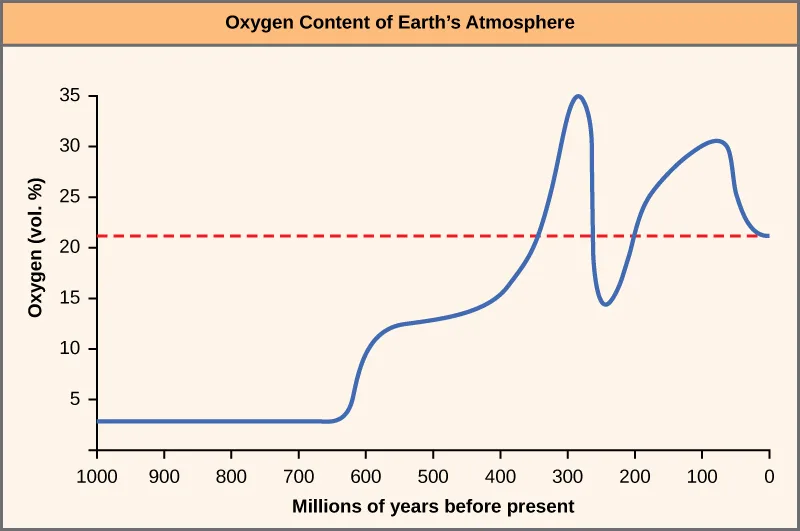
The cause of the Cambrian explosion is still debated, and in fact, it may be that a number of interacting causes ushered in this incredible explosion of animal diversity. For this reason, there are a number of hypotheses that attempt to answer this question. Environmental changes may have created a more suitable environment for animal life. Examples of these changes include rising atmospheric oxygen levels (below) and large increases in oceanic calcium concentrations that preceded the Cambrian period. Some scientists believe that an expansive, continental shelf with numerous shallow lagoons or pools provided the necessary living space for larger numbers of different types of animals to coexist. There is also support for hypotheses that argue that ecological relationships between species, such as changes in the food web, competition for food and space, and predator-prey relationships, were primed to promote a sudden massive coevolution of species. Yet other hypotheses claim genetic and developmental reasons for the Cambrian explosion. The morphological flexibility and complexity of animal development afforded by the evolution of Hox control genes may have provided the necessary opportunities for increases in possible animal morphologies at the time of the Cambrian period. Hypotheses that attempt to explain why the Cambrian explosion happened must be able to provide valid reasons for the massive animal diversification, as well as explain why it happened when it did. There is evidence that both supports and refutes each of the hypotheses described above, and the answer may very well be a combination of these and other theories.
Extended description
The x-axis runs from 1,000 to 0 million years before present, right to left toward the present; the y-axis runs from 0 to 35 percent oxygen by volume. The blue curve holds flat at about 3 percent from 1,000 to roughly 650 million years ago, then rises steadily to about 12 percent by 550 million years ago, climbs more gradually to about 15 percent by 400 million years ago, then rises sharply to a peak of about 35 percent around 300 million years ago. It then drops sharply to a low of about 14 percent around 220 million years ago, rises again to a second, lower peak of about 30 percent around 100 million years ago, and finally declines to settle at the present-day value of about 21 percent, marked by a horizontal dashed red reference line.
However, unresolved questions about the animal diversification that took place during the Cambrian period remain. For example, we do not understand how the evolution of so many species occurred in such a short period of time. Was there really an “explosion” of life at this particular time? Some scientists question the validity of this idea, because there is increasing evidence to suggest that more animal life existed prior to the Cambrian period and that other similar species’ so-called explosions (or radiations) occurred later in history as well. Furthermore, the vast diversification of animal species that appears to have begun during the Cambrian period continued well into the following Ordovician period. Despite some of these arguments, most scientists agree that the Cambrian period marked a time of impressively rapid animal evolution and diversification of body forms that is unmatched for any other time period.
Link to Learning
View an animation of what ocean life may have been like during the Cambrian explosion.
Post-Cambrian Evolution and Mass Extinctions
The periods that followed the Cambrian during the Paleozoic Era are marked by further animal evolution and the emergence of many new orders, families, and species. As animal phyla continued to diversify, new species adapted to new ecological niches. During the Ordovician period, which followed the Cambrian period, plant life first appeared on land. This change allowed formerly aquatic animal species to invade land, feeding directly on plants or decaying vegetation. Continual changes in temperature and moisture throughout the remainder of the Paleozoic Era due to continental plate movements encouraged the development of new adaptations to terrestrial existence in animals, such as limbed appendages in amphibians and epidermal scales in reptiles.
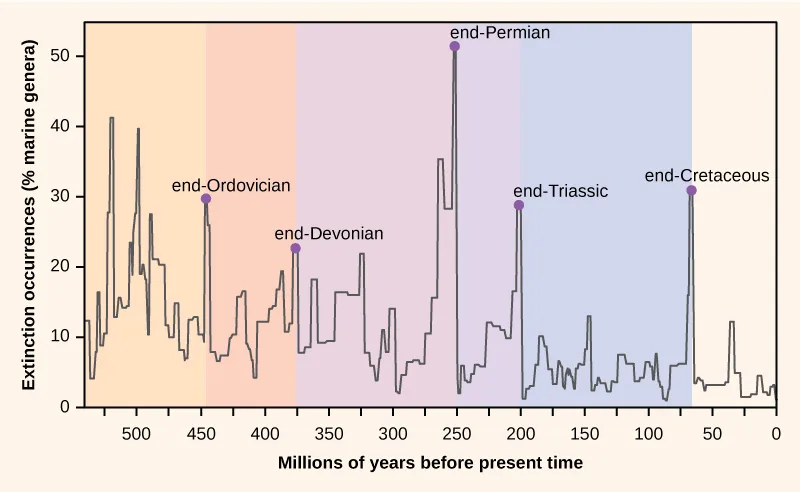
Changes in the environment often create new niches (diversified living spaces) that invite rapid speciation and increased diversity. On the other hand, cataclysmic events, such as volcanic eruptions and meteor strikes that obliterate life, can result in devastating losses of diversity to some clades, yet provide new opportunities for others to “fill in the gaps” and speciate. Such periods of mass extinction (below) have occurred repeatedly in the evolutionary record of life, erasing some genetic lines while creating room for others to evolve into the empty niches left behind. The end of the Permian period (and the Paleozoic Era) was marked by the largest mass extinction event in Earth’s history, a loss of an estimated 95 percent of the extant species at that time. Some of the dominant phyla in the world’s oceans, such as the trilobites, disappeared completely. On land, the disappearance of some dominant species of Permian reptiles made it possible for a new line of reptiles to emerge, the dinosaurs. The warm and stable climatic conditions of the ensuing Mesozoic Era promoted an explosive diversification of dinosaurs into every conceivable niche in land, air, and water. Plants, too, radiated into new landscapes and empty niches, creating complex communities of producers and consumers, some of which became very large on the abundant food available.
Another mass extinction event occurred at the end of the Cretaceous period, bringing the Mesozoic Era to an end. Skies darkened and temperatures fell after a large meteor impact and tons of volcanic ash ejected into the atmosphere blocked incoming sunlight. Plants died, herbivores and carnivores starved, and the dinosaurs ceded their dominance of the landscape to the more warm-blooded mammals. In the following Cenozoic Era, mammals radiated into terrestrial and aquatic niches once occupied by dinosaurs, and birds—the warm-blooded direct descendants of one line of the ruling reptiles—became aerial specialists. The appearance and dominance of flowering plants in the Cretaceous Era created new niches for pollinating insects, as well as for birds and mammals. Changes in animal species diversity during the late Cretaceous and early Cenozoic were also promoted by a dramatic shift in Earth’s geography, as tectonic plates slid over the crust into their current positions, leaving some animal groups isolated on islands and continents, or separated by mountain ranges or inland seas from other competitors. Early in the Cenozoic, new ecosystems appeared, with the evolution of grasses and coral reefs, leading to their wide distribution. Late in the Cenozoic, further extinctions followed by speciation occurred during ice ages that covered high latitudes with ice and then retreated, leaving new open spaces for colonization.
Link to Learning
Watch a video about the mass extinctions that have occurred throughout the evolutionary history of animals.
Extended description
The x-axis runs from about 550 to 0 million years before present time, right to left toward the present; the y-axis runs from 0 to over 50 percent extinction occurrences among marine genera. A jagged gray line tracks extinction intensity throughout, with five points marked by purple dots and labels, left to right: ’end-Ordovician’ at about 450 million years ago and about 30 percent; ’end-Devonian’ at about 375 million years ago and roughly 23 percent; ’end-Permian’ at about 250 million years ago and the graph’s highest point, about 51 percent; ’end-Triassic’ at about 200 million years ago and about 29 percent; and ’end-Cretaceous’ at about 66 million years ago and about 31 percent. Four shaded vertical bands divide the plot at these boundaries, tinted orange, red, purple, and blue in turn, with a fifth, unshaded band after the end-Cretaceous marker.
Career Connection. Paleontologist
Natural history museums contain the fossils of extinct animals as well as information about how these animals evolved, lived, and died. Paleontologists are scientists who study prehistoric life. They use fossils to observe and explain how life evolved on Earth and how species interacted with each other and with the environment. The first paleontologists were scientists from other disciplines, such as geology, who evaluated the fossils they found to determine the concepts of extended ages of the Earth, prehistoric life, and extinction. They were aided in their work by surprise discoveries by laypeople, and other more concentrated efforts by self-taught scientists. Mary Anning, for example, was a well-known fossil hunter who discovered, cataloged, and diagrammed the fossils of significant dinosaurs such as the Plesiosaurus. Scientists from throughout Europe consulted with her to deepen their own understanding and draw conclusions that laid the foundation for the discipline.
Paleontology today relies on far more varied knowledge and technology than it did in Anning’s day. A paleontologist needs to be knowledgeable in mathematics, biology, ecology, chemistry, geology, and many other scientific disciplines. A paleontologist’s work may involve field studies: searching for and studying fossils. In addition to digging for and finding fossils, paleontologists also prepare fossils for further study and analysis. Although dinosaurs are probably the first animals that come to mind when thinking about ancient life, paleontologists study a variety of life forms, from plants, fungi and invertebrates to the vertebrate fishes, amphibians, reptiles, birds and mammals. Biophysics, biochemistry, geographic information systems, and data science are all additional fields of knowledge that paleontologists use to uncover the truth of the past.
An undergraduate degree in earth science or biology is a good place to start toward the career path of becoming a paleontologist. Most often, a graduate degree is necessary. Additionally, work experience in a museum or in a paleontology lab is useful.
Summary
The most rapid documented diversification and evolution of animal species in all of history occurred during the Cambrian period of the Paleozoic Era, a phenomenon known as the Cambrian explosion. Until recently, scientists believed that there were only very few tiny and simplistic animal species in existence before this period. However, recent fossil discoveries have revealed that additional, larger, and more complex animals existed during the Ediacaran period, and even possibly earlier, during the Cryogenian period. Still, the Cambrian period undoubtedly witnessed the emergence of the majority of animal phyla that we know today, although many questions remain unresolved about this historical phenomenon.
The remainder of the Paleozoic Era is marked by the growing appearance of new classes, families, and species, and the early colonization of land by certain marine animals and semiaquatic arthropods, both freshwater and marine. The evolutionary history of animals is also marked by numerous major extinction events, each of which wiped out a majority of extant species. Some species of most animal phyla survived these extinctions, allowing the phyla to persist and continue to evolve into species that we see today.
Key terms
- Cambrian explosion — time during the Cambrian period (542–488 million years ago) when most of the animal phyla in existence today evolved.
- Cryogenian period — geologic period (850–630 million years ago) characterized by a very cold global climate.
- Ediacaran period — geological period (630–542 million years ago) when the oldest definite multicellular organisms with tissues evolved.
- mass extinction — event or environmental condition that wipes out the majority of species within a relatively short geological time period.
Practice
Describe the features that characterized the earliest animals and approximately when they appeared on earth
Which of the following periods is the earliest during which animals may have appeared?
This period predates the Ediacaran, and recent fossil finds from South Australia have pushed the possible origin of animal life back into it.What type of data is primarily used to determine the existence and appearance of early animal species?
The Ediacaran and Cambrian discoveries this section describes are all impressions and remains preserved in rock.Until recent discoveries suggested otherwise, animals existing before the Cambrian period were believed to be:
The recently discovered Ediacaran and Cryogenian fossils are notable specifically for showing evidence of hard body parts, which overturned the older assumption.The geological period (630–542 million years ago) when the oldest definite multicellular organisms with tissues evolved is called the ________.
Fossils from this period were first found in hills of the same name in Southern Australia.The geologic period (850–630 million years ago) characterized by a very cold global climate is called the ________.
It came before the Ediacaran, and ended with a great ice age.Explain the significance of the Cambrian period for animal evolution and the changes in animal diversity that took place during that time
The time between 542–488 million years ago marks which period?
This is the period during which most living animal phyla rapidly diversified.Plant life first appeared on land during which of the following periods?
This period directly followed the Cambrian, and its new land plants let formerly aquatic animals follow them ashore.The time during the Cambrian period (542–488 million years ago) when most of the animal phyla in existence today evolved is called the ________.
This term describes the most rapid diversification of animal life documented in Earth’s history.Describe some of the unresolved questions surrounding the Cambrian explosion
Briefly describe at least two theories that attempt to explain the cause of the Cambrian explosion.
Show model answer
Did your answer mention:
The Cambrian period undoubtedly witnessed the emergence of the majority of animal phyla that we know today, although ________ remain unresolved about this historical phenomenon.
The Summary notes that despite the emergence of most phyla during this period, much about the event itself is still not understood.Which of the following is one of the unresolved questions this section raises about the Cambrian explosion?
Reread the paragraph beginning ‘However, unresolved questions…’ — it names one specific puzzle about pacing, not about the identity of extinct species or the timing of the dinosaurs.Discuss the implications of mass animal extinctions that have occurred in evolutionary history
Approximately how many mass extinction events occurred throughout the evolutionary history of animals?
The extinctions graph above marks five major events, but the text describes the full evolutionary record as full of ’numerous’ such events.How is it that most, if not all, of the extant animal phyla today evolved during the Cambrian period if so many massive extinction events have taken place since then?
Show model answer
Did your answer mention:
An event or environmental condition that wipes out the majority of species within a relatively short geological time period is called a ________.
The largest such event closed out the Permian period, eliminating an estimated 95 percent of the species alive at the time.This section is adapted from Biology 2e, Section 27.4: The Evolutionary History of the Animal Kingdom by Mary Ann Clark, Jung Choi, Matthew Douglas, and OpenStax, © OpenStax, licensed under CC BY-NC-SA 4.0. Access the original for free at openstax.org. Changes: figures re-encoded as WebP with a custom, shorter alt written from each image rather than reusing the source’s own long alt text; five figures re-kinded after inspection from the manifest’s file-extension guess — Figure_B27_04_01ab from “photo” to “diagram” (an illustrated timeline table and spiral, not a photograph), Figure_27_04_05f and Figure_B27_04_06-extinctions from “photo” to “diagram” (line graphs), and Figure_B27_04_02ab and Figure_B27_04_04 from “diagram” to “photo” (actual photographs of fossils); a longdesc added to the timeline diagram (Figure_B27_04_01ab), the four-panel trilobite photograph (Figure_B27_04_04), and the two line graphs (Figure_27_04_05f, Figure_B27_04_06-extinctions), none of whose full content is carried by their one- or two-line captions; the two Link to Learning notes rendered as callouts with descriptive link text over the source URLs; the Career Connection note rendered as a callout; the end-of-section Review Questions and Critical Thinking Questions adapted into the closing interactive Practice block (multiple choice and self-check, respectively), with rubric checkpoints added to each self-check decomposing its model answer (the source solution) into check-off clauses with no new claims; four key-term recall items added from the glossary; one cloze recall item added from the section’s own Summary sentence (“many questions remain unresolved about this historical phenomenon”); and one multiple choice written locally from the section’s own paragraph on unresolved questions, since the “unresolved questions” objective had no dedicated end-of-section exercise of its own.