Invertebrates
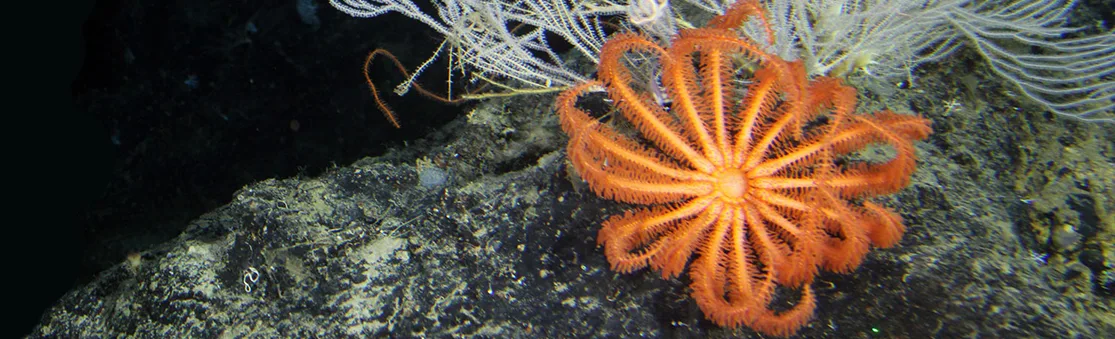
A brief look at any magazine pertaining to our natural world, such as National Geographic, would show a rich variety of vertebrates, especially mammals and birds. To most people, these are the animals that attract our attention. Concentrating on vertebrates, however, gives us a rather biased and limited view of animal diversity, because it ignores nearly 97 percent of the animal kingdom—the invertebrates—animals that lack a cranium and a defined vertebral column or spine.
The invertebrate animal phyla exhibit an enormous variety of cells and tissues adapted for specific purposes, and frequently these tissues are unique to their phyla. These specializations show the range of cellular differentiation possible within the clade Opisthokonta, which has both unicellular and multicellular members. Cellular and structural specializations include cuticles for protection, spines and tiny harpoons for defense, toothy structures for feeding, and wings for flight. An exoskeleton may be adapted for movement or for the attachment of muscles as in clams and insects. Secretory cells can produce venom, mucus, or digestive enzymes. The body plans of some phyla, such as those of the mollusks, annelids, arthropods, and echinoderms, have been modified and adapted throughout evolution to produce thousands of different forms. Perhaps you will find it amazing that an enormous number of both aquatic and terrestrial invertebrates—perhaps millions of species—have not yet been scientifically classified. As a result, the phylogenetic relationships among the invertebrates are constantly being updated as new information is collected about the organisms of each phylum.
Sections
- Phylum Porifera — the organizational features of the simplest multicellular animals, and the body forms and bodily functions of sponges.
- Phylum Cnidaria — structural and organizational comparisons between Porifera and Cnidaria, the progressive development of tissues and its relevance to animal complexity, the two general cnidarian body forms, and the identifying features of the major cnidarian classes.
- Superphylum Lophotrochozoa: Flatworms, Rotifers, and Nemerteans — the unique anatomical and morphological features of flatworms, rotifers, and Nemertea, an important extracoelomic cavity found in Nemertea, and the key features of Platyhelminthes and their importance as parasites.
- Superphylum Lophotrochozoa: Mollusks and Annelids — the unique anatomical and morphological features of mollusks and annelids, the formation of the coelom, an important extracoelomic cavity in mollusks, the major body regions of Mollusca, the advantages of true body segmentation, and the features of phylum Annelida.
- Superphylum Ecdysozoa: Nematodes and Tardigrades — the structural organization of nematodes, the importance of Caenorhabditis elegans in research, and the features of tardigrades.
- Superphylum Ecdysozoa: Arthropods — the internal systems and appendage specializations of phylum Arthropoda, the environmental importance of arthropods, and the reasons for their success and abundance.
- Superphylum Deuterostomia — the distinguishing characteristics of echinoderms and of chordates.
This chapter is adapted from Biology 2e, Chapter 28: Invertebrates by Mary Ann Clark, Jung Choi, Matthew Douglas, and OpenStax, © OpenStax, licensed under CC BY-NC-SA 4.0. Access the original for free at openstax.org. Each section page records its own changes from the source. Changes: the chapter-opening image is the source’s, re-encoded for the web, with its source alt kept since it already says what the single photo shows; the caption’s italicized species name is set in italics per the source’s own markup, though the vendored manifest’s plain-text caption field does not carry it; the source’s own <emphasis> markup (the magazine title National Geographic) is italicized per house style.