Vertebrates
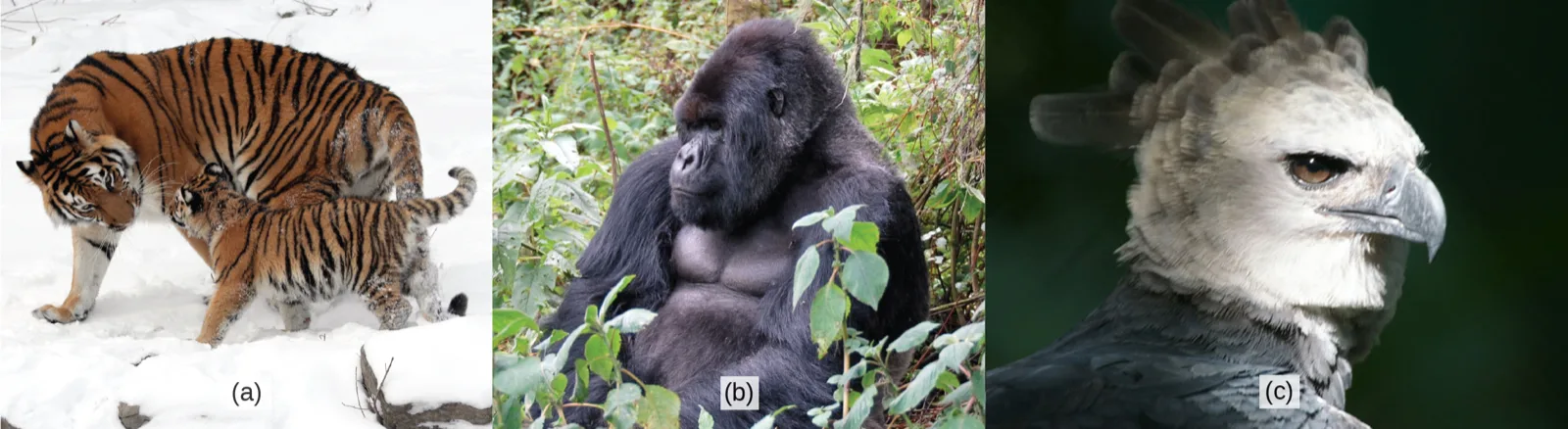
Vertebrates are among the most recognizable organisms of the Animal Kingdom, and more than 62,000 vertebrate species have been identified. The vertebrate species now living represent only a small portion of the vertebrates that have existed in the past. The best-known extinct vertebrates are the dinosaurs, a unique group of reptiles, some of which reached sizes not seen before or after in terrestrial animals. In fact, they were the dominant terrestrial animals for 150 million years, until most of them died out in a mass extinction near the end of the Cretaceous period (except for the feathered theropod ancestors of modern birds, whose direct descendents now number nearly 10,000 species). Although it is not known with certainty what caused this mass extinction (not only of dinosaurs, but of many other groups of organisms), a great deal is known about the anatomy of the dinosaurs and early birds, given the preservation of numerous skeletal elements, nests, eggs, and embryos in the fossil record.
Sections
- Chordates — the distinguishing characteristics of chordates, the derived characters of craniates that set them apart from other chordates, and the developmental fate of the notochord in vertebrates.
- Fishes — the difference between jawless and jawed fishes, and the distinguishing features of sharks and rays compared to other modern fishes.
- Amphibians — the important difference between the life cycle of amphibians and the life cycles of other vertebrates, the characteristics that distinguish Urodela, Anura, and Apoda, and the evolutionary history of amphibians.
- Reptiles — the main characteristics of amniotes, the difference between anapsids, synapsids, and diapsids, the characteristics of reptiles, and the evolution of reptiles.
- Birds — the evolutionary history of birds and the derived characteristics that facilitate flight.
- Mammals — the distinguishing features of the three main groups of mammals, the likely line of evolutionary descent that produced mammals, derived features tied to mammals’ need for constant, high-level metabolism, and the major clades of eutherian mammals.
- The Evolution of Primates — the derived features that distinguish primates from other animals, the defining features of the major primate groups, the major hominin precursors to modern humans, and why scientists are having difficulty determining the true lines of descent in hominids.
This chapter is adapted from Biology 2e, Chapter 29: Vertebrates by Mary Ann Clark, Jung Choi, Matthew Douglas, and OpenStax, © OpenStax, licensed under CC BY-NC-SA 4.0. Access the original for free at openstax.org. Each section page records its own changes from the source. Changes: the chapter-opening image is the source’s, re-encoded for the web, with its alt text extended from the source’s “Photos show a tiger, a gorilla, and an eagle.” to name the cub visible beside the tiger in panel (a); the vendored manifest tags this composite diagram, but all three panels are photographs, so the mediafigure here is set kind="photo"; the source’s own <emphasis> markup (terrestrial, and the species names in the caption) is italicized per house style.