Chordates
By the end of this section, you will be able to:
- Describe the distinguishing characteristics of chordates
- Identify the derived characters of craniates that sets them apart from other chordates
- Describe the developmental fate of the notochord in vertebrates
The vertebrates exhibit two major innovations in their evolution from the invertebrate chordates. These innovations may be associated with the whole genome duplications that resulted in a quadruplication of the basic chordate genome, including the Hox gene loci that regulate the placement of structures along the three axes of the body. One of the first major steps was the emergence of the quadrupeds in the form of the amphibians. A second step was the evolution of the amniotic egg, which, similar to the evolution of pollen and seeds in plants, freed terrestrial animals from their dependence on water for fertilization and embryonic development. Within the amniotes, modifications of keratinous epidermal structures have given rise to scales, claws, hair, and feathers. The scales of reptiles sealed their skins against water loss, while hair and feathers provided insulation to support the evolution of endothermy, as well as served other functions such as camouflage and mate attraction in the vertebrate lineages that led to birds and mammals.
Currently, a number of vertebrate species face extinction primarily due to habitat loss and pollution. According to the International Union for the Conservation of Nature, more than 6,000 vertebrate species are classified as threatened. Amphibians and mammals are the classes with the greatest percentage of threatened species, with 29 percent of all amphibians and 21 percent of all mammals classified as threatened. Attempts are being made around the world to prevent the extinction of threatened species. For example, the Biodiversity Action Plan is an international program, ratified by 188 countries, which is designed to protect species and habitats.
Vertebrates are members of the kingdom Animalia and the phylum Chordata (below). Recall that animals that possess bilateral symmetry can be divided into two groups—protostomes and deuterostomes—based on their patterns of embryonic development. The deuterostomes, whose name translates as “second mouth,” consist of two major phyla: Echinodermata and Chordata. Echinoderms are invertebrate marine animals that have pentaradial symmetry and a spiny body covering, a group that includes sea stars, sea urchins, and sea cucumbers. The most conspicuous and familiar members of Chordata are vertebrates, but this phylum also includes two groups of invertebrate chordates.
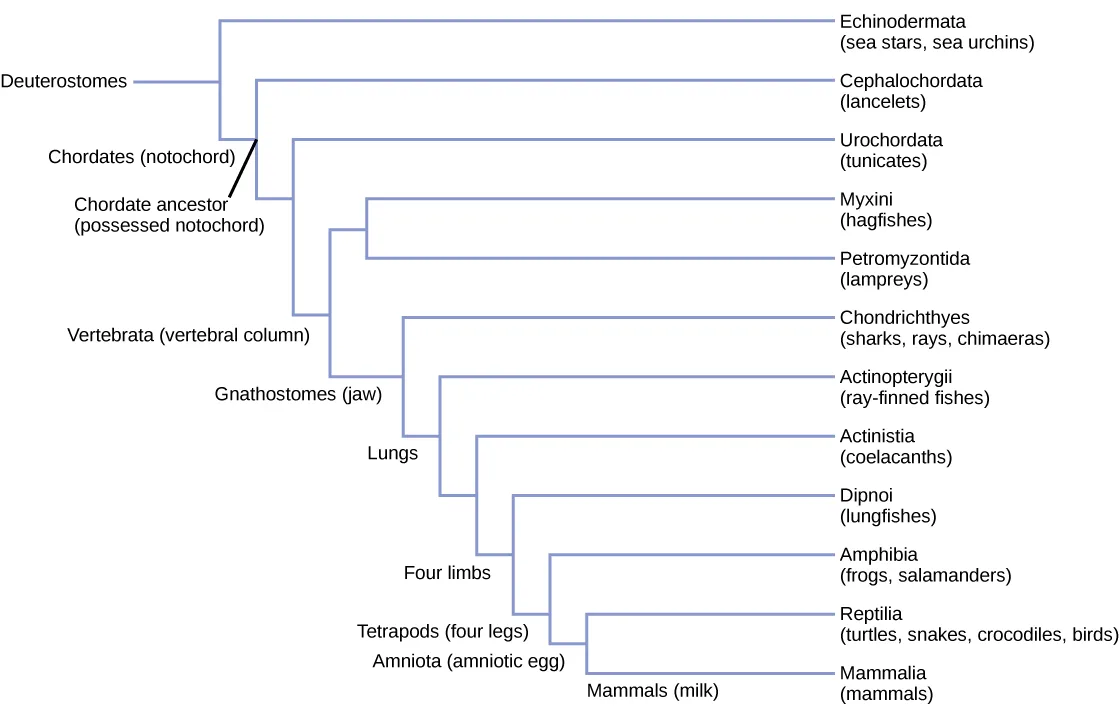
Extended description
A rectangular cladogram, read left (ancestral) to right (tips), with tips listed top to bottom. The root, labeled Deuterostomes, splits into Echinodermata (sea stars, sea urchins) at the top and a lineage labeled Chordates (notochord) — annotated by a pointer reading ‘Chordate ancestor (possessed notochord)’ — continuing right. That lineage splits into Cephalochordata (lancelets) at top and a continuing lineage. That lineage splits into Urochordata (tunicates) at top and a lineage labeled Vertebrata (vertebral column) continuing right. The Vertebrata lineage splits into two sister tips, Myxini (hagfishes) and Petromyzontida (lampreys), as one branch, and a lineage labeled Gnathostomes (jaw) as the other. The Gnathostomes lineage splits into Chondrichthyes (sharks, rays, chimaeras) at top and a continuing lineage, which splits into Actinopterygii (ray-finned fishes) at top and a lineage labeled Lungs. The Lungs lineage splits into Actinistia (coelacanths) at top and a lineage labeled Four limbs, which splits into Dipnoi (lungfishes) at top and a lineage labeled Tetrapods (four legs), which splits into Amphibia (frogs, salamanders) at top and a lineage labeled Amniota (amniotic egg), which splits into two final sister tips, Reptilia (turtles, snakes, crocodiles, birds) and Mammalia (mammals).
Characteristics of Chordata
Animals in the phylum Chordata share five key characteristics that appear at some stage during their development: a notochord, a dorsal hollow (tubular) nerve cord, pharyngeal gill arches or slits, a post-anal tail, and an endostyle/thyroid gland (below). In some groups, some of these key characteristics are present only during embryonic development.
The chordates are named for the notochord, which is a flexible, rod-shaped mesodermal structure that is found in the embryonic stage of all chordates and in the adult stage of some chordate species. It is strengthened with glycoproteins similar to cartilage and covered with a collagenous sheath. The notochord is located between the digestive tube and the nerve cord, and provides rigid skeletal support as well as a flexible location for attachment of axial muscles. In some chordates, the notochord acts as the primary axial support of the body throughout the animal’s lifetime. However, in vertebrates (craniates), the notochord is present only during embryonic development, at which time it induces the development of the neural tube and serves as a support for the developing embryonic body. The notochord, however, is not found in the postembryonic stages of vertebrates; at this point, it has been replaced by the vertebral column (that is, the spine).
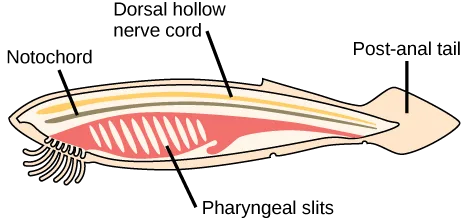
Extended description
A fish-shaped outline, labeled left to right and top to bottom. ‘Dorsal hollow nerve cord’ labels a long thin strip running the length of the body along the top. Immediately beneath it, ‘Notochord’ labels a second strip also running the full length of the body. Below the notochord, ‘Pharyngeal slits’ labels a set of diagonal red gill-like slits cut into the tissue toward the front of the body. ‘Post-anal tail’ labels the tapering rear extension of the body beyond the trunk.
Which of the following statements about common features of chordates is true?
The section explains what actually becomes of the pharyngeal slits, the notochord, and the tail in vertebrates and in humans — check each of those three claims against that account before picking the option about the nerve cord.The dorsal hollow nerve cord is derived from ectoderm that rolls into a hollow tube during development. In chordates, it is located dorsally to the notochord. In contrast, the nervous system in protostome animal phyla is characterized by solid nerve cords that are located either ventrally and/or laterally to the gut. In vertebrates, the neural tube develops into the brain and spinal cord, which together comprise the central nervous system (CNS). The peripheral nervous system (PNS) refers to the peripheral nerves (including the cranial nerves) lying outside of the brain and spinal cord.
Pharyngeal slits are openings in the pharynx (the region just posterior to the mouth) that extend to the outside environment. In organisms that live in aquatic environments, pharyngeal slits allow for the exit of water that enters the mouth during feeding. Some invertebrate chordates use the pharyngeal slits to filter food out of the water that enters the mouth. The endostyle is a strip of ciliated mucus-producing tissue in the floor of the pharynx. Food particles trapped in the mucus are moved along the endostyle toward the gut. The endostyle also produces substances similar to thyroid hormones and is homologous with the thyroid gland in vertebrates. In vertebrate fishes, the pharyngeal slits are modified into gill supports, and in jawed fishes, into jaw supports. In tetrapods (land vertebrates), the slits are highly modified into components of the ear, and tonsils and thymus glands. In other vertebrates, pharyngeal arches, derived from all three germ layers, give rise to the oral jaw from the first pharyngeal arch, with the second arch becoming the hyoid and jaw support.
The post-anal tail is a posterior elongation of the body, extending beyond the anus. The tail contains skeletal elements and muscles, which provide a source of locomotion in aquatic species, such as fishes. In some terrestrial vertebrates, the tail also helps with balance, courting, and signaling when danger is near. In humans and other great apes, the post-anal tail is reduced to a vestigial coccyx (“tail bone”) that aids in balance during sitting.
Chordates and the Evolution of Vertebrates
Two clades of chordates are invertebrates: Cephalochordata and Urochordata. Members of these groups also possess the five distinctive features of chordates at some point during their development.
Cephalochordata
Members of Cephalochordata possess a notochord, dorsal hollow tubular nerve cord, pharyngeal slits, endostyle/thyroid gland, and a post-anal tail in the adult stage (below). The notochord extends into the head, which gives the subphylum its name. Although the neural tube also extends into the head region, there is no well-defined brain, and the nervous system is centered around a hollow nerve cord lying above the notochord. Extinct members of this subphylum include Pikaia, which is the oldest known cephalochordate. Excellently preserved Pikaia fossils were recovered from the Burgess shales of Canada and date to the middle of the Cambrian age, making them more than 500 million years old. The anatomy of Pikaia closely resembles that of the extant lancelet in the genus Branchiostoma.
The lancelets are named for their bladelike shape. Lancelets are only a few centimeters long and are usually found buried in sand at the bottom of warm temperate and tropical seas. Cephalochordates are suspension feeders. A water current is created by cilia in the mouth, and is filtered through oral tentacles. Water from the mouth then enters the pharyngeal slits, which filter out food particles. The filtered water collects in a gill chamber called the atrium and exits through the atriopore. Trapped food particles are caught in a stream of mucus produced by the endostyle in a ventral ciliated fold (or groove) of the pharynx and carried to the gut. Most gas exchange occurs across the body surface. Sexes are separate and gametes are released into the water through the atriopore for external fertilization.
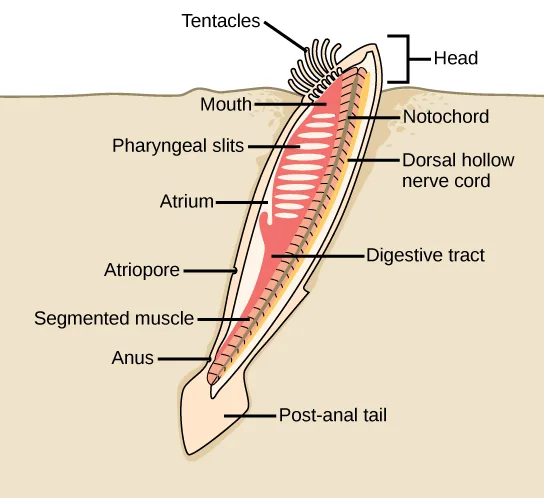
Extended description
Reading head to tail: at the front, tentacles surround the mouth, bracketed together as the head. From the mouth, a digestive tract runs the length of the body. Alongside it, the pharyngeal slits open into a chamber labeled atrium, which empties through the atriopore. A dorsal hollow nerve cord and a notochord run above the digestive tract the length of the body. Segmented muscle blocks line the body wall. Toward the rear, the anus opens just before the body narrows into the post-anal tail, and the whole animal is shown with its head end protruding from a bed of sand while the rest of the body stays buried.
Urochordata
The 1,600 species of Urochordata are also known as tunicates (below). The name tunicate derives from the cellulose-like carbohydrate material, called the tunic, which covers the outer body of tunicates. Although tunicates are classified as chordates, the adults do not have a notochord, a dorsal hollow nerve cord, or a post-anal tail, although they do have pharyngeal slits and an endostyle. The “tadpole” larval form, however, possesses all five structures. Most tunicates are hermaphrodites; their larvae hatch from eggs inside the adult tunicate’s body. After hatching, a tunicate larva (possessing all five chordate features) swims for a few days until it finds a suitable surface on which it can attach, usually in a dark or shaded location. It then attaches via the head to the surface and undergoes metamorphosis into the adult form, at which point the notochord, nerve cord, and tail disappear, leaving the pharyngeal gill slits and the endostyle as the two remaining features of its chordate morphology.
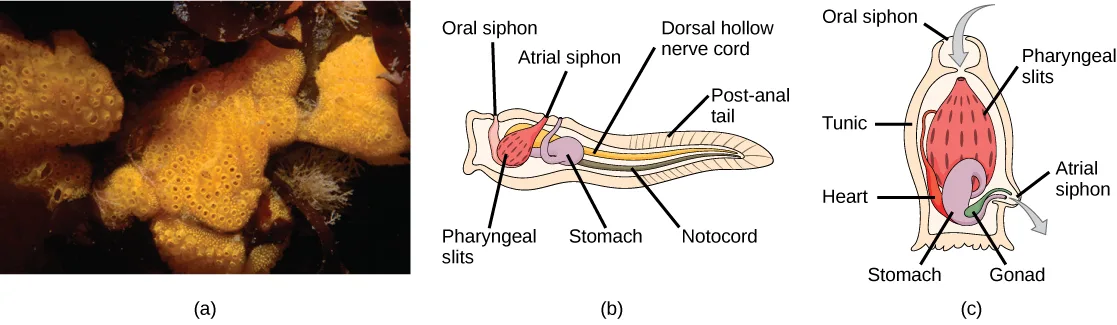
Extended description
Panel (a) is a photograph of a colony of the tunicate Botrylloides violaceus, a bumpy, sponge-like orange-and-yellow mass dotted with small pored openings; no labels. Panel (b) shows the tadpole-shaped larva, labeled front to back and top to bottom: an oral siphon and an atrial siphon at the front; pharyngeal slits and a stomach in the body; a dorsal hollow nerve cord running above a notochord the length of the tail (the panel’s own label, printed ’notocord,’ omits the h — the image itself misspells the word); the tail ends as the post-anal tail. Panel (c) shows the sessile adult, anchored at its base inside its outer tunic, labeled: an oral siphon at the top drawing water in; pharyngeal slits filtering it; an atrial siphon at the side expelling it; a heart and a gonad tucked beside the stomach at the base.
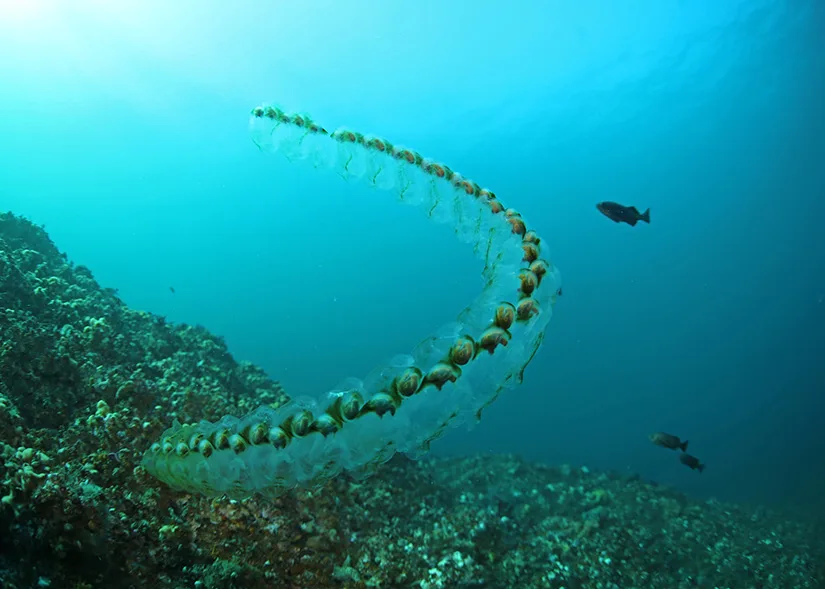
Adult tunicates may be either solitary or colonial forms, and some species may reproduce by budding. Most tunicates live a sessile existence on the ocean floor and are suspension feeders. However, chains of thaliacean tunicates called salps (below) can swim actively while feeding, propelling themselves as they move water through the pharyngeal slits. The primary foods of tunicates are plankton and detritus. Seawater enters the tunicate’s body through its incurrent siphon. Suspended material is filtered out of this water by a mucous net produced by the endostyle and is passed into the intestine via the action of cilia. The anus empties into the excurrent siphon, which expels wastes and water. Tunicates are found in shallow ocean waters around the world.
Subphylum Vertebrata (Craniata)
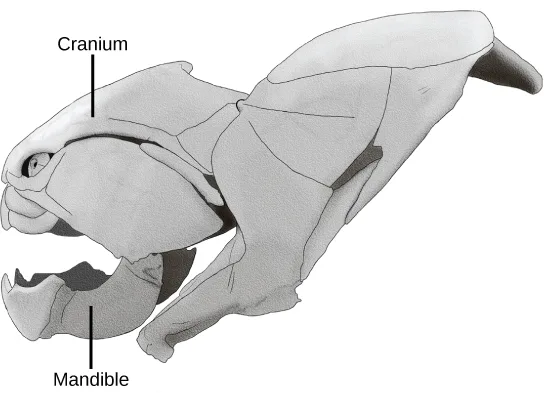
A cranium is a bony, cartilaginous, or fibrous structure surrounding the brain, jaw, and facial bones (below). Most bilaterally symmetrical animals have a head; of these, those that have a cranium comprise the clade Craniata/Vertebrata, which includes the primitively jawless Myxini (hagfishes), Petromyzontida (lampreys), and all of the organisms called “vertebrates.” (We should note that the Myxini have a cranium but lack a backbone.)
Extended description
A side-on skull illustration with two labels. ‘Cranium’ points to the domed upper portion of the skull enclosing the braincase. ‘Mandible’ points to the toothed lower jaw beneath it.
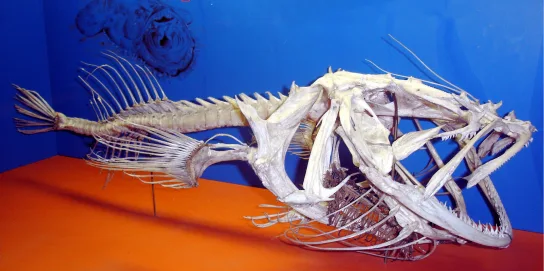
Members of the phylum Craniata/Vertebrata display the five characteristic features of the chordates; however, members of this group also share derived characteristics that distinguish them from invertebrate chordates. Vertebrates are named for the vertebral column, composed of vertebrae—a series of separate, irregularly shaped bones joined together to form a backbone (below). Initially, the vertebrae form in segments around the embryonic notochord, but eventually replace it in adults. In most derived vertebrates, the notochord becomes the nucleus pulposus of the intervertebral discs that cushion and support adjacent vertebrae.
The relationship of the vertebrates to the invertebrate chordates has been a matter of contention, but although these cladistic relationships are still being examined, it appears that the Craniata/Vertebrata are a monophyletic group that shares the five basic chordate characteristics with the other two subphyla, Urochordata and Cephalochordata. Traditional phylogenies place the cephalochordates as a sister clade to the vertebrates, a view that has been supported by most current molecular analyses. This hypothesis is further supported by the discovery of a fossil in China from the genus Haikouella. This organism seems to be an intermediate form between cephalochordates and vertebrates. The Haikouella fossils are about 530 million years old and appear similar to modern lancelets. These organisms had a brain and eyes, as do vertebrates, but lack the skull found in craniates. This evidence suggests that vertebrates arose during the Cambrian explosion.
Vertebrates are the largest group of chordates, with more than 62,000 living species, which are grouped based on anatomical and physiological traits. More than one classification and naming scheme is used for these animals. Here we will consider the traditional groups Agnatha, Chondrichthyes, Osteichthyes, Amphibia, Reptilia, Aves, and Mammalia, which constitute classes in the subphylum Vertebrata/Craniata. Virtually all modern cladists classify birds within Reptilia, which correctly reflects their evolutionary heritage. Thus, we now have the nonavian reptiles and the avian reptiles in our reptilian classification. We consider them separately only for convenience. Further, we will consider hagfishes and lampreys together as jawless fishes, the Agnatha, although emerging classification schemes separate them into chordate jawless fishes (the hagfishes) and vertebrate jawless fishes (the lampreys).
Animals that possess jaws are known as gnathostomes, which means “jawed mouth.” Gnathostomes include fishes and tetrapods. Tetrapod literally means “four-footed,” which refers to the phylogenetic history of various land vertebrates, even though in some of the tetrapods, the limbs may have been modified for purposes other than walking. Tetrapods include amphibians, reptiles, birds, and mammals, and technically could also refer to the extinct fishlike groups that gave rise to the tetrapods. Tetrapods can be further divided into two groups: amphibians and amniotes. Amniotes are animals whose eggs contain four extraembryonic membranes (yolk sac, amnion, chorion, and allantois) that provide nutrition and a water-retaining environment for their embryos. Amniotes are adapted for terrestrial living, and include mammals, reptiles, and birds.
Summary
The five characteristic features of chordates present during some time of their life cycles are a notochord, a dorsal hollow tubular nerve cord, pharyngeal slits, endostyle/thyroid gland, and a post-anal tail. Chordata contains two clades of invertebrates: Urochordata (tunicates) and Cephalochordata (lancelets), together with the vertebrates in the Vertebrata/Craniata. Lancelets are suspension feeders that feed on phytoplankton and other microorganisms. Most tunicates live on the ocean floor and are suspension feeders. Which of the two invertebrate chordate clades is more closely related to the vertebrates continues to be debated. Vertebrata is named for the vertebral column, which is a feature of almost all members of this clade. The name Craniata (organisms with a cranium) is considered to be synonymous with Vertebrata.
Key terms
- Cephalochordata — chordate clade whose members possess a notochord, dorsal hollow nerve cord, pharyngeal slits, and a post-anal tail in the adult stage.
- Chordata — phylum of animals distinguished by their possession of a notochord, a dorsal hollow nerve cord, pharyngeal slits, and a post-anal tail at some point during their development.
- Craniata — clade composed of chordates that possess a cranium; includes Vertebrata together with hagfishes.
- cranium — bony, cartilaginous, or fibrous structure surrounding the brain, jaw, and facial bones.
- dorsal hollow nerve cord — hollow, tubular structure derived from ectoderm, which is located dorsal to the notochord in chordates.
- lancelet — member of Cephalochordata; named for its blade-like shape.
- notochord — flexible, rod-shaped support structure that is found in the embryonic stage of all chordates and in the adult stage of some chordates.
- pharyngeal slit — opening in the pharynx.
- post-anal tail — muscular, posterior elongation of the body extending beyond the anus in chordates.
- tetrapod — phylogenetic reference to an organism with a four-footed evolutionary history; includes amphibians, reptiles, birds, and mammals.
- tunicate — sessile chordate that is a member of Urochordata.
- Urochordata — clade composed of tunicates.
- vertebral column — series of separate bones joined together as a backbone.
- Vertebrata — members of the phylum Chordata that possess a backbone.
Practice
Describe the distinguishing characteristics of chordates
Which of the following is not contained in phylum Chordata?
Recall which phylum the section lists sea stars, sea urchins, and sea cucumbers under — it is introduced as a sister group to the chordates within the deuterostomes, not a member of Chordata itself.What are the characteristic features of the chordates?
Show model answer
Did your answer mention:
The phylum of animals distinguished by a notochord, a dorsal hollow nerve cord, pharyngeal slits, and a post-anal tail at some point in development is called ________.
This phylum groups the two invertebrate subphyla discussed in this section together with every vertebrate.A muscular, posterior elongation of the body extending beyond the anus, found in chordates, is called the ________.
In humans and other great apes this structure is reduced to the vestigial coccyx that aids balance while sitting.Identify the derived characters of craniates that sets them apart from other chordates
Hagfish, lampreys, sharks, and tuna are all chordates that can also be classified into which group?
The section notes that hagfishes have a cranium but lack a backbone, so the term covering all four animals — including one without a spine — is not the one defined by having a backbone.Which group of invertebrates is most closely related to vertebrates?
Traditional phylogenies and most current molecular analyses place this invertebrate subphylum as the sister clade to the vertebrates, a view also supported by a fossil genus resembling modern lancelets.A bony, cartilaginous, or fibrous structure that surrounds the brain, jaw, and facial bones is called a ________.
Animals that have this structure, together with all vertebrates, make up the clade Craniata.The clade of chordates that possess a cranium, including Vertebrata together with the hagfishes, is called ________.
This clade is treated as synonymous with Vertebrata, though the section notes the hagfishes it includes lack a backbone.Describe the developmental fate of the notochord in vertebrates
What is the structural advantage of the notochord in the human embryo? Be sure to compare the notochord with the corresponding structure in adults.
Show model answer
Did your answer mention:
The flexible, rod-shaped support structure found in the embryonic stage of every chordate, and in the adult stage of some, is called the ________.
In vertebrates, this embryonic structure does not persist as the adult body’s main axial support — something else replaces it before birth.A series of separate, irregularly shaped bones joined together to support the body’s main axis is called the ________.
In most vertebrates, the notochord’s remnant becomes the nucleus pulposus that cushions each segment of this jointed structure.This section is adapted from Biology 2e, Section 29.1: Chordates by Mary Ann Clark, Jung Choi, Matthew Douglas, and OpenStax, © OpenStax, licensed under CC BY-NC-SA 4.0. Access the original for free at openstax.org. Changes: figures re-encoded as WebP; Figure_B29_01_01 re-kinded from the manifest’s file-extension “photo” guess to “diagram” (a drawn cladogram, not a photograph) and given a rewritten alt and a longdesc tracing every branch and label in reading order, because the source alt describes a “Craniata” node and a Myxini/Vertebrata split that the actual figure does not draw — the image instead pairs Myxini and Petromyzontida as sister tips under a lineage labeled Vertebrata, with no “Craniata” label anywhere — reported as a source defect; Figure_29_01_05 re-kinded from “photo” to “diagram” (a line illustration, not a photograph); a longdesc added to Figure_29_01_02, Figure_29_01_04, Figure_B29_01_02abc, and Figure_29_01_05, walking each labeled diagram in reading order (Figure_B29_01_02abc’s panel (b) prints its own notochord label as “notocord,” an artwork typo corrected in the longdesc’s wording, not in the image); the note wrapping the chordate-features Visual Connection rendered as its figure followed by a multiple choice, kept in the body, using the four options and key of the module’s own visual-exercise item (the note’s inline list of the same question in the body prints a fifth option, “The endostyle secretes steroid hormones,” that the graded exercise does not carry — the multiple choice keeps the graded exercise’s four options rather than inventing a distractor) — reported as a source defect; the “interactive interactive-long” note rendered as a Link to Learning callout; the end-of-section Review Questions and Critical Thinking Questions adapted into the closing interactive Practice block (multiple choice and self-check respectively), each self-check given rubric checkpoints decomposing its model answer with no new claims; six key-term recall items (Chordata, post-anal tail, cranium, Craniata, notochord, vertebral column) added from the glossary.