Amphibians
By the end of this section, you will be able to:
- Describe the important difference between the life cycle of amphibians and the life cycles of other vertebrates
- Distinguish between the characteristics of Urodela, Anura, and Apoda
- Describe the evolutionary history of amphibians
Amphibians are vertebrate tetrapods (“four limbs”), and include frogs, salamanders, and caecilians. The term “amphibian” loosely translates from the Greek as “dual life,” which is a reference to the metamorphosis that many frogs and salamanders undergo and the unique mix of aquatic and terrestrial phases that are required in their life cycle. In fact, they cannot stray far from water because their reproduction is intimately tied to aqueous environments. Amphibians evolved during the Devonian period and were the earliest terrestrial tetrapods. They represent an evolutionary transition from water to land that occurred over many millions of years. Thus, the Amphibia are the only living true vertebrates that have made a transition from water to land in both their ontogeny (life development) and phylogeny (evolution). They have not changed much in morphology over the past 350 million years!
Link to Learning. Watch this series of four videos on tetrapod evolution:
Characteristics of Amphibians
As tetrapods, most amphibians are characterized by four well-developed limbs. In some species of salamanders, hindlimbs are reduced or absent, but all caecilians are (secondarily) limbless. An important characteristic of extant amphibians is a moist, permeable skin that is achieved via mucus glands. Most water is taken in across the skin rather than by drinking. The skin is also one of three respiratory surfaces used by amphibians. The other two are the lungs and the buccal (mouth) cavity. Air is taken first into the mouth through the nostrils, and then pushed by positive pressure into the lungs by closing the nostrils and elevating the throat.
All extant adult amphibians are carnivorous, and some terrestrial amphibians have a sticky tongue used to capture prey. Amphibians also have multiple small teeth at the edge of the jaws. In salamanders and caecilians, teeth are present in both jaws, sometimes in multiple rows. In frogs and toads, teeth are seen only in the upper jaw. Additional teeth, called vomerine teeth, may be found in the roof of the mouth. Amphibian teeth are pedicellate, which means that the root and crown are calcified, separated by a zone of noncalcified tissue.
Amphibians have image-forming eyes and color vision. Ears are best developed in frogs and toads, which vocalize to communicate. Frogs use separate regions of the inner ear for detecting higher and lower sounds: the papilla amphibiorum, which is sensitive to frequencies below 10,000 hertz and unique to amphibians, and the papilla basilaris, which is sensitive to higher frequencies, including mating calls, transmitted from the eardrum through the stapes bone. Amphibians also have an extra bone in the ear, the operculum, which transmits low-frequency vibrations from the forelimbs and shoulders to the inner ear, and may be used for the detection of seismic signals.
Evolution of Amphibians
The fossil record provides evidence of the first tetrapods: now-extinct amphibian species dating to nearly 400 million years ago. Evolution of tetrapods from lobe-finned freshwater fishes (similar to coelacanths and lungfish) represented a significant change in body plan from one suited to organisms that respired and swam in water, to organisms that breathed air and moved onto land; these changes occurred over a span of 50 million years during the Devonian period.
Aquatic tetrapods of the Devonian period include Ichthyostega and Acanthostega. Both were aquatic, and may have had both gills and lungs. They also had four limbs, with the skeletal structure of limbs found in present-day tetrapods, including amphibians. However, the limbs could not be pulled in under the body and would not have supported their bodies well out of water. They probably lived in shallow freshwater environments, and may have taken brief terrestrial excursions, much like “walking” catfish do today in Florida. In Ichthyostega, the forelimbs were more developed than the hind limbs, so it might have dragged itself along when it ventured onto land. What preceded Acanthostega and Ichthyostega?
In 2006, researchers published news of their discovery of a fossil of a “tetrapod-like fish,” Tiktaalik roseae, which seems to be a morphologically “intermediate form” between sarcopterygian fishes having feet-like fins and early tetrapods having true limbs (pictured below). Tiktaalik likely lived in a shallow water environment about 375 million years ago (Daeschler, E. B., Shubin, N. H., and Jenkins, F. J. “A Devonian tetrapod-like fish and the evolution of the tetrapod body plan,” Nature 440 (2006): 757–763, doi:10.1038/nature04639, http://www.nature.com/nature/journal/v440/n7085/abs/nature04639.html). Tiktaalik also had gills and lungs, but the loss of some gill elements gave it a neck, which would have allowed its head to move sideways for feeding. The eyes were on top of the head. It had fins, but the attachment of the fin bones to the shoulder suggested they might be weight-bearing. Tiktaalik preceded Acanthostega and Ichthyostega, with their four limbs, by about 10 million years and is considered to be a true intermediate clade between fish and amphibians.
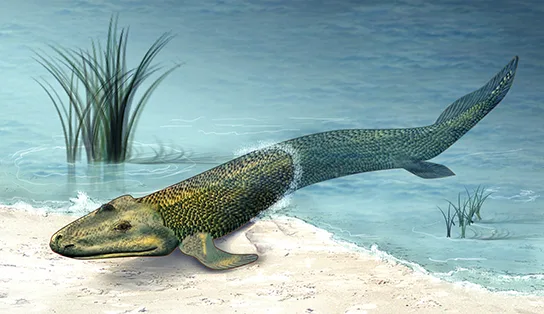
The early tetrapods that moved onto land had access to new nutrient sources and relatively few predators. This led to the widespread distribution of tetrapods during the early Carboniferous period, a period sometimes called the “age of the amphibians.”
Modern Amphibians
Amphibia comprises an estimated 6,770 extant species that inhabit tropical and temperate regions around the world. All living species are classified in the subclass Lissamphibia (“smooth-amphibian”), which is divided into three clades: Urodela (“tailed”), the salamanders; Anura (“tail-less”), the frogs; and Apoda (“legless ones”), the caecilians.
Urodela: Salamanders
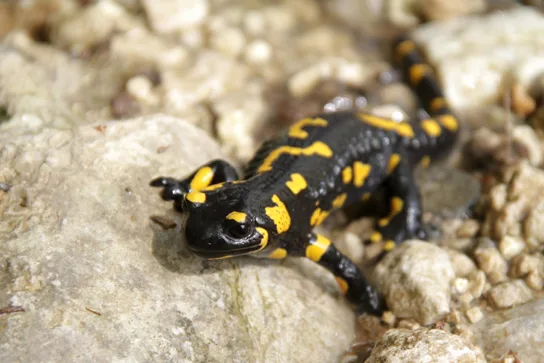
Salamanders are amphibians that belong to the order Urodela (or Caudata). These animals are probably the most similar to ancestral amphibians. Living salamanders (pictured below) include approximately 620 species, some of which are aquatic, others terrestrial, and some that live on land only as adults. Most adult salamanders have a generalized tetrapod body plan with four limbs and a tail. The placement of their legs makes it difficult to lift their bodies off the ground and they move by bending their bodies from side to side, called lateral undulation, in a fish-like manner while “walking” their arms and legs fore-and-aft. It is thought that their gait is similar to that used by early tetrapods. The majority of salamanders are lungless, and respiration occurs through the skin or through external gills in aquatic species. Some terrestrial salamanders have primitive lungs; a few species have both gills and lungs. The giant Japanese salamander, the largest living amphibian, has additional folds in its skin that enlarge its respiratory surface.
Most salamanders reproduce using an unusual process of internal fertilization of the eggs. Mating between salamanders typically involves an elaborate and often prolonged courtship. Such a courtship ends in the deposition of sperm by the males in a packet called a spermatophore, which is subsequently picked up by the female, thus ultimately fertilization is internal. Most salamanders are oviparous; a few, such as the fire salamander and the alpine salamander, bear live young. (Source note: the source says all salamanders except the fire salamander are oviparous; viviparity has arisen several times within the family Salamandridae, including the alpine salamanders Salamandra atra and S. lanzai and the genus Lyciasalamandra (Buckley, “Evolution of Viviparity in Salamanders,” eLS, 2012).) Aquatic salamanders lay their eggs in water, where they develop into legless larvae called efts. Terrestrial salamanders lay their eggs in damp nests, where the eggs are guarded by their mothers. These embryos go through the larval stage and complete metamorphosis before hatching into tiny adult forms. One aquatic salamander, the Mexican axolotl, never leaves the larval stage, becoming sexually mature without metamorphosis.
Anura: Frogs
Frogs (pictured below) are amphibians that belong to the order Anura or Salientia (“jumpers”). Anurans are among the most diverse groups of vertebrates, with approximately 5,965 species that occur on all of the continents except Antarctica. Anurans, ranging from the minute New Guinea frog at 7 mm to the huge goliath frog at 32 cm from tropical Africa, have a body plan that is more specialized for movement. Adult frogs use their hind limbs and their arrow-like endoskeleton to jump accurately to capture prey on land. Tree frogs have hands adapted for grasping branches as they climb. In tropical areas, “flying frogs” can glide from perch to perch on the extended webs of their feet. Frogs have a number of modifications that allow them to avoid predators, including skin that acts as camouflage. Many species of frogs and salamanders also release defensive chemicals that are poisonous to predators from glands in the skin. Frogs with more toxic skins have bright warning (aposematic) coloration.
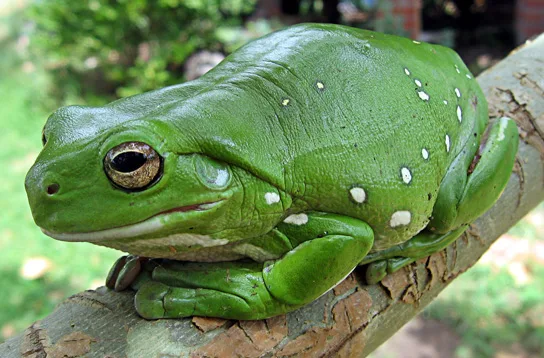
Frog eggs are fertilized externally, and like other amphibians, frogs generally lay their eggs in moist environments. Although amphibian eggs are protected by a thick jelly layer, they would still dehydrate quickly in a dry environment. Frogs demonstrate a great diversity of parental behaviors, with some species laying many eggs and exhibiting little parental care, to species that carry eggs and tadpoles on their hind legs or embedded in their backs. The males of Darwin’s frog carry tadpoles in their vocal sac. Many tree frogs lay their eggs off the ground in a folded leaf located over water so that the tadpoles can drop into the water as they hatch.
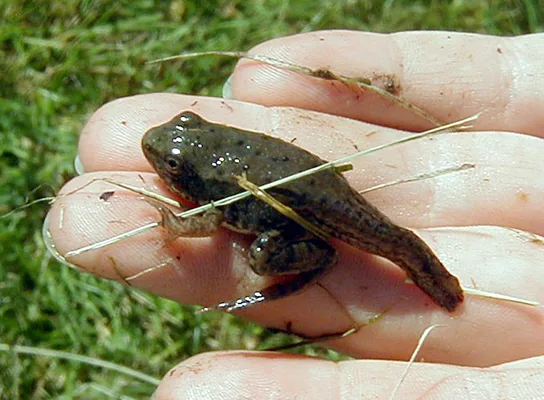
The life cycle of most frogs, as other amphibians, consists of two distinct stages: the larval stage followed by metamorphosis to an adult stage. However, the eggs of frogs in the genus Eleutherodactylus develop directly into little froglets, guarded by a parent. The larval stage of a frog, the tadpole, is often a filter-feeding herbivore. Tadpoles usually have gills, a lateral line system, longfinned tails, and lack limbs. At the end of the tadpole stage, frogs undergo metamorphosis into the adult form (pictured below). During this stage, the gills, tail, and lateral line system disappear, and four limbs develop. The jaws become larger and are suited for carnivorous feeding, and the digestive system transforms into the typical short gut of a predator. An eardrum and air-breathing lungs also develop. These changes during metamorphosis allow the larvae to move onto land in the adult stage.
Apoda: Caecilians
An estimated 185 species comprise the caecilians, a group of amphibians that belong to the order Apoda. They have no limbs, although they evolved from a legged vertebrate ancestor. The complete lack of limbs makes them resemble earthworms. This resemblance is enhanced by folds of skin that look like the segments of an earthworm. However, unlike earthworms, they have teeth in both jaws, and feed on a variety of small organisms found in soil, including earthworms! Caecilians are adapted for a burrowing or aquatic lifestyle, and they are nearly blind, with their tiny eyes sometimes covered by skin. Although they have a single lung, they also depend on cutaneous respiration. These animals are found in the tropics of South America, Africa, and Southern Asia. In the caecilians, the only amphibians in which the males have copulatory structures, fertilization is internal. Some caecilians are oviparous, but most bear live young. In these cases, the females help nourish their young with tissue from their oviduct before birth and from their skin after birth.
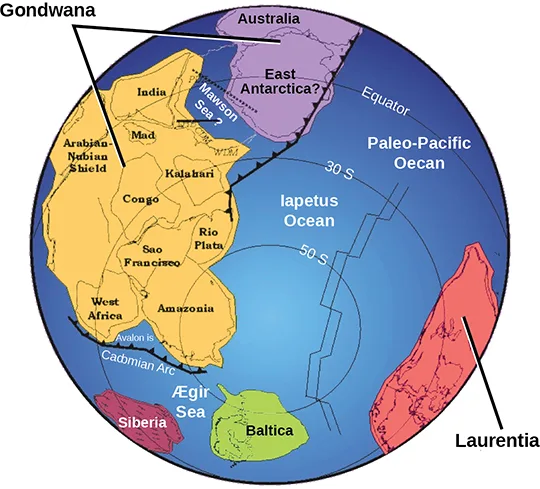
Evolution Connection. The Paleozoic Era and the Evolution of Vertebrates. When the vertebrates arose during the Paleozoic Era (542 to 251 MYA), the climate and geography of Earth was vastly different. The distribution of landmasses on Earth were also very different from that of today. Near the equator were two large supercontinents, Laurentia and Gondwana, which included most of today’s continents, but in a radically different configuration (pictured below). At this time, sea levels were very high, probably at a level that hasn’t been reached since. As the Paleozoic progressed, glaciations created a cool global climate, but conditions warmed near the end of the first half of the Paleozoic. During the latter half of the Paleozoic, the landmasses began moving together, with the initial formation of a large northern block called Laurasia, which contained parts of what is now North America, along with Greenland, parts of Europe, and Siberia. Eventually, a single supercontinent, called Pangaea, was formed, starting in the latter third of the Paleozoic. Glaciations then began to affect Pangaea’s climate and the distribution of vertebrate life.
Extended description
A shaded globe centered on the ancient equator, which runs diagonally across the upper half of the sphere. At upper left, a leader line labeled ‘Gondwana’ points to a large gold landmass that fills most of the globe’s left and lower half; within it, smaller named regions are labeled from top to bottom and left to right: Australia (separate, purple, at upper center, adjoining a purple ‘East Antarctica?’ region), India, Mad(agascar), Arabian-Nubian Shield, Kalahari, Congo, Sao Francisco, Rio Plata, West Africa, and Amazonia, with ‘Mawson Sea?’ as a small notch between Australia and India and ‘Avalon is’ and the ‘Cadomian Arc’ labeled along Gondwana’s lower coastline. To the right of Gondwana, across open ocean, three smaller landmasses sit near the bottom of the globe: a magenta ‘Siberia,’ a green ‘Baltica,’ and, further right, a red ‘Laurentia’ (labeled by its own leader line at lower right). The open ocean is labeled in three regions: the ‘Paleo-Pacific Ocean’ at upper right, the ‘Iapetus Ocean’ running down the globe’s center between Gondwana and Laurentia, and the small ‘Aegir Sea’ between Siberia and Baltica. Curved lines across the globe are labeled ‘Equator’ near the top, ‘30 S’ below it, and ‘50 S’ further down, marking latitude on the ancient globe.
During the early Paleozoic, the amount of carbon dioxide in the atmosphere was much greater than it is today. This may have begun to change later, as land plants became more common. As the roots of land plants began to infiltrate rock and soil began to form, carbon dioxide was drawn out of the atmosphere and became trapped in the rock. This reduced the levels of carbon dioxide and increased the levels of oxygen in the atmosphere, so that by the end of the Paleozoic, atmospheric conditions were similar to those of today.
As plants became more common through the latter half of the Paleozoic, microclimates began to emerge and ecosystems began to change. As plants and ecosystems continued to grow and become more complex, vertebrates moved from the water to land. The presence of shoreline vegetation may have contributed to the movement of vertebrates onto land. One hypothesis suggests that the fins of aquatic vertebrates were used to maneuver through this vegetation, providing a precursor to the movement of fins on land and the further development of limbs. The late Paleozoic was a time of diversification of vertebrates, as amniotes emerged and became two different lines that gave rise, on one hand, to synapsids and mammals, and, on the other hand, to the codonts, reptiles, dinosaurs, and birds. Many marine vertebrates became extinct near the end of the Devonian period, which ended about 360 million years ago, and both marine and terrestrial vertebrates were decimated by a mass extinction at the end of the Permian period about 250 million years ago.
Summary
As tetrapods, most amphibians are characterized by four well-developed limbs, although some species of salamanders and all caecilians are limbless. The most important characteristic of extant amphibians is a moist, permeable skin used for cutaneous respiration, although lungs are found in the adults of many species.
All amphibians are carnivores and possess many small teeth. The fossil record provides evidence of amphibian species, now extinct, that arose over 400 million years ago as the first tetrapods. Living Amphibia can be divided into three classes: salamanders (Urodela), frogs (Anura), and caecilians (Apoda). In the majority of amphibians, development occurs in two distinct stages: a gilled aquatic larval stage that metamorphoses into an adult stage, acquiring lungs and legs, and losing the tail in Anurans. A few species in all three clades bypass a free-living larval stage. Various levels of parental care are seen in the amphibians.
Key terms
- Acanthostega — one of the earliest known tetrapods.
- Amphibia — frogs, salamanders, and caecilians.
- Anura — frogs.
- Apoda — caecilians.
- caecilian — legless amphibian that belongs to the clade Apoda.
- cutaneous respiration — gas exchange through the skin.
- frog — tail-less amphibian that belongs to the clade Anura.
- salamander — tailed amphibian that belongs to the clade Urodela.
- tadpole — larval stage of a frog.
- Urodela — salamanders.
Practice
Describe the important difference between the life cycle of amphibians and the life cycles of other vertebrates
Explain why frogs are restricted to a moist environment.
Show model answer
Did your answer mention:
Describe the differences between the larval and adult stages of frogs.
Show model answer
Did your answer mention:
Describe how metamorphosis changes the structures involved in gas exchange over the life cycle of animals in the clade Anura, and what evolutionary advantage this change provides.
Show model answer
Did your answer mention:
Gas exchange through the skin, one of an amphibian’s three respiratory surfaces, is called ________ respiration.
This word also names the outer, moist, mucus-covered organ amphibians take up most of their water across.Distinguish between the characteristics of Urodela, Anura, and Apoda
Frogs belong to which order?
This order’s name means “tail-less,” unlike the tailed salamanders.The legless amphibians that belong to the clade Apoda are called ________.
Folds of skin make this burrowing, nearly blind group resemble earthworms.The tailed amphibians that belong to the clade Urodela are called ________.
Most of this group moves by bending its body from side to side, called lateral undulation.The larval stage of a frog is called a ________.
It is often a filter-feeding herbivore with gills, a lateral line system, and long-finned tails, but no limbs.Describe the evolutionary history of amphibians
Which of the following is not true of Acanthostega?
Think about which of the four traits belongs to a lineage that had fully left the water, and which three the section attributes to this aquatic tetrapod.The group made up of frogs, salamanders, and caecilians is called ________.
This taxon’s name loosely translates from the Greek as “dual life,” for the aquatic and terrestrial phases many of its members pass through.One of the earliest known tetrapods, whose fossils are found alongside those of Ichthyostega in Devonian rocks, is called ________.
Along with Ichthyostega, this aquatic tetrapod may have had both gills and lungs, and could not yet support its body well on land.This section is adapted from Biology 2e, Section 29.3: Amphibians by Mary Ann Clark, Jung Choi, Matthew Douglas, and OpenStax, © OpenStax, licensed under CC BY-NC-SA 4.0. Access the original for free at openstax.org. Changes: figures re-encoded as WebP; Figure_29_03_01 re-kinded from the manifest’s file-extension “photo” guess to “diagram” after inspection (a digital reconstruction/illustration of Tiktaalik, not a photograph); a longdesc added to the labeled Paleozoic-continents globe schematic (Figure_B29_03_04), whose named landmasses and latitude lines are not carried by its one-line caption; the interactive-long Link to Learning’s four embedded videos rendered as a linked list rather than iframes, and its two sibling Link to Learning notes rendered the same way; the footnote citing Daeschler et al. 2006 kept as a parenthetical after the sentence it supports; the Evolution Connection feature box rendered as a callout with its bold name and italicized title, its figure kept inside it as in the source; the end-of-section Review Questions and Critical Thinking Questions adapted into the closing interactive Practice block (multiple choice and self-check respectively); rubric checkpoints added to each self-check, decomposing its model answer (the source solution) into check-off clauses with no new claims; five key-term recall items (cutaneous respiration, caecilians, salamanders, tadpole, Amphibia) and one further recall item (Acanthostega) added from the glossary to give each objective group an auto-graded item; the source’s “caecelians” corrected to “caecilians” — reported as a source defect. One claim is corrected with a visible Source note: several salamanders, not the fire salamander alone, bear live young (erratum 432).