The Plant Body
By the end of this section, you will be able to:
- Describe the shoot organ system and the root organ system
- Distinguish between meristematic tissue and permanent tissue
- Identify and describe the three regions where plant growth occurs
- Summarize the roles of dermal tissue, vascular tissue, and ground tissue
- Compare simple plant tissue with complex plant tissue
Like animals, plants contain cells with organelles in which specific metabolic activities take place. Unlike animals, however, plants use energy from sunlight to form sugars during photosynthesis. In addition, plant cells have cell walls, plastids, and a large central vacuole: structures that are not found in animal cells. Each of these cellular structures plays a specific role in plant structure and function.
Link to Learning
Watch Botany Without Borders, a video produced by the Botanical Society of America about the importance of plants.
Plant Organ Systems
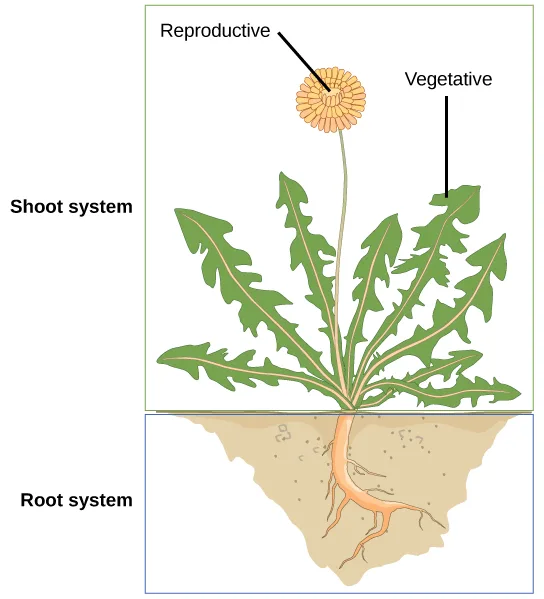
In plants, just as in animals, similar cells working together form a tissue. When different types of tissues work together to perform a unique function, they form an organ; organs working together form organ systems. Vascular plants have two distinct organ systems: a shoot system, and a root system. The shoot system consists of two portions: the vegetative (non-reproductive) parts of the plant, such as the leaves and the stems, and the reproductive parts of the plant, which include flowers and fruits. The shoot system generally grows above ground, where it absorbs the light needed for photosynthesis. The root system, which supports the plants and absorbs water and minerals, is usually underground. The figure below shows the organ systems of a typical plant.
Extended description
The figure is drawn as two stacked panels. The upper panel, outlined in green and labeled ‘Shoot system’ at its left, shows the dandelion’s aboveground parts: a rosette of jagged, lobed leaves radiating from a central stalk, with a line labeled ‘Vegetative’ pointing to one leaf, and a rounded, spiky flower head atop the stalk, with a line labeled ‘Reproductive’ pointing to it. The lower panel, outlined in blue and labeled ‘Root system’ at its left, shows the belowground parts: a thick central taproot descending into speckled soil and branching into several thinner lateral roots.
Plant Tissues
Plants are multicellular eukaryotes with tissue systems made of various cell types that carry out specific functions. Plant tissue systems fall into one of two general types: meristematic tissue, and permanent (or non-meristematic) tissue. Cells of the meristematic tissue are found in meristems, which are plant regions of continuous cell division and growth. Meristematic tissue cells are either undifferentiated or incompletely differentiated, and they continue to divide and contribute to the growth of the plant. In contrast, permanent tissue consists of plant cells that are no longer actively dividing.
Meristematic tissues consist of three types, based on their location in the plant. Apical meristems contain meristematic tissue located at the tips of stems and roots, which enable a plant to extend in length. Lateral meristems facilitate growth in thickness or girth in a maturing plant. Intercalary meristems occur only in monocots, at the bases of leaf blades and at nodes (the areas where leaves attach to a stem). This tissue enables the monocot leaf blade to increase in length from the leaf base; for example, it allows lawn grass leaves to elongate even after repeated mowing.
Meristems produce cells that quickly differentiate, or specialize, and become permanent tissue. Such cells take on specific roles and lose their ability to divide further. They differentiate into three main types: dermal, vascular, and ground tissue. Dermal tissue covers and protects the plant, and vascular tissue transports water, minerals, and sugars to different parts of the plant. Ground tissue serves as a site for photosynthesis, provides a supporting matrix for the vascular tissue, and helps to store water and sugars.
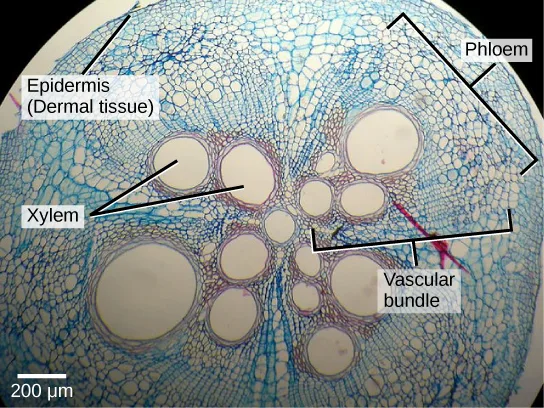
Secondary tissues are either simple (composed of similar cell types) or complex (composed of different cell types). Dermal tissue, for example, is a simple tissue that covers the outer surface of the plant and controls gas exchange. Vascular tissue is an example of a complex tissue, and is made of two specialized conducting tissues: xylem and phloem. Xylem tissue transports water and nutrients from the roots to different parts of the plant, and includes three different cell types: vessel elements and tracheids (both of which conduct water), and xylem parenchyma. Phloem tissue, which transports organic compounds from the site of photosynthesis to other parts of the plant, consists of four different cell types: sieve cells (which conduct photosynthates), companion cells, phloem parenchyma, and phloem fibers. Unlike xylem conducting cells, phloem conducting cells are alive at maturity. The xylem and phloem always lie adjacent to each other (see the figure below). In stems, the xylem and the phloem form a structure called a vascular bundle; in roots, this is termed the vascular stele or vascular cylinder.
Extended description
Four call-out labels point into the round micrograph. At upper left, ‘Epidermis (Dermal tissue)’ points up and to the right, to the thin outer rim of the section. At upper right, ‘Phloem’ points down and to the left, to the small, densely packed cells just outside two of the four teardrop-shaped vascular bundles. At lower left, ‘Xylem’ points up and to the right, to the large, open, circular vessels clustered at the narrow point of one bundle. At lower right, ‘Vascular bundle’ points up and to the left, to one whole teardrop-shaped cluster of xylem and phloem cells. A white scale bar in the lower left corner of the image is labeled ‘200 µm.’
Summary
A vascular plant consists of two organ systems: the shoot system and the root system. The shoot system includes the aboveground vegetative portions (stems and leaves) and reproductive parts (flowers and fruits). The root system supports the plant and is usually underground. A plant is composed of two main types of tissue: meristematic tissue and permanent tissue. Meristematic tissue consists of actively dividing cells found in root and shoot tips. As growth occurs, meristematic tissue differentiates into permanent tissue, which is categorized as either simple or complex. Simple tissues are made up of similar cell types; examples include dermal tissue and ground tissue. Dermal tissue provides the outer covering of the plant. Ground tissue is responsible for photosynthesis; it also supports vascular tissue and may store water and sugars. Complex tissues are made up of different cell types. Vascular tissue, for example, is made up of xylem and phloem cells.
Key terms
- apical meristem — meristematic tissue located at the tips of stems and roots; enables a plant to extend in length
- dermal tissue — protective plant tissue covering the outermost part of the plant; controls gas exchange
- ground tissue — plant tissue involved in photosynthesis; provides support, and stores water and sugars
- intercalary meristem — meristematic tissue located at nodes and the bases of leaf blades; found only in monocots
- lateral meristem — meristematic tissue that enables a plant to increase in thickness or girth
- meristematic tissue — tissue containing cells that constantly divide; contributes to plant growth
- meristem — plant region of continuous growth
- permanent tissue — plant tissue composed of cells that are no longer actively dividing
- root system — belowground portion of the plant that supports the plant and absorbs water and minerals
- shoot system — aboveground portion of the plant; consists of nonreproductive plant parts, such as leaves and stems, and reproductive parts, such as flowers and fruits
- vascular bundle — strands of stem tissue made up of xylem and phloem
- vascular stele — strands of root tissue made up of xylem and phloem
- vascular tissue — tissue made up of xylem and phloem that transports food and water throughout the plant
Practice
Describe the shoot organ system and the root organ system
The aboveground portion of a plant, consisting of nonreproductive parts such as leaves and stems and reproductive parts such as flowers and fruits, is called the ________.
This organ system generally grows above ground, where it absorbs the light needed for photosynthesis.The belowground portion of a plant that supports it and absorbs water and minerals is called the ________.
This organ system is usually underground, unlike the vegetative and reproductive parts above ground.The shoot system includes the aboveground ________ portions (stems and leaves) and reproductive parts (flowers and fruits).
These are the plant’s non-reproductive parts — the opposite of the reproductive flowers and fruits named in the same sentence.Distinguish between meristematic tissue and permanent tissue
Plant regions of continuous growth are made up of ________.
These cells stay undifferentiated or incompletely differentiated so they can keep dividing and contributing to the plant’s growth — unlike the tissue type in the other three options.Plant tissue containing cells that constantly divide and contribute to plant growth is called ________.
This tissue’s cells are undifferentiated or incompletely differentiated, letting them keep dividing rather than settle into a permanent role.Plant tissue composed of cells that are no longer actively dividing is called ________.
Once meristematic cells differentiate, they take on this specialized, non-dividing role — the endpoint of tissue development, not the region where it starts growing.Identify and describe the three regions where plant growth occurs
What type of meristem is found only in monocots, such as lawn grasses? Explain how this type of meristematic tissue is beneficial in lawn grasses that are mowed each week.
Show model answer
Did your answer mention:
The plant region of continuous growth is called a ________.
Meristematic tissue cells are found here — it names the place, not the tissue type itself.Meristematic tissue located at the tips of stems and roots, which enables a plant to extend in length, is called the ________.
This region sits at the very tip — of the shoot or the root — where the plant lengthens rather than thickens.Meristematic tissue that enables a plant to increase in thickness or girth is called the ________.
This meristem runs along the side of stems and roots in a maturing plant, rather than sitting at a growing tip.Meristematic tissue located at nodes and the bases of leaf blades, found only in monocots, is called the ________.
This meristem lets a mowed grass blade keep lengthening from its base, even after the tip is cut off.Summarize the roles of dermal tissue, vascular tissue, and ground tissue
Which of the following is the major site of photosynthesis?
This simple tissue also supports the vascular tissue running through it and can store water and sugars.Which plant part is responsible for transporting water, minerals, and sugars to different parts of the plant? Name the two types of tissue that make up this overall tissue, and explain the role of each.
Show model answer
Did your answer mention:
Plant tissue that covers and protects the plant is called ________.
This simple tissue covers the outer surface of the plant and controls gas exchange.Tissue made up of xylem and phloem that transports food and water throughout the plant is called ________.
This complex tissue is made of two specialized conducting tissues that always lie adjacent to each other.Strands of stem tissue made up of xylem and phloem form a structure called a ________.
In roots, this same xylem-and-phloem strand structure is instead called the vascular stele or vascular cylinder.Compare simple plant tissue with complex plant tissue
Simple tissues are made up of ________ cell types; examples include dermal tissue and ground tissue.
Think about what dermal and ground tissue’s cells have in common with each other, compared to the two different cell types that make up vascular tissue.Complex tissues are made up of ________ cell types.
Vascular tissue is the section’s example of this kind of tissue, made of two distinct types working together: xylem and phloem.Vascular tissue is an example of a complex tissue, made of two specialized conducting tissues: ________.
These are the two tissues that transport water and sugars through the plant, named earlier in the section.This section is adapted from Biology 2e, Section 30.1: The Plant Body by Mary Ann Clark, Jung Choi, Matthew Douglas, and OpenStax, © OpenStax, licensed under CC BY-NC-SA 4.0. Access the original for free at openstax.org. Changes: figures re-encoded as WebP; Figure_30_01_01 re-kinded from the manifest’s file-extension “photo” guess to “diagram” (a drawn, labeled illustration, not a captured photograph); a longdesc added to both figures, walking through the labels and arrows the captions do not carry (the shoot/root panel labels and the four micrograph call-outs); the Link to Learning note rendered as a callout with its source URL kept; the end-of-section Review Questions and Critical Thinking Questions adapted into the closing interactive Practice block (multiple choice and self-check respectively); rubric checkpoints added to each self-check, decomposing its model answer (the source solution) into check-off clauses with no new claims; eleven key-term recall items (shoot system, root system, meristematic tissue, permanent tissue, meristem, apical meristem, lateral meristem, intercalary meristem, dermal tissue, vascular tissue, vascular bundle) added from the glossary; three cloze recall items (vegetative; the simple/complex tissue pair “similar”/“different”) and one select-the-term multiple choice (“xylem and phloem,” distractors drawn from the module’s own organ-system and meristem terms) added from the section summary to cover the “shoot vs. root” and “simple vs. complex tissue” objectives, which the glossary and exercise sets do not test directly.