Stems
By the end of this section, you will be able to:
- Describe the main function and basic structure of stems
- Compare and contrast the roles of dermal tissue, vascular tissue, and ground tissue
- Distinguish between primary growth and secondary growth in stems
- Summarize the origin of annual rings
- List and describe examples of modified stems
Stems are a part of the shoot system of a plant. They may range in length from a few millimeters to hundreds of meters, and also vary in diameter, depending on the plant type. Stems are usually above ground, although the stems of some plants, such as the potato, also grow underground. Stems may be herbaceous (soft) or woody in nature. Their main function is to provide support to the plant, holding leaves, flowers and buds; in some cases, stems also store food for the plant. A stem may be unbranched, like that of a palm tree, or it may be highly branched, like that of a magnolia tree. The stem of the plant connects the roots to the leaves, helping to transport absorbed water and minerals to different parts of the plant. It also helps to transport the products of photosynthesis, namely sugars, from the leaves to the rest of the plant.
Plant stems, whether above or below ground, are characterized by the presence of nodes and internodes (pictured below). Nodes are points of attachment for leaves, aerial roots, and flowers. The stem region between two nodes is called an internode. The stalk that extends from the stem to the base of the leaf is the petiole. An axillary bud is usually found in the axil—the area between the base of a leaf and the stem—where it can give rise to a branch or a flower. The apex (tip) of the shoot contains the apical meristem within the apical bud.
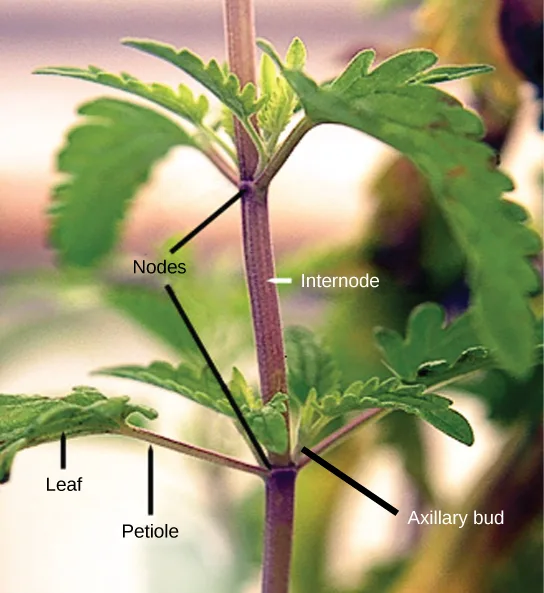
Stem Anatomy
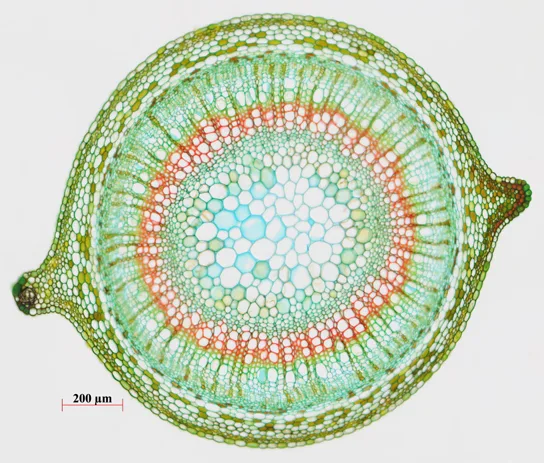
The stem and other plant organs arise from the ground tissue, and are primarily made up of simple tissues formed from three types of cells: parenchyma, collenchyma, and sclerenchyma cells.
Parenchyma cells are the most common plant cells (pictured below). They are found in the stem, the root, the inside of the leaf, and the pulp of the fruit. Parenchyma cells are responsible for metabolic functions, such as photosynthesis, and they help repair and heal wounds. Some parenchyma cells also store starch.
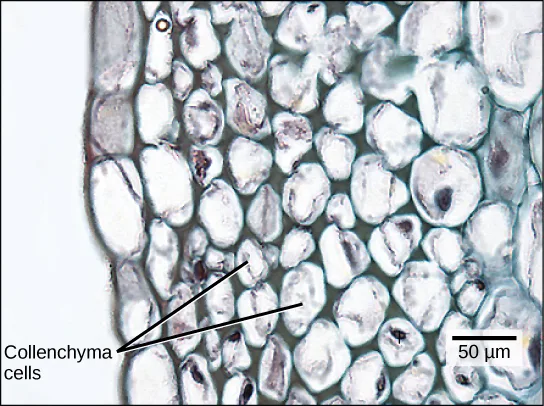
Collenchyma cells are elongated cells with unevenly thickened walls (pictured below). They provide structural support, mainly to the stem and leaves. These cells are alive at maturity and are usually found below the epidermis. The “strings” of a celery stalk are an example of collenchyma cells.
Sclerenchyma cells also provide support to the plant, but unlike collenchyma cells, many of them are dead at maturity. There are two types of sclerenchyma cells: fibers and sclereids. Both types have secondary cell walls that are thickened with deposits of lignin, an organic compound that is a key component of wood. Fibers are long, slender cells; sclereids are smaller-sized. Sclereids give pears their gritty texture. Humans use sclerenchyma fibers to make linen and rope (pictured below).
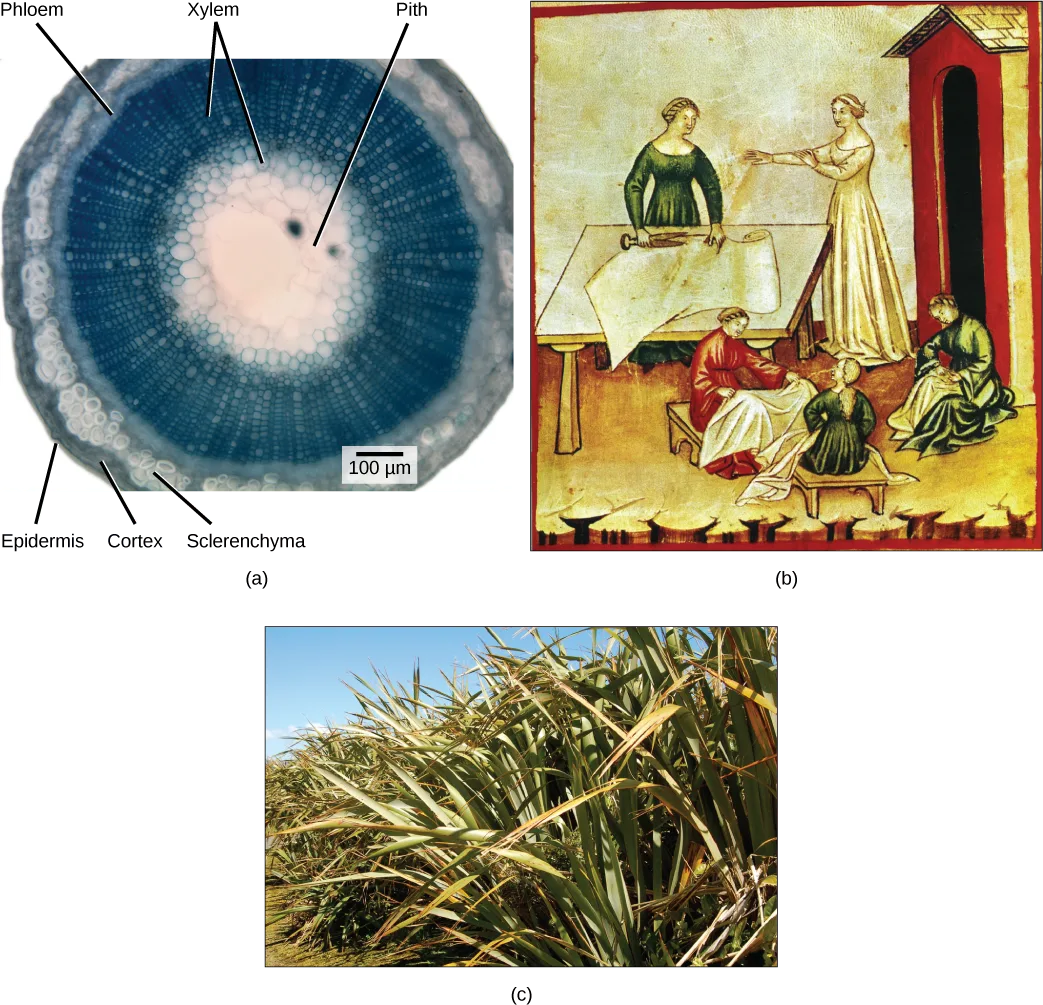
Extended description
Panel (a) is a micrograph cross section of a flax stem labeled from the center outward: ‘Pith’ (two dark dots at the middle), ‘Xylem’ (the ring just outside the pith), and ‘Phloem’ (the ring outside the xylem), then, along the rim, ‘Epidermis’, ‘Cortex’, and ‘Sclerenchyma’; a 100 µm scale bar sits at lower right. Panel (b) is a fourteenth-century painting of five women preparing linen inside a red-roofed room: one smooths a length of white cloth on a table while a second gestures beside her, and three more sit on a bench and the floor working cloth in their laps. Panel (c) is a photo of flax plants’ long, tapering leaves against a blue sky.
Which layers of the stem are made of parenchyma cells?
Ground tissue is made of parenchyma cells; check the Ground Tissue discussion below for which two structures make up the stem’s ground tissue.Like the rest of the plant, the stem has three tissue systems: dermal, vascular, and ground tissue. Each is distinguished by characteristic cell types that perform specific tasks necessary for the plant’s growth and survival.
Dermal Tissue
The dermal tissue of the stem consists primarily of epidermis, a single layer of cells covering and protecting the underlying tissue. Woody plants have a tough, waterproof outer layer of cork cells commonly known as bark, which further protects the plant from damage. Epidermal cells are the most numerous and least differentiated of the cells in the epidermis. The epidermis of a leaf also contains openings known as stomata, through which the exchange of gases takes place (pictured below). Two cells, known as guard cells, surround each leaf stoma, controlling its opening and closing and thus regulating the uptake of carbon dioxide and the release of oxygen and water vapor. Trichomes are hair-like structures on the epidermal surface. They help to reduce transpiration (the loss of water by aboveground plant parts), increase solar reflectance, and store compounds that defend the leaves against predation by herbivores.
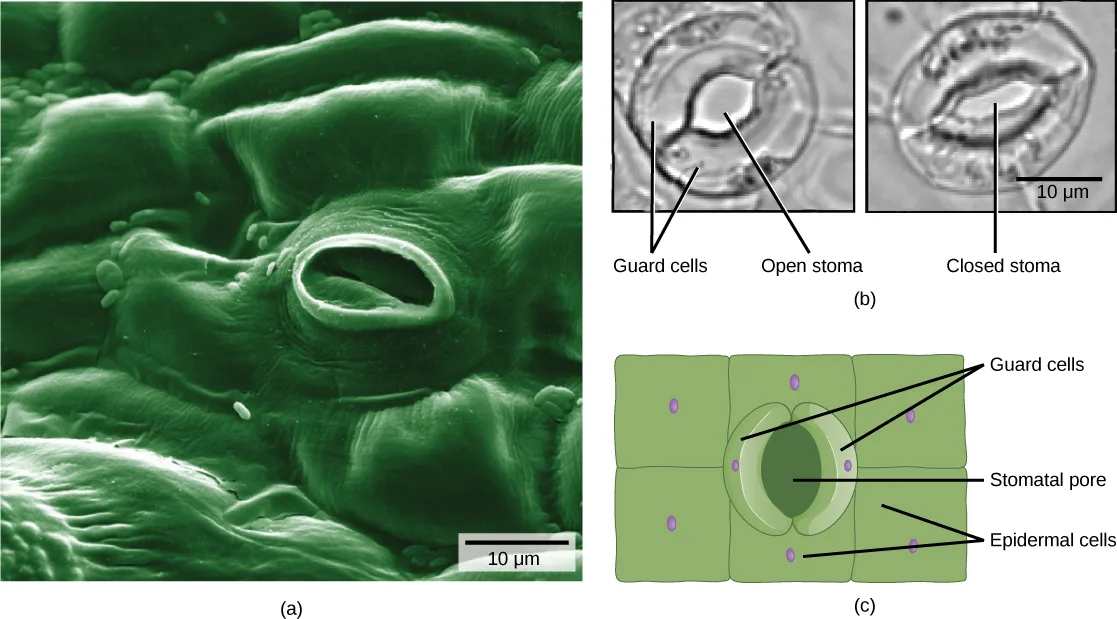
Extended description
Panel (a) is a green-toned electron micrograph of a wrinkled leaf surface with one oval stoma near center and a 10 µm scale bar at lower right. Panel (b) shows two black-and-white light micrographs side by side: the left one, labeled ‘Guard cells’ (two leader lines) and ‘Open stoma’, shows a round open pore; the right one, labeled ‘Closed stoma’, shows the same paired cells pressed shut; a 10 µm scale bar sits between them. Panel (c) is a green schematic of a leaf epidermis: a central oval ‘Stomatal pore’ is flanked by two kidney-shaped ‘Guard cells’, surrounded by six-sided ‘Epidermal cells’ each with a small purple oval nucleus.
Vascular Tissue
The xylem and phloem that make up the vascular tissue of the stem are arranged in distinct strands called vascular bundles, which run up and down the length of the stem. When the stem is viewed in cross section, the vascular bundles of dicot stems are arranged in a ring. In plants with stems that live for more than one year, the individual bundles grow together and produce the characteristic growth rings. In monocot stems, the vascular bundles are randomly scattered throughout the ground tissue (pictured below).
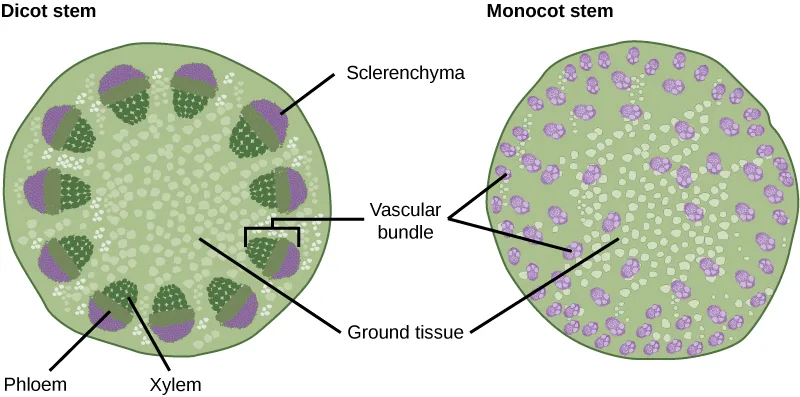
Extended description
Two circular cross sections sit side by side, headed ‘Dicot stem’ at left and ‘Monocot stem’ at right. The dicot stem has about ten wedge-shaped vascular bundles evenly spaced in a ring near its outer edge, each with a dark-green ‘Xylem’ cap toward the center of the stem, a purple ‘Phloem’ band next to it, and a purple ‘Sclerenchyma’ cap at its outermost tip; a light-green ‘Ground tissue’ with pale dots fills the center and the spaces between bundles. A ‘Vascular bundle’ label points with two lines to two adjacent bundles in the dicot ring and with a third line across to one bundle in the monocot stem, where dozens of smaller purple-and-green bundles are scattered at random throughout the ground tissue instead of forming a ring.
Xylem tissue has three types of cells: xylem parenchyma, tracheids, and vessel elements. The latter two types conduct water and are dead at maturity. Tracheids are xylem cells with thick secondary cell walls that are lignified. Water moves from one tracheid to another through regions on the side walls known as pits, where secondary walls are absent. Vessel elements are xylem cells with thinner walls; they are shorter than tracheids. Each vessel element is connected to the next by means of a perforation plate at the end walls of the element. Water moves through the perforation plates to travel up the plant.
Phloem tissue is composed of sieve-tube cells, companion cells, phloem parenchyma, and phloem fibers. A series of sieve-tube cells (also called sieve-tube elements) are arranged end to end to make up a long sieve tube, which transports organic substances such as sugars and amino acids. The sugars flow from one sieve-tube cell to the next through perforated sieve plates, which are found at the end junctions between two cells. Although still alive at maturity, the nucleus and other cell components of the sieve-tube cells have disintegrated. Companion cells are found alongside the sieve-tube cells, providing them with metabolic support. The companion cells contain more ribosomes and mitochondria than the sieve-tube cells, which lack some cellular organelles.
Ground Tissue
Ground tissue is mostly made up of parenchyma cells, but may also contain collenchyma and sclerenchyma cells that help support the stem. The ground tissue towards the interior of the vascular tissue in a stem or root is known as pith, while the layer of tissue between the vascular tissue and the epidermis is known as the cortex.
Growth in Stems
Growth in plants occurs as the stems and roots lengthen. Some plants, especially those that are woody, also increase in thickness during their life span. The increase in length of the shoot and the root is referred to as primary growth, and is the result of cell division in the shoot apical meristem. Secondary growth is characterized by an increase in thickness or girth of the plant, and is caused by cell division in the lateral meristem. The figure below shows the areas of primary and secondary growth in a plant. Herbaceous plants mostly undergo primary growth, with hardly any secondary growth or increase in thickness. Secondary growth or “wood” is noticeable in woody plants; it occurs in some dicots, but occurs very rarely in monocots.
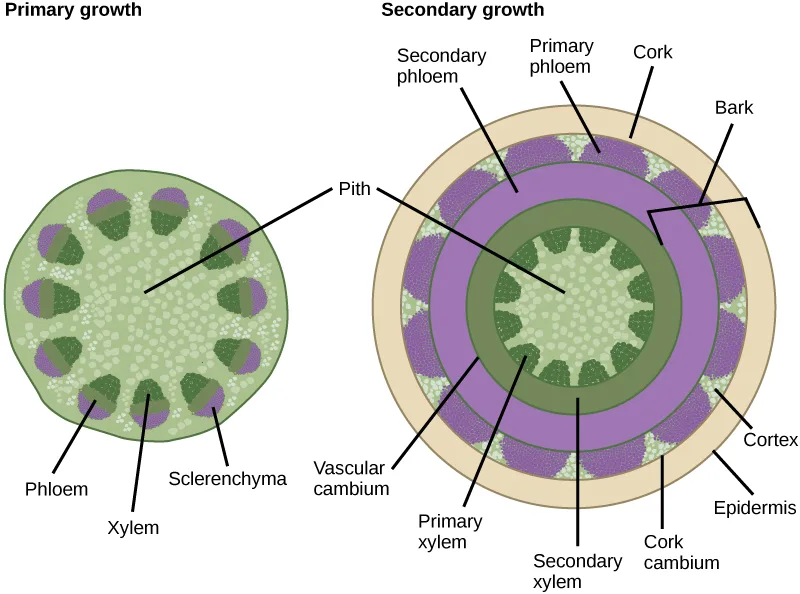
Extended description
Two circular cross sections are shown, headed ‘Primary growth’ at left and ‘Secondary growth’ at right. In the primary-growth stem, a central ‘Pith’ is ringed by about ten egg-shaped vascular bundles, each with ‘Xylem’ toward the inside, ‘Phloem’ in the middle, and ‘Sclerenchyma’ capping the outside. In the secondary-growth stem, the core is again ‘Pith’, with rounded bundles of ‘Primary xylem’ projecting inward from it out of a surrounding ring of ‘Secondary xylem’; a thin ‘Vascular cambium’ ring separates that xylem from a wide ‘Secondary phloem’ ring outside it, and bundles of ‘Primary phloem’ project outward from the secondary phloem into the ‘Cortex’ layer; a ‘Cork’ ring surrounds the cortex, separated from it by a thin ‘Cork cambium’, and a ‘Bark’ bracket spans from the vascular cambium outward to the ‘Epidermis’.
Some plant parts, such as stems and roots, continue to grow throughout a plant’s life: a phenomenon called indeterminate growth. Other plant parts, such as leaves and flowers, exhibit determinate growth, which ceases when a plant part reaches a particular size.
Primary Growth
Most primary growth occurs at the apices, or tips, of stems and roots. Primary growth is a result of rapidly dividing cells in the apical meristems at the shoot tip and root tip. Subsequent cell elongation also contributes to primary growth. The growth of shoots and roots during primary growth enables plants to continuously seek water (roots) or sunlight (shoots).
The influence of the apical bud on overall plant growth is known as apical dominance, which diminishes the growth of axillary buds that form along the sides of branches and stems. Most coniferous trees exhibit strong apical dominance, thus producing the typical conical Christmas tree shape. If the apical bud is removed, then the axillary buds will start forming lateral branches. Gardeners make use of this fact when they prune plants by cutting off the tops of branches, thus encouraging the axillary buds to grow out, giving the plant a bushy shape.
Link to Learning
Watch this BBC Nature video showing how time-lapse photography captures plant growth at high speed.
Secondary Growth
The increase in stem thickness that results from secondary growth is due to the activity of the lateral meristems, which are lacking in herbaceous plants. Lateral meristems include the vascular cambium and, in woody plants, the cork cambium (pictured above). The vascular cambium is located just outside the primary xylem and to the interior of the primary phloem. The cells of the vascular cambium divide and form secondary xylem (tracheids and vessel elements) to the inside, and secondary phloem (sieve elements and companion cells) to the outside. The thickening of the stem that occurs in secondary growth is due to the formation of secondary phloem and secondary xylem by the vascular cambium, plus the action of cork cambium, which forms the tough outermost layer of the stem. The cells of the secondary xylem contain lignin, which provides hardiness and strength.
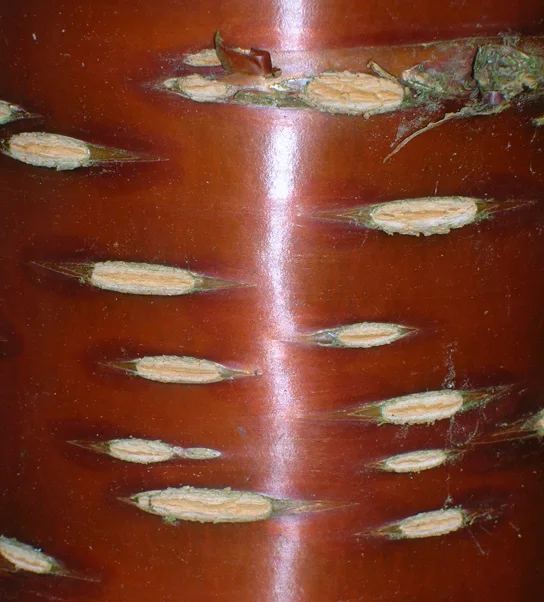
In woody plants, cork cambium is the outermost lateral meristem. It produces cork cells (bark) containing a waxy substance known as suberin that can repel water. The bark protects the plant against physical damage and helps reduce water loss. The cork cambium also produces a layer of cells known as phelloderm, which grows inward from the cambium. The cork cambium, cork cells, and phelloderm are collectively termed the periderm. The periderm substitutes for the epidermis in mature plants. In some plants, the periderm has many openings, known as lenticels, which allow the interior cells to exchange gases with the outside atmosphere (pictured below). This supplies oxygen to the living and metabolically active cells of the cortex, xylem, and phloem.
Annual Rings
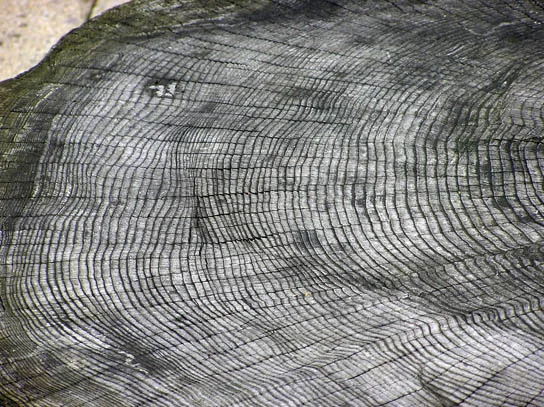
The activity of the vascular cambium gives rise to annual growth rings. During the spring growing season, cells of the secondary xylem have a large internal diameter and their primary cell walls are not extensively thickened. This is known as early wood, or spring wood. During the fall season, the secondary xylem develops thickened cell walls, forming late wood, or autumn wood, which is denser than early wood. This alternation of early and late wood is due largely to a seasonal decrease in the number of vessel elements and a seasonal increase in the number of tracheids. It results in the formation of an annual ring, which can be seen as a circular ring in the cross section of the stem (pictured below). An examination of the number of annual rings and their nature (such as their size and cell wall thickness) can reveal the age of the tree and the prevailing climatic conditions during each season.
Stem Modifications
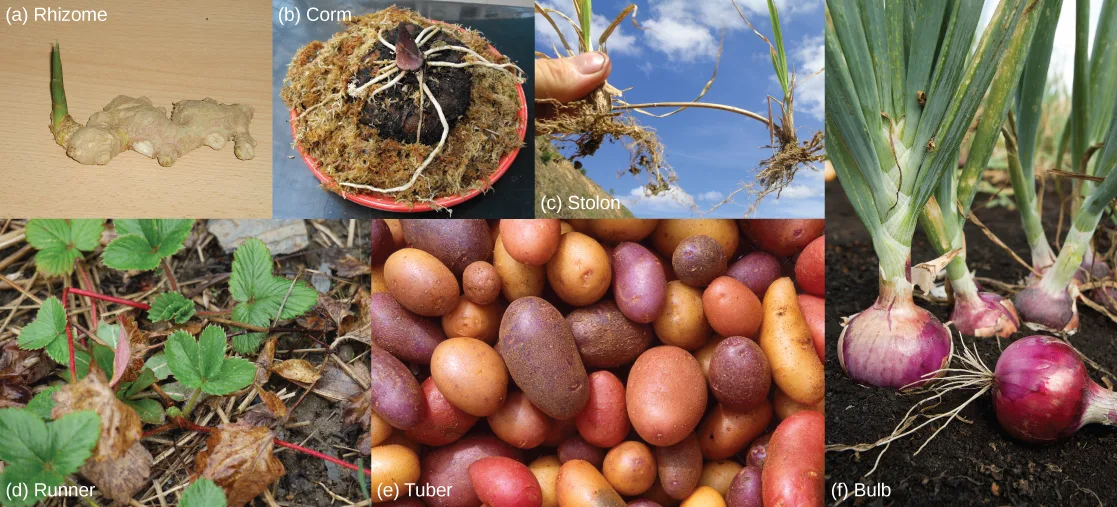
Some plant species have modified stems that are especially suited to a particular habitat and environment (pictured below). A rhizome is a modified stem that grows horizontally underground and has nodes and internodes. Vertical shoots may arise from the buds on the rhizome of some plants, such as ginger and ferns. Corms are similar to rhizomes, except they are more rounded and fleshy (such as in gladiolus). Corms contain stored food that enables some plants to survive the winter. Stolons are stems that run almost parallel to the ground, or just below the surface, and can give rise to new plants at the nodes. Runners are a type of stolon that runs above the ground and produces new clone plants at nodes at varying intervals: strawberries are an example. Tubers are modified stems that may store starch, as seen in the potato (Solanum sp.). Tubers arise as swollen ends of stolons, and contain many adventitious or unusual buds (familiar to us as the “eyes” on potatoes). A bulb, which functions as an underground storage unit, is a modification of a stem that has the appearance of enlarged fleshy leaves emerging from the stem or surrounding the base of the stem, as seen in the iris.
Link to Learning
Watch botanist Wendy Hodgson, of Desert Botanical Garden in Phoenix, Arizona, explain how agave plants were cultivated for food hundreds of years ago in the Arizona desert in this video, Finding the Roots of an Ancient Crop.
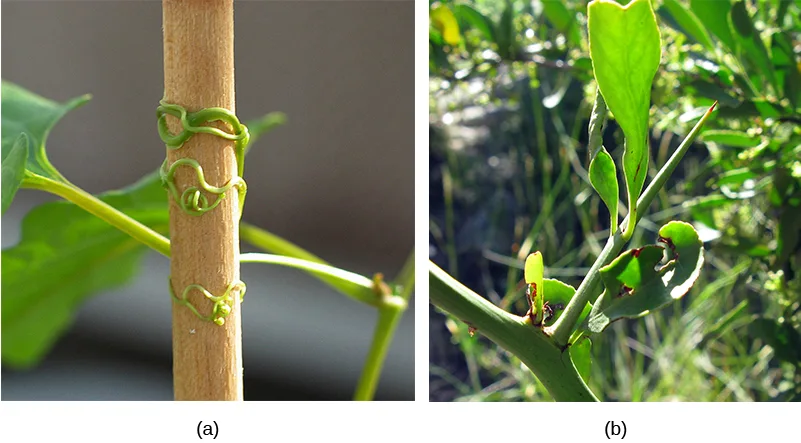
Some aerial modifications of stems are tendrils and thorns (pictured below). Tendrils are slender, twining strands that enable a plant (like a vine or pumpkin) to seek support by climbing on other surfaces. Thorns are modified branches appearing as sharp outgrowths that protect the plant; common examples include roses, Osage orange, and devil’s walking stick.
Summary
The stem of a plant bears the leaves, flowers, and fruits. Stems are characterized by the presence of nodes (the points of attachment for leaves or branches) and internodes (regions between nodes).
Plant organs are made up of simple and complex tissues. The stem has three tissue systems: dermal, vascular, and ground tissue. Dermal tissue is the outer covering of the plant. It contains epidermal cells, stomata, guard cells, and trichomes. Vascular tissue is made up of xylem and phloem tissues and conducts water, minerals, and photosynthetic products. Ground tissue is responsible for photosynthesis and support and is composed of parenchyma, collenchyma, and sclerenchyma cells.
Primary growth occurs at the tips of roots and shoots, causing an increase in length. Woody plants may also exhibit secondary growth, or increase in thickness. In woody plants, especially trees, annual rings may form as growth slows at the end of each season. Some plant species have modified stems that help to store food, propagate new plants, or discourage predators. Rhizomes, corms, stolons, runners, tubers, bulbs, tendrils, and thorns are examples of modified stems.
Key terms
- apical bud — bud formed at the tip of the shoot.
- axillary bud — bud located in the axil: the stem area where the petiole connects to the stem.
- bark — tough, waterproof, outer epidermal layer of cork cells.
- bulb — modified underground stem that consists of a large bud surrounded by numerous leaf scales.
- collenchyma cell — elongated plant cell with unevenly thickened walls; provides structural support to the stem and leaves.
- companion cell — phloem cell that is connected to sieve-tube cells; has large amounts of ribosomes and mitochondria.
- corm — rounded, fleshy underground stem that contains stored food.
- cortex — ground tissue found between the vascular tissue and the epidermis in a stem or root.
- epidermis — single layer of cells found in plant dermal tissue; covers and protects underlying tissue.
- guard cells — paired cells on either side of a stoma that control stomatal opening and thereby regulate the movement of gases and water vapor.
- internode — region between nodes on the stem.
- lenticel — opening on the surface of mature woody stems that facilitates gas exchange.
- node — point along the stem at which leaves, flowers, or aerial roots originate.
- parenchyma cell — most common type of plant cell; found in the stem, root, leaf, and in fruit pulp; site of photosynthesis and starch storage.
- periderm — outermost covering of woody stems; consists of the cork cambium, cork cells, and the phelloderm.
- pith — ground tissue found towards the interior of the vascular tissue in a stem or root.
- primary growth — growth resulting in an increase in length of the stem and the root; caused by cell division in the shoot or root apical meristem.
- rhizome — modified underground stem that grows horizontally to the soil surface and has nodes and internodes.
- runner — stolon that runs above the ground and produces new clone plants at nodes.
- sclerenchyma cell — plant cell that has thick secondary walls and provides structural support; usually dead at maturity.
- secondary growth — growth resulting in an increase in thickness or girth; caused by the lateral meristem and cork cambium.
- sieve-tube cell — phloem cell arranged end to end to form a sieve tube that transports organic substances such as sugars and amino acids.
- stolon — modified stem that runs parallel to the ground and can give rise to new plants at the nodes.
- tendril — modified stem consisting of slender, twining strands used for support or climbing.
- thorn — modified stem branch appearing as a sharp outgrowth that protects the plant.
- tracheid — xylem cell with thick secondary walls that helps transport water.
- trichome — hair-like structure on the epidermal surface.
- tuber — modified underground stem adapted for starch storage; has many adventitious buds.
- vessel element — xylem cell that is shorter than a tracheid and has thinner walls.
Practice
Describe the main function and basic structure of stems
Stem regions at which leaves are attached are called ________.
These are the points of attachment for leaves, aerial roots, and flowers — not the stem segment between them, and not the hair-like or gas-exchange structures in the other options.Which of the following cell types forms most of the inside of a plant?
This cell type carries out photosynthesis and wound repair, and is found in the stem, root, leaf, and fruit pulp.The stem region between two nodes is called an ________.
Nodes are the points of attachment for leaves, aerial roots, and flowers; this is the length of stem separating them.Compare and contrast the roles of dermal tissue, vascular tissue, and ground tissue
Tracheids, vessel elements, sieve-tube cells, and companion cells are components of ________.
The first two cell types conduct water as part of xylem; the last two transport sugars as part of phloem.Describe the roles played by stomata and guard cells. What would happen to a plant if these cells did not function correctly?
Show model answer
Did your answer mention:
Compare the structure and function of xylem to that of phloem.
Show model answer
Did your answer mention:
Hair-like structures on the epidermal surface that reduce transpiration and increase solar reflectance are called ________.
These structures also store compounds that defend leaves against predation by herbivores.The layer of ground tissue between the vascular tissue and the epidermis in a stem or root is called the ________.
The ground tissue on the interior side of the vascular tissue, by contrast, is called the pith.Distinguish between primary growth and secondary growth in stems
The primary growth of a plant is due to the action of the ________.
This meristem sits at the tip of the shoot or root, where rapidly dividing cells lengthen the plant.Which of the following is an example of secondary growth?
This kind of growth is caused by cell division in the lateral meristem rather than the apical meristem.Secondary growth in stems is usually seen in ________.
This growth pattern is noticeable in woody plants and occurs very rarely in the other major group of flowering plants.Explain the role of the cork cambium in woody plants.
Show model answer
Did your answer mention:
What is the function of lenticels?
Show model answer
Did your answer mention:
Summarize the origin of annual rings
Besides the age of a tree, what additional information can annual rings reveal?
Show model answer
Did your answer mention:
In woody plants, especially trees, ________ may form as growth slows at the end of each season.
Counting these bands, and examining their size and cell-wall thickness, can reveal a tree’s age and past growing conditions.Secondary xylem cells that form during the spring growing season, with a large internal diameter and cell walls that are not extensively thickened, are known as ________.
Its denser, thicker-walled counterpart forms in the fall as vessel elements become scarcer and tracheids more numerous.List and describe examples of modified stems
Give two examples of modified stems and explain how each example benefits the plant.
Show model answer
Did your answer mention:
A modified stem that grows horizontally underground and has nodes and internodes is called a ________.
Vertical shoots, as in ginger and ferns, may arise from buds on this underground stem.A rounded, fleshy underground stem that contains stored food, as in gladiolus, is called a ________.
This modified stem is similar to a rhizome, but more rounded and fleshy, and helps some plants survive winter.A modification of a stem with the appearance of enlarged fleshy leaves surrounding its base, as seen in the iris or onion, is called a ________.
This underground storage unit is not a swollen stolon end like a tuber, but a bud surrounded by leaf scales.This section is adapted from Biology 2e, Section 30.2: Stems by Mary Ann Clark, Jung Choi, Matthew Douglas, and OpenStax, © OpenStax, licensed under CC BY-NC-SA 4.0. Access the original for free at openstax.org. Changes: figures re-encoded as WebP with a custom alt written from each image rather than reusing the source’s own long, walk-through-style alt text; three figures re-kinded after inspection — Figure_30_02_04abcf from the manifest’s file-extension “diagram” guess to “photo” (a composite of a micrograph, a painted-artwork reproduction, and a plant photo, not a line drawing), and Figure_30_02_06 and Figure_30_02_07 from “photo” to “diagram” (both are drawn, labeled schematics of stem cross sections, not photographs); a longdesc added to the four labeled multi-panel figures (Figure_30_02_04abcf, Figure_30_02_05abc, Figure_30_02_06, Figure_30_02_07) whose on-image callout labels are not carried by their one-line captions; the Visual Connection note rendered as its figure followed by a multiple choice, kept in the body; its solution as printed (“A and B. The cortex, pith, and epidermis are made of parenchyma cells.”) does not match its own four-option list (there is no option B/pith separate from option A, “phloem” is option B, and “epidermis” is not offered as an option at all, nor is it identified as parenchymatous anywhere in this module) — the option this module’s own text supports, “cortex and pith,” is kept as the key, and the mismatched solution wording is reported as a source defect; the end-of-chapter Review Questions and Critical Thinking Questions belonging to this section (identified by their Chapter Summary and Visual Connection Questions cross-references) adapted into the closing interactive Practice block (multiple choice and self-check respectively); rubric checkpoints added to each self-check, decomposing its model answer (the source solution) into check-off clauses with no new claims; six key-term recall items (internode, trichomes, cortex, rhizome, corm, bulb) added from the glossary; one summary-cloze textin (“annual rings”) built from the Chapter Summary sentence about ring formation, and one multiple choice (“early wood” vs. “late wood”) built strictly from the Annual Rings subsection’s own sentences describing spring versus fall secondary-xylem growth, since no source exercise or glossary term tests that objective directly — both disclosed here and in the source ledger; the Critical Thinking solution comparing xylem to phloem, printed “Xylem is made up tracheids and vessel elements” (missing “of”), corrected to “Xylem is made up of tracheids and vessel elements” — reported as a source defect.